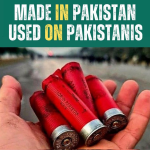
The idea of a nation’s own citizens taking their armed forces to international courts is indeed groundbreaking. Such actions could involve seeking justice for human rights abuses, corruption, or other illegal activities allegedly committed by military officials. If Pakistani citizens were to demand international intervention, it could lead to legal efforts such as:
- Travel bans on military officers implicated in human rights abuses or corruption, enforced by international bodies like the United Nations, the European Union, or under national laws like the Magnitsky Act in the U.S.
- Asset freezes and seizures, where foreign courts or governments block access to properties and financial holdings owned by implicated military officials abroad.
While unprecedented for a country’s own people to lead such charges against their military,
the legal mechanisms do exist under principles of universal jurisdiction and international human rights law. Some African and Latin American countries have seen former military leaders prosecuted internationally for similar crimes.
If successful, this could send a strong signal, demonstrating the accountability of even the most powerful domestic institutions when they violate the rights of their own people.
Consequences of public massacre, after what Pakistan Army has done to the people of Pakistan in Islamabad (#IslamabadMassacre)
When soldiers and officers of the Pakistan Army engage in violence against the people of Pakistan, particularly in violation of human rights, there are several international bodies and mechanisms that can be invoked to investigate and potentially hold them accountable. Here are some key institutions and legal frameworks:
International Criminal Court (ICC)
The
ICC can be invoked when there are allegations of war crimes, crimes against humanity, or genocide. If members of the Pakistan Army commit systematic violence, including extrajudicial killings or oppression, they could be referred to the ICC for investigation. However, Pakistan is not a party to the Rome Statute (the treaty that established the ICC), so for the ICC to get involved, the UN Security Council would need to refer the case.
United Nations Human Rights Council (UNHRC)
The
UNHRC can investigate allegations of human rights violations by a member state. The
UN Special Rapporteur can be appointed to assess the situation, and a fact-finding mission may be initiated. Civil society organisations, human rights defenders, or even member states can submit complaints to the UNHRC to trigger international scrutiny.
UN Security Council (UNSC)
In cases where large-scale atrocities, violence, or a breakdown of state order is observed, the
UNSC can impose sanctions, arms embargoes, or refer the matter to the ICC. The Security Council can also authorise peacekeeping or intervention missions in extreme cases.
International Court of Justice (ICJ)
The
ICJ primarily deals with disputes between states. However, if violence escalates to the level of a state-sponsored policy against civilians, Pakistan could be brought before the ICJ by another country for violations of international law, including violations of human rights treaties.
Universal Jurisdiction
Universal jurisdiction allows national courts in countries other than Pakistan to try cases involving serious human rights violations, such as war crimes or crimes against humanity, even if those crimes were committed outside their borders. For example, in the past, Spanish courts and Belgian courts have tried cases against foreign officials for atrocities under this principle. Pakistani military officials could be prosecuted abroad if they travel to a country that has universal jurisdiction laws.
UN Special Procedures
The
Special Procedures of the UN are independent human rights experts with mandates to report and advise on human rights from a thematic or country-specific perspective. This mechanism can be used to call attention to the situation in Pakistan and recommend international intervention.
Sanctions by International Bodies
Economic or travel sanctions can be imposed on military officers and key individuals responsible for human rights violations. For example, the
Magnitsky Act enables countries like the US, UK, and Canada to freeze assets and impose travel bans on individuals involved in severe human rights abuses.
Human Rights Organisations
NGOs such as
Human Rights Watch,
Amnesty International, and
International Federation for Human Rights (FIDH) can document abuses, call for international action, and advocate for criminal proceedings against individuals responsible for violence. These organizations can provide reports to the UN and other international bodies to support legal cases against the perpetrators.
Regional Bodies (e.g., Commonwealth)
If the violence and corruption become systemic, international organisations like the
Commonwealth can suspend Pakistan’s membership or impose diplomatic pressure for reform.
----
Pakistan is a strong country, not because its soldiers are strong, but its a land of strong individuals who would stand against any illegal occupation. Britishers had their fate, Pakistan Army too will see music for their consequences. Murder of innocents in #IslamabadMassacre would not go unpunished.