Pakistan Telecom, IT, Tech updates

Why do so many people in Pakistan suddenly have a button phone? (It’s not for the vibes)


Of the 12.05 million mobile phone units assembled during the first five months of 2025, 54pc or 6.53 million were 2G feature phones, PTA data reveals.

Saadiya Atiq
January 16, 2026

Years ago, when I got a feature phone at the age of 12 — my very first cellphone, a hefty little brick — I quickly developed the terrible habit of slamming it on the ground for dramatic effect. It was a cool way to punctuate very ordinary statements, I thought.

In reality, though, it was a ridiculous joke; a silly imitation of television drama that got old really fast, but was mostly inconsequential since the phone was a little black Nokia 2220, cheap but sturdy. Its only worthwhile feature was the single greatest game in mobile phone history — Pinball Club (sorry Snake fans).

You could throw that thing off the second floor of your house at least half a dozen times before any real damage occurred, not exactly how I’d handle my current, delicate, shatter-prone smartphone — 80 per cent glass screen, 100pc pain in my clumsy neck.

Today, these small, stocky phones are making a resurgence. In the US, folks call them ‘dumbphones’ tied directly to their use case as tools for social media cleanses. In Pakistan, or more specifically, at the Saddar Mobile Market in Karachi, shopkeepers refer to these devices as ‘button phones’ and maintain a diverse collection of brand-new and second-hand options for potential customers to peruse, and — spoiler alert — they happen to be pretty popular around here.

Of the 12.05 million mobile phone units assembled during the first five months of 2025, 54pc or 6.53 million were 2G feature phones, according to data shared by the Pakistan Telecommunications Authority (PTA). During the same period, 94pc of the mobile phone demand was met through local manufacturing and assembly, compared to the five-year (2020-2024) average of 77pc and the nine-year (2016-2024) average of 52pc, per media reports.

Hence proven: the button phone market in Pakistan is alive and pumping. But to learn more, I walked along the margins of the Saddar Mobile Market eyeing road-facing stores looking for stubby boxes of G’Five, Vivo, and the occasional second-hand Nokia — the Godsend button phone to end all button phones.

Directness seemed most appropriate, so upon locating a store that not only dealt with button phones, but had a front counter laden with refurbished landline telephones, I presented the question with what the sophisticated may excuse as ‘straightforwardness’: “Who even buys button phones nowadays?”

Stupid question; I saw it on Naveed the salesman‘s face. “The elderly, the older generation, don’t care about smartphones; they don’t like them,” he said, almost as if stating the obvious.
 
Set in their ways, the 16.5m Pakistanis over the age of 60, as per the latest census in 2023, seem to swear by button phones for communication. Look no further than your own grandparents.

“I could put my SIM card in any set I wanted,” said Muhammad Ilyas, an elderly salesman. He stood by his store counter at the mobile market, holding a worn-out, ancient-looking CAT button phone.

Behind him, sleek and shiny smartphones were laid out neatly on a shelf to entice customers. They do not attract Ilyas, though. “I don‘t really need one,” he said, pointing toward them. “I have this phone, and I’ll probably use it for years … because it will last forever.”

The elderly are, however, not the only target market for button phones. As it turns out, Gen Z — for all their tech-savvy and screen-addicted ways, their social media branding, and apparent diminishing attention span courtesy the constant doom-scrolling — are also as ready and willing customers.

Granted, they are not as lucrative a consumer group as the tech-averse boomers, but Gen-Z, especially those in Pakistan, do have their own vested interest in maintaining a button phone.

For one, security. Karachi reported about 13,213 phone snatching cases in the first nine months of 2025, according to the Citizens Police Liaison Committee, maintaining its legacy as ‘phone-snatching central’.
 
“Younger people prefer to keep button phones when they’re outside,” said Muhammad Irfan, who sells second-hand smartphones and tablets. He sells roughly 20 button phones a month, and a majority of them are to the younger generation.

It is a creative security measure. Simply put, a button phone a day keeps snatchers away.

The sight is not strange; that one friend (or in my case, four) taking out their iPhone, the latest model, at the lunch table for ‘foodgram’. But this phone seldom rings, unless they have managed to secure the WiFi password of the restaurant. For the menial tasks — calls and messages — they have a substitute, usually a button phone.

This is yet another creative loophole that many millennial and Gen Z iPhone enthusiasts have adopted to dodge paying exorbitant taxes just to keep their SIMs alive.

Pakistan tech laws require all imported devices to be registered with the PTA, threatening to block users’ SIM cards otherwise, using its Device Identification Registration and Blocking System that tracks compliance. The regulation is not only restricted to imported phones but is also applicable to foreigners who travel to Pakistan with their unregistered devices.

But does this only impact iPhones? Why the correlation? Because iPhones are very expensive, more so than your average Android-run device. Even the most recent depreciated valuations of older iPhone models by the Directorate General of Customs Valuation range from Rs70,000 to Rs350,000. Of course, buying the phone is one thing; the taxes that follow are another bane.

Consider the iPhone 16 Plus (512GB) that was valued at $1,050 — a little over Rs300,000 — in the April 2025 valuation. For Pakistanis, an additional Rs87,219 would be required to pay off the necessary duty as per the Federal Board of Revenue’s ‘Rate of Duty and Taxes on Mobile Phones (2021-22)’.

No wonder Gen Z is suddenly so interested in the ‘so-2010’ button phones.
But here is what bothers me. Is it really worth purchasing a six-figure iPhone and then spending more money on getting its life jacket (button phone) too?

According to Midhat, a software engineer and recent proud owner of a non-PTA-approved iPhone 15 Pro worth Rs140,000, it is. There are two reasons: security and features.

“If someone steals my iPhone and it’s screen-locked, they can’t break into it like other phones,” she explained. “Sure, there is software you could use to break into it, but that would ruin its IMEI number.”

Other brands, such as Samsung, she continued, are improving their features, but they aren’t a match to the iPhone when it comes to data security. “It also has some great features that you can’t find on other phones, like the camera.”
 
There is some irony here, though; you can’t get a phone stolen if it never leaves the house with you. Midhat shared that she doesn’t take her iPhone everywhere with her. “It’s such an expensive phone. You can’t take it out in Karachi. Most people I know just keep it at home and use another phone for everyday purposes.”

Rameesha, another iPhone enthusiast and a customer experience consultant, added that there was no sense in spending thousands on PTA registrations because, like most tech, iPhones too depreciate merely with months, given the speed at which Apple keeps updating their models.

However, particularly with iPhones, there is a “bitter reality” that is often overlooked. “They are widely recognised as a status symbol. It’s a good visual to have,” Rameesha told Dawn. Pull out an iPhone in a room full of people, and the aura flips.

And so, whether for safety, money or status, the verdict is in: button phones, once obsolete, have made a comeback in the Pakistani tech scene with quiet confidence. While they may not promise flashy cameras, seamless functionality or social clout, they are unbreakable (quite literally) and will keep you out of trouble, mostly.

In a city where carrying an expensive smartphone can feel like a liability, the button phone is the perfect jugaar.
 

Why do so many people in Pakistan suddenly have a button phone? (It’s not for the vibes)


Of the 12.05 million mobile phone units assembled during the first five months of 2025, 54pc or 6.53 million were 2G feature phones, PTA data reveals.

Saadiya Atiq
January 16, 2026

Years ago, when I got a feature phone at the age of 12 — my very first cellphone, a hefty little brick — I quickly developed the terrible habit of slamming it on the ground for dramatic effect. It was a cool way to punctuate very ordinary statements, I thought.

In reality, though, it was a ridiculous joke; a silly imitation of television drama that got old really fast, but was mostly inconsequential since the phone was a little black Nokia 2220, cheap but sturdy. Its only worthwhile feature was the single greatest game in mobile phone history — Pinball Club (sorry Snake fans).

You could throw that thing off the second floor of your house at least half a dozen times before any real damage occurred, not exactly how I’d handle my current, delicate, shatter-prone smartphone — 80 per cent glass screen, 100pc pain in my clumsy neck.

Today, these small, stocky phones are making a resurgence. In the US, folks call them ‘dumbphones’ tied directly to their use case as tools for social media cleanses. In Pakistan, or more specifically, at the Saddar Mobile Market in Karachi, shopkeepers refer to these devices as ‘button phones’ and maintain a diverse collection of brand-new and second-hand options for potential customers to peruse, and — spoiler alert — they happen to be pretty popular around here.

Of the 12.05 million mobile phone units assembled during the first five months of 2025, 54pc or 6.53 million were 2G feature phones, according to data shared by the Pakistan Telecommunications Authority (PTA). During the same period, 94pc of the mobile phone demand was met through local manufacturing and assembly, compared to the five-year (2020-2024) average of 77pc and the nine-year (2016-2024) average of 52pc, per media reports.

Hence proven: the button phone market in Pakistan is alive and pumping. But to learn more, I walked along the margins of the Saddar Mobile Market eyeing road-facing stores looking for stubby boxes of G’Five, Vivo, and the occasional second-hand Nokia — the Godsend button phone to end all button phones.

Directness seemed most appropriate, so upon locating a store that not only dealt with button phones, but had a front counter laden with refurbished landline telephones, I presented the question with what the sophisticated may excuse as ‘straightforwardness’: “Who even buys button phones nowadays?”

Stupid question; I saw it on Naveed the salesman‘s face. “The elderly, the older generation, don’t care about smartphones; they don’t like them,” he said, almost as if stating the obvious.

One reason is that people carry two phones—a non-PTA device (like iPhone which is cheaper) kept in secure locations like the home or office, and a secondary phone for calls and SMS that stays with them at all times.
 

IT exports surge to record $437m in December


The Newspaper's Staff Reporter
January 20, 2026

IT exports reached $2.12bn in 2020-21 as against $1.44bn in the preceding year, according to data released by Commerce Ministry on Monday. — AP/File

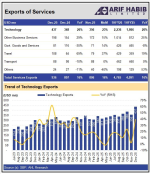
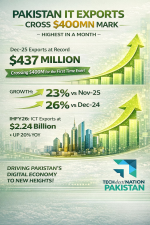
ISLAMABAD: Pakistan recorded its highest-ever monthly information technology (IT) exports at $437 million in December 2025, marking a 26 per cent increase compared to the same month last year.

During the first half (July-December) of 2025-26, IT exports reached $2.2 billion, posting a growth of 20pc over the corresponding period of the previous year.

According to a report compiled by Topline Research, the year-on-year growth in December was driven by an expansion in the global client base of Pakistani IT exporters, particularly in the Gulf Cooperation Council region.

The report noted that the State Bank of Pakistan’s relaxation of the permissible retention limit in Exporters’ Specialised Foreign Currency Accounts from 35pc to 50pc has enhanced confidence among IT companies, prompting them to repatriate earnings rather than park funds abroad.

Another contributing factor was the government’s decision to allow equity investment abroad through specialised foreign currency accounts.

“The SBP’s introduction of Equity Investment Abroad (EIA), allowing IT exporters to acquire interest in entities abroad using up to 50pc of proceeds from specialised foreign currency accounts, will continue to boost confidence of IT exporters to remit proceeds back to Pakistan,” said Sania Irfan of Topline Research.
 

Local mobile phone production hits 30.21mn units in 2025

  • Total value of mobile phone imports stand at Rs417.351bn during FY2024-25
Tahir Amin

ISLAMABAD: The local manufacturing/ assembling plants manufactured/ assembled 30.21 million mobile handsets during the calendar year (January-December) 2025 compared to 2.37 million imported commercially.

Official data revealed that 2.61 million mobile handsets were manufactured/ assembled in December 2025 against 0.33 million imported commercially.

The local manufacturing/ assembling plants manufactured/ assembled 30.21 million mobile handsets included 15.64 million smart phones and 14.57 million 2G phones.

Besides, as per the Pakistan Telecommunication Authority (PTA) data, 71 per cent of mobile devices are smartphones, and 29 per cent are 2G on the Pakistan network.

Pakistan imported mobile phones worth $801.139 million in the first five months (July-November) of current fiscal year 2025-26 compared to $570.184 million during the same period of last year, registering a growth of over 40.51 percent.

Official data revealed that in terms of rupees, the total value of mobile phone imports stood at Rs226.133 billion during July-November 2025 compared to Rs158.518 billion, registering 42.65 percent growth.

On a Month-on-Month (MoM) basis, Pakistan’s mobile phone imports saw a 8.30 percent growth, totalling $156.565 million in November 2025, compared to $1444.563 million in October 2025. Year on year mobile imports witnessed a negative growth of 4.81 percent when compared to $149.378 million in November 2024.

Pakistan imported mobile phones worth $1.494 billion in the last fiscal year 2024-25, registering a fall of 21.31 per cent compared to $1.898 billion during the previous year, 2023-24.
 
In terms of Pakistani rupees, the total value of mobile phone imports stood at Rs417.351 billion during fiscal year 2024-25. This represents a 22.09 percent decline when compared to Rs535.690 billion in the same period of 2023-24.

Overall telecom imports into Pakistan stood at $2.099 billion during fiscal year 2024-25, reflecting a negative growth of 11.30 percent when compared to $2.366 billion during the same period of 2023-24.
 
As mobile phone prices remain elevated for new buyers due to higher assessed values, the Customs Valuation Department has reduced assessment rates for duties and taxes on the commercial import of used and old mobile phone sets to ease pressure on consumers in the used smartphone market.

At the same time, fresh assessment values have been set for high-end used iPhone models, ranging from the iPhone 14 and its variants to the iPhone 15 series. For Samsung, Google Pixel and OnePlus, the assessed rates have largely been left unchanged or fixed for the first time.

Read more: https://www.dawn.com/news/1968540/used-phone-rates-to-fall-as-govt-revisits-valuation
 

Government expands telecom spectrum to 600MHz to boost internet speed​


Move expected to increase capacity by 200% and reduce network congestion

Our Correspondent
January 23, 2026


tribune


ISLAMABAD: The government is expanding the country's telecom spectrum to 600 megahertz, a move expected to increase internet capacity by around 200 per cent and significantly improve speed, stability and service continuity, the National Assembly was informed on Thursday.

The parliamentary secretary for IT and Telecom, responding to questions during Question Hour, said the rapid increase in internet usage over the past one to two years — driven by digitisation of government services, education, employment portals and businesses — had put immense pressure on the existing network, leading to slow speeds and frequent disruptions.

She told the house that the spectrum expansion would help reduce congestion, improve data flow and minimise service interruptions, adding that tangible improvement in services was expected by the end of February once the process was completed.

The parliamentary secretary said that in many areas the problem was not the absence of telecom companies but technical constraints, including limited spectrum, backhaul congestion, electricity outages and delays in regulatory clearances.
 

Chinese Brands Lead Pakistan’s Mobile Manufacturing to 30.2M Units in 2025​

By Tahir Ali | Gwadar Pro
Jan 26, 2026

ISLAMABAD- Pakistan’s local mobile phone manufacturing and assembling sector continued its rapid expansion in 2025, while commercially imported handsets dropped sharply, according to new data released by the Pakistan Telecommunication Authority (PTA) last week.

Chinese Brands Lead Pakistan’s Mobile Manufacturing to 30.2M Units in 2025


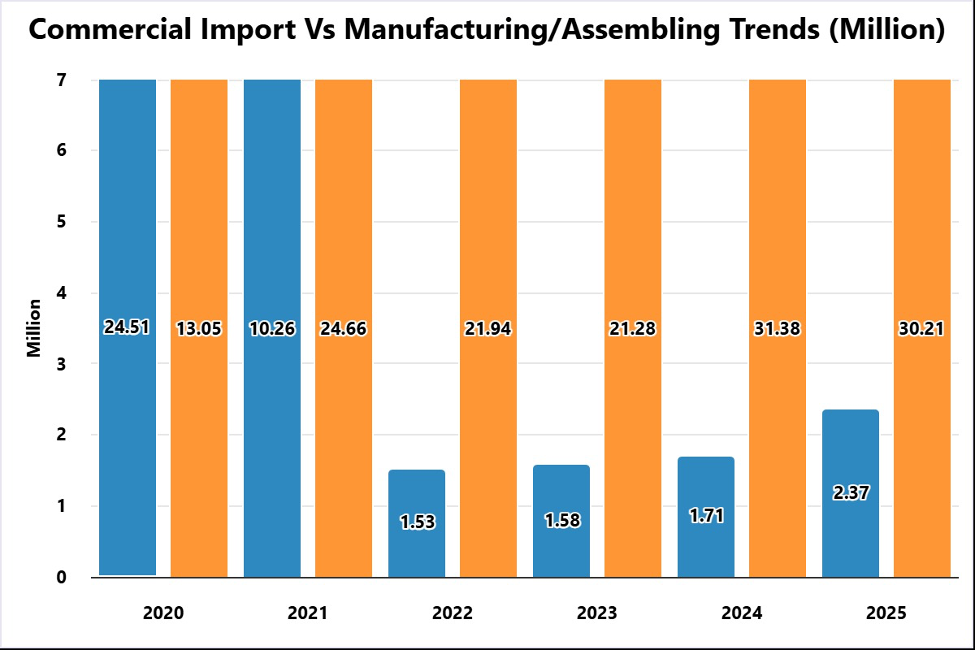
Commercial imports vs locally manufactured/assembled phones in Pakistan, 2020–2025 (Source: PTA)

The regulator’s latest Mobile Device Manufacturing indicators show that local assembly and manufacturing reached 30.21 million units in 2025, compared with just 2.37 million commercially imported phones, underscoring a decisive shift toward domestic production.

The PTA’s data suggests that Pakistan’s handset ecosystem has undergone a structural transformation over the past decade. Local manufacturing rose from just 0.29 million units in 2016 to 1.72 million in 2017, 5.2 million in 2018, and 11.74 million in 2019, before accelerating to 13.05 million in 2020 and 24.66 million in 2021.

Output remained above 21 million units in both 2022 and 2023, surged to a record 31.38 million in 2024, and eased slightly to 30.21 million in 2025, while commercial imports collapsed from more than 21 million units in 2016 to near historic lows in recent years
 
The figures mark another milestone for Pakistan’s import-substitution drive. As recently as 2020, commercial imports stood at more than 24 million units, while local manufacturing was limited to about 13 million. By 2021, domestic output had overtaken imports, and the gap has widened steadily since then.

The trend reflects the combined impact of PTA’s Mobile Device Manufacturing (MDM) regulations, tighter controls under the Device Identification Registration and Blocking System (DIRBS), and incentives aimed at encouraging global brands to assemble devices locally.
 

Users who are viewing this thread

Latest Posts

Back
Top