Pakistan Telecom, IT, Tech updates

Smartphone manufacturing boom positions Pakistan for export-driven growth

  • Rising share of local production reflects the expansion of manufacturing capacity and investment in the local market, says one expert
Gohar Ali Khan
Published November 26, 2025


1764345858738.gif

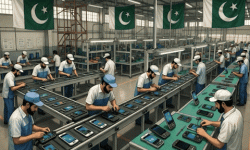
KARACHI: Smartphone production in Pakistan continues to rise, reaching 53 percent of total mobile phone output in October. The shift reflects both growing manufacturing capacity among local and foreign assemblers and an increasing national demand for smart devices.

According to data released by the Pakistan Telecommunication Authority (PTA), more than 25.11 million mobile phones were produced locally during the first 10 months of the current year. Of these, smartphones accounted for 53 percent, or 13.2 million units, while the remaining 47 percent, 11.9 million units, were 2G feature phones.


Four months earlier, local mobile phone output stood at 14.24 million units, with feature phones comprising 54 percent of production and smartphones 46 percent in June 2025.

Khushnood Aftab, CEO of tech firm Viper Group and an active advocate of ‘made-in-Pakistan’ brands, said that the rising share of local production reflects the expansion of manufacturing capacity and investment in the local market. He noted that this will not only strengthen the presence of local brands in the domestic market but also help them tap export opportunities.

He added that Pakistan has the potential to significantly expand the production of smart devices, including smartphones, tablets, laptops, and PCs, provided the government introduces favourable and investor-friendly policies. Such measures, he said, would attract both domestic and foreign investment, create jobs, and facilitate technology transfer to the local industry.

Pakistan met 94 percent of its mobile phone demand through local manufacturing and assembly in the first 10 months of 2025, a major improvement compared to the five-year (2020–2024) average of 77 percent and the nine-year (2016–2024) average of 52 percent.

Despite this progress, smartphone penetration remains low in the country, with only 31 percent of the population owning smart devices

Rising share of local production reflects the expansion of manufacturing capacity and investment in the local market. This will not only strengthen the presence of local brands in the domestic market but also help them tap export opportunities: Khushnood Aftab, CEO of tech firm Viper Group
Dr. Noman Said, CEO of SI Global Solutions, stressed that widespread smartphone adoption is essential to empower citizens with access to education, skills development, financial services, and digital platforms. He observed that economies with high smartphone penetration enjoy significant digital advantages and improvements in quality of life. For Pakistan to follow suit, he said, the government and private sector must work together to promote smartphone adoption nationwide.

He emphasized the need for supportive policies and a cohesive ecosystem involving the government, local assemblers, and enablers, such as buy-now-pay-later services to increase smartphone accessibility in the country.

According to PTA, the top 10 locally assembled brands during the first 10 months of 2025 were Infinix (3.12 million units), followed by VGO Tel (2.82 million), Vivo (2.27 million), Itel (2.06 million), Tecno (1.62 million), Samsung (1.48 million), Xiaomi (1.31 million), QMobile (0.93 million), Realme (0.91 million), and G’Five (0.84 million units). With distributors and retailers currently holding surplus inventory, manufacturers have scaled back production to prevent further stock accumulation.

Industry analysts expect mobile phone sales to grow by 7–8 percent year-on-year over the next 12 months, supported by a stable exchange rate, easing inflation, and improving consumer purchasing power.
 
Despite this progress, smartphone penetration remains low in the country, with only 31 percent of the population owning smart devices
This market gap is indeed quite large.

According to PTA, the top 10 locally assembled brands during the first 10 months of 2025 were Infinix (3.12 million units), followed by VGO Tel (2.82 million), Vivo (2.27 million), Itel (2.06 million), Tecno (1.62 million), Samsung (1.48 million), Xiaomi (1.31 million), QMobile (0.93 million), Realme (0.91 million), and G’Five (0.84 million units). With distributors and retailers currently holding surplus inventory, manufacturers have scaled back production to prevent further stock accumulation.
Is Transsion Holdings really that powerful?

In China, hardly anyone knows about this company. None of their products are sold within China......
 

Smartphone manufacturing boom positions Pakistan for export-driven growth

  • Rising share of local production reflects the expansion of manufacturing capacity and investment in the local market, says one expert
Gohar Ali Khan
Published November 26, 2025

View attachment 162332

KARACHI: Smartphone production in Pakistan continues to rise, reaching 53 percent of total mobile phone output in October. The shift reflects both growing manufacturing capacity among local and foreign assemblers and an increasing national demand for smart devices.

According to data released by the Pakistan Telecommunication Authority (PTA), more than 25.11 million mobile phones were produced locally during the first 10 months of the current year. Of these, smartphones accounted for 53 percent, or 13.2 million units, while the remaining 47 percent, 11.9 million units, were 2G feature phones.

Four months earlier, local mobile phone output stood at 14.24 million units, with feature phones comprising 54 percent of production and smartphones 46 percent in June 2025.


Khushnood Aftab, CEO of tech firm Viper Group and an active advocate of ‘made-in-Pakistan’ brands, said that the rising share of local production reflects the expansion of manufacturing capacity and investment in the local market. He noted that this will not only strengthen the presence of local brands in the domestic market but also help them tap export opportunities.

He added that Pakistan has the potential to significantly expand the production of smart devices, including smartphones, tablets, laptops, and PCs, provided the government introduces favourable and investor-friendly policies. Such measures, he said, would attract both domestic and foreign investment, create jobs, and facilitate technology transfer to the local industry.

Pakistan met 94 percent of its mobile phone demand through local manufacturing and assembly in the first 10 months of 2025, a major improvement compared to the five-year (2020–2024) average of 77 percent and the nine-year (2016–2024) average of 52 percent.

Despite this progress, smartphone penetration remains low in the country, with only 31 percent of the population owning smart devices


Dr. Noman Said, CEO of SI Global Solutions, stressed that widespread smartphone adoption is essential to empower citizens with access to education, skills development, financial services, and digital platforms. He observed that economies with high smartphone penetration enjoy significant digital advantages and improvements in quality of life. For Pakistan to follow suit, he said, the government and private sector must work together to promote smartphone adoption nationwide.

He emphasized the need for supportive policies and a cohesive ecosystem involving the government, local assemblers, and enablers, such as buy-now-pay-later services to increase smartphone accessibility in the country.

According to PTA, the top 10 locally assembled brands during the first 10 months of 2025 were Infinix (3.12 million units), followed by VGO Tel (2.82 million), Vivo (2.27 million), Itel (2.06 million), Tecno (1.62 million), Samsung (1.48 million), Xiaomi (1.31 million), QMobile (0.93 million), Realme (0.91 million), and G’Five (0.84 million units). With distributors and retailers currently holding surplus inventory, manufacturers have scaled back production to prevent further stock accumulation.

Industry analysts expect mobile phone sales to grow by 7–8 percent year-on-year over the next 12 months, supported by a stable exchange rate, easing inflation, and improving consumer purchasing power.
Please don't change the article headline.
 

Pakistan’s IT chief calls to ‘indigenize’ AI models

  • Degrees alone are not sufficient, says Shaza Fatima
BR Web Desk
November 29, 2025

Pakistan needs to ‘indigenize’ Artificial Intelligence (AI) models, said Federal Minister for IT and Telecommunication Shaza Fatima Khawaja on Saturday.

“We cannot just remain consumers of models made in some foreign countries, which do not include and contextualise our cultural identities,” said Shaza in an address.

“We need to make sure that our perspectives are a part of the larger machine learning that is happening today. We need to ensure that biases do not go against you,” she said.

Talking about government initiatives, Shaza said that the National AI Initiative targets to train one million people in the next five years.

The minister also shed light on the current education system, noting that the current standards need to be upgraded to meet the local demand.

“We have spoken extensively with the industry, the higher education department and vice chancellors of different universities. Finally, we have mandated that any CS (Computer Science) student who graduates does not just graduate with a degree, but at least one certification or an apprenticeship, which makes them still ready for the future of employment today.”

“Degrees alone would not be sufficient anymore; it is going to be very difficult for our upcoming generation to find jobs, with the traditional degrees that we are giving out today”
 
IMG-20251201-WA0012.jpg

EDITORIAL: Pakistan's Cybersecurity Act has been presented as a milestone. The proposed legislation marks a long-awaited attempt to strengthen national defences in an age where the first strike is often digital. Yet ambition alone will not suffice when dealing with the weaknesses that have repeatedly left the country exposed.

As outlined by the IT minister on Friday, the law aims to establish a National Cybersecurity Authority, a beefed-up incident-response system, and a secure digital infrastructure built under the Digital Economy Enhancement Project. These are welcome steps. But a cybersecurity framework cannot be judged by announcements alone. It must also be assessed against Pakistan’s recent record.

Over the past few years, Pakistan has found itself in the headlines not for its cyber readiness but for a series of damaging breaches. Banks, hospitals, government email servers and even tax and identity databases have faced cyber intrusions, some of which brought services to a halt for days.

Read full editorial: https://www.dawn.com/news/1958470/
 

Air Link launches ZEXO Technologies with Rs200mn investment


Says subsidiary will be established with an authorised investment of Rs200 million

BR Web Desk

1764598446873.png

Air Link Communication Limited (AIRLINK) announced on Monday that it had approved the incorporation of a wholly owned subsidiary under the name ZEXO Technologies (Private) Limited, with an authorized investment of Rs. 200,000,000/-.

The technology firm shared the development in a notice to the Pakistan Stock Exchange (PSX) today.

The subsidiary will be established with an authorized investment of Rs200,000,000/-, divided into 20,000,000 ordinary shares at a nominal value of Rs10/- per share.

The notice said that the primary objective of the proposed subsidiary will be to undertake the manufacturing, import, export, distribution, retail and e-commerce operations of smartphones, laptops, related accessories, electronics, home appliances, and other technology-related products of certain additional selected brand(s).

Air Link Communication Limited was incorporated in Pakistan as a private limited company in January 2014 and was converted into a public limited company in April 2019.

The company is engaged in import, export, distribution, identification, wholesale, and retail of communication and IT-related products and services, including smartphones/ cellular phones, tablets, laptop accessories, and related products.
 

Pakistan Sets 100 Mbps Goal for All Users Under New National Fiberization Policy​


The Ministry of Information Technology and Telecommunication (MoITT) is targeting a minimum fixed broadband speed of 100 Mbps for all users across Pakistan as part of a major national overhaul of the country’s digital infrastructure.

To achieve this, the Ministry will hire a consulting firm to develop Pakistan’s first National Fiberization Policy and Plan.

The initiative is being launched under the World Bank–supported Digital Economy Enhancement Project (DEEP) to improve high-speed connectivity, expand fiber infrastructure, and support the government’s broader digital transformation agenda.

The new policy will work to expand fixed broadband coverage by enabling the deployment of 8-10 million new optical-fiber-based house passes nationwide. The Ministry also aims to improve mobile network capacity and reliability by ensuring that 80 percent of telecom towers are connected to fiber. This is essential for strengthening 4G networks and preparing Pakistan for future 5G rollout. These goals are designed to help Pakistan reach the top 50 countries in Ookla’s global speed rankings.

MoITT has assigned the upcoming consultant to conduct a national gap assessment. This includes mapping the current fiber network, analyzing service availability, and identifying gaps in quality of service, coverage, latency, penetration, and operator incentives. The consultant will also benchmark Pakistan’s fiber development using the Fiber Development Index (FDI) and other international indicators to ensure the policy follows global best practices.

The consultancy will then prepare a detailed National Fiberization Strategy and Operational Plan. It will outline investment options, financing models, and governance structures to guide public and private sector participation. Bankable feasibility studies will be developed to attract local and international investors through public-private partnership (PPP) models. The strategy will also identify priority areas for new fiber deployment and recommend measures to strengthen the resilience of fiber networks against disasters and cyber threats.


Legal and regulatory reforms will play a key role in the policy. Recommendations will focus on updating laws and directives that currently slow broadband growth. These may include changes related to spectrum use, incentives for fiber backhaul, and reducing capital cost barriers for private operators.

The National Fiberization Policy is set to become a foundational document for Pakistan’s digital future, supporting faster, more reliable, and more affordable broadband services nationwide.

1764781603671.png
 

USF approves Rs13b new telecom projects

Over 5.5 million underserved people will receive high-speed internet, voice services

APP
December 04, 2025

photo ucl

PHOTO: UCL

ISLAMABAD: The Universal Service Fund (USF) is poised to achieve a major milestone under the prime minister's Digital Pakistan vision with the approval of nine new telecom projects valuing at Rs13.05 billion.

These projects are set to provide high-speed internet and voice services to 5.55 million un-served and underserved residents across 178 towns/union councils and 753 mauzas of 11 districts across the country, significantly empowering the rural population to participate in the digital economy and connect with the digital world, said a press release.

Six projects will deliver high-speed broadband and voice services to 1.27 million people in 753 mauzas across seven districts. Similarly, three projects will lay optic fibre cable over 1,428 km in 178 towns/union councils in four districts and enable connectivity for 4.29 million people.

The new projects received formal approval during the 101st meeting of the USF board of directors, chaired by Board Chairman and IT and Telecom Secretary Zarrar Hasham Khan.

The USF board awarded the projects to various service providers following a rigorous and transparent process, selecting the lowest compliant bidders.

Board Chairman Zarrar Hasham underscored the urgent need to enhance the fiberisation of mobile towers and Base Transceiver Stations (BTS) nationwide, proactively encouraging the USF to spearhead the crucial effort within its mandated areas.

"In line with the vision of Prime Minister Shehbaz Sharif and Federal Minister for IT & Telecom Shaza Fatima Khawaja, we are fully committed to providing superior-quality connectivity to the rural population, thereby bridging the digital divide between urban and rural communities," he said.

While praising the USF's role in empowering rural communities, he asserted that connectivity was the key driver for digital growth and the IT sector. He noted the fund's vital support for the IT industry, freelancers and essential health and educational services. To date, 39.4 million people in rural areas have been provided broadband, voice and fixed-line services through the USF projects.
 

Pakistan to fiberise 10m homes​

Sets 2029 target; fragmented networks, low FTTH threaten broadband ambitions


KARACHI:
Pakistan, long criticised for inadequate public service delivery, now sees a rare opportunity to leap into modern governance through technology. But its race towards a digitally enabled future depends on whether it can overcome deep connectivity gaps, high infrastructure costs, and sluggish fibre-to-the-home penetration, as the government rolls out an ambitious National Fiberisation Plan aimed at delivering high-speed broadband to 10 million households by 2029.

While the initiative promises 100 Mbps fixed internet for every user and aims to elevate the country into the top 50 global speed rankings, experts warn that fragmented networks, limited fibre density, spectrum inefficiencies, and cybersecurity vulnerabilities could stall progress unless policy, investment, and execution align at scale.

The country is also targeting 80% fiberisation of mobile towers to enhance network capacity and reliability, and to improve Pakistan's standing in the top 50 countries on the Ookla global speed rankings.

The initiative is being led by the Ministry of Information Technology and Telecommunication (MoITT) in collaboration with the World Bank, as part of the Digital Economy Enhancement Project (DEEP). The main objective of the programme is to enhance the government's capacity to deliver digitally enabled public services for citizens and businesses.

To achieve its targets, the ministry is currently seeking to hire a consultancy firm to develop a roadmap for attracting investment within the existing policy framework.

The plan will also explore how Administrative Incentive Pricing (AIP) can be used as a complementary policy tool to promote efficient spectrum use and incentivise fibre deployment for backhaul and middle-mile connectivity, particularly to support 4G densification and 5G readiness. It will also clarify the complementary roles of fibre (long-haul, middle-mile, and deep access) and spectrum (last-mile wireless), ensuring that AIP discourages spectrum hoarding while encouraging sustainable, long-term investment in fibre-based infrastructure.


Syed Muhammad Taha Owais, a fibre-optic infrastructure specialist, said demand for high-speed internet is rising sharply in urban areas for both commercial and domestic use, which could boost business productivity and output.

"Pakistan ranks among the lowest globally for internet speeds due to obsolete infrastructure and the slow adoption of new technologies, particularly FTTH (fibre-to-the-home)," he said. All stakeholders, including the government and the private sector, should fast-track fibre deployment nationwide to improve connectivity and support the digitisation of business and governance systems.

Owais, a senior official at Optix Pakistan, underscored the importance of high-speed internet, adding that the deployment of fibre optic in commercial areas and posh localities has increased the uptake of internet and increased the performance of the businesses.

At present, Pakistan has over 211,000 kilometres of deployed optical fibre, including 75,967 km of long-haul and 135,506 km of metro fibre.

"For a technopreneur, fibre is not infrastructure; it is oxygen and digital power," he said. This fiberisation plan is Pakistan's launchpad. Every startup, every smart city, every digital service depends on it.

If Pakistan wants to leapfrog, not just catch up, then fibre to every home is non-negotiable, stated by Dr Noman A Said, an IT exporter. Pakistan cannot build an AI-driven, cloud-powered, data-centric future without deep fibre. "If we deliver this rollout with precision, we unlock a digital economy that outpaces our region; if we delay, we suffocate innovation before it begins," he added.

Said commented that the key challenges which Pakistan must address are fragmented infrastructure and high capital costs, limited FTTH adoption, spectrum inefficiency and above all, a deep-sea fibre to cater for the requirements and cybersecurity as a non-negotiable layer.

Saad Shah, an IT exporter, said that the availability of internet speed through a modern and hi-tech infrastructure could not only improve the digitisation of the country, but it also improves the global image of the country as a reliable outsourcing country.

Pakistan could achieve its national goals of digitisation and export growth through speedy, uninterrupted and reliable internet services at an affordable cost, he added. The government achieved various milestones recently, including resolving the right-of-way issue, which will help the country achieve the smooth proliferation of fast internet.
 

Zong’s new data centre marks key milestone in Pakistan’s digital transformation, says IT Minister​


Shaza says 5G, satellite internet services will be rolled out soon

Irshad Ansari
December 10, 2025


tribune


Federal Minister for Information Technology and Telecom, Shaza Fatima Khawaja, inaugurated Zong’s new state-of-the-art data centre in Islamabad on Wednesday.

The event was attended by senior officials from the Ministry of Information Technology and the Pakistan Telecommunication Authority (PTA), including PTA Chairman Hafeezur Rehman and Secretary of Information Technology Zarrar Hashim. Zong's Chief Commercial Officer (CCO) and other officials briefed the minister on the facility's capabilities and its role in enhancing the country’s digital infrastructure.

Officials said that PTA has made considerable progress in addressing the illegal SIMs issue, and that PTA is "working diligently to improve customer service and resolve complaints".

On the matter of data protection and cybersecurity, PTA has made significant strides, introducing cyber audits, a re-verification system, and an eco-cyber system.
 

Pakistan Sets 100 Mbps Goal for All Users Under New National Fiberization Policy​


The Ministry of Information Technology and Telecommunication (MoITT) is targeting a minimum fixed broadband speed of 100 Mbps for all users across Pakistan as part of a major national overhaul of the country’s digital infrastructure.

To achieve this, the Ministry will hire a consulting firm to develop Pakistan’s first National Fiberization Policy and Plan.

The initiative is being launched under the World Bank–supported Digital Economy Enhancement Project (DEEP) to improve high-speed connectivity, expand fiber infrastructure, and support the government’s broader digital transformation agenda.

The new policy will work to expand fixed broadband coverage by enabling the deployment of 8-10 million new optical-fiber-based house passes nationwide. The Ministry also aims to improve mobile network capacity and reliability by ensuring that 80 percent of telecom towers are connected to fiber. This is essential for strengthening 4G networks and preparing Pakistan for future 5G rollout. These goals are designed to help Pakistan reach the top 50 countries in Ookla’s global speed rankings.

MoITT has assigned the upcoming consultant to conduct a national gap assessment. This includes mapping the current fiber network, analyzing service availability, and identifying gaps in quality of service, coverage, latency, penetration, and operator incentives. The consultant will also benchmark Pakistan’s fiber development using the Fiber Development Index (FDI) and other international indicators to ensure the policy follows global best practices.

The consultancy will then prepare a detailed National Fiberization Strategy and Operational Plan. It will outline investment options, financing models, and governance structures to guide public and private sector participation. Bankable feasibility studies will be developed to attract local and international investors through public-private partnership (PPP) models. The strategy will also identify priority areas for new fiber deployment and recommend measures to strengthen the resilience of fiber networks against disasters and cyber threats.


Legal and regulatory reforms will play a key role in the policy. Recommendations will focus on updating laws and directives that currently slow broadband growth. These may include changes related to spectrum use, incentives for fiber backhaul, and reducing capital cost barriers for private operators.

The National Fiberization Policy is set to become a foundational document for Pakistan’s digital future, supporting faster, more reliable, and more affordable broadband services nationwide.

View attachment 163249


I hope it won't take years and this speed will be transfered to people and not utilized by govt. in the name of secure data ......
 

Zong inaugurates Pakistan’s tier-III certified data center in Islamabad​

By Fatima Javed | Gwadar Pro
Dec 11, 2025

ISLAMABAD - Zong on Wednesday inaugurated a Tier-III certified data center at its headquarters in Islamabad, marking an addition to Pakistan’s digital infrastructure. The centre is intended to support cloud services, enterprise solutions, artificial intelligence applications, Internet of Things (IoT), and enhanced cybersecurity capabilities.

The Federal Minister for IT and Telecommunication Shaza Fatima Khawaja attended the ceremony as chief guest, alongside senior government officials and representatives from the technology sector. Officials said the facility would contribute to ongoing efforts aimed at strengthening the country’s digital and technological ecosystem.

Addressing the event, the federal minister said that improved digital infrastructure is essential for economic growth, innovation, and employment generation. She noted that investment in data centers and related technologies plays an important role in advancing Pakistan’s digital transformation goals.

Zong Chief Executive Officer Huo Junli said the company views the facility as part of its broader involvement in Pakistan’s telecommunications and information technology sector. He added that initiatives in cloud computing and digital platforms are aimed at supporting businesses and users as digital services expand across the country.
 

Pakistan IT exports jump 19% to $1.8bn in Jul-Nov

  • In November, IT exports stand at $356 million
Gohar Ali Khan Published December 17, 2025

Facebook


Twitter


Whatsapp


Comments


2

Follow us
Pakistan’s IT exports maintain healthy growth with a double-digit growth of 19% year-on-year (YoY) during the first five months (July-November) of the current financial year 2025-26 as compared to the same period the previous year.

IT exports in 5MFY26 stood at $1.8 billion, according to data released by the State Bank of Pakistan (SBP).

The growth in information technology exports come in line with IT export companies growing client base globally, especially in the Gulf Cooperation Council (GCC) region; relaxation in the permissible retention limit by the SBP, increasing it from 35% to 50% in the Exporters’ Specialised Foreign Currency Accounts; allowance of equity investment abroad through these foreign currency accounts; and stability in Pakistan rupee against the US dollar encouraging IT exporters to bring higher portion of profits back to Pakistan.


Forex inflows: All sectors must share export-boost burden, not just textiles: Aurangzeb

Former chairman of Pakistan Software Houses Association (P@SHA), Muhammad Zohaib Khan said the continuation of the policy and the aggressive role of the ministry and association of IT companies continued to generate positive results for IT exports by each passing month, reflecting the steady growth in the IT exports.

He maintained that the growth in IT exports was the key component in stabilising the current account deficit of the country. “Hence, the government should continue to support IT industry with supportive policies.”

In the month of November, IT exports stood at $356 million, up by 14% YoY but down 8% month-on-month (MoM). The monthly IT exports in November were higher than the last 12-month average of $337 million.

Saad Shah, an IT exporter, said the government, along with IT companies, had continued its “aggressive strategy” to explore new markets, including the GCC and the Association of Southeast Asian Nations (ASEAN) regions, which reflected the positive development for IT industry on a long-term basis.

He pointed out that that IT exports could have been increase additionally if issues of internet were resolved on time because internet disruption and its slow speed hurt the productivity of IT companies.

According to a P@SHA survey, 62% of IT companies are maintaining specialised foreign currency accounts. SBP’s introduction of Equity Investment Abroad (EIA), allowing IT exporters to acquire interest in entities abroad using up to 50% proceeds from specialised foreign currency accounts is expected to continue helping boost confidence of IT exporters to remit proceeds back to Pakistan.

Chairman Pakistan Freelancers Association (PAFLA) Ibrahim Amin said the freelancers were playing a key role in the growth of IT exports in line with an increasing trend of freelancing in the country and worldwide.

He pointed out that a number of institutions were providing training to talented youth in Pakistan, resulting increased freelancers with more contribution to freelancing platforms.

It is estimated that IT industry is likely to cross a mark of $4 billion by the end of the current financial year. In the financial year 2024-25, Pakistan’s IT exports hit a record high of $3.8 billion, driven by innovation and quality service delivery.


Users who are viewing this thread

Pakistan Defence Latest

Country Watch Latest

Back
Top