Pakistan Telecom, IT, Tech updates

IT sector drives services’ exports

The Newspaper's Staff Reporter
April 12, 2026

ISLAMABAD: Pakistan’s services exports rose by 18.38 per cent in the first eight months of the current fiscal year, largely driven by higher earnings from the information technology sector, according to official data.

The steady expansion of services exports contrasts with mixed trends in commodity shipments, as the sector has maintained uninterrupted growth since the start of FY26. Data compiled by the Pakistan Bureau of Statistics showed that services exports rose to $6.46 billion in July-February FY26, up from $5.46bn in the same period last year.

The increase was led by telecommunications, computer and information services, which have remained the main contributors since the beginning of the fiscal year. In rupee terms, services exports climbed 19.66pc to Rs1.818 trillion in 8MFY26, compared to Rs1.519tr in the corresponding period last year, indicating a continued upward trend.

In February alone, services exports stood at $812.25 million, up from $694.90m a year earlier, marking a 16.89pc increase. However, on a month-on-month basis, exports declined by 7.3pc.

Services exports have seen positive growth since February 2024, mainly due to a surge in information technology exports as well as other business exports. However, there was a 6.50pc decline in August 2024.

According to the data compiled by the State Bank of Pakistan, the exports of Telecommunications, Computer, and Information Services reached to $2.97 billion in July-Feb FY26 against $2.48bn over the corresponding months of last year, indicating a growth of 19.75pc.
 

IT exports hold the line


BR Research
April 22, 2026

Pakistan’s IT exports are quietly becoming an important support line for the economy. In a year when the goods trade picture has remained fragile and pressure on the external account has not fully eased, the digital services sector is growing steadily and bringing in much-needed foreign exchange.

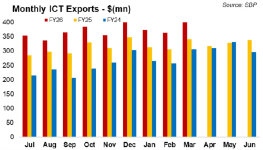
In Mar-26 alone, Pakistan’s IT exports rose to USD413 million, up 21 percent year-on-year and 13 percent over Feb-26. It was the second-highest monthly inflow on record and only the second time the country crossed the USD400 million mark in a single month.

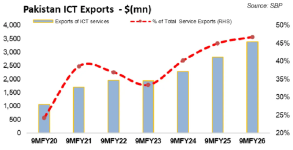
Over 9MFY26, IT exports reached around USD3.38 billion, showing 20 percent growth over the same period last year. This performance reflects continued global demand for IT services and improving sector capability, though sustaining this pace will depend on diversification of markets and the ability to navigate external uncertainties.

These numbers matter even more because of what is happening around them. Pakistan’s broader trade position remains under strain.
 

As Gulf tensions rise, Pakistan’s IT sector navigates risks and opportunities

  • Iran war has pushed the Gulf region into a state of economic and strategic uncertainty, with disruptions in shipping routes, energy flows, and investment activity.
Gohar Ali Khan
April 22, 2026

According to industry experts, Pakistan’s IT companies are witnessing a slowdown in business activities in the Gulf region, particularly in the United Arab Emirates (UAE) and Qatar, whereas a major market such as Saudi Arabia remains stable and growing despite challenges for logistics amid security concerns.

Saad Shah, an IT exporter, said Saudi Arabia has maintained its demand for foreign companies in IT sector and infrastructure development despite the tense situation in the region - an evident that many Pakistani companies are getting projects in public and private sectors.

On the other hand, the business situation from other Gulf economies seems a cautious break, as the government and private sector kept their new projects on hold not only for Pakistanis but for foreign countries due to the prevailing situation.
 
To view this content we will need your consent to set third party cookies.
For more detailed information, see our cookies page.
 

Zong launches Pakistan's first 5G airport kiosk in collaboration with Chinese-backed digital transformation push​

By Shafqat Ali | Gwadar Pro
Apr 22, 2026

ISLAMABAD, April 22: Pakistan's digital transformation received a major boost as Zong, a leading technology services enterprise, on Tuesday afternoon launched the country's first 5G Customer Facilitation and Sales Kiosk at Islamabad International Airport, marking a key step toward next-generation connectivity infrastructure influenced by China-backed telecom advancements.

The initiative, developed in collaboration with the Pakistan Airports Authority (PAA), aims to modernise airport services and introduce seamless 5G-enabled digital solutions for international and domestic passengers.

Positioned at a high-traffic transit hub, the kiosk allows travellers immediate access to high-speed connectivity upon arrival, supporting essential services such as real-time communication, digital navigation, ride-hailing applications, and cashless payment systems integrated into Pakistan's expanding digital ecosystem.

Zong officials said the project reflects the company's broader 5G strategy focused on enhanced customer experience, Artificial Intelligence (AI) integration, and expansion of digital infrastructure across key national sectors.

Faheem Durrani, Head of Sales and Distribution at Zong, said airports represent critical digital entry points where instant connectivity is essential for modern travel experiences. He emphasised that the initiative ensures seamless integration into Pakistan's digital network from the moment passengers land.

The Director General of the Pakistan Airports Authority described the project as part of a wider plan to modernise airport infrastructure and align it with global aviation and digital standards. He said the introduction of 5G-enabled facilities would transform airports into smarter, more efficient hubs.
 

PTA mandates domestic routing for all local internet traffic, bans international gateways

  • Move signals a decisive push toward building a sovereign, cost-efficient, and secure internet ecosystem
Published April 22, 2026

1777107092892.jpeg

By Tahir Amin

In a sweeping regulatory shift aimed at overhauling Pakistan’s internet infrastructure, the Pakistan Telecommunication Authority (PTA) has mandated telecom operators to route all local internet traffic domestically, effectively outlawing the long-standing practice of sending in-country data through costly international gateways.

The move, notified through the newly issued Local Peering and Internet Exchange Points Regulations, 2026, signals a decisive push toward building a sovereign, cost-efficient, and secure internet ecosystem.

Industry stakeholders say the regulations could transform how data flows within Pakistan, slashing bandwidth costs while improving service quality—but not without posing significant compliance challenges for operators.

READ MORE: PTA continues to curb illegal internet services

Under the new framework, all licensed telecom operators are now required to exchange local internet traffic either through direct local peering arrangements or via Internet Exchange Points (IXPs)—physical hubs where networks interconnect and share data.


The regulations explicitly prohibit routing domestic traffic through international routes, a practice that has historically inflated costs and exposed data to external vulnerabilities.

Cost, Control, and Cybersecurity at the Core

At the heart of the policy lies a strategic objective: reducing reliance on international bandwidth while tightening control over data flows. PTA has underscored that local routing will not only cut operational expenses for telecom companies but also mitigate cybersecurity risks associated with offshore data handling.

“Local internet traffic shall not be routed on upstream bandwidth or international gateways,” the notification states, leaving little room for ambiguity.

IXPs take centre stage

The regulations place strong emphasis on the establishment and expansion of IXPs, encouraging telecom operators to collaborate on shared infrastructure. Operators can jointly set up IXPs on a cost-sharing basis, or even outsource management to third parties—subject to PTA approval.

To ensure transparency and fair competition, all such arrangements must adhere to “fair and non-discriminatory” principles, preventing dominant players from monopolizing access.

The PTA has also reserved the authority to identify regions where IXPs are necessary and can direct operators to establish them—making compliance not just mandatory but geographically targeted.

CDN Integration and Data Localization Push

In a notable addition, the regulations promote the deployment of Content Delivery Networks (CDNs) within Pakistan. These systems cache and deliver digital content—such as videos, social media, and applications—closer to users, significantly improving speed and reducing load on international links.

Operators are allowed to deploy CDNs at IXPs or share CDN resources commercially with other participants. However, prior notification to PTA is mandatory for all CDN deployments, and strict conditions apply: unlawful content is prohibited, and all data must flow through licensed communication channels.

This provision aligns with broader global trends toward data localization, where countries seek to retain greater control over digital infrastructure and content distribution.

Strict compliance and enforcement mechanism

The regulations come with robust enforcement provisions. PTA has empowered itself to conduct inspections, demand traffic data, and take legal action in cases of non-compliance. In extreme cases, it can even order the disruption of improperly routed traffic on international gateways.

Licensees are also required to maintain detailed traffic records for at least 12 months and submit them upon request, signaling tighter regulatory oversight of network operations.

Industry Impact: Opportunities and Challenges

While the policy is being hailed as a long-overdue modernization step, industry players caution that implementation will require significant investment in infrastructure, particularly fiber connectivity and IXP development.

Smaller operators may face financial and technical hurdles in meeting the new requirements, especially in regions where digital infrastructure is underdeveloped. However, PTA’s allowance for cost-sharing and joint ventures could ease the burden.

On the upside, telecom companies stand to benefit from reduced international bandwidth costs, which could improve margins and potentially lead to lower prices for consumers.

A step toward digital sovereignty

The regulations mark a critical step in Pakistan’s journey toward digital sovereignty, where control over data, infrastructure, and digital services becomes a national priority.

By mandating local routing, promoting IXPs, and integrating CDNs, PTA is laying the groundwork for a more resilient and efficient internet ecosystem—one that is less dependent on external networks and better aligned with the country’s growing digital ambitions.

However, the success of this transformation will hinge on swift and coordinated implementation, industry cooperation, and continued regulatory clarity.
 

Pakistan ranks 16th globally in outsourcing talent index, says IT minister​


Says report suggests Pakistan could improve its ranking to 11 with further improvements in digital infrastructure

Web Desk
April 25, 2026

shaza also revealed that chinese satellite internet firms including galaxy space and shanghai space have expressed interest in entering the pakistani market photo app


Shaza also revealed that Chinese satellite internet firms, including Galaxy Space and Shanghai Space, have expressed interest in entering the Pakistani market. PHOTO: APP

Pakistan ranks 16th out of 193 countries in the 2026 Global Outsourcing Talent Index by Ataraxis, placing it among the top 9% globally, Minister for Information Technology and Telecommunication Shaza Fatima Khawaja said on Saturday.

The country has been growing at an average rate of around 20% annually, reflecting what the minister described as steady expansion in Pakistan’s technology sector.

In a statement, Fatima said that, notably, Pakistan had outstripped several major economies in the index, including the United Kingdom (29th), Spain (49th), France (73rd), and Germany (84th). It also ranks ahead of China (37th), Vietnam (32nd), and Colombia (31st).
 
The ministry highlighted ongoing initiatives, including expansion of telecom spectrum, a national fibreisation plan, addition of submarine cables, and improved terrestrial connectivity with China and Central Asia.

She also pointed to efforts to develop digital skills, including training programmes targeting one million youth in artificial intelligence, the government’s Digiskills.pk platform, and various apprenticeship and internship schemes aimed at supporting freelancers and IT companies.

The minister said Pakistan was also focusing on international outreach, noting participation in more than 40 global technology events over the past 18 months, alongside efforts to promote the country’s tech branding in major global markets.

The initiatives, she said, aimed to position Pakistan as a competitive destination for technology services and outsourcing.
 

Users who are viewing this thread

Back
Top