Pakistan: The Archaeological Marvel

The Kanishka stupa was a monumental stupa established by the Kushan king Kanishka during the 2nd century CE in today's Shah-ji-Dheri on the outskirts of Peshawar, Pakistan.

Archaeologists have examined the remains of the structure and determined that it had a diameter of 286 feet. Ancient Chinese manuscripts tell of Buddhist pilgrims reporting that the stupa had a height of 591 feet (The measurements they stated were in Chinese units, which were 700.

Sung Yun describes the stupa in the following terms:

"The king proceeded to widen the foundation of the Great Tower 300 paces and more. To crown all, he placed a roof-pole upright and even. Throughout the building he used ornamental wood, he constructed stairs to lead to the top....there was an iron-pillar, 3-feet high with thirteen gilded circlets. Altogether the height from the ground was 700 feet.

The stupa was discovered and excavated in 1908–1909 by a British arch;logical mission, and led to the discovery in its base of the Kanishka casket, a six-sided rock crystal reliquary containing three small fragments of bone, relics of the Buddha (which were transferred to Mandalay, Burma for safekeeping, where they still remain), and a dedication in Kharoshthi involving Kanishka.

According to Buddhist the building of the stupa was foretold by the Buddha:

"The Buddha, pointing to a small boy making a mud tope. that on that spot Kanishka would erect a tope by his name." Vinaya sutra

The same story is repeated in a Khotanese scroll found at Dunhuang, which first described how Kanishka would arrive 400 years after the death of the Buddha. The account also describes how Kanishka came to raise his stupa:

"A desire thus arose in [Kanishka to build a vast stupa]….at that time the four world-regents learnt the mind of the king. So for his sake they took the form of young boys] began a stupa of mud....the boys said to [Kanishka] ‘We are making the Kanishka-stupa.;.At that time the boys changed their form....[and] said to him, Great king, by you according to the Buddha prophecy is a Sangharama to be built wholly with a large stupa and hither relics must be invited which the meritorious good beings...will bring."

8e3d7f892ddbc11e309e3f4cb19cb915.jpg


Remnants of the Kanishka Stupa in Shah-Ji-Ki-Dheri.


f099de6d1542fde7e83272d9fac531c9.jpg


The famous inscribed Kanishka Casket found at the site of the Kanishka Stupa and containing relics of the Buddha.

Buddha relics from Kanishka's stupa in Peshawar, Pakistan, now in Mandalay, Burma. Teresa Merrigan,
 
The Kanishka stupa was a monumental stupa established by the Kushan king Kanishka during the 2nd century CE in today's Shah-ji-Dheri on the outskirts of Peshawar, Pakistan.

Archaeologists have examined the remains of the structure and determined that it had a diameter of 286 feet. Ancient Chinese manuscripts tell of Buddhist pilgrims reporting that the stupa had a height of 591 feet (The measurements they stated were in Chinese units, which were 700.

Sung Yun describes the stupa in the following terms:

"The king proceeded to widen the foundation of the Great Tower 300 paces and more. To crown all, he placed a roof-pole upright and even. Throughout the building he used ornamental wood, he constructed stairs to lead to the top....there was an iron-pillar, 3-feet high with thirteen gilded circlets. Altogether the height from the ground was 700 feet.

The stupa was discovered and excavated in 1908–1909 by a British arch;logical mission, and led to the discovery in its base of the Kanishka casket, a six-sided rock crystal reliquary containing three small fragments of bone, relics of the Buddha (which were transferred to Mandalay, Burma for safekeeping, where they still remain), and a dedication in Kharoshthi involving Kanishka.

According to Buddhist the building of the stupa was foretold by the Buddha:

"The Buddha, pointing to a small boy making a mud tope. that on that spot Kanishka would erect a tope by his name." Vinaya sutra

The same story is repeated in a Khotanese scroll found at Dunhuang, which first described how Kanishka would arrive 400 years after the death of the Buddha. The account also describes how Kanishka came to raise his stupa:

"A desire thus arose in [Kanishka to build a vast stupa]….at that time the four world-regents learnt the mind of the king. So for his sake they took the form of young boys] began a stupa of mud....the boys said to [Kanishka] ‘We are making the Kanishka-stupa.;.At that time the boys changed their form....[and] said to him, Great king, by you according to the Buddha prophecy is a Sangharama to be built wholly with a large stupa and hither relics must be invited which the meritorious good beings...will bring."

8e3d7f892ddbc11e309e3f4cb19cb915.jpg


Remnants of the Kanishka Stupa in Shah-Ji-Ki-Dheri.


f099de6d1542fde7e83272d9fac531c9.jpg


The famous inscribed Kanishka Casket found at the site of the Kanishka Stupa and containing relics of the Buddha.

Buddha relics from Kanishka's stupa in Peshawar, Pakistan, now in Mandalay, Burma. Teresa Merrigan,
Pakistan should try to get the artifact back from Burma.
 
Pakistan should try to get the artifact back from Burma.
Agreed.

Also, Delhi is holding artifacts from Mohenjo-Daro. They should be challenged on the grounds of colonial appropriation of Pakistan's historical artifacts.
 
Agreed.

Also, Delhi is holding artifacts from Mohenjo-Daro. They should be challenged on the grounds of colonial appropriation of Pakistan's historical artifacts.
Getting things back from India will be tough, but should still be attempted.
 
@FuturePAF

FP sb,

Rather than bickering with each other, we should collectively seek return of our heritage looted abroad, especially Britain.

Regards
 
@FuturePAF

FP sb,

Rather than bickering with each other, we should collectively seek return of our heritage looted abroad, especially Britain.

Regards
Both don’t have to be mutually exclusive. I agree we should both work together to get back artifacts from Britain, while also looking to repatriate artifacts from Pakistani sites in other countries, including India.
 
Last edited:
1751565764540.png

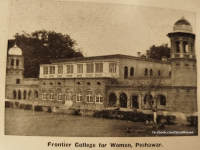
A century old: This graceful building, soon to complete 100 years, was originally constructed in 1925–26 on land nestled below Peshawar’s iconic Balahisar Fort.

The site was once bounded by a Sikh temple to the south, a Hindu temple to the east, the Kafila Serai of the Municipal Committee to the west and other serais such as Serai Kirpa Ram and Serai Murli Mal to the south, along with various other old city structures.

It first opened as Khalsa High School for Boys - Peshawar City, a Sikh-run institution open to students of all faiths. In 1949, it was transformed into Frontier College for Women, marking a new chapter in the educational history of the region.
 

The silent stupas of Thareli​


1752498424758.png

Perched on a quiet hilltop in Mardan, the Buddhist complex stands as a testament to the grandeur of Gandhara

By Abdur Razzaq
July 13, 2025

MARDAN: High in the hills in Sawaldher village of Mardan district, Khyber Pakhtunkhwa (KP) lie the time-tested remains of the somewhat 2000-year-old and once-thriving, Thareli Buddhist archeological site, from the ancient Gandhara civilisation. It once served as an educational institution and spiritual complex of Buddhism for about 550 years during Kushan dynasty.

While rich in history and cultural significance, Thareli today remains on the fringes of public awareness and government attention. With narrow access roads, minimal facilities, and limited promotion, the site’s potential as a religious tourism destination remains untapped, despite its standing as the third-largest Buddhist site in Mardan district.

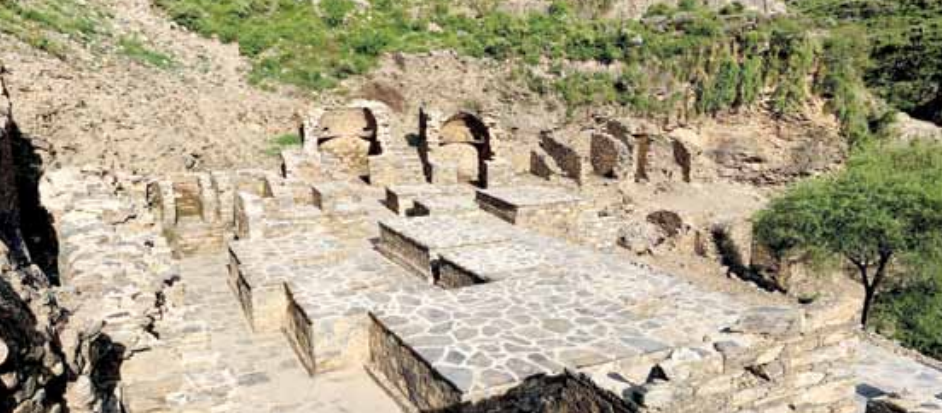
Located about nineteen kilometres from Mardan city on a hilltop approximately 300 metres high, the site has preserved stupas, and chapels where sculptures of Buddha were placed for worship, as well as a residential area at high altitude in mountain.

“After Takht Bhai and Jamal Gahri Buddhist remains, Thareli is the third-largest historical site in Mardan district,” shares Dr Ghayur Shahab, a faculty member of the department of archeology at the University of Malakand and the then in-charge of Mardan Museum.

“It was constructed during the Kushan period, from 1st century BC to 5th century AD. After its construction, the site remained active for 550 years. The decline of Buddhism began when the state stopped supporting it. With the arrival of the Huns and later the Muslims, Buddhism came to an end in this region.”

According to the directorate of archeology and museums, KP, the complex was first discovered in 18th century and then from 1964 to 1967, a Japanese archaeological mission began excavations of the site and uncovered the main stupa beside a spring, surrounded by several votive stupas, students’ quarters, monks’ cells, assembly halls and chapels.

budhistss1752362546-2.png


Constructed with diaper masonry, the main stupa featured niches that housed Buddhist sculptures. The site spanned over multiple terraced spurs with evidence of multistoried structures.

“This site was a religious seminary where Buddhism was taught, studied and practiced,” shares Dr Shahab. “Antiquities excavated from the site include Buddhist panels revealing the life stories of Buddha, sculptures, stucco sculptures and coins. These are [now] showcased in the Peshawar and Lahore Museums.”

Junaid Khan, a local resident of the area, said that like other historical sites in KP, Thareli Buddhist complex is suitable and relevant for religious tourism.

“However, unfortunately only tourists from nearby villages visit the site,” he adds. “The Pakistan Tehreek Insaf (PTI) provincial government has so far failed to fulfill its promises regarding the promotion of religious tourism in the religion.

A major obstacle in the promotion of the thousand-years-old historical complex is the road leading to the archeological site, which is narrow and dilapidated. In addition to the construction of a proper road and walking tracks, it is crucial that the government must focus on promoting the site through main stream and social media.”

According to Khan, initially, the site was under the jurisdiction of the federal government. In 2010, it was handed over to the provincial directorate of archaeology, and in 2013, the KP government protected it under the Antiquities Act and carried out some conservation and restoration work.

“In 2023, the Peshawar High Court, in a verdict, banned crush plants, mining, and blasting within one kilometre of the site,” officials in the directorate revealed.

“For the promotion of religious tourism, we need to attract foreigners from Buddhist countries to visit these sites,” shares Bakhat Muhammad, deputy director of directorate of archeology and museums, KP.

He added the Thareli archeological complex is important for religious tourism but because of security concerns, the local police do not allow foreigners to visit this monastic complex and the Jamal Garhi site. As a result, they only visit the Takht Bhai monastic complex which has a negative impact on tourism.

“The site spreads over 253 kanals in a mountainous area,” shares the deputy director. “Currently, no entry fee is collected and the site is not officially open to visitors.”

Regarding further excavation and development, Bakhat Muhammad said that a two-year project for eight historical sites, including Thareli complex has been approved, adding that under the project, excavation, conservation and development will be carried out before the site is opened for local and foreigner visitors with proper facilities.

Thareli’s crumbling chapels, centuries-old stupas, and scattered sculptures represent more than just historical artefacts — they are fragments of a pluralistic and intellectual past that once defined the region.

Yet despite its profound archaeological and spiritual significance, the site lies in neglect, eclipsed by more accessible or popular monuments like Takht Bhai. With renewed efforts in excavation, conservation, and infrastructure, Thareli could emerge not only as a key node in the Gandharan heritage trail but also as a source of cultural diplomacy and economic opportunity through religious tourism. For that to happen, however, preservation must meet promotion — and history must be given a second life.
 
Indus Valley School of Art & Architecture , Clifton

pmbgqkM.jpg
 
Bahauddin Zakariya's Shrine, Multan

23351228262_2fdd633170_b.jpg


Bhong Mosque, Sadiqabad

gX1OnWe.jpg
 
Light house (there is no light house but this area is known as light house) Karachi.


MJmvKbY.jpg
 
A building which was built in 1937 as a gurdwara, and has now been converted into a public library known as Mansehra Municipal Library.


58bb6fff94086.jpg


On main Kashmir Road stands the three-storey building in the middle of small shops in Kashmir market.

58bb70161af9b.jpg

A man sits at the entrance of the library. Khandas, the sikh-faith symbol, can be seen on either side

.

58bb70392852e.jpg


The ceiling of the library depicts Sikh traditional tales
 
A true gift to every Pakistani and certainly all people of Lahore to have this beautiful Asset.


5871535857_24dd72e929_b.jpg
 

Users who are viewing this thread

Back
Top