Four decades after his death, Sadequain’s monumental murals have found a new public canvas on Pakistan Post’s record-length stamps.
Umer Sheikh
July 26, 2026
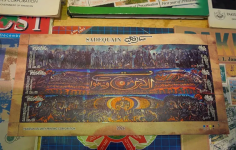
A perforated sheet containing the stamps issued by the Pakistan Post on Sadequain's 96th birthday | PNCA
The first time I stood beneath the ceiling of the Sadequain Gallery at Frere Hall, I could not look away.
Arz-o-Samawat [The Earth and the Heavens] was
Sadequain’s most ambitious mural and possibly his largest. His
demise in 1986 left the mural permanently unfinished, and the empty blue space that remains gives the work a strange, mystic appeal, holding in itself the same intrigue that one might feel for the promised idea of heaven. Sadequain is said to have called it his own Sistine Chapel.
I came across the same mural again recently, in miniature, on a postage stamp. On June 30, 2026, Sadequain’s 96th birthday, Pakistan Post unveiled three record-length stamps in the artist’s honour at the Pakistan National Council of the Arts (PNCA), Islamabad.
Each stamp measures 280mm by 40mm, and a set of three stamps — billed as the longest in the world — are available on one perforated sheet. The stamp sheet itself features two panels from the Frere hall ceiling, alongside the entire length of another Sadequain mural, Treasures of Time.
Sadequain’s gift for scale and precision showed early. As a boy, he could reproduce entire schoolbooks by hand and taught himself to draw the world map from memory. He would fill the neighbourhood walls with charcoal birds and animals, much to his neighbours’ bewilderment and annoyance.
A reflection of that instinct for line and geography can still be traced in the details of the Frere Hall ceiling.
These early creative habits, alongside the history of his 1961 State Bank mural, Treasures of Time, were documented by his cousin Saiyid Ali Naqvi in his book
Sadequain: Artist and Poet.


