Pakistani Achievers - at Home / Abroad

Dr Adib Rizvi honoured

580ba06d46455.jpg


KARACHI: The prestigious American College of Surgeons has conferred an honorary fellowship on Dr Adib Rizvi of the Sindh Institute of Urology and Transplantation for his services in the field of surgical sciences, public services and pioneering the transplant movement in Pakistan.

The fellowship was conferred on Dr Rizvi at the annual congress of the college held in Washington DC, according to information reaching here. This year honorary fellowships were awarded to five surgeons hailing from various parts of the world who have made extraordinary contributions to their respective branches of surgery. The globally renowned surgeons who received fellowships were from Australia, Colombia, France and Japan besides Dr Rizvi of Pakistan.

In its citation the college recounted the meritorious services rendered by Dr Adib Rizvi by setting up the SIUT in Karachi which not only provides free state of the art medical treatment to the people but is also one of the growing urological and transplant centers of the region. The citation also lauded the role Dr Rizvi has played in his country by bringing legislation to prohibit commercial transplantation.

The American College of Surgeons established in 1903 is the largest professional organisation of surgeons in the world with 80,000 members on its roll
 
Pride of Pakistan. Ms. Dr. Fakhira Anwar, the daughter of a poor laboring newspaper vendor Muhammad Anwar of Okara, bagged seven gold medals in MBBS.

To view this content we will need your consent to set third party cookies.
For more detailed information, see our cookies page.
 
In Saudi Arab

To view this content we will need your consent to set third party cookies.
For more detailed information, see our cookies page.
 
''You must not lose faith in humanity''

This is the message we learnt from the magic healer Dr Ruth Pfao
❤


1660132148111.png


1660132185670.png


1660132281182.png


2017

Death anniversary of Dr. Ruth Pfau a selfless mother of this nation Who devoted her life to battling leprosy in Pakistan, is being observed today: Due to her tireless effort, Pakistan was declared Leprosy free by World Health Organization in 1996. She was an honorary citizen of Pakistan, died a national hero and buried with full state honors.


1660132365216.png
 

‘Gift to Karachi’: Gulgee Museum opens in tribute to master artist


Exhibit houses over 170 works, dating back to the 1950s

Faiza Virani
February 20, 2025

Gulgee Museum – celebrating the work of contemporary Pakistani artist Ismail Gulgee – opened Wednesday evening to the public in Karachi, welcoming the art fraternity, collectors, friends and family.

Curated by his son, artist Amin Gulgee, the new space was two years in the making and now houses a permanent collection of Gulgee’s paintings, mosaics in lapis lazuli, sketches and sculpture spanning from the 1950s up to the year 2007.

“I’ve curated the collection of over 170 works dividing it into 17 sections which are spread over 13 rooms over two floors of the museum”, Amin told Business Recorder.

Humbled and “overjoyed” by the turnout at the opening, Amin shared how his architect Samina Anjarwala helped him “reimagine the space, which is now an extension of the adjoining Amin Gulgee Gallery”.

Each theme is described in wall text personally written by Amin, who shares much personal context and anecdotal evidence. “I have tried to tell a story about my father, and it was a very personal experience doing that,” he shared.


 Photo: Business Recorder

Photo: Business Recorder

Gulgee, an engineer by profession, attended the prestigious Columbia University in 1947 as well as Harvard University in 1948.

During his time as a graduate student in the United States, Gulgee studied art on his own, spending countless hours in the Metropolitan Museum of Art in New York and the Museum of Fine Arts in Boston – his two favorite painters being Velázquez and Rembrandt, as described by Amin.

Also included in the museum are archival photographs.

Gulgee witnessed the birth of Pakistan and images include him showing his works to former French statesman Charles de Gaulle, former Prime Minister of India Rajiv Gandhi, Former US President Richard Nixon, among others.

Additionally, there are videos of interviews with Gulgee in which the artist describes his works, as well as the room that he painted in, replete with his brushes, palette knife and materials, which Amin shared he has left as his father had.


Pietra dura

Pietra dura – a technique of inlaying stonework in which different sections are precisely cut and placed together – was one of the mediums Gulgee was especially synonymous with.

In the 17th century, this method of mosaic was reinterpreted in Mughal India and called ‘parchin kari’.

The marble walls of the Taj Mahal commissioned in 1631 by the fifth Mughal emperor, Shah Jahan brought about richly colored floral and geometric patterns using jade, cornelian, lapis lazuli and other semi-precious stones.

In 1957, King Mohammad Zahir Shah asked Gulgee to paint his portrait in oils. Gulgee went on to make portraits of members of the royal family, spending almost a year in Kabul.

During his stay in Afghanistan, Gulgee conceived his first mosaic: a depiction of the king using polychrome onyx and marble in pietra dura.

In the 1970s, Gulgee revisited this method to assemble a portrait of Aga Khan III Sultan Muhammad Shah – a replica of which is on display. During his trajectory, Gulgee made portraits of various heads of state and royalty in lapis lazuli.

Incidentally, one of his favourite and oft-used colours, ultramarine, is derived from lapis lazuli.

 Photo: Business Recorder

Photo: Business Recorder

Artist Adeel uz Zaffar lauded the curation of the exhibit saying, “Gulgee has produced outstanding portraits of the late Karim Aga Khan IV and his grandfather made with lapis lazuli – a precious stone found in Central Asia.”

“I have always seen the works in print and on social media, but it is a breathtaking moment for me to physically experience them at close range, to feel and understand the craft and the beauty. Certainly a photograph does not do justice to the actual work.”


 Photo: Business Recorder

Photo: Business Recorder

Calligraphy

While the origins of the ‘Naskh’ script can be traced to the first century, they became popular in the 6th century as used by scribes.

In 1974, Gulgee engaged with Islamic text for the first time, with a painting depicts a verse from Quran stating, “And hold firmly to the rope of Allah all together and do not become divided.”

“Gulgee’s hand would fly across the paper as he inscribed calligraphy in these rounded letters,” Amin writes for that section of the gallery.

“He would often conjecture that the movement of foliage must have inspired the early calligraphers to develop Arabic script, noting how a leaf curves and gestures in the wind, creating fluid lines.”

“The works are very carefully selected for each section and the entire retrospective is very well-curated which allows an audience to experience the various thought processes of Ismail Gulgee – the entire range of an artist, state commissions to his personal narratives and selected themes,” added uz Zaffar.

“My favorite section is the one showcases an entire range of his brushes as a reminder of his long life journey.”


 Photo: Business Recorder


Photo: Business Recorder

Artist Mona Naqsh – daughter of seminal Pakistani artist Jamil Naqsh – called the endeavour a “gift to Karachi”, citing it an important addition to the art landscape.

The goal of the Gulgee Museum is to be an educational tool for the study of the artist, according to a press release issued by the museum.

Eventually there will be an outreach program targeting schools and universities of Pakistan to give students free guided tours of Gulgee’s immense trajectory. The roof of the museum is a space where discursive sessions can be held on topics of culture relevant to Pakistan.

“It was my parents’ dream that their home would eventually become a museum. I truly hope that I have done justice to that vision,” Amin added.
 
To view this content we will need your consent to set third party cookies.
For more detailed information, see our cookies page.
 

Sadequain’s work brings a message of freedom, justice and resilience to Dubai

Mehreen Shahid

1757184363193.png


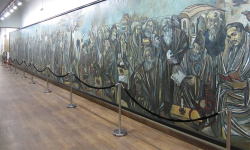
Sadequain’s work still has the quality to stir its audience more than three decades after the famous Pakistani artist’s death.

Like many others, Dubai-based Pakistani business owner Fahad Ali’s first introduction to his work was through his calligraphy at a state-owned building. In his lifetime, Sadequain painted several murals at government-owned properties, such as the State Bank of Pakistan and the ceiling of Frere Hall in Karachi, Mangla Dam near Mangla City, Punjab, University of the Punjab and Lahore Museum in Lahore.

The brief initial introduction to Sadequain’s work, Ali said, wasn’t enough and left him wanting more. The exhibition, held at Noor Royal Gallery, Dubai, from August 26–31, was a chance to re-acquaint himself with Sadequain’s work. The gallery had borrowed more than 30 pieces from personal collections.

On Instagram, the exhibition was described as “an exclusive selection from the private collection of Master Sadequain, a legendary figure of Pakistani modern art.”

“This exhibition offers a rare glimpse into the visionary world of this pioneering artist—who fused Islamic calligraphy with modern expression to create a unique artistic language.”

“Witness iconic paintings and monumental murals; the transformation of calligraphy from tradition to modern expressiveness; profound symbols including the “cactus” as a sign of resilience,” it added.

The Noor Royal Gallery exhibition, titled The Holy Sinner, the name of the biggest catalogue of his works produced for a retrospective of displayed at Mohatta Palace Musuem, gave Ali the chance to immerse himself in a variety of the award-winning artist’s works.

“You look at his calligraphy and it’s very different,” added Ali. “It’s very graphical. When you usually look at calligraphy, you’re looking for a certain type of script, like Kufi or Salis, but in his case, it’s very vibrant and I haven’t seen that at all.”

It wasn’t just the calligraphy that surprised him. Sadequain’s other pieces were equally awe-inspiring for Ali.

“They tell a story about what he was thinking in those times,” he noted. “I don’t know much about his life, but his work tells me that the artist had his own perception of how the common man was being treated. It’s pretty much a reflection of how things were at that point in his head.

“His work seems like the common man is stifled, is bound, he’s been tortured or been kept away from something as basic as food and water or even just freedom of movement,” concluded Ali.

Sadequain’s work was a first for his Excellency, Denny Lesmana, Consul General of the Republic of Indonesia.

“Frankly speaking, I did not know the name of Sadequain before,” he said, talking to Business Recorder on the last day of the exhibition, “but after looking at his paintings here, maybe I will check on Google about him.”

“I think his paintings symbolize something — I feel the desperation of some of the subjects in the paintings, so I have to look it up because there’s something hidden in there,” added Lesmana.
 
1757188907307.png

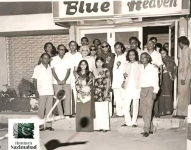
Blue Haven Restaurant in the 70's, 80's.
ناظم آباد چورنگی،
Literary gathering in Karachi
From left to right: Mohsin Bhopali, Dr. Hilal Naqvi, Mukhtar Zaman, Alam Tab, Asmat Chaghtai, Ateeq Sadiqi, Raees Amrohavi, Akhtar Farooz, Jaun Elia, M Ali Sadiqi and Anjum Azmi
 

AI startup Cursor with Pakistani co-founder set for $60bn deal with SpaceX

News Desk
April 23, 2026


1776948047103.png

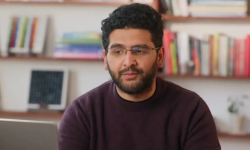
A photo of Cursor co-founder Sualeh Asif. — Screengrab taken from video via X/@cursor_ai

Cursor, an AI code-generation startup co-founded by Pakistani-born Sualeh Asif, has secured a $60 billion acquisition deal with Elon Musk’s SpaceX, according to multiple reports on Thursday.

Along with OpenAI and Anthropic, Cursor is one of several Silicon Valley startups that have drawn waves of developers by using artificial intelligence to automate coding, a business where AI companies have found early commercial traction, according to Reuters.

SpaceX announced in a post on X that Cursor gave SpaceX the right to acquire the company later this year for $60 billion. If SpaceX doesn’t buy Cursor, it will pay $10 billion for their work together, the company said.

“The combination of Cursor’s leading product and distribution to expert software engineers with SpaceX’s million H100 equivalent Colossus training supercomputer will allow us to build the world’s most useful models,” it added.
 
Originally from Karachi, Asif attended Nixor College before attending the Massachusetts Institute of Technology (MIT), and represented the country in the International Math Olympiad from 2016 to 2018.

While there, he cofounded Anysphere, the maker of the popular AI code editing tool Cursor, with three friends from MIT.

The company now claims to have more than $1bn in annualised revenue, making it one of the fastest growing AI startups according to Forbes.

In MIT, he started an AI-powered search engine company.

Umar Saif, the former federal minister for IT, praised the co-founder, calling him “the kind of role [model] Pakistani youth needs”.

“Not property dealers, tax evaders, bank defaulters, rent seekers, born into wealth etc. But a self-made kid from a middle-class family in Karachi,” he pointed out.

“Studied at MIT, started a hugely impactful company, changed the way people write code, now worth over $1 billion at the age of 26!”
 
To view this content we will need your consent to set third party cookies.
For more detailed information, see our cookies page.
 

Sualeh Asif​

Cofounder, Anysphere
$1.3B

Real Time Net Worth​

as of 4/23/26
#2919 in the world today
Photo by Cursor

profile image for Sualeh Asif


Last Updated Mar 10, 2026, 1:01am EDT​

  • Sualeh Asif cofounded Cursor, the maker of a popular AI code editing tool, with three friends from MIT.
  • Cursor reached a $29.3 billion valuation in November 2025, after raising $2.3 billion in a funding round co-led by VC heavyweights Accel and Coatue.
  • Cursor claims to have more than $1 billion in annualized revenue, making it one of the fastest growing AI startups.
  • Today, millions of software developers at 50,000 enterprises like Nvidia, Adobe, Uber and Shopify use Cursor to generate and edit chunks of code.
  • Originally from Karachi, Pakistan, Asif represented the country in the International Math Olympiad from 2016 to 2018.
  • In college, he started an AI-powered search engine company.
 
1777721411153.png

"From Slipper to Chair" -

The Story of a Poor Girl Becoming a Commissioner

1. Thar Hut and Broken Slipper
Tharparkar, Sindh. A sandstorm afternoon. 14-year-old Noor Bano. Her father used to herd camels, her mother worked in people's homes. There was no electricity in the hut, and water had to be brought from 3 kilometers away.

Noor's slipper was broken. She walked barefoot on the sand to school. The teacher asked: "What will you be when you grow up?"
Noor raised her hands covered in dust: "Baji, Commissioner. Whoever gives orders, listens to the people."
The whole class laughed. The teacher too. "The dreams of the poor do not grow big, son."

2. Books, clay stove and night studies

Topped the district in matriculation. Second position in the whole of Sindh in inter. But college fees? Father sold camels. Mother sold her silver bangles.

Getted admission in Karachi University. There was no hostel fee. Noor taught tuition at 3 places during the day. Prepared for CSS at night by the light of a clay stove. Hands would get cold in winter, there was no fan in summer.

Friends say: "Noor, CSS is a game for the rich. Academy, notes, English medium. So leave me."
Noor would reply: "Poverty is my constraint, not my identity."

3. Failed three times, taunts and stubborn girl

I failed CSS three times. The first time was in English. The second time was in current affairs. The third time was in an interview.

The villagers would taunt me: "Oh, Commissioner's daughter, make tea."

Relatives would say: "You are getting old. Get married. This officer's job is not for you."

Mother would cry: "Son, just stop. What will people say?"

Noor would press her mother's feet: "Mother, people will still talk when I become a commissioner. They will say, 'Look, the poor man's daughter has become an officer.' Just a little patience."

4. Fourth time and history

In the fourth time, Noor did it day and night. She studied for 18-18 hours. She would ask for old newspapers and bring them. Free lectures on YouTube. She made notes under the street light on the roadside.

The result came. Noor Bano - CSS 2025 - 7th position in Pakistan. PAS group allotment.

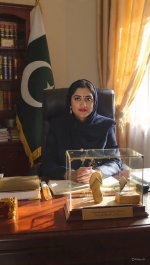
The day the joining letter came, Noor picked up the same broken slippers in which she used to go to school. She kept them in a glass case on the officer's desk. She put a plate below: "This reminds me of where I came from."

5. Commissioner Noor Bano

Today, Commissioner Noor Bano is in charge of Larkana Division. There is a line outside the office. Rich, poor, everyone listens the same.

What was the first order issued? "Fan and water in every school in Thar. No girl should come barefoot."

When a poor girl comes with a file, Noor sits her on a chair. She makes tea herself and drinks it.
"Son, don't be afraid. This chair can be yours too. Just don't stop if your slippers break."

The teacher who had laughed has now retired. Noor awarded her with her own hand. The teacher cried.

Noor said: "Baji, you were right. The dreams of the poor are not big... *They are very big.
 

Users who are viewing this thread

Back
Top