Pakistani Fruits and Vegetables

ام کی ورائٹی سندھڑی
King of Fruits / Sindhiri Mango In Multan Mandi


May 5, 2024
 
ام کی ورائٹی سندھڑی
King of Fruits / Sindhiri Mango In Multan Mandi


May 5, 2024
I remember shopping for these with my grandma when I was a kid so it must have been exported to India in those days.

Unless India has some variety with same name.
 
I remember shopping for these with my grandma when I was a kid so it must have been exported to India in those days.

Unless India has some variety with same name.
I am not sure. But the name is given to it is, because this is from Sindh and is early arrival in Market, as Sindh gets summer earlier than Punjab.
Punjab famous variety is Chonsa.
 
I am not sure. But the name is given to it is, because this is from Sindh and is early arrival in Market, as Sindh gets summer earlier than Punjab.
Punjab famous variety is Chonsa.
Must be from Pakistan in those days things might have been easier.

Anyway these are some famous Indian varieties and had most of them except few verities. My family is crazy for mangoes.


There are also some very good south American verity available in USA Kent, Marathon, Honey …
 
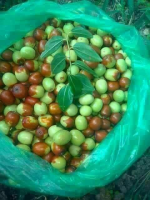
اس پھل کا نام گوندی ھے
اسکے بعد لہسوزی ھوتی ھے اسکا ساءز گوندی سے تھوزاا بزا ھوتا ھے​

1716842482861.png
 
To view this content we will need your consent to set third party cookies.
For more detailed information, see our cookies page.
 
To view this content we will need your consent to set third party cookies.
For more detailed information, see our cookies page.
 

THE LUSCIOUS LYCHEE

Muhammad Sadaqat
October 13, 2024

A lychee tree in an orchard in Khanpur | Photo by the writer


A lychee tree in an orchard in Khanpur | Photo by the writer

Malik Fiaz, now 70, has been involved in lychee farming in the Panjkatha area of Khanpur in Khyber Pakhtunkhwa’s Haripur district for decades. It started with his father, and now his children and grandchildren are also working as pre-harvest fruit contractors.

Khanpur’s Panjkatha [Five Watercourses] is a conglomeration of over a dozen small and large countryside localities. The majority of its dwellers resettled there following displacement by the Khanpur Dam project in the 1970s. With fertile soil and abundant water, the area is known as the fruit basket of the district, with lychee among its most sought-after produce.

A recent survey, conducted by Dr Waseem Ahmed, an adjunct professor in the horticulture department at the University of Haripur (UoH), found that around 5,000 farmers across Haripur were growing lychee over roughly 1,500 hectares of land. The fruit is harvested between June and July, with an estimated yield of 15,000-20,000 metric tonnes, and an appraised yearly worth of Rs1.5-2 billion (USD 10-15 million), says Dr Ahmed.

Until a few years ago, lychee farmers in KP’s Haripur district were earning Pakistan hefty foreign exchange from export of their much sought-after fruit. But climate change and environmental deterioration have meant they are now scrambling to meet even domestic demand

It also provides employment opportunities to hundreds of unskilled and skilled workers, with Dr Ahmed telling Eos that the flowering to ripening duration of the fruit lasts between 120-150 days, with processes such as pruning, fertilisation, pest/disease management and irrigation involving 150-200 people per hectare.
 
ORIGINS OF LYCHEE

The lychee is a native to Southeast Asia and has been a favourite fruit of the Cantonese since ancient times, according to the Encyclopaedia Britannica. China is the main producer of lychees, followed by India, with production also occurring in other countries in Southeast Asia.

According to the records of the provincial agriculture department, the Nursery Fruit Farm, locally known as Sarkari Bagh and spread over 128 kanals (one kanal is approximately 500 sq metres), was established during British rule in 1913. It included a lychee farm of around 180 trees, spread over 22 kanals.

Octogenarian Haider Khan, a retired teacher, relying on oral history, says his grandfather told him that lychee was first cultivated in Haripur during the early days of Sikh rule. “The Sarkari Bagh was established by General Hari Singh Nalwa in 1822, and its original name is Hari ka Bagh or Garden of Hari Singh Nalwa,” Khan tells Eos.

A 2008 paper, published in Acta Horticulturae, contends that lychee was first introduced in Pakistan in the 1930s by Sardar Faqir Singh from Dheradun in India, and remained an exotic plant until the 1960s, when commercial production started from few orchards located near Lahore. Owing to its good fruit quality and profitability, large scale plantations expanded to Haripur, Hazara and, later, to parts of Sindh.
 
Experts agree that farmers growing the lychee crop need to take adaptive measures, such as selecting resilient lychee varieties, adjusting planting schedules, implementing water management strategies, and adopting climate-smart agricultural practices to mitigate the effects of climate change.

This includes, according to Dr Ahmed, using known approaches to counter lychee browning. “One approach to control it involves using abscisic acid to reduce polyphenol oxides and peroxides activity, effectively controlling peel browning,” he tells Eos.

Another method includes treating lychee fruit with a melatonin solution before harvesting, followed by cleaning with acidic electrolysed water and storing the fruit in modified-atmosphere packaging with polythene film bags, resulting in reduced disease occurrence and peel browning, Dr Ahmed continues.

Dr Abdul Qayum, a climate change expert at the agronomy department of the University of Haripur recommends the development of climate-resilient lychee varieties, and the implementation of efficient irrigation systems and management practices to reduce water stress and optimise water use.

Meanwhile, the agriculture department has planted different fruit species over an area of 250 hectares in Haripur as part of a World Bank-funded project to achieve climatic resilience through horticulture. “We are also educating farmers to adopt and adapt climate-resilient agriculture practices,” says Mumtaz Khan, the department’s district director in Haripur.

The writer is a freelance journalist and human rights defender based in KP. X: @MSadqat

Published in Dawn, EOS, October 13th, 2024
 

Users who are viewing this thread

Pakistan Defence Latest

Latest Posts

Back
Top