Navigation
Install the app
How to install the app on iOS
Follow along with the video below to see how to install our site as a web app on your home screen.
Note: This feature may not be available in some browsers.
More options
Style variation
You are using an out of date browser. It may not display this or other websites correctly.
You should upgrade or use an alternative browser.
You should upgrade or use an alternative browser.
PTI News, Updates and Discussion
- Thread starter ghazi52
- Start date
- Status
- Not open for further replies.
More options
Who Replied?



PakAl
Elite Member
It seems like Pakistan establishment has decided to never allow IK back as PM.Is it DG? directly reporting to the boss that IK name has been removed?
View attachment 13584

Forsvaret
Trusted Member

Who are they (establishment) to decide which leader people of Pakistan gets to choose?It seems like Pakistan establishment has decided to never allow IK back as PM.
PakAl
Elite Member
The establishment of most nations decide, unfortunate but its a fact.Who are they (establishment) to decide which leader people of Pakistan gets to choose?
Forsvaret
Trusted Member
Then what’s the point of people going to elections? Send the establishment to vote instead.The establishment of most nations decide, unfortunate but its a fact.

ghazi52
THINK TANK: CONSULTANT

- Thread starter
- #231
PTI founder says ‘inactive’ nominees to lose candidature
Malik AsadJanuary 24, 2024 U
ISLAMABAD: As PTI-backed candidates struggle to launch their election campaign amid a crackdown on the party supporters, imprisoned PTI founder Imran Khan has warned that he would replace ‘inactive’ nominees with ‘suitable candidates’ if the former failed to step up their election campaigns.
The PTI leader made these comments during his interaction with reporters at Adiala Jail on Tuesday after the hearing of the cipher case, in which star witness Asad Majeed — a central character in the cipher controversy — recorded his statement.
Speaking to reporters, Mr Khan asked his party’s candidates to take out ‘massive rallies’ and organise public gatherings to show the strength of the PTI in their constituencies. He said their tickets would be cancelled if the PTI electioneering did not pick up steam by Sunday.
ghazi52
THINK TANK: CONSULTANT
- Thread starter
- #232
PTI candidates face loyalty oath dilemma
Election aspirants caught in the crossfire between powerful stakeholders and party supportersRizwan Shehzad J
anuary 24, 2024
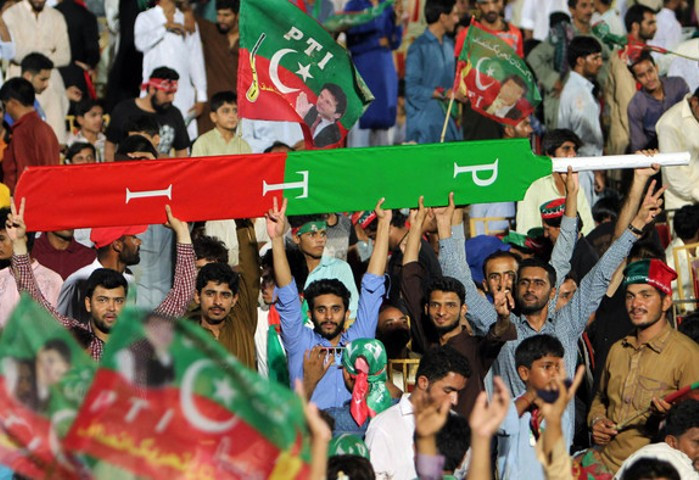
Supporters of former prime minister Imran Khan hold a giant cricket bat with the colours and initials of the party.
Pakistan Tehreek-e-Insaf (PTI) leaders find themselves navigating another oath-taking spree, leaving candidates treading on a double-edged sword to prove their loyalty to the party’s founder Imran Khan ahead of general elections.
Not too long ago, several PTI leaders recorded video statements under oath as evidence, attesting that the former prime minister never issued any instructions to them before or after May 9 to attack or vandalise state institutions, buildings, and military installations.
What began as a pre-emptive measure to shield against potential arrests and coercion to testify against Imran has turned into a spectacle where PTI voters demand their candidates take a renewed oath on the Holy Quran and win their trust.
This has left many party candidates caught in the crossfire between powerful stakeholders and party supporters. On one hand, they, along with the party leadership, are confronting the wrath of powerful stakeholders; on the other hand, party voters and supporters are compelling them to take an oath on the Holy Quran, pledging their enduring loyalty to Imran even after winning elections.
The scenario has triggered a debate on whether swearing upon the Holy Quran could be the ultimate solution for PTI if it can save the party from the wrath of concerned quarters, and if it is the appropriate method to bridge the trust gap between PTI candidates and voters.
This debate becomes more pertinent, particularly when the candidates are steadfastly standing with the party amid pressure and various challenges.
“I think it is not just insulting, it is humiliating for those who have been asked to publicly take oath,” renowned political expert Zaigham Khan said, adding that we keep hearing that Pakistan Muslim League-Nawaz (PML-N) also takes oath from its members; sometimes the party members are asked to say it on oath that they would not disclose the contents of a specific meeting.
Zaigham said that the oath-taking ceremonies show two things: first, the PTI is facing tremendous pressure; and second, the newcomers who have been awarded election tickets do not have the required trust level with the decision-makers in the party, especially, Imran Khan. “[People] feel that they do not have any other option than asking people to take oath,” he said.
Ghazi
Registered Member

Do not change titles.
Several journalists say they have been asked to impose near-blanket ban on the political party’s coverage ahead of February 8 elections.
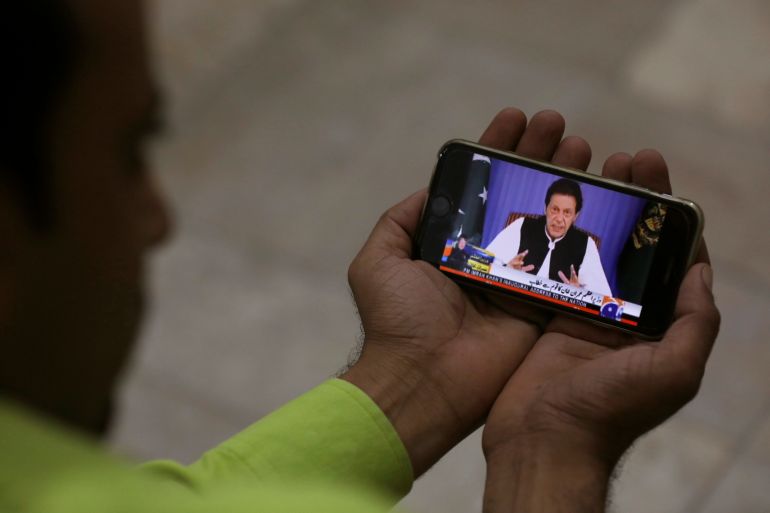
A journalist poses with a cell phone displaying a speech by Imran Khan [File: Akhtar Soomro/Reuters]
Islamabad, Pakistan – Journalist Amir Mehmood* was getting ready for work when his phone buzzed with a WhatsApp message.
As a member of the top management at a private news channel in Pakistan’s second-largest city, Lahore, Mehmood was used to getting non-stop calls and messages, even at odd hours.
But the name of the sender of that message on Tuesday morning caught his attention and he immediately picked up his phone. It was an official who belonged to the country’s powerful military, which has directly ruled over Pakistan for more than three decades of its 75-year existence as a constitutional republic and has controlled most levers of power, from behind the scenes, even when civilian governments have been in office.
“Basically, the person pointed out some of our election coverage and said we must not use the flags of PTI or mention their affiliation with candidates backed by the party. It instructed us to clearly identify the candidates only as ‘independent’ and not show which party they were related to,” Mehmood told Al Jazeera.
Mehmood is among multiple journalists working in newsrooms of different TV news channels and web outlets, who have told Al Jazeera of instructions they have received effectively imposing near-blanket censorship on coverage of the Pakistan Tehreek-e-Insaf (PTI) party ahead of the nation’s February 8 elections.
PTI, founded by former Prime Minister Imran Khan, is widely seen as possibly the country’s most popular political party. But Khan, a cricketing icon, has been imprisoned since August 2023 as he awaits trials over charges of corruption and leaking of state secrets – allegations he dismisses as being politically motivated.
Since he lost a confidence vote in parliament in April 2022 and was forced out of power, Khan and his PTI have faced a crackdown. Tens of thousands of the PTI’s members were arrested and hundreds of leaders have quit the party – many under alleged pressure by the military.
The nomination papers of Khan and dozens of his party leaders for the February 8 elections were rejected by the Election Commission of Pakistan. Recently, the Supreme Court upheld the poll commission’s decision to strip the PTI of its election symbol – a cricket bat – forcing many of the party’s candidates to contest the vote as independents.
Pakistani media was already barred from reporting Khan’s speeches or rallies on TV. But now, the restrictions on coverage of the PTI appear to have become even more expansive.
Of the seven journalists Al Jazeera spoke to, six insisted on anonymity for fear of reprisals from their organisations. Three of them, including Mehmood, confirmed receiving instructions on Tuesday to not run PTI flags or show party affiliations with their candidates.
A Lahore-based executive producer at one of the top news channels also confirmed receiving instructions from his management, which said that candidates endorsed by the PTI must not be identified as such.
“We are told to not even display the PTI party flag with their name, and to emphasise that they are only independent candidate,” he told Al Jazeera.
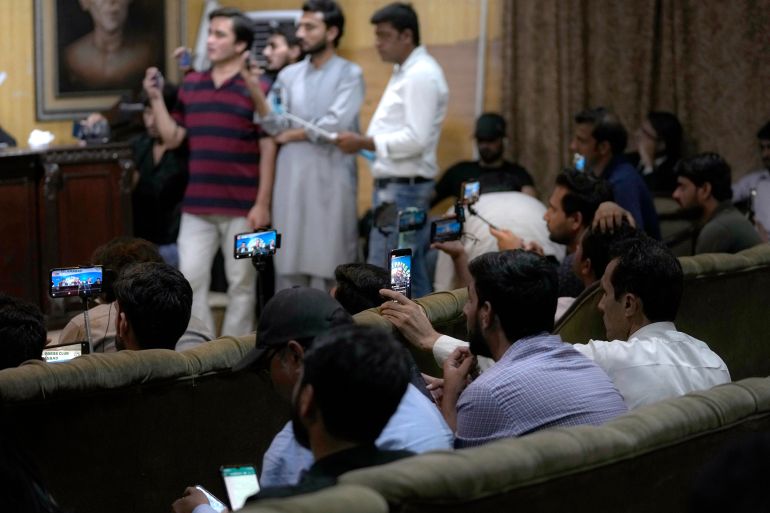
Journalists at a news conference with Shah Mahmood Qureshi, a top PTI leader [File: Anjum Naveed/AP]
Murtaza Solangi, Pakistan’s caretaker information minister, however, denied the claims. “We have NOT issued any orders like that,” he replied to Al Jazeera in a WhatsApp message.
The country’s media regulator, the Pakistan Electronic Media Regulatory Authority (PEMRA), has so far not issued an official statement or order that concerns restricting coverage of any party. It did not respond to queries by Al Jazeera on whether such instructions had been issued.
Inter Services Public Relations (ISPR), the military’s media wing, also did not respond to questions sent by Al Jazeera.
To be sure, accusations of censorship, pre-poll rigging and suppression of dissent are not new in the country. “This pattern of instructions coming down from the establishment has been going on for a long time,” said Mehmood. It used to be other parties that faced the brunt earlier. Now, it’s the PTI’s turn.
Indeed, when Khan was prime minister and the PTI was in power, it enjoyed good relations at the time with the “establishment” – a euphemism for the Pakistani military. International media watchdogs such as Reporters Without Borders had then issued reports, condemning harassment and intimidation of journalists.
Now, in addition to the intimidation and harassment faced by Khan and his party leadership, media personnel identified as PTI-leaning have been targeted too.
Multiple journalists have been picked up by state authorities, often without explanation, and kept in detention for days and even months. Many others have faced charges of sedition.
All the journalists Al Jazeera spoke to pointed to the events of May 9 last year as a turning point – a moment after which Pakistani authorities have engaged in unprecedented levels of media monitoring and censorship, they said.
On that day, thousands of PTI and Khan supporters came out on the streets to protest their leader’s arrest in a corruption case. While Khan was released after a brief detention, the rioters torched government buildings and military installations, resulting in a massive crackdown against the party and its supporters.
Days after the events of May 9, media watchdog PEMRA issued a circular, enforcing a ban on coverage of those involved in the riots, and later it was reported that a ban had been imposed on using Khan’s name or his image in broadcast coverage.
An Islamabad-based journalist, who is the website editor of a news channel, explained that after May 9, there were clear directions that anything regarding Khan or his party that went on air or online required clearance from top management.
“We understand that PTI and Imran Khan are right now entities which are out of favour, so we work accordingly. For example, we try to avoid using Khan’s photo as much as possible but if it is necessary, we try to use one in which he appears worried, or distressed, kind of building a particular perception about him,” he told Al Jazeera.
What makes the situation even more complicated, says another journalist with nearly 15 years of experience in print and digital journalism, is the lack of clarity and the “arbitrary” manner of censorship.
“Prior to the 2018 polls, there was some clarity on what we could say and could not. Now, sometimes Imran Khan and news related to him are mentioned on TV, or instructions are to use his name only in the text of the story but not in the headline. It appears that this confusion is done deliberately,” the journalist told Al Jazeera.
Another example she cited was the usage of the term “establishment” for the Pakistani military.
“Last year, we were instructed to not directly the use term establishment on TV or in news reports, but use some other alternatives, even when everybody knows who we are talking about. We stopped for a while, but our channel is again using the term, without any consequences,” she added.
Referring to a number of incidents in the past, Syed said journalists associated with news organisations used to be targeted in their individual capacity.
“While those individuals, who are primarily working in a personal capacity as social media journalists, still continue to get targeted such as Imran Riaz Khan, by and large, the intimidation and pressure is now exerted on media owners and the top tier of management,” he told Al Jazeera. Imran Riaz Khan, a popular TV anchor, was arrested last May while on his way to Oman, and only released four months later.
An Islamabad-based television journalist said in his previous role at another TV channel, he would get direct calls from the military’s media wing but that has completely stopped now.
“ISPR officials would call us to give directions about news agenda and editorial control, which at that time used to be in favour of the PTI. However, now this does not happen anymore. Whatever new instruction or policy decision there is, it only comes from management,” the journalist told Al Jazeera.
On more than six occasions in the last one year, different social media apps such as Facebook, YouTube, Instagram, TikTok and X have faced restrictions, with three instances in just the last one month. All three instances coincided with online events organised by the PTI.
On January 22, government officials indicated that they cannot guarantee unrestricted access to the internet before and on election day.
Solangi, the interim information minister, said during a news conference that the recent issue of internet access was caused due to “technical reasons” and there was no way he could issue a “guarantee” that this would not happen in future.
Ahmed Shamim Pirzada, director-general of the Pakistan Telecommunication Authority, the telecom regulator, also said in the same presser, that existing systems were being “upgraded” without providing details.
“Our system is being upgraded, and these [internet accessibility] problems could continue for two, three months,” he added.
Ramsha Jahangir, a policy and communications expert at the Global Network Initiative (GNI), an organisation focused on freedom of expression and privacy in technology, said such incidents and comments are only proof of “a longstanding pattern of censorship” in Pakistan.
“In the context of elections, internet shutdowns specifically prevent individuals from exercising free expression about the elections, undermine the watchdog role of journalists and media, and obstruct the efforts of those documenting elections, which limits information integrity,” Jahangir told Al Jazeera.
These concerns were also expressed by journalists, who say that if internet access is restricted on polling day, it could gravely impact their coverage.
An Islamabad-based journalist, member of the election cell of a newly launched TV channel, says the recent news conference by the interim information minister left him and his colleagues worried about performing their duties.
“These kinds of things add extra pressure to a day which is already stressful. Imagine, if there are internet restrictions, how will we be able to coordinate with our correspondent out in the field? ” the journalist told Al Jazeera. “How can we prepare for those situations?”
“While some large media organisations have DSNGs [Digital Satellite News Gathering units] in 10-12 cities, the rest of us rely heavily on WhatsApp and other social media apps to collect information. If the internet ends up being restricted, are we going to rely on only those few cities to give election results of a country as big as Pakistan?” he asked. DSNGs allow television crews to remote and broadcast live from the spot.
Jahangir of GNI agreed, saying any restriction on internet access could lead to further erosion of trust and the fairness of the elections.
“This brazen disregard of democratic principles sends a chilling signal that Pakistan is becoming an inhospitable ground for both freedom of expression and business,” she added.
A journalist recalls that in December last year, he had commissioned a segment where people in different areas of the city were asked to share which party would they vote for in the polls.
“The constituency where the vox pop was done, was a stronghold of Pakistan Muslim League-Nawaz (PMLN) and over 60 percent of respondents said they will vote for them, with other 40 percent naming PTI. Despite that, we were instructed by the management to drop it,” he said.
The PMLN is the party of former Prime Minister Nawaz Sharif, who returned recently from years in exile, and has seen multiple corruption cases against him dropped by courts, sparking speculation that he is the military’s favoured candidate in the coming elections.
The Islamabad-based journalist said he fears the closer Pakistan gets to election day, the harsher these restrictions will get to sideline the PTI and promote the PMLN and Sharif.
“What I personally feel is that these orders to promote PMLN will increase while PTI and its candidates, even though they are independent, will be pushed aside,” he said.
Mehmood, the senior official of the Lahore-based channel, says there was while there was “undoubted” manipulation in the run-up to the polls in 2018 too, things are far worse this time, and there’s barely even a whiff of “fair competition”.
“Back in 2018, we were never asked to black out any party. Even though Nawaz Sharif was sentenced and there were restrictions on him, his party, their candidates were all able to campaign. This time, there is no PTI or their symbol on a ballot,” Mehmood said.
“The coverage is completely lopsided now. There is no level playing field. The latest instruction to remove the candidate’s party affiliation or PTI flag means the idea is complete erasure, so people don’t know who the PTI candidate is.”
*Name changed due to concerns over potential retribution.
A journalist poses with a cell phone displaying a speech by Imran Khan [File: Akhtar Soomro/Reuters]
Islamabad, Pakistan – Journalist Amir Mehmood* was getting ready for work when his phone buzzed with a WhatsApp message.
As a member of the top management at a private news channel in Pakistan’s second-largest city, Lahore, Mehmood was used to getting non-stop calls and messages, even at odd hours.
But the name of the sender of that message on Tuesday morning caught his attention and he immediately picked up his phone. It was an official who belonged to the country’s powerful military, which has directly ruled over Pakistan for more than three decades of its 75-year existence as a constitutional republic and has controlled most levers of power, from behind the scenes, even when civilian governments have been in office.
“Basically, the person pointed out some of our election coverage and said we must not use the flags of PTI or mention their affiliation with candidates backed by the party. It instructed us to clearly identify the candidates only as ‘independent’ and not show which party they were related to,” Mehmood told Al Jazeera.
Mehmood is among multiple journalists working in newsrooms of different TV news channels and web outlets, who have told Al Jazeera of instructions they have received effectively imposing near-blanket censorship on coverage of the Pakistan Tehreek-e-Insaf (PTI) party ahead of the nation’s February 8 elections.
PTI, founded by former Prime Minister Imran Khan, is widely seen as possibly the country’s most popular political party. But Khan, a cricketing icon, has been imprisoned since August 2023 as he awaits trials over charges of corruption and leaking of state secrets – allegations he dismisses as being politically motivated.
Since he lost a confidence vote in parliament in April 2022 and was forced out of power, Khan and his PTI have faced a crackdown. Tens of thousands of the PTI’s members were arrested and hundreds of leaders have quit the party – many under alleged pressure by the military.
The nomination papers of Khan and dozens of his party leaders for the February 8 elections were rejected by the Election Commission of Pakistan. Recently, the Supreme Court upheld the poll commission’s decision to strip the PTI of its election symbol – a cricket bat – forcing many of the party’s candidates to contest the vote as independents.
Pakistani media was already barred from reporting Khan’s speeches or rallies on TV. But now, the restrictions on coverage of the PTI appear to have become even more expansive.
No flag, no reference
As soon as Mehmood received the WhatsApp message, he shared it with his boss. After a brief discussion, the two issued a channel-wide notice to remove PTI references from all visuals, graphics and talking points, and identify its candidates solely as independents, with no mention of the party they represent.Of the seven journalists Al Jazeera spoke to, six insisted on anonymity for fear of reprisals from their organisations. Three of them, including Mehmood, confirmed receiving instructions on Tuesday to not run PTI flags or show party affiliations with their candidates.
A Lahore-based executive producer at one of the top news channels also confirmed receiving instructions from his management, which said that candidates endorsed by the PTI must not be identified as such.
“We are told to not even display the PTI party flag with their name, and to emphasise that they are only independent candidate,” he told Al Jazeera.
Journalists at a news conference with Shah Mahmood Qureshi, a top PTI leader [File: Anjum Naveed/AP]
Murtaza Solangi, Pakistan’s caretaker information minister, however, denied the claims. “We have NOT issued any orders like that,” he replied to Al Jazeera in a WhatsApp message.
The country’s media regulator, the Pakistan Electronic Media Regulatory Authority (PEMRA), has so far not issued an official statement or order that concerns restricting coverage of any party. It did not respond to queries by Al Jazeera on whether such instructions had been issued.
Inter Services Public Relations (ISPR), the military’s media wing, also did not respond to questions sent by Al Jazeera.
Undeniable intimidation
It isn’t just journalists who are alleging censorship. The Human Rights Watch in its latest report said the Pakistani government has increased pressure on media outlets and individuals.To be sure, accusations of censorship, pre-poll rigging and suppression of dissent are not new in the country. “This pattern of instructions coming down from the establishment has been going on for a long time,” said Mehmood. It used to be other parties that faced the brunt earlier. Now, it’s the PTI’s turn.
Indeed, when Khan was prime minister and the PTI was in power, it enjoyed good relations at the time with the “establishment” – a euphemism for the Pakistani military. International media watchdogs such as Reporters Without Borders had then issued reports, condemning harassment and intimidation of journalists.
Now, in addition to the intimidation and harassment faced by Khan and his party leadership, media personnel identified as PTI-leaning have been targeted too.
Multiple journalists have been picked up by state authorities, often without explanation, and kept in detention for days and even months. Many others have faced charges of sedition.
All the journalists Al Jazeera spoke to pointed to the events of May 9 last year as a turning point – a moment after which Pakistani authorities have engaged in unprecedented levels of media monitoring and censorship, they said.
On that day, thousands of PTI and Khan supporters came out on the streets to protest their leader’s arrest in a corruption case. While Khan was released after a brief detention, the rioters torched government buildings and military installations, resulting in a massive crackdown against the party and its supporters.
Days after the events of May 9, media watchdog PEMRA issued a circular, enforcing a ban on coverage of those involved in the riots, and later it was reported that a ban had been imposed on using Khan’s name or his image in broadcast coverage.
An Islamabad-based journalist, who is the website editor of a news channel, explained that after May 9, there were clear directions that anything regarding Khan or his party that went on air or online required clearance from top management.
“We understand that PTI and Imran Khan are right now entities which are out of favour, so we work accordingly. For example, we try to avoid using Khan’s photo as much as possible but if it is necessary, we try to use one in which he appears worried, or distressed, kind of building a particular perception about him,” he told Al Jazeera.
What makes the situation even more complicated, says another journalist with nearly 15 years of experience in print and digital journalism, is the lack of clarity and the “arbitrary” manner of censorship.
“Prior to the 2018 polls, there was some clarity on what we could say and could not. Now, sometimes Imran Khan and news related to him are mentioned on TV, or instructions are to use his name only in the text of the story but not in the headline. It appears that this confusion is done deliberately,” the journalist told Al Jazeera.
Another example she cited was the usage of the term “establishment” for the Pakistani military.
“Last year, we were instructed to not directly the use term establishment on TV or in news reports, but use some other alternatives, even when everybody knows who we are talking about. We stopped for a while, but our channel is again using the term, without any consequences,” she added.
Changed tactics
Azaz Syed, a veteran journalist who works for the country’s largest media outlet Geo, said while attacks on the media and efforts to censor the press have been a reality of Pakistani journalism for decades, the tactics have now evolved.Referring to a number of incidents in the past, Syed said journalists associated with news organisations used to be targeted in their individual capacity.
“While those individuals, who are primarily working in a personal capacity as social media journalists, still continue to get targeted such as Imran Riaz Khan, by and large, the intimidation and pressure is now exerted on media owners and the top tier of management,” he told Al Jazeera. Imran Riaz Khan, a popular TV anchor, was arrested last May while on his way to Oman, and only released four months later.
An Islamabad-based television journalist said in his previous role at another TV channel, he would get direct calls from the military’s media wing but that has completely stopped now.
“ISPR officials would call us to give directions about news agenda and editorial control, which at that time used to be in favour of the PTI. However, now this does not happen anymore. Whatever new instruction or policy decision there is, it only comes from management,” the journalist told Al Jazeera.
Erosion of trust
While the mainstream media faces the brunt of diktats on what to air and what to avoid, the tentacles of censorship have further spread on the internet and social media, considered the strength of PTI and its typically younger supporters.On more than six occasions in the last one year, different social media apps such as Facebook, YouTube, Instagram, TikTok and X have faced restrictions, with three instances in just the last one month. All three instances coincided with online events organised by the PTI.
On January 22, government officials indicated that they cannot guarantee unrestricted access to the internet before and on election day.
Solangi, the interim information minister, said during a news conference that the recent issue of internet access was caused due to “technical reasons” and there was no way he could issue a “guarantee” that this would not happen in future.
Ahmed Shamim Pirzada, director-general of the Pakistan Telecommunication Authority, the telecom regulator, also said in the same presser, that existing systems were being “upgraded” without providing details.
“Our system is being upgraded, and these [internet accessibility] problems could continue for two, three months,” he added.
Ramsha Jahangir, a policy and communications expert at the Global Network Initiative (GNI), an organisation focused on freedom of expression and privacy in technology, said such incidents and comments are only proof of “a longstanding pattern of censorship” in Pakistan.
“In the context of elections, internet shutdowns specifically prevent individuals from exercising free expression about the elections, undermine the watchdog role of journalists and media, and obstruct the efforts of those documenting elections, which limits information integrity,” Jahangir told Al Jazeera.
These concerns were also expressed by journalists, who say that if internet access is restricted on polling day, it could gravely impact their coverage.
An Islamabad-based journalist, member of the election cell of a newly launched TV channel, says the recent news conference by the interim information minister left him and his colleagues worried about performing their duties.
“These kinds of things add extra pressure to a day which is already stressful. Imagine, if there are internet restrictions, how will we be able to coordinate with our correspondent out in the field? ” the journalist told Al Jazeera. “How can we prepare for those situations?”
“While some large media organisations have DSNGs [Digital Satellite News Gathering units] in 10-12 cities, the rest of us rely heavily on WhatsApp and other social media apps to collect information. If the internet ends up being restricted, are we going to rely on only those few cities to give election results of a country as big as Pakistan?” he asked. DSNGs allow television crews to remote and broadcast live from the spot.
Jahangir of GNI agreed, saying any restriction on internet access could lead to further erosion of trust and the fairness of the elections.
“This brazen disregard of democratic principles sends a chilling signal that Pakistan is becoming an inhospitable ground for both freedom of expression and business,” she added.
Lopsided coverage
The targeting of Khan and the PTI, and the blackout of their political messaging, has led to electoral coverage that is bereft of the almost festive feel of previous campaigns in the run-up to the elections.A journalist recalls that in December last year, he had commissioned a segment where people in different areas of the city were asked to share which party would they vote for in the polls.
“The constituency where the vox pop was done, was a stronghold of Pakistan Muslim League-Nawaz (PMLN) and over 60 percent of respondents said they will vote for them, with other 40 percent naming PTI. Despite that, we were instructed by the management to drop it,” he said.
The PMLN is the party of former Prime Minister Nawaz Sharif, who returned recently from years in exile, and has seen multiple corruption cases against him dropped by courts, sparking speculation that he is the military’s favoured candidate in the coming elections.
The Islamabad-based journalist said he fears the closer Pakistan gets to election day, the harsher these restrictions will get to sideline the PTI and promote the PMLN and Sharif.
“What I personally feel is that these orders to promote PMLN will increase while PTI and its candidates, even though they are independent, will be pushed aside,” he said.
Mehmood, the senior official of the Lahore-based channel, says there was while there was “undoubted” manipulation in the run-up to the polls in 2018 too, things are far worse this time, and there’s barely even a whiff of “fair competition”.
“Back in 2018, we were never asked to black out any party. Even though Nawaz Sharif was sentenced and there were restrictions on him, his party, their candidates were all able to campaign. This time, there is no PTI or their symbol on a ballot,” Mehmood said.
“The coverage is completely lopsided now. There is no level playing field. The latest instruction to remove the candidate’s party affiliation or PTI flag means the idea is complete erasure, so people don’t know who the PTI candidate is.”
*Name changed due to concerns over potential retribution.
Last edited by a moderator:


VCheng
THINK TANK: CONSULTANT
Fixed. Please use the report function for such issues. Those are very helpful.
M
Mr X
Guest
Nawaz Sharif is the future Prime Minister of our beloved Army
Imran Khan is the future Prime Minister of youth and a lot common citizens
Bilawal is the future Prime Minister of Waderas and opportunists who will switch sides in the parliament if the numbers can be raised to make him the P
We may finally see his release after the General Elections as he under prison for the crimes he did not commit for too long. But the miracle will happens if we had fair elections in 2024. Everybody knows it’s just a rehearsal, already staged and preprogrammed.
Imran Khan is the future Prime Minister of youth and a lot common citizens
Bilawal is the future Prime Minister of Waderas and opportunists who will switch sides in the parliament if the numbers can be raised to make him the P
We may finally see his release after the General Elections as he under prison for the crimes he did not commit for too long. But the miracle will happens if we had fair elections in 2024. Everybody knows it’s just a rehearsal, already staged and preprogrammed.

Fatman17
THINK TANK: CONSULTANT

Don’t cover Imran Khan’s PTI: Pakistan’s media told to censor popular ex-PM
Several journalists say they have been asked to impose near-blanket ban on party’s coverage ahead of February 8 polls.
Fatman17
THINK TANK: CONSULTANT
Cowardly actions. Hope the world recognises this censorship.Several journalists say they have been asked to impose near-blanket ban on the political party’s coverage ahead of February 8 elections.
A journalist poses with a cell phone displaying a speech by Imran Khan [File: Akhtar Soomro/Reuters]
Islamabad, Pakistan – Journalist Amir Mehmood* was getting ready for work when his phone buzzed with a WhatsApp message.
As a member of the top management at a private news channel in Pakistan’s second-largest city, Lahore, Mehmood was used to getting non-stop calls and messages, even at odd hours.
But the name of the sender of that message on Tuesday morning caught his attention and he immediately picked up his phone. It was an official who belonged to the country’s powerful military, which has directly ruled over Pakistan for more than three decades of its 75-year existence as a constitutional republic and has controlled most levers of power, from behind the scenes, even when civilian governments have been in office.
“Basically, the person pointed out some of our election coverage and said we must not use the flags of PTI or mention their affiliation with candidates backed by the party. It instructed us to clearly identify the candidates only as ‘independent’ and not show which party they were related to,” Mehmood told Al Jazeera.
Mehmood is among multiple journalists working in newsrooms of different TV news channels and web outlets, who have told Al Jazeera of instructions they have received effectively imposing near-blanket censorship on coverage of the Pakistan Tehreek-e-Insaf (PTI) party ahead of the nation’s February 8 elections.
PTI, founded by former Prime Minister Imran Khan, is widely seen as possibly the country’s most popular political party. But Khan, a cricketing icon, has been imprisoned since August 2023 as he awaits trials over charges of corruption and leaking of state secrets – allegations he dismisses as being politically motivated.
Since he lost a confidence vote in parliament in April 2022 and was forced out of power, Khan and his PTI have faced a crackdown. Tens of thousands of the PTI’s members were arrested and hundreds of leaders have quit the party – many under alleged pressure by the military.
The nomination papers of Khan and dozens of his party leaders for the February 8 elections were rejected by the Election Commission of Pakistan. Recently, the Supreme Court upheld the poll commission’s decision to strip the PTI of its election symbol – a cricket bat – forcing many of the party’s candidates to contest the vote as independents.
Pakistani media was already barred from reporting Khan’s speeches or rallies on TV. But now, the restrictions on coverage of the PTI appear to have become even more expansive.
No flag, no reference
As soon as Mehmood received the WhatsApp message, he shared it with his boss. After a brief discussion, the two issued a channel-wide notice to remove PTI references from all visuals, graphics and talking points, and identify its candidates solely as independents, with no mention of the party they represent.
Of the seven journalists Al Jazeera spoke to, six insisted on anonymity for fear of reprisals from their organisations. Three of them, including Mehmood, confirmed receiving instructions on Tuesday to not run PTI flags or show party affiliations with their candidates.
A Lahore-based executive producer at one of the top news channels also confirmed receiving instructions from his management, which said that candidates endorsed by the PTI must not be identified as such.
“We are told to not even display the PTI party flag with their name, and to emphasise that they are only independent candidate,” he told Al Jazeera.
Journalists at a news conference with Shah Mahmood Qureshi, a top PTI leader [File: Anjum Naveed/AP]
Murtaza Solangi, Pakistan’s caretaker information minister, however, denied the claims. “We have NOT issued any orders like that,” he replied to Al Jazeera in a WhatsApp message.
The country’s media regulator, the Pakistan Electronic Media Regulatory Authority (PEMRA), has so far not issued an official statement or order that concerns restricting coverage of any party. It did not respond to queries by Al Jazeera on whether such instructions had been issued.
Inter Services Public Relations (ISPR), the military’s media wing, also did not respond to questions sent by Al Jazeera.
Undeniable intimidation
It isn’t just journalists who are alleging censorship. The Human Rights Watch in its latest report said the Pakistani government has increased pressure on media outlets and individuals.
To be sure, accusations of censorship, pre-poll rigging and suppression of dissent are not new in the country. “This pattern of instructions coming down from the establishment has been going on for a long time,” said Mehmood. It used to be other parties that faced the brunt earlier. Now, it’s the PTI’s turn.
Indeed, when Khan was prime minister and the PTI was in power, it enjoyed good relations at the time with the “establishment” – a euphemism for the Pakistani military. International media watchdogs such as Reporters Without Borders had then issued reports, condemning harassment and intimidation of journalists.
Now, in addition to the intimidation and harassment faced by Khan and his party leadership, media personnel identified as PTI-leaning have been targeted too.
Multiple journalists have been picked up by state authorities, often without explanation, and kept in detention for days and even months. Many others have faced charges of sedition.
All the journalists Al Jazeera spoke to pointed to the events of May 9 last year as a turning point – a moment after which Pakistani authorities have engaged in unprecedented levels of media monitoring and censorship, they said.
On that day, thousands of PTI and Khan supporters came out on the streets to protest their leader’s arrest in a corruption case. While Khan was released after a brief detention, the rioters torched government buildings and military installations, resulting in a massive crackdown against the party and its supporters.
Days after the events of May 9, media watchdog PEMRA issued a circular, enforcing a ban on coverage of those involved in the riots, and later it was reported that a ban had been imposed on using Khan’s name or his image in broadcast coverage.
An Islamabad-based journalist, who is the website editor of a news channel, explained that after May 9, there were clear directions that anything regarding Khan or his party that went on air or online required clearance from top management.
“We understand that PTI and Imran Khan are right now entities which are out of favour, so we work accordingly. For example, we try to avoid using Khan’s photo as much as possible but if it is necessary, we try to use one in which he appears worried, or distressed, kind of building a particular perception about him,” he told Al Jazeera.
What makes the situation even more complicated, says another journalist with nearly 15 years of experience in print and digital journalism, is the lack of clarity and the “arbitrary” manner of censorship.
“Prior to the 2018 polls, there was some clarity on what we could say and could not. Now, sometimes Imran Khan and news related to him are mentioned on TV, or instructions are to use his name only in the text of the story but not in the headline. It appears that this confusion is done deliberately,” the journalist told Al Jazeera.
Another example she cited was the usage of the term “establishment” for the Pakistani military.
“Last year, we were instructed to not directly the use term establishment on TV or in news reports, but use some other alternatives, even when everybody knows who we are talking about. We stopped for a while, but our channel is again using the term, without any consequences,” she added.
Changed tactics
Azaz Syed, a veteran journalist who works for the country’s largest media outlet Geo, said while attacks on the media and efforts to censor the press have been a reality of Pakistani journalism for decades, the tactics have now evolved.
Referring to a number of incidents in the past, Syed said journalists associated with news organisations used to be targeted in their individual capacity.
“While those individuals, who are primarily working in a personal capacity as social media journalists, still continue to get targeted such as Imran Riaz Khan, by and large, the intimidation and pressure is now exerted on media owners and the top tier of management,” he told Al Jazeera. Imran Riaz Khan, a popular TV anchor, was arrested last May while on his way to Oman, and only released four months later.
An Islamabad-based television journalist said in his previous role at another TV channel, he would get direct calls from the military’s media wing but that has completely stopped now.
“ISPR officials would call us to give directions about news agenda and editorial control, which at that time used to be in favour of the PTI. However, now this does not happen anymore. Whatever new instruction or policy decision there is, it only comes from management,” the journalist told Al Jazeera.
Erosion of trust
While the mainstream media faces the brunt of diktats on what to air and what to avoid, the tentacles of censorship have further spread on the internet and social media, considered the strength of PTI and its typically younger supporters.
On more than six occasions in the last one year, different social media apps such as Facebook, YouTube, Instagram, TikTok and X have faced restrictions, with three instances in just the last one month. All three instances coincided with online events organised by the PTI.
On January 22, government officials indicated that they cannot guarantee unrestricted access to the internet before and on election day.
Solangi, the interim information minister, said during a news conference that the recent issue of internet access was caused due to “technical reasons” and there was no way he could issue a “guarantee” that this would not happen in future.
Ahmed Shamim Pirzada, director-general of the Pakistan Telecommunication Authority, the telecom regulator, also said in the same presser, that existing systems were being “upgraded” without providing details.
“Our system is being upgraded, and these [internet accessibility] problems could continue for two, three months,” he added.
Ramsha Jahangir, a policy and communications expert at the Global Network Initiative (GNI), an organisation focused on freedom of expression and privacy in technology, said such incidents and comments are only proof of “a longstanding pattern of censorship” in Pakistan.
“In the context of elections, internet shutdowns specifically prevent individuals from exercising free expression about the elections, undermine the watchdog role of journalists and media, and obstruct the efforts of those documenting elections, which limits information integrity,” Jahangir told Al Jazeera.
These concerns were also expressed by journalists, who say that if internet access is restricted on polling day, it could gravely impact their coverage.
An Islamabad-based journalist, member of the election cell of a newly launched TV channel, says the recent news conference by the interim information minister left him and his colleagues worried about performing their duties.
“These kinds of things add extra pressure to a day which is already stressful. Imagine, if there are internet restrictions, how will we be able to coordinate with our correspondent out in the field? ” the journalist told Al Jazeera. “How can we prepare for those situations?”
“While some large media organisations have DSNGs [Digital Satellite News Gathering units] in 10-12 cities, the rest of us rely heavily on WhatsApp and other social media apps to collect information. If the internet ends up being restricted, are we going to rely on only those few cities to give election results of a country as big as Pakistan?” he asked. DSNGs allow television crews to remote and broadcast live from the spot.
Jahangir of GNI agreed, saying any restriction on internet access could lead to further erosion of trust and the fairness of the elections.
“This brazen disregard of democratic principles sends a chilling signal that Pakistan is becoming an inhospitable ground for both freedom of expression and business,” she added.
Lopsided coverage
The targeting of Khan and the PTI, and the blackout of their political messaging, has led to electoral coverage that is bereft of the almost festive feel of previous campaigns in the run-up to the elections.
A journalist recalls that in December last year, he had commissioned a segment where people in different areas of the city were asked to share which party would they vote for in the polls.
“The constituency where the vox pop was done, was a stronghold of Pakistan Muslim League-Nawaz (PMLN) and over 60 percent of respondents said they will vote for them, with other 40 percent naming PTI. Despite that, we were instructed by the management to drop it,” he said.
The PMLN is the party of former Prime Minister Nawaz Sharif, who returned recently from years in exile, and has seen multiple corruption cases against him dropped by courts, sparking speculation that he is the military’s favoured candidate in the coming elections.
The Islamabad-based journalist said he fears the closer Pakistan gets to election day, the harsher these restrictions will get to sideline the PTI and promote the PMLN and Sharif.
“What I personally feel is that these orders to promote PMLN will increase while PTI and its candidates, even though they are independent, will be pushed aside,” he said.
Mehmood, the senior official of the Lahore-based channel, says there was while there was “undoubted” manipulation in the run-up to the polls in 2018 too, things are far worse this time, and there’s barely even a whiff of “fair competition”.
“Back in 2018, we were never asked to black out any party. Even though Nawaz Sharif was sentenced and there were restrictions on him, his party, their candidates were all able to campaign. This time, there is no PTI or their symbol on a ballot,” Mehmood said.
“The coverage is completely lopsided now. There is no level playing field. The latest instruction to remove the candidate’s party affiliation or PTI flag means the idea is complete erasure, so people don’t know who the PTI candidate is.”
*Name changed due to concerns over potential retribution.

graphican
Elite Member

Pakistan Army is acting as the enemy to the state and people of Pakistan. No institution is bigger than the state itself.
Officers of the Pakistan Army who violate the constitution should be prosecuted by the military courts, and if they won't then the people of Pakistan will.
If people have to choose between Pakistan Army and Pakistan - the choice is evident.
Officers of the Pakistan Army who violate the constitution should be prosecuted by the military courts, and if they won't then the people of Pakistan will.
If people have to choose between Pakistan Army and Pakistan - the choice is evident.

FuturePAF
THINK TANK: CONSULTANT
PTI could use the imposition of running as an independent around upon itself.
Vote for …. (He is running as an “Independent”), so you can be have true independence
; Hakeeki Azadi.
So the brave news channels and journalists can refer to these candidates as “An Independent”, without mentioning any affiliation, and the people should get the reference.
Vote for …. (He is running as an “Independent”), so you can be have true independence
; Hakeeki Azadi.
So the brave news channels and journalists can refer to these candidates as “An Independent”, without mentioning any affiliation, and the people should get the reference.
- Status
- Not open for further replies.
Users who are viewing this thread
Total: 31 (members: 0, guests: 31)
Pakistan Defence Latest


Country Watch Latest
-
Iran - Israel/US War: Israel-US declare war on Iran, Iran responds (158 Viewers)
- Latest: BananaRepublic
-

-
-
-

Latest Posts
-
Iran - Israel/US War: Israel-US declare war on Iran, Iran responds (158 Viewers)
- Latest: BananaRepublic
-
-

-
-
 Makkah Defence Alliance: Turkey, Saudi Arabia, and Pakistan, news & updates (42 Viewers)
- Latest: El Sidd