PTI News, Updates and Discussion

Do you think PTI has a future without Imran Khan?

  • Yes

    Votes: 22 19.6%
  • No

    Votes: 80 71.4%
  • Only if senior leadership is released

    Votes: 10 8.9%

  • Total voters
    112
Status
Not open for further replies.
To view this content we will need your consent to set third party cookies.
For more detailed information, see our cookies page.
 
37 years ago this day General Zia died in a plant crash. He was a brutal dictator who ruled for 11 years. No one cares to remember him anymore. A lesson for those who rule now
 

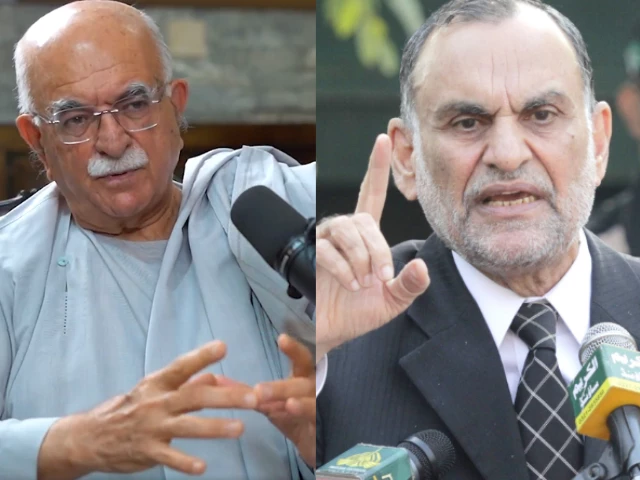
Imran picks Achakzai as NA opposition leader, Swati for Senate role​


Move follows disqualification of Omar Ayub, Shibli Faraz after conviction in May 9 cases

Web Desk
August 20, 2025


pashtunkhwa milli awami party chief mahmood khan achakzai and and pakistan tehreek e insaf senator azam swati photo screeengrab


Pashtunkhwa Milli Awami Party chief Mahmood Khan Achakzai and and Pakistan Tehreek-e-Insaf Senator Azam Swati. Photo: SCREEENGRAB

Pakistan Tehreek-e-Insaf (PTI) founder Imran Khan has nominated Pashtunkhwa Milli Awami Party chief (PKMAP) Mahmood Khan Achakzai as Leader of the Opposition in the National Assembly and Senator Azam Swati has been nominated as Leader of the Opposition in Senate, PTI Secretary General Salman Akram Raja revealed on Wednesday.
 
To view this content we will need your consent to set third party cookies.
For more detailed information, see our cookies page.
 
They are torturing Imran Khan to death
To view this content we will need your consent to set third party cookies.
For more detailed information, see our cookies page.
 
The Beautiful Path of Forgiveness

By: Ayaz Amir
Roznama Dunya
Publication Date: 20 August 2025

Forgiveness and compromise were also options for Tipu Sultan. Fighting the British was nearly impossible. By then, the British were no longer just another Indian power—they had become a global force. In terms of strength and resources, Tipu had no comparison with them. Yet, he never learned submission from his illustrious father, Haider Ali. Therefore, in the name of reconciliation or pragmatism, he refused to bow to the British and chose martyrdom instead. There were countless kings and princes in India, but even today, it is only Tipu Sultan’s tomb that draws people in reverence.

Reconciliation and pragmatism are beautiful words. In their place, they represent wisdom and foresight. But in many contexts, they become synonymous with cowardice. In 1958, Khan Abdul Qayyum Khan, head of the Muslim League at that time, was considered a great leader. Pakistan’s first general elections were scheduled for February 1959, and it was widely believed that Khan Qayyum and the Muslim League would triumph. But martial law was imposed, and Khan Qayyum was arrested. The harsh conditions of prison proved unbearable for him, and from his cell, he wrote a long letter to General Ayub Khan, detailing his illnesses and poor health, and pleading for release. His request was granted, but his stature as a leader vanished forever with that letter.

In 1977, Rafiq Bajwa was the General Secretary of the Pakistan National Alliance (PNA), well-known for his role in the anti-Bhutto movement. His fortune collapsed when he secretly met with Zulfiqar Ali Bhutto and the news leaked. He was removed from his post and slipped into such obscurity that no one could even recall what became of him.

During India’s freedom struggle, countless Congress leaders endured imprisonment. Jawaharlal Nehru and Maulana Abul Kalam Azad spent years behind bars. Some of Nehru’s most famous books in English were written from prison. They could have compromised with the British, but had they done so, they would no longer be remembered as leaders. Nelson Mandela’s example need hardly be mentioned here—his story does not fit our politics. He was of another world entirely. But it is worth remembering that he spent 25–26 years in the harsh prisons of Robben Island. He lost his youth and the prime of his life, yet he remained steadfast—and was immortalized in world history.

Bhutto, too, could have begged for mercy, but then he would not have remained Bhutto. He endured unimaginable hardships in prison. Towards the end, he grew frail—surviving only on coffee, cigars, and books. When Rawalpindi Jail Superintendent Yar Muhammad Daryanah informed him of his black warrant, Bhutto was shocked for a moment, then quickly composed himself and said, “My beard has grown. Bring shaving items. I do not wish to die looking like a cleric.” To say such a thing with death looming requires immense courage. Assistant Superintendent Majeed Qureshi, who was tasked with escorting him to the gallows, recalled that when he entered Bhutto’s cell around 1:30 am, Bhutto was in deep sleep and had to be shaken awake. Imagine—the gallows waiting for you, yet you still fall asleep. What nerves of steel that man possessed.

Those who advise forgiveness or compromise may be sincere, but they forget that in societies like ours, matters never end with forgiveness. If one bends even slightly, the oppressor is not satisfied until the victim is utterly humiliated. Forget the grand halls of power—even in police stations, if you beg a Station House Officer for mercy, your ordeal will not end until you are fully disgraced. What we call “fate” is nothing more than a person’s character and temperament. Character is destiny. Life presents moments where a person must stand firm. A weak man cannot do this, and that weakness becomes his destiny. Bhutto could never have sought forgiveness from General Zia, because to bow in such a manner was against his very nature. He was “Akad Khan”—a man of defiance—and remained one till the very end.

Could Nawab Akbar Bugti have reconciled with General Musharraf? If he had bent a little, his life might have been spared. Why, in old age, did he need to ride camels into the mountains wearing a cowboy hat? He could have lived out his last years in comfort as a Nawab. There are no shortage of Baloch sardars who are masters of compromise and flattery. But Akbar Bugti was a man of principles—unyielding. If he had been more “pragmatic,” perhaps he would have lived longer.

Today, there is no shortage of those eager to advise Imran Khan. Indeed, a whole industry now exists for the sole purpose of advising him to “forgive” or “compromise.” Their real demand is that he bow down a little, adopt a pleading look, and then, perhaps, life will become easier for him. But first, they must answer this: does the “prisoner” (Imran Khan) even possess the temperament to bend? If such an element is entirely absent from a man’s nature, how can anyone expect him to adopt it? And even if he somehow agrees to bend, will it end there?

When Bayezid surrendered to Tamerlane, he was locked in a cage to be displayed before the world. When Hulagu Khan descended upon Baghdad, the humiliation of the defeated Caliph Al-Musta’sim was not enough to satisfy him. The last Abbasid Caliph was rolled in a carpet and trampled to death by Mongol horses. In our environment, compromise is nothing less than inviting eternal disgrace. Ordinary people suffer ordinary tragedies; historical figures, however, suffer historical tragedies.

There is no denying that Imran Khan has made mistakes. Great men make great mistakes. Bhutto made many mistakes too, and he paid the price. But societies like ours have no standard of justice. The scales of accountability are always tilted. The greatest “crime” in Pakistan has always been to be a popular leader. When the people embrace someone, the rotten pillars of power feel threatened. The greater the popularity, the greater the fear. For such leaders, there is no margin for error.

When Ayub Khan retired, he was no longer a threat to anyone. Once Yahya Khan was ousted, he became harmless. Bhutto was different—he remained a danger to those in power, and therefore, in 1977–79, he could not be forgiven. The rest, intelligent readers can conclude for themselves.
 

SC accepts Imran’s bail pleas in eight May 9 cases


Umer Mehtab
August 21, 2025

The Supreme Court on Thursday accepted the bail pleas of former prime minister Imran Khan in eight cases related to the May 9, 2023 riots.

In November 2024, a Lahore anti-terrorism court had denied Imran bail in the cases related to the May 9, 2023 riots, including an attack on the house of the Lahore corps commander.

The incarcerated PTI leader’s plea challenging that was also rejected by the Lahore High Court (LHC) on June 24. Subsequently, days later, Imran had challenged that dismissal before the apex court.

A three-member bench led by Chief Justice of Pakistan (CJP) Yahya Afridi, which also comprised Justices Muhammad Shafi Siddiqui and Hasan Azhar Rizvi, resumed hearing the petitions today.

Barrister Salman Safdar appeared on behalf of the PTI founder, while Punjab Special Prosecutor Zulfiqar Naqvi represented the state.
 
Breaking News: Supreme Court has granted bail to Imran Khan for May 9th cases, now bail is needed for just one more case (Al Qadir case) for IK to come out of jail. Biggest news is that May 9th false flag operation is now proven … Allah Al Haq Hai!
 

May 9 riots: SC approves bail for Imran Khan in eight cases


Three-member bench headed by Chief Justice Yahya Afridi hears the case

BR Web Desk
August 21, 2025

1755787371692.png

The Supreme Court on Thursday approved bail for Pakistan Tehreek-e-Insaf (PTI) founding chairman Imran Khan in eight cases related to May 9 violent incidents, Aaj News reported.

Hearing the bail petition lodged by the PTI founder, a three-member bench headed by Chief Justice Yahya Afridi and comprising Justice Shafi Siddiqui and Justice Miangul Hassan Aurangzeb overturned the Lahore High Court (LHC) verdict against Imran in the cases linked to May 9 mayhem.

Meanwhile, CJ Afridi has called lawyers of the former prime minister and other party to the Special Prosecutor’s chamber at 1 PM for a detailed verdict.


The bench had on August 12 questioned whether the merit of the case could be touched by the LHC in Imran’s post-arrest bail plea.

On the other hand, a division bench comprising Justice Syed Shahbaz Ali Rizvi and Tariq Mahmood Bajwa had dismissed the incarcerated ex-premier’s bail petition last month, citing his alleged involvement in planning attacks on military installations in anticipation of his arrest on May 9, 2023.

Leaders of the embattled PTI have been facing multiple cases for their alleged involvement in the violent protests that erupted countrywide on May 9, 2023 following arrest of PTI founding chairman Imran Khan in a corruption case.

Imran, who has been in prison since 2023 facing charges of corruption, land fraud and disclosure of official secrets, is also being tried separately on similar charges related to the riots.

The government accused him and other PTI leaders of inciting the May 9, 2023, protests, during which demonstrators attacked military and government buildings, including the army headquarters in Rawalpindi and Jinnah House Lahore.

The former prime minister denies wrongdoing and says all the cases are politically motivated to dismantle his party.
 
The PTI termed the Supreme Court’s decision to grant bail to its founder a “ray of hope” and claimed that the order not only “exposed the fabricated narrative” but also stood as proof of Imran Khan’s innocence.

Speaking at a press conference on Thursday, flanked by PTI senior leaders Latif Khosa and Aamir Dogar, PTI Secretary General Salman Akram Raja said that the day marked a “moment of relief and joy for the nation”, as the courts had finally delivered justice after a prolonged wait. He pointed out that only one case — the Al-Qadir Trust corruption case — remained pending. He hoped it would also be decided in PTI’s favour, paving the way for Mr Khan’s release from detention.

Read more: https://www.dawn.com/news/1933255
 

Imran Khan gets bail in 8 cases related to attacks on military installations in May 2023

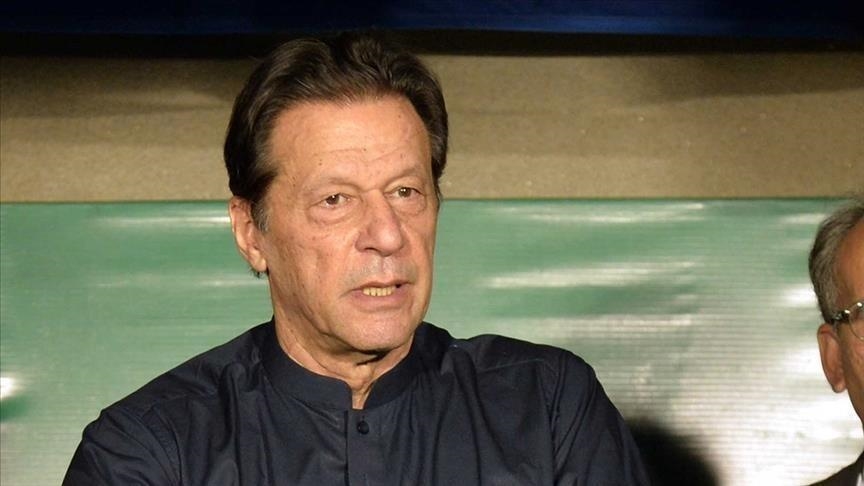
Aamir Latif |21.08.2025 - Update : 22.08.2025​
Pakistan's top court grants bail to jailed ex-Premier Imran Khan


  • Khan, however, to remain in jail as he has been convicted in a corruption case​
KARACHI, Pakistan

Pakistan's top court Thursday granted bail to the country's incarcerated former Prime Minister Imran Khan in multiple cases related to attacks on military installations in May 2023, a court record and his lawyer said.
A three-member bench of the Supreme Court headed by Chief Justice Yahya Afridi granted Khan's appeal against a Lahore High Court verdict, which rejected his bail application in eight cases related to the 2023 violence.
The court ordered 72-year-old Khan's release, if he is not wanted in any other case.
Khan, however, will remain in jail as he has been convicted in a corruption case.
The cricketer-turned-politician is facing a barrage of cases ranging from corruption to terrorism, which he dubs a "sham."
Several leaders and lawmakers from his Pakistan Tehreek-e-Insaf party, including opposition leaders in both houses of the parliament, have recently been convicted in similar cases.
Several military installations, including the army headquarters, commonly known as the General Headquarters, in the garrison city of Rawalpindi, were stormed by protesters after Khan was briefly arrested in a corruption case in May 2023.
 
Saw this on an FB post, tried to search online but only showing on indian news sites and one lonely post on Anadolu Ajansi.
 
Saw this on an FB post, tried to search online but only showing on indian news sites and one lonely post on Anadolu Ajansi.
That is the reason , now people follow social media. No one in Pakistan watch mainstream media ..
 
To view this content we will need your consent to set third party cookies.
For more detailed information, see our cookies page.
 
Status
Not open for further replies.

Users who are viewing this thread

Back
Top