Officials from a mission of five multilateral international lenders survey the Karachi Railway Division, as it will be connected to ML-1.—Courtesy Railways
• Phase-I covers 480km Karachi-Rohri railway section
• Online market engagement with contractors, consultants set for Sept 8
• Project expected to take up to three years to complete
LAHORE: Civil work on the $2.5 billion first phase of the Main Line-1 (ML-1) railway project is likely to begin in January 2027, as Pakistan Railways (PR) accelerates market consultations, pre-bid preparations and other processes required to meet the timeline set by Prime Minister Shehbaz Sharif.
PR has announced an online early market engagement session for Sept 8, inviting local and international civil works contractors as well as project design and monitoring consultants to discuss project readiness, procurement progress and strategy, developments since March and other matters related to the first phase.
“We are trying our level best to launch this project as early as possible. The prime minister wants its commencement by January next year by all means,” Railways Minister Hanif Abbasi told
Dawn on Saturday.
He said early market engagement, international tendering, bidding, shortlisting of contractors and consultants and award of contracts could take four to five months, but PR would make every effort to have the project launched by the prime minister in January.
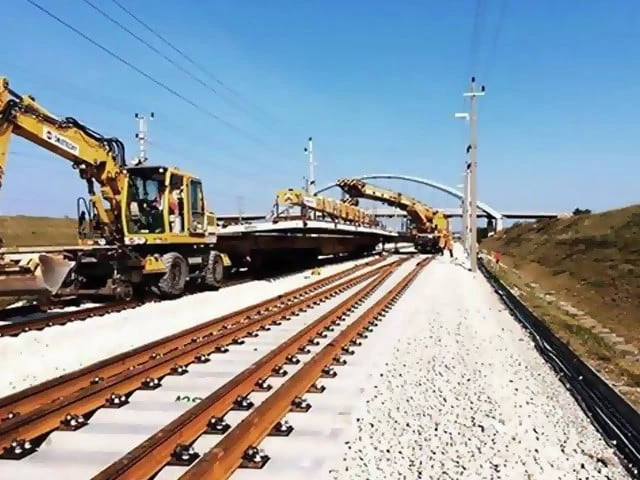
The first phase of ML-1 covers the 480km Karachi-Rohri/Sukkur section, where new up and down tracks will be laid along with fencing on both sides to prevent unauthorised access by people, animals and vehicles.
The project is expected to take between two-and-a-half and three years to complete and will serve a corridor carrying 76 per cent of passenger and 98pc of freight traffic, besides connecting major population centres and industrial zones.
The project is expected to be financed by the Asian Development Bank, while co-financing is being explored from AIIB, EIN, the World Bank and IsDB.
Its indicative scope includes civil and track works on the Keamari-Landhi-Hyderabad, Hyderabad-Nawabshah and Nawabshah-Rohri sections, including track reconstruction, limited realignments, bridges, culverts and other structures, stations, freight yards and buildings.
The plan also includes upgrading Walton Academy, signalling and telecommunications across the corridor, project management and supervision consultancy services.
During engagement with contractors and consultants, discussions will cover package sizes and scope, qualification criteria and joint-venture structures, experience requirements, signalling and telecommunications packages, bid preparation periods, technical and financial weightings, risk allocation, construction under live railway operations, local industry participation and climate-resilient and digital solutions.
“Karachi-Rohri and Rohri-Multan are the most critical railway sections where most derailments and accidents take place due to the existing decaying track, which is repaired off and on at a huge cost. This is why PR has selected the Karachi-Rohri section as the first to start the ML-1 project,” a PR official told
Dawn.
The official expressed confidence that work could begin in January, or possibly earlier, given the government’s priority attached to the project.
He said the upgraded infrastructure would enable trains to operate at speeds of up to 160km per hour.
Meanwhile, an important meeting on the ML-1 project was held at PR headquarters on Saturday, chaired by Railway Board Chairman Syed Mazhar Ali Shah and attended by international design and review consultants and senior railway officials.
The meeting reviewed the planned upgrade of the Karachi-Rohri section, project preparations, progress and the future course of action.
Mr Shah directed that the review phase of the ML-1 project be completed by Oct 30, 2026, and ordered weekly monitoring of progress.
It was also decided that the second phase of market consultations would begin on Sept 8, involving detailed discussions with market experts and relevant stakeholders on project preparation, technical issues and the way forward.
PR said international experience, market proposals and expert opinions would be used to make the project more effective, modern and viable, while merit, transparency and competitiveness would be ensured throughout preparation and implementation.
Mr Abbasi expressed satisfaction over the progress, describing ML-1 as the foundation for the development and modernisation of Pakistan Railways and its future requirements.
“The upgradation of the project will significantly improve train speeds, passenger facilities and the overall performance of Pakistan Railways,” he said in a statement.
He said the project would be further strengthened in light of expert recommendations and stressed that there would be no compromise on merit, transparency and competitiveness.
Published in Dawn, August 16th, 2026