Ranked: The Countries With the Most High-Speed Rail

To view this content we will need your consent to set third party cookies.
For more detailed information, see our cookies page.


To view this content we will need your consent to set third party cookies.
For more detailed information, see our cookies page.

Many westerners believe those videos are fake and from Sci-fi Movies.
 
  • Haha
Reactions: ety

COMPLETE CHAOS: Germany Rail Network SHUT DOWN After Critical System Failure​

To view this content we will need your consent to set third party cookies.
For more detailed information, see our cookies page.
 

COMPLETE CHAOS: Germany Rail Network SHUT DOWN After Critical System Failure​

To view this content we will need your consent to set third party cookies.
For more detailed information, see our cookies page.

To view this content we will need your consent to set third party cookies.
For more detailed information, see our cookies page.


Video in English subtitles. German politicians blame the failure on China, lol.
 
Last edited:

The stalled Indian Shinkansen project prompts a former Japanese minister to say: "Indians have no credibility, it's all their fault."


July 17, 2026, 17:29:43, from Shanghai

Despite India's claim that its first high-speed rail line, considered a "flagship project" of the Japan-India cooperation, will be "partially operational" in 2027, the future of the project remains uncertain after more than a decade of setbacks, including land acquisition difficulties, construction delays, and soaring costs.

On July 15 local time, Hideki Makihara, who served as Minister of Justice in the Shigeru Ishiba cabinet, posted on the X website that the project's bumpy progress was entirely due to India's "lack of credibility" and "unreasonableness".

Hideki Makihara stated, "I was also involved in the Indian high-speed rail project. At various international conferences and negotiations, the unreasonable behavior of the Indian side was particularly prominent. They simply did not abide by the agreements, and even if an agreement was finalized, they would immediately renege on it, only caring about their own interests from beginning to end. The officials in charge of the project were especially excessive. With such behavior at the top level, it was impossible to reach a proper cooperative deal."

"To set the record straight for all the Japanese personnel involved in this project, I must say: the obstruction of this project is 100% the responsibility of the Indian side," Hideki Makihara wrote.

He added, "Even though PM Takashi visited India, she failed to achieve any results, and the Indian high-speed rail project has been declared a failure. Moreover, Japan has been excluded from the signaling system, which is the core of safety."

In December 2015, during then-Japanese Prime Minister Shinzo Abe's visit to India, the two countries signed a high-speed rail contract worth US$14.7 billion, with Japan to construct India's first high-speed railway—the Mumbai-Ahmedabad high-speed rail. Japan will provide US$8 billion in low-interest loans.

This high-speed rail line, spanning 508 kilometers and utilizing Japanese Shinkansen technology, began construction in 2017 and was originally scheduled for completion in 2023, but construction has been repeatedly delayed. Media outlets attribute the delays to obstacles in land acquisition, the impact of the pandemic, and mutual distrust between Japan and India, with India demanding revisions to the design.

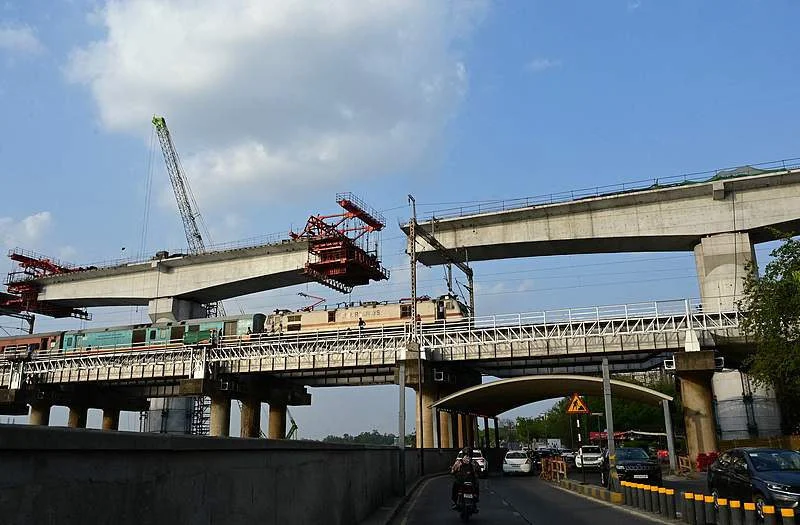
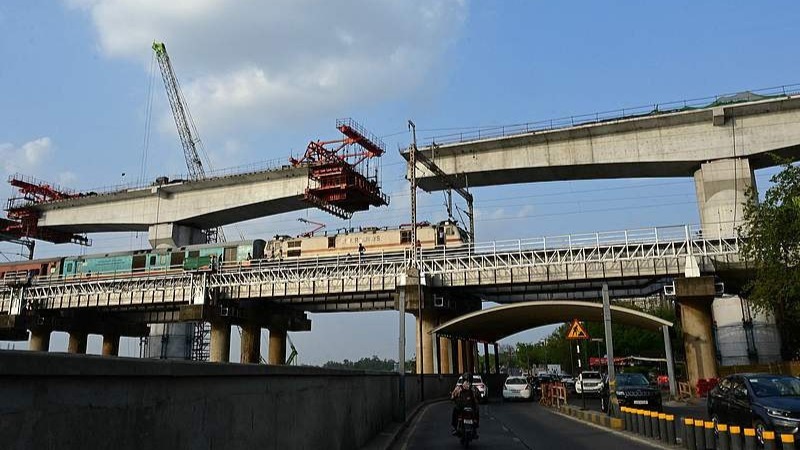
On June 24, 2026, local time, a section of the Mumbai-Ahmedabad high-speed rail project under construction was seen in Ahmedabad, India. (Visual China)


On June 24, 2026, local time, a section of the Mumbai-Ahmedabad high-speed rail project under construction was seen in Ahmedabad, India. (Visual China)

Around 2024, calls arose within India for Japan to "lay the railway" and for French-made trains to be imported, or for Indian-made trains to be used. As construction continued to be delayed, the cost of this high-speed railway also increased.

India originally planned to import Japan's E5 series Shinkansen bullet trains, but production halts and other factors led to a price surge, sparking discontent from the Indian side. In August 2025, then-Japanese Prime Minister Shigeru Ishiba proposed during a meeting with Modi to begin importing Japan's "E10 series" Shinkansen bullet trains from the early 2030s. In a joint statement on July 2nd, Kaohsiung City and Modi explicitly stated their intention to import the "E10 series" trains.

However, according to Indian reports, the "E10 series" trains are still under development. The report did not specify when the Japanese trains would be deployed to India's high-speed rail system.

Indian Railways official Damandra Twari recently told AFP that a "significant amount" of work on the high-speed rail project has been completed, and the Surat-Vapi section will open in 2027.

According to a report submitted to Parliament by the Indian Railways Standing Committee in March of this year, the Surat-Waphi section is scheduled to be operational in August 2027, using the domestically manufactured B28 train, which has a design speed of 280 km/h.


Furthermore, in a report from Toyo Keizai Online that Hideki Makihara forwarded, a Japanese railway engineer pointed out that in January 2025, India issued a tender for the signal and communication system of the high-speed rail line, explicitly stipulating that the European ETCS-L2 signaling system should be used, excluding Japan's DS-ATC system.

The engineer emphasized that the Shinkansen trains are inseparable from the signaling system and cannot operate on the European ETCS-L2 system, therefore Japan is destined to be excluded in terms of trains as well.

“The joint statement from Takashi and Modi only reiterated the goal of introducing the E10 train, but did not mention compatibility with the signaling system. It is almost certain that India’s ‘Shinkansen’ project is destined to be a pipe dream,” he said. “It is no exaggeration to say that the Japanese government shot itself in the foot, ultimately leading to failure.”


China Built a Mega Station 5× the Size of Grand Central... So I Went​

ul 24, 2026
I travelled to China to explore newly built Chongqing East Station, the world's largest railway station. Five times the size of New York's Grand Central Terminal, this colossal transport hub is a glimpse into China's future of infrastructure. Join me as I go inside to discover how a station of this scale was built.
To view this content we will need your consent to set third party cookies.
For more detailed information, see our cookies page.
 
Beijing to Shanghai In World's Fastest Train - Flights Feel Outdated | 1,200 KM in Just 4 Hours
To view this content we will need your consent to set third party cookies.
For more detailed information, see our cookies page.
 

Ranked: The Countries With the Most High-Speed Rail

June 14, 2026

High-Speed-Rail_Globally_02-web.webp


Key Takeaways​

  • China operates 40,493 km of high-speed rail, more than the rest of the world combined.
  • Spain leads Europe with 3,993 km, ahead of Japan and France.
  • Morocco is Africa’s only country with a high-speed rail network, while the U.S. has just 735 km in operation.
Over the last two decades, high-speed rail has evolved from a niche transportation technology into a centerpiece of national infrastructure strategy.

Countries have pursued these networks for different reasons, from reducing domestic flight demand to improving connections between major economic hubs. The result is a striking global divide between nations that have invested heavily in high-speed rail and those that have largely stayed on the sidelines.

This graphic ranks countries by installed high-speed rail length using 2024 data from the International Union of Railways (UIC). High-speed rail generally refers to passenger lines capable of operating at speeds of at least 200 km/h (124 mph), including Japan’s famous Shinkansen bullet trains.

China: The Giant of High-Speed Rail​

China has built 40,493 km of high-speed rail, giving it a network larger than all other countries combined. The scale of this lead is striking: Spain, the world’s second-ranked country, operates less than one-tenth as much high-speed rail.

China’s rail expansion has been one of the largest infrastructure buildouts in modern history. Since the late 2000s, the country has rapidly connected major cities through a national network designed to reduce travel times and support economic growth. The network links major metropolitan areas including Guangzhou, Shanghai, and Wuhan.

This data table ranks countries based on their total high-speed rail length in operation as of 2024.

View attachment 201882

China’s high-speed rail network extends to all Chinese provinces as well as Hong Kong, although Macau remains disconnected as of 2026.

The Beijing-Tianjin route, which began operations in 2008, was China’s first high-speed passenger rail line.

Europe’s High-Speed Rail Champion​

In Europe, no country has rolled out high-speed rail more extensively than Spain, which counted 3,993 km of network length as of 2024.

The Barcelona-Madrid high-speed line, which was also introduced in 2008, has helped reduce carbon emissions as travelers have opted for rail instead of short-haul flights between the nation’s two largest cities.

Unlike China’s coast-oriented system, Spain’s high-speed rail network is concentrated around Madrid, which is located in the center of the country. This creates a drawback for travelers hoping to bypass the capital, such as those traveling between Barcelona and Valencia or Alicante and Málaga.

The Lack of High-Speed Rail in the Americas​

High-speed rail remains rare outside Eurasia. Of the world’s 10 largest high-speed rail networks, eight are located in Europe or Asia, highlighting how concentrated this infrastructure remains despite decades of discussion in other regions.

In Africa, the challenge has largely been one of resources. Morocco (186 km) is the only country with any high-speed rail in operation as of 2024, while other countries have prioritized more essential infrastructure projects.

In the Americas, meanwhile, high-speed rail has lagged due to transportation systems that prioritize highways and automobile travel over intercity rail. The U.S. has only 735 km of high-speed rail in operation, as long-awaited projects in California have yet to come to fruition.

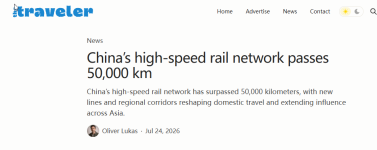
No longer 40,000 kilometers, now it's already 50,000km, adding 10,000km in a single year.

搜狗截图20260725153911.png


Users who are viewing this thread

Pakistan Defence Latest

Back
Top