
Oscar
Moderator


The Point Is Not Less Security
In Part 1, the argument was that the Pakistan Army does not need less discipline. It needs better tools for disciplined thinking: stronger officer selection, more honest internal critique, mission-command training, better after-action reviews, and promotion systems that reward accurate reporting instead of simply reassuring seniors.
In Part 2, the argument was that Pakistan does not need an unrealistic overnight end to civil-military coordination. The country’s security, economic, and institutional realities do not allow for slogans to substitute for a functioning state. What Pakistan needs is a clearer settlement: defined roles, review points, civilian-capacity targets, and an agreed process for returning extraordinary responsibilities to normal civilian institutions when they are ready.
Part 3 is about where these reforms matter most.
They matter in Balochistan, Khyber Pakhtunkhwa, the former tribal districts, and every part of Pakistan where citizens do not experience the state through Parliament, a ministry, or an elected representative. They experience it through a checkpoint, a search operation, a land-acquisition notice, an intelligence inquiry, disaster relief, a development project, or the complete absence of state support when they need a school, hospital, court, job, or police protection.
That experience shapes whether people see the state as their own.
And that is why military reform, civilian reform, and national cohesion are not three separate conversations. They are one conversation.
This is not an argument for a soft state.
Any serious Pakistani reform proposal has to begin with a basic reality: Pakistan’s security institutions are not operating in a vacuum.
The India challenge is not imaginary or merely rhetorical. The Kashmir dispute has driven enduring India-Pakistan strategic competition, while India retains a substantial conventional advantage in overall defence resources, personnel, equipment, and maritime capacity. The 2025 crisis also showed that limited strikes, air operations, drones, cyber activity, information warfare, and public pressure can create escalation risks below the nuclear threshold.
Pakistan therefore cannot simply remove the military from national-security planning and assume normal civilian processes can immediately carry the burden. A country facing a larger conventional rival, an unresolved Kashmir dispute, and nuclear-risk dynamics requires a capable, cohesive, and professionally autonomous military. The reforms proposed in Part 1 are meant to improve that capability, not dilute it.
Afghanistan is the other major external factor. The TTP’s cross-border space, networks, and operating environment mean that a purely domestic response will always be incomplete. Counterterrorism must involve border management, intelligence, diplomacy, pressure on facilitators, and cooperation where it is possible. Pakistan’s past operations reduced terrorist violence substantially, but the TTP adapted and resurged rather than disappearing permanently
The Army, intelligence agencies, police, and paramilitary forces have a duty to protect Pakistanis.
That duty does not disappear because a province has grievances, a district has been neglected, or a political system has failed to deliver.
External actors do not create every internal conflict. But they can exploit existing weaknesses.
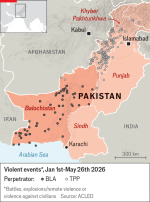
The TTP, BLA, and similar groups are not simply “angry people with concerns.” They are armed organizations that use violence, intimidation, extortion, assassination, and fear to pursue their goals. The state cannot negotiate away its responsibility to protect citizens, secure borders, defend infrastructure, and uphold the constitutional order.
But there is a difference between being strong and being blunt. India cannot create Baloch grievances from nothing. Afghanistan cannot create anger over delayed compensation, weak courts, unemployment, or poor service delivery from nothing. Outside intelligence services and hostile information networks cannot invent every complaint. But they can amplify distrust, fund or facilitate violent networks, shape narratives, exploit local recruits, and turn unresolved domestic problems into security vulnerabilities.
A state that sees every complaint as terrorism eventually loses the ability to tell who is genuinely dangerous and who simply feels unheard. A state that sees every security operation as oppression eventually loses the ability to protect ordinary people from real armed groups.
Pakistan needs to be able to hold both truths at once:
But their real impact would be felt outside the institution.
An officer trained to ask, “What are we missing?” before acting is not less capable of fighting insurgency. He is more capable of separating:
If a market is shut down repeatedly, if compensation has not been paid, if local hiring promises were ignored, if a school is closed, if a land dispute is unresolved, or if militants are exploiting anger over basic services—someone on the ground usually knows.
The question is whether the system allows that truth to travel upward.
A professional force should reward the officer who says:
“The operation achieved its immediate objective, but the civilian follow-through has not happened. If this continues, the security situation will worsen again.”
That is not making excuses. That is giving senior leadership the information needed to avoid repeating the same operation under worse conditions six months later.
This is where Parts 1&2 come useful - It creates the internal military habits needed for a credible civilian handover. They do not magically create competent district administrations. They make it possible to build them without asking the Army to abandon a real security vacuum first.
Pakistan has ministries, provinces, police departments, district administrations, courts, elected assemblies, and local-government laws. The problem is that these bodies often lack one or more of the things that turn paper institutions into working ones:
Civilian capacity does not grow because the military simply steps away.
Lets take examples:
A local commander, liaison officer, or staff officer can say:
“The area is secure enough for civilian return, but the district police have no investigators, the compensation office has not paid claims, and the provincial works department cannot maintain the road.”
This creates an accurate civilian-readiness assessment, rather than treating “area cleared” as identical to “district stabilized.”
Instead of saying, “Civilian capacity is weak,” the report identifies the actual bottleneck:
They receive usable operational facts:
The Army does not need to surrender sensitive intelligence sources or operational details. It needs structured channels for sharing the decision-relevant conclusion with the civilian body that must act next.
For the Army, this reduces mission creep. It protects the institution from being blamed for failures that belong to provincial departments.
For civilians, it means the state has to confront real delivery gaps rather than declaring “normalcy” after an operation.
For citizens, it means the metric becomes whether life functions, not merely whether violence has temporarily declined.
The civilian incentive is obvious: they get the ability to deliver visibly without being left alone in an insecure district on day one.
A Provincial Stability Cell should not be a forum where military officers brief civilians and everyone nods. It should allow civilian officials to say:
“The security picture may look better, but the district cannot take over because there are no prosecutors, the police recruitment batch has not arrived, and compensation claims are piling up.”
Likewise, military officers should be able to say: “The civilian side has announced a handover, but the conditions for it are not present yet.”
That is useful to both sides. It prevents civilians being pushed into symbolic takeovers and prevents the military being blamed for staying because nobody recorded why withdrawal would be unsafe.
If Part 1 makes the civilian task visible. Part 2 makes it worth doing.
The basic civilian problem is not only incompetence. It is incentives.
A province will not invest political capital in police reform, district administration, courts, or local government if:
If the Frontier Corps is supporting a border district, the compact identifies the provincial police force, district administration, and relevant ministries that must eventually own routine policing, services, and development.
If FWO builds a road, the provincial works department is named as the future operator and given a date, maintenance budget, staff plan, and performance standard.
If an area is cleared of TTP activity, the provincial home department is assigned responsibility for police deployment, courts, prosecution, and local administration.
That means the civilian institution is no longer able to say, “This is still the military’s matter.”
But it also means it cannot be asked to perform without resources.
If the Frontier Corps is supporting a border district, the compact identifies the provincial police force, district administration, and relevant ministries that must eventually own routine policing, services, and development.
If FWO builds a road, the provincial works department is named as the future operator and given a date, maintenance budget, staff plan, and performance standard.
If an area is cleared of TTP activity, the provincial home department is assigned responsibility for police deployment, courts, prosecution, and local administration.
That means the civilian institution is no longer able to say, “This is still the military’s matter.”
But it also means it cannot be asked to perform without resources.
A provincial chief minister can point to jobs, roads, clinics, compensation, and police stations delivered under civilian authority. A district officer can build a career around measurable performance rather than political loyalty. A provincial police force gains staff, equipment, and professional authority. Elected representatives gain something more valuable than a press conference: evidence that their government can deliver.
A key note here:
Civilian institutions cannot be expected to accept responsibility without authority. But they also cannot retain the excuse of having no authority once money, staff, legal power, security support, and a defined mandate are provided.
At every review, the question is not “Is the Army good or bad?” or “Are civilians ready in theory?”
It is:
The incentive is that successful civilian delivery creates an independent political base.
If a provincial government can show that it:
That matters because civilian politicians often turn to military support when they lack their own institutional sources of authority. A government that can point to working district institutions becomes less dependent on informal backing.
This is the political payoff that past reform pitches often ignore.
The reform package should give them:
Part 1’s promotion logic applies directly here. Just as the Army should reward officers who report honestly and deliver under complexity, the civil service should reward officials who keep a district functioning under pressure.
People will not bring disputes to a court they do not trust, report crime to police they fear, or engage with a district office that cannot resolve anything. They will go to local power brokers, political patrons, militant actors, or military formations instead.
The practical goal is to make civilian channels more useful than informal alternatives:
Targeted Applications of Reforms:
India: Stronger Institutions, Stronger Deterrence
This needs to be stated plainly: civilian capacity does not replace military deterrence against India. It makes deterrence more sustainable. India’s conventional size and spending advantage means Pakistan cannot rely on matching India platform for platform. Pakistan needs better use of intelligence, jointness, air defence, cyber resilience, mobility, professional leadership, deterrence, and crisis management.
That is exactly why Part 1’s military reforms matter.
A military that is professionally stronger at deterrence and warfighting has less institutional reason to remain the permanent manager of every civilian-sector failure. A focused Army is not a lesser Army. It is a more credible one.
It matters because of geography, the coastline, Gwadar, CPEC, mineral resources, borders, maritime access, foreign investment, infrastructure, and the security of Pakistani and foreign workers. No responsible Pakistani can argue that the state should simply disengage or allow armed groups to determine national policy.
At the same time, Balochistan cannot be treated only as a security file.
For many Baloch citizens, the state is not experienced as opportunity. It is experienced as distance. Decisions are made elsewhere. Resources leave. Jobs appear to go elsewhere. Land, water, fishing rights, movement, and local dignity become sources of tension. Even where development is real, people may feel that it was done around them rather than with them.
That feeling does not justify violence. It does explain why violence can find space to recruit, intimidate, or gain passive support.
The wrong conclusion is: “Stop development because there is opposition.”
The right conclusion is: make development visibly beneficial to the people who live around it.
A major road, port, mine, energy project, or industrial zone should not only answer the question, “Is this good for Pakistan?”
It should also answer:
“What does the surrounding district tangibly gain from this, and how can people verify that it happened?”
That is not surrendering national interest. It is securing national interest.
A Balochistan Participation Test
Pakistan should apply a simple participation test to major security-development projects in Balochistan.
Before a major project is finalized, the state should be able to show:
Afghanistan: Security Cannot End at the Border
Pakistan’s Afghanistan policy must remain realistic. The border is long, difficult, and shaped by family, trade, ethnicity, displacement, and historical movement. It cannot be treated as if a fence alone resolves every security problem.
At the same time, Pakistan cannot accept cross-border space being used for violence against Pakistani civilians or security forces. The state must retain the ability to defend itself through border management, intelligence-led action, diplomacy, targeted pressure on militant facilitation, and regional engagement.
But the domestic side matters just as much.
A militant organization has a much easier time returning to an area if the state clears it militarily and then leaves behind unresolved land claims, delayed compensation, unemployment, weak policing, inaccessible courts, and no local political channel. That does not excuse militancy. It explains why a military success can fail to become a permanent security outcome.
The Part 3 proposal for Stability Cells and post-operation civilian takeover plans directly addresses this. It ensures that when the Army creates space, civilian institutions have measurable obligations to fill it.
Pakistan cannot counter every hostile narrative by declaring it hostile. In fact, the state becomes weaker when every critic is casually labelled foreign-backed, because then genuine failures cannot be corrected and ordinary citizens stop trusting official messaging.
The best answer to information warfare is not only better messaging. It is verifiable performance.
If a project promises 2,000 local jobs, publish how many local people were hired. If compensation was promised, publish how many claims were resolved. If an area was cleared, publish when schools, courts, police stations, and health services returned.
This protects security institutions as well. It lets them say: “Our role was to secure the space. Here is what civilian institutions delivered afterward.” That is far stronger than carrying responsibility for every claim, every delay, and every failure indefinitely.
But reforms can reduce how much those pressures are able to exploit.
For people who distrust the military: it creates a path toward stronger civilian institutions without pretending Pakistan has no security threats.
For people who support the military: it protects the Army’s core role, improves professional capability, and reduces the burden of being expected to solve every civilian failure.
For people who are simply exhausted by the argument: it offers something better than slogans.
A Pakistan that is secure enough to defend itself, competent enough to govern itself, and cohesive enough that outside actors find fewer openings to turn internal problems into national crises.
In Part 1, the argument was that the Pakistan Army does not need less discipline. It needs better tools for disciplined thinking: stronger officer selection, more honest internal critique, mission-command training, better after-action reviews, and promotion systems that reward accurate reporting instead of simply reassuring seniors.
In Part 2, the argument was that Pakistan does not need an unrealistic overnight end to civil-military coordination. The country’s security, economic, and institutional realities do not allow for slogans to substitute for a functioning state. What Pakistan needs is a clearer settlement: defined roles, review points, civilian-capacity targets, and an agreed process for returning extraordinary responsibilities to normal civilian institutions when they are ready.
Part 3 is about where these reforms matter most.
They matter in Balochistan, Khyber Pakhtunkhwa, the former tribal districts, and every part of Pakistan where citizens do not experience the state through Parliament, a ministry, or an elected representative. They experience it through a checkpoint, a search operation, a land-acquisition notice, an intelligence inquiry, disaster relief, a development project, or the complete absence of state support when they need a school, hospital, court, job, or police protection.
That experience shapes whether people see the state as their own.
And that is why military reform, civilian reform, and national cohesion are not three separate conversations. They are one conversation.
This is not an argument for a soft state.
Any serious Pakistani reform proposal has to begin with a basic reality: Pakistan’s security institutions are not operating in a vacuum.
The India challenge is not imaginary or merely rhetorical. The Kashmir dispute has driven enduring India-Pakistan strategic competition, while India retains a substantial conventional advantage in overall defence resources, personnel, equipment, and maritime capacity. The 2025 crisis also showed that limited strikes, air operations, drones, cyber activity, information warfare, and public pressure can create escalation risks below the nuclear threshold.
Pakistan therefore cannot simply remove the military from national-security planning and assume normal civilian processes can immediately carry the burden. A country facing a larger conventional rival, an unresolved Kashmir dispute, and nuclear-risk dynamics requires a capable, cohesive, and professionally autonomous military. The reforms proposed in Part 1 are meant to improve that capability, not dilute it.
Afghanistan is the other major external factor. The TTP’s cross-border space, networks, and operating environment mean that a purely domestic response will always be incomplete. Counterterrorism must involve border management, intelligence, diplomacy, pressure on facilitators, and cooperation where it is possible. Pakistan’s past operations reduced terrorist violence substantially, but the TTP adapted and resurged rather than disappearing permanently
The Army, intelligence agencies, police, and paramilitary forces have a duty to protect Pakistanis.
That duty does not disappear because a province has grievances, a district has been neglected, or a political system has failed to deliver.
External actors do not create every internal conflict. But they can exploit existing weaknesses.
The TTP, BLA, and similar groups are not simply “angry people with concerns.” They are armed organizations that use violence, intimidation, extortion, assassination, and fear to pursue their goals. The state cannot negotiate away its responsibility to protect citizens, secure borders, defend infrastructure, and uphold the constitutional order.
But there is a difference between being strong and being blunt. India cannot create Baloch grievances from nothing. Afghanistan cannot create anger over delayed compensation, weak courts, unemployment, or poor service delivery from nothing. Outside intelligence services and hostile information networks cannot invent every complaint. But they can amplify distrust, fund or facilitate violent networks, shape narratives, exploit local recruits, and turn unresolved domestic problems into security vulnerabilities.
A state that sees every complaint as terrorism eventually loses the ability to tell who is genuinely dangerous and who simply feels unheard. A state that sees every security operation as oppression eventually loses the ability to protect ordinary people from real armed groups.
Pakistan needs to be able to hold both truths at once:
- Armed groups must be dealt with firmly and professionally.
- Legitimate grievances must not be handed over to armed groups because no lawful channel exists to address them.
What Part 1 Changes on the Ground
The reforms proposed in Part 1 may sound internal: better selection, mission command, red-teaming, honest reporting, and protected critique.But their real impact would be felt outside the institution.
An officer trained to ask, “What are we missing?” before acting is not less capable of fighting insurgency. He is more capable of separating:
- An armed threat from a frustrated population
- A time-sensitive operation from a routine show of force
- A necessary security restriction from an avoidable humiliation
- A tactical success from a strategic mistake
- An intelligence gap from a community that no longer trusts the state
If a market is shut down repeatedly, if compensation has not been paid, if local hiring promises were ignored, if a school is closed, if a land dispute is unresolved, or if militants are exploiting anger over basic services—someone on the ground usually knows.
The question is whether the system allows that truth to travel upward.
A professional force should reward the officer who says:
“The operation achieved its immediate objective, but the civilian follow-through has not happened. If this continues, the security situation will worsen again.”
That is not making excuses. That is giving senior leadership the information needed to avoid repeating the same operation under worse conditions six months later.
How Civilian Capacity Actually Grows
It is easy to say “the civilian government should take over.” Pakistan has said versions of that for decades. The harder question is: who builds the police station, trains the investigator, funds the district officer, clears the land record, processes compensation, staffs the court, and keeps the system working after the Army reduces its role?This is where Parts 1&2 come useful - It creates the internal military habits needed for a credible civilian handover. They do not magically create competent district administrations. They make it possible to build them without asking the Army to abandon a real security vacuum first.
Pakistan has ministries, provinces, police departments, district administrations, courts, elected assemblies, and local-government laws. The problem is that these bodies often lack one or more of the things that turn paper institutions into working ones:
- A job they genuinely own
- Money they can predict and control
- Staff who stay long enough to learn the job
- Protection from political interference
- Honest feedback when delivery fails
- Consequences for failure
- A reason for stronger institutions to stop doing the job for them
Civilian capacity does not grow because the military simply steps away.
Lets take examples:
A local commander, liaison officer, or staff officer can say:
“The area is secure enough for civilian return, but the district police have no investigators, the compensation office has not paid claims, and the provincial works department cannot maintain the road.”
This creates an accurate civilian-readiness assessment, rather than treating “area cleared” as identical to “district stabilized.”
Instead of saying, “Civilian capacity is weak,” the report identifies the actual bottleneck:
- No judge posted
- No prosecutor assigned
- No police investigators trained
- Compensation funding unreleased
- Land records unresolved
- District health office unstaffed
- School rebuilding complete but teachers absent
They receive usable operational facts:
- Which roads are safe enough for civilian staff to travel
- Which police stations can operate without military protection
- Where recruitment is being exploited by militants
- Which land, compensation, or service-delivery failures are affecting local intelligence
- Which projects have created local support and which have created resentment
- What security support is still genuinely needed, and for how long
The Army does not need to surrender sensitive intelligence sources or operational details. It needs structured channels for sharing the decision-relevant conclusion with the civilian body that must act next.
For the Army, this reduces mission creep. It protects the institution from being blamed for failures that belong to provincial departments.
For civilians, it means the state has to confront real delivery gaps rather than declaring “normalcy” after an operation.
For citizens, it means the metric becomes whether life functions, not merely whether violence has temporarily declined.
The civilian incentive is obvious: they get the ability to deliver visibly without being left alone in an insecure district on day one.
A shared early-warning system
Part 1’s red-team concept also gives civilians a way to challenge security optimism before it becomes a crisis.A Provincial Stability Cell should not be a forum where military officers brief civilians and everyone nods. It should allow civilian officials to say:
“The security picture may look better, but the district cannot take over because there are no prosecutors, the police recruitment batch has not arrived, and compensation claims are piling up.”
Likewise, military officers should be able to say: “The civilian side has announced a handover, but the conditions for it are not present yet.”
That is useful to both sides. It prevents civilians being pushed into symbolic takeovers and prevents the military being blamed for staying because nobody recorded why withdrawal would be unsafe.
If Part 1 makes the civilian task visible. Part 2 makes it worth doing.
The basic civilian problem is not only incompetence. It is incentives.
A province will not invest political capital in police reform, district administration, courts, or local government if:
- The Army will remain responsible regardless
- Funding is uncertain
- Officials can be transferred by political rivals
- Success is invisible
- Failure carries no cost
- Taking responsibility creates risk but little political reward
Defined handovers create real ownership
Every extraordinary military role should come with a named civilian counterpart.If the Frontier Corps is supporting a border district, the compact identifies the provincial police force, district administration, and relevant ministries that must eventually own routine policing, services, and development.
If FWO builds a road, the provincial works department is named as the future operator and given a date, maintenance budget, staff plan, and performance standard.
If an area is cleared of TTP activity, the provincial home department is assigned responsibility for police deployment, courts, prosecution, and local administration.
That means the civilian institution is no longer able to say, “This is still the military’s matter.”
But it also means it cannot be asked to perform without resources.
Funding gives them a stake
A civilian department is far more likely to step up when taking over brings a protected budget, staff positions, equipment, professional training, and visible credit for delivery.Defined handovers create real ownership
Every extraordinary military role should come with a named civilian counterpart.If the Frontier Corps is supporting a border district, the compact identifies the provincial police force, district administration, and relevant ministries that must eventually own routine policing, services, and development.
If FWO builds a road, the provincial works department is named as the future operator and given a date, maintenance budget, staff plan, and performance standard.
If an area is cleared of TTP activity, the provincial home department is assigned responsibility for police deployment, courts, prosecution, and local administration.
That means the civilian institution is no longer able to say, “This is still the military’s matter.”
But it also means it cannot be asked to perform without resources.
Funding gives them a stake
A civilian department is far more likely to step up when taking over brings a protected budget, staff positions, equipment, professional training, and visible credit for delivery.| Civilian institution takes on | It receives |
| Local policing | Recruitment funding, vehicles, communications, investigation training, protected high-risk postings |
| District administration | Stable tenure, dedicated staff, district operating budget, authority to resolve compensation and land issues |
| Courts and prosecution | Judges, prosecutors, court staff, case-management systems, witness protection and mobile access where needed |
| Infrastructure maintenance | Budget, technical staff, asset records, defined transfer date from FWO or another builder |
| Development delivery | Local procurement targets, apprenticeship funding, public reporting data, authority to enforce contracts |
A provincial chief minister can point to jobs, roads, clinics, compensation, and police stations delivered under civilian authority. A district officer can build a career around measurable performance rather than political loyalty. A provincial police force gains staff, equipment, and professional authority. Elected representatives gain something more valuable than a press conference: evidence that their government can deliver.
A key note here:
The Deal Must Be Fair
There is a basic fairness rule here:Civilian institutions cannot be expected to accept responsibility without authority. But they also cannot retain the excuse of having no authority once money, staff, legal power, security support, and a defined mandate are provided.
At every review, the question is not “Is the Army good or bad?” or “Are civilians ready in theory?”
It is:
- Did the province receive the agreed funding?
- Did it fill the agreed posts?
- Did it keep officials in place?
- Did courts and police start functioning?
- Did compensation get paid?
- Did services reach people?
- Has the security risk reduced enough to narrow military support?
- If not, which specific condition is missing?
The Political Incentive
Civilian politicians have to see why this helps them personally and politically, not only why it is good for Pakistan in the abstract.The incentive is that successful civilian delivery creates an independent political base.
If a provincial government can show that it:
- Reopened schools after an operation
- Paid compensation fairly
- Built a functioning police force
- Resolved land disputes
- Created local apprenticeships around a CPEC or mining project
- Delivered water, clinics, and roads
- Reduced the need for permanent military support
That matters because civilian politicians often turn to military support when they lack their own institutional sources of authority. A government that can point to working district institutions becomes less dependent on informal backing.
This is the political payoff that past reform pitches often ignore.
The Bureaucratic Incentive
Civil servants also need a reason to perform beyond “serve the nation.”The reform package should give them:
- Minimum protected posting tenure in priority districts
- Promotion credit for measurable district outcomes, not only seniority and political connections
- Hardship pay, secure housing, family support, and professional training for high-risk postings
- Legal protection when they enforce rules against local elites
- Clear performance targets that distinguish failure caused by missing resources from failure caused by poor management
- A route into provincial and federal leadership roles for officers who successfully serve difficult districts
Part 1’s promotion logic applies directly here. Just as the Army should reward officers who report honestly and deliver under complexity, the civil service should reward officials who keep a district functioning under pressure.
The Public Incentive
Finally, civilian institutions grow when citizens begin using them.People will not bring disputes to a court they do not trust, report crime to police they fear, or engage with a district office that cannot resolve anything. They will go to local power brokers, political patrons, militant actors, or military formations instead.
The practical goal is to make civilian channels more useful than informal alternatives:
- A compensation claim gets resolved through a district office
- A land dispute gets heard by a court or tribunal
- A road complaint goes to the works department and is tracked publicly
- A local contractor can compete for a project transparently
- A citizen can report crime to professional police
- A community can raise a concern before it becomes a protest or security crisis
Targeted Applications of Reforms:
India: Stronger Institutions, Stronger Deterrence
This needs to be stated plainly: civilian capacity does not replace military deterrence against India. It makes deterrence more sustainable. India’s conventional size and spending advantage means Pakistan cannot rely on matching India platform for platform. Pakistan needs better use of intelligence, jointness, air defence, cyber resilience, mobility, professional leadership, deterrence, and crisis management.
That is exactly why Part 1’s military reforms matter.
- Mission command improves adaptation when communications are disrupted or events move faster than central approval.
- Red teams identify assumptions an adversary may exploit. (already practiced vis a vis India)
- Protected critique reduces the risk that bad news is buried until a crisis becomes harder to manage.
- Inter-service balance prevents jointness from becoming paperwork rather than genuine integration.
- Clear civilian-military crisis procedures make political objectives, escalation limits, and diplomatic messaging more coherent.
A military that is professionally stronger at deterrence and warfighting has less institutional reason to remain the permanent manager of every civilian-sector failure. A focused Army is not a lesser Army. It is a more credible one.
Balochistan Is Not Only a Security File
Balochistan is strategically indispensable to Pakistan.It matters because of geography, the coastline, Gwadar, CPEC, mineral resources, borders, maritime access, foreign investment, infrastructure, and the security of Pakistani and foreign workers. No responsible Pakistani can argue that the state should simply disengage or allow armed groups to determine national policy.
At the same time, Balochistan cannot be treated only as a security file.
For many Baloch citizens, the state is not experienced as opportunity. It is experienced as distance. Decisions are made elsewhere. Resources leave. Jobs appear to go elsewhere. Land, water, fishing rights, movement, and local dignity become sources of tension. Even where development is real, people may feel that it was done around them rather than with them.
That feeling does not justify violence. It does explain why violence can find space to recruit, intimidate, or gain passive support.
The wrong conclusion is: “Stop development because there is opposition.”
The right conclusion is: make development visibly beneficial to the people who live around it.
A major road, port, mine, energy project, or industrial zone should not only answer the question, “Is this good for Pakistan?”
It should also answer:
“What does the surrounding district tangibly gain from this, and how can people verify that it happened?”
That is not surrendering national interest. It is securing national interest.
A Balochistan Participation Test
Pakistan should apply a simple participation test to major security-development projects in Balochistan.
Before a major project is finalized, the state should be able to show:
- What percentage of jobs will go to local residents
- What training or apprenticeship pathway will prepare local people for skilled work
- What share of procurement can realistically go to local businesses
- What water, roads, clinics, schools, electricity, or digital access will improve for surrounding communities
- How land, fishing, environmental, and compensation disputes will be handled
- Which civilian department will operate and maintain the project once construction is complete
- How communities can raise complaints before those complaints become protests, sabotage, or recruitment opportunities for armed groups
- It distinguishes lawful grievance from violent sabotage.
- It gives local citizens a stake in defending projects rather than merely tolerating them.
- It deprives external actors of the claim that Pakistan’s strategic development is purely extractive.
Afghanistan: Security Cannot End at the Border
Pakistan’s Afghanistan policy must remain realistic. The border is long, difficult, and shaped by family, trade, ethnicity, displacement, and historical movement. It cannot be treated as if a fence alone resolves every security problem.
At the same time, Pakistan cannot accept cross-border space being used for violence against Pakistani civilians or security forces. The state must retain the ability to defend itself through border management, intelligence-led action, diplomacy, targeted pressure on militant facilitation, and regional engagement.
But the domestic side matters just as much.
A militant organization has a much easier time returning to an area if the state clears it militarily and then leaves behind unresolved land claims, delayed compensation, unemployment, weak policing, inaccessible courts, and no local political channel. That does not excuse militancy. It explains why a military success can fail to become a permanent security outcome.
The Part 3 proposal for Stability Cells and post-operation civilian takeover plans directly addresses this. It ensures that when the Army creates space, civilian institutions have measurable obligations to fill it.
Information Warfare Is Also a Governance Test
Modern pressure does not arrive only through weapons, militants, or border crossings. It arrives through social media, disinformation, edited video, diaspora networks, rumor, economic panic, and political polarization.Pakistan cannot counter every hostile narrative by declaring it hostile. In fact, the state becomes weaker when every critic is casually labelled foreign-backed, because then genuine failures cannot be corrected and ordinary citizens stop trusting official messaging.
The best answer to information warfare is not only better messaging. It is verifiable performance.
If a project promises 2,000 local jobs, publish how many local people were hired. If compensation was promised, publish how many claims were resolved. If an area was cleared, publish when schools, courts, police stations, and health services returned.
This protects security institutions as well. It lets them say: “Our role was to secure the space. Here is what civilian institutions delivered afterward.” That is far stronger than carrying responsibility for every claim, every delay, and every failure indefinitely.
The Strategic Payoff
The three-part reform agenda does not assume Pakistan can reform its way out of hostile geography. India will remain a powerful rival. Afghanistan will remain a complex and vital neighbour. External intelligence activity, economic pressure, and regional competition will remain facts of life.But reforms can reduce how much those pressures are able to exploit.
- A more adaptive Army is harder to surprise.
- Better joint planning makes deterrence more credible.
- Honest internal reporting reduces strategic mistakes.
- Stronger provincial governance reduces militant recruitment space.
- Local benefit-sharing makes infrastructure harder to sabotage.
- Clear civil-military roles reduce confusion during crises.
- Transparent delivery makes disinformation less persuasive.
- Defined review points prevent useful emergency measures from becoming permanent institutional dependencies.
For people who distrust the military: it creates a path toward stronger civilian institutions without pretending Pakistan has no security threats.
For people who support the military: it protects the Army’s core role, improves professional capability, and reduces the burden of being expected to solve every civilian failure.
For people who are simply exhausted by the argument: it offers something better than slogans.
A Pakistan that is secure enough to defend itself, competent enough to govern itself, and cohesive enough that outside actors find fewer openings to turn internal problems into national crises.
Last edited:


