Remittances from Overseas Pakistanis - Updates

you're not wrong. Pakistani people investing in other Pakistani people is the best kind of support we can give the economy. Especially if you can help setup someone work exporting goods or services.
The nizam in Pakistan is such that you either need to live there or have trusted deputies to look after any investment or business. It's one thing I lack.

But there are still ways to attract money to Pakistan if one can make it easy and electronic. The Naya Pakistan Certificates by Imran Khan government was one example.
 
Bahi people are surviving here. Don't you worry. If you want to help, please considering opening a call center or three for our youth. The rest is just yapping <3
I try to help as I can without expecting any return, but, brother, I have learnt from experience to keep emotion out of investment decisions. For emotional decisions, I don't think twice about profit or loss.

I wish things were better, but in the present situation, I would prefer to give money directly to those I want to help than make an "investment " and based on the macro statistics, most people think exactly like me, which is why remittances dwarf investment from abroad. I also wish it weren't so, but living in denial doesn't help anyone.
 
Remittances from Overseas Pakistanis - Updates

Remittances surge by 13% to $2.38b in Dec 2023​

Stability in rupee-dollar parity, crackdown on illegal networks boost numbers

Salman Siddiqui
January 11, 2024
design ibrahim yahya

design: Ibrahim Yahya

The inflows of workers’ remittances sent home by overseas Pakistanis increased by 13% to $2.38 billion in December 2023, as they dispatched the funds through official channels following the return of stability in the rupee-dollar parity and the crackdown against illegal currency networks.

The improvement in remittances fuelled the ongoing gradual rally in the rupee against the US dollar on Wednesday, strengthening the market view that the balance of the current account would record a surplus for the second consecutive month of December 2023.

The State Bank of Pakistan (SBP) reported that remittances rose by 13% compared to $2.10 billion in the same month of December of the previous year.

Inflows improved by 5.5% in the month compared to $2.26 billion in the prior month of November 2023.

However, workers’ remittances have cumulatively slowed down by 7% in the first half (Jul-Dec) of the current fiscal year 2023-24, amounting to $13.45 billion compared to $14.42 billion in the same period of the previous year, according to the central bank.

Topline Securities, CEO, Muhammad Sohail mentioned that the latest monthly inflows of $2.38 billion are higher than the full-year 2023 average of $2.20 billion a month.

Market talk suggests that the receipts have increased due to the crackdown against foreign currency smugglers, such as hawala-hundi operators and hoarders, since September 2023.

The cleanup operation crushed illicit currency markets, especially in the bordering areas with Afghanistan, and strengthened the hold of official operating networks like commercial banks and authorised exchange companies.

The crackdown not only helped arrest the then freefall in the domestic currency but also assisted it in bouncing back by over 9%, or around Rs26 in the past four months, closing at a 10-week high at Rs281.13 against the US dollar on Wednesday. Earlier, it had hit an all-time low at Rs307.10/$ in the first week of September 2023.

The inflows of workers’ remittances play a pivotal role in the economy, significantly helping finance the twin trade and current account deficits.

The total inflows in the first half of FY24 have, however, slipped by 7% due to high volatility in the currency between July-September 2023, in the wake of the then political and economic instability, according to market talks.

Speaking to The Express Tribune, Maaz Azam, Research Analyst at Optimus Capital Management, projected that the inflows would remain better in the second half of the ongoing fiscal year amid stability in the rupee-dollar exchange rate.

He estimated the average inflows at $2.4 billion a month during January-June 2024, including likely spikes above the average in the months around Ramadan and Eid festivals falling in the second half of FY24.

He foresaw FY24 full-year workers’ remittances inflows at $28.6 billion, slightly higher compared to the receipts at $27.3 billion recorded in FY23.

He noted that risk factors, which if occur, would disrupt the improved inflows, including the return of political and economic instability after the new political government is formed post the February 2024 general elections and a delay in the acquisition of another IMF programme after the current one of $3 billion completes in March 2024.

“The political instability and delays in the IMF new programme, if they take place, may allow illicit players to re-establish illegal currency markets and mount pressure on the rupee.”

On the flip side, a better-than-estimated increase in economic activities would prompt non-resident Pakistanis to send higher remittances, including for investment purposes. “The inflows would surge along with economic activities.”

He believed that overseas Pakistanis slowed down the dispatch of remittances for investment purposes amid the economic slowdown in the first half of FY24.

Region-wise inflows:

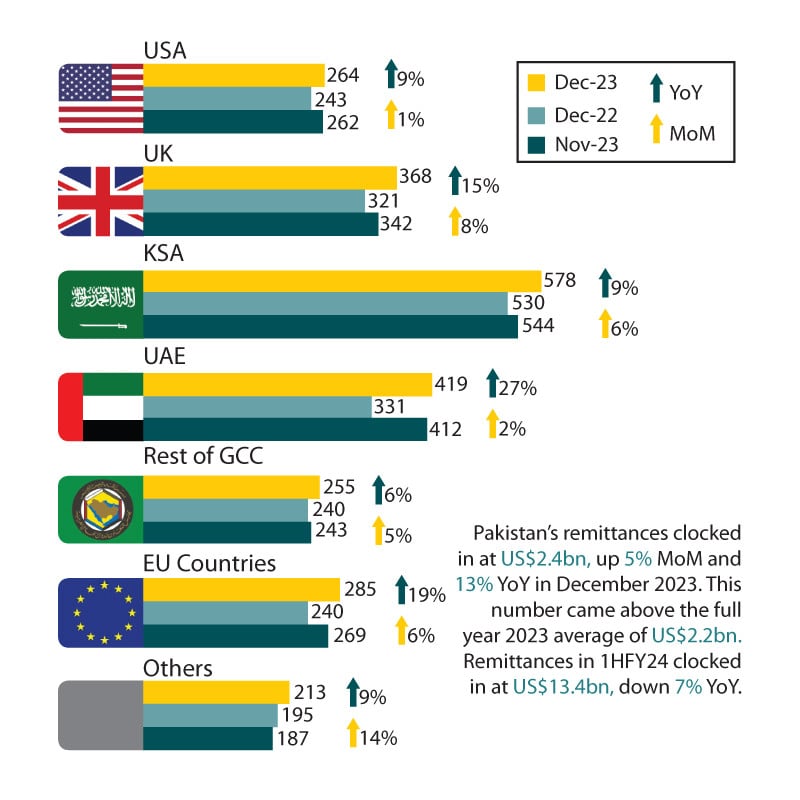
The central bank reported that remittance inflows during December 2023 were mainly sourced from Saudi Arabia at $578 million, increasing by 9% from $530 million received in the same month of the previous year.

Non-resident Pakistanis dispatched $419 million from the United Arab Emirates in the month, which was 27% higher compared to $331 million in the same month of the previous year.

Expatriates sent 15% higher remittances at $368 million from the United Kingdom compared to $321 million.

They dispatched 9% higher remittances at $264 million from the United States of America compared to $243 million.

Inflows from other GCC countries improved 6% to $255 million in the month compared to $240 million.

Pakistanis from European Union countries sent $285 million remittances, which were 19% higher compared to $240 million.

Workers’ remittances surged by 9% to $213 million from other countries around the world in December 2023 compared to $195 million in December 2022.


INDIA REMAINS AS THE WORLD’S LARGEST RECIPIENT OF REMITTANCES, WITH INFLOWS REACHING USD 135.4 BILLION IN FY25

🇮🇳

.
=>
Remittances significantly reduce India's Current Account Deficit (CAD) by providing a steady stream of foreign exchange. 👍 Because India consistently imports more goods than it exports, it runs a persistent merchandise trade deficit. Remittances act as an independent, liability-free surplus that offsets a massive portion of this gap. [1, 2]

 
Nothing to be proud of. Workers having to move abroad to support their families is a sign of problems in the domestic economy.
 
@Owaiz sb

highest quality source of foreign exchange is FDI, then FPI, then services exports, then goods exports,

Why do you consider FDI/FPI as a higher quality source of forex than goods/services export? Quite curious.

Regards
 
@Owaiz sb

highest quality source of foreign exchange is FDI, then FPI, then services exports, then goods exports,

Why do you consider FDI/FPI as a higher quality source of forex than goods/services export? Quite curious.

Regards
Exports are often underpinned by fiscal subsidies and subject to favourable tariff regime ( like GSP, LDC status benefits, etc), whereas FDI /FPI ( even though it is "hot money") reflects fundamental strengths of the economy based on the views of informed investors.

Also, investment is a forward looking indicator.
 
@Owaiz sb

Thanks for the explanation. But there are other things to consider:

FPI is hot money-it can fly out as fast as it comes in.

FDI is a better source of money-but if it is used mainly for meeting domestic demand it may not add much to permanent capital. Disinvestment through IPO, dividends, royalties may result in net negative cashflows- in IND we have seen that with large high profile IPOs of Korean and Japanese entities operating in the domestic market.

Regards
 
Exports are often underpinned by fiscal subsidies and subject to favourable tariff regime ( like GSP, LDC status benefits, etc), whereas FDI /FPI ( even though it is "hot money") reflects fundamental strengths of the economy based on the views of informed investors.

Also, investment is a forward looking indicator.
Also (and I assume) it’s impact is lopsided towards productivity increase, where as down the chain it increasingly becomes lopsided towards consumption.
 
@Owaiz sb

Thanks for the explanation. But there are other things to consider:

FPI is hot money-it can fly out as fast as it comes in.

FDI is a better source of money-but if it is used mainly for meeting domestic demand it may not add much to permanent capital. Disinvestment through IPO, dividends, royalties may result in net negative cashflows- in IND we have seen that with large high profile IPOs of Korean and Japanese entities operating in the domestic market.

Regards
Sure, there are lot of dimensions and different measures of "quality ". FPI can more "hot" for volatile economies , but fundamentally strong economies , for e.g. the US have been able to sustain positive net FPI for extended periods of time. That is one reason I think it is a good measure of "quality".


Generally, FDI is stable , long term capital. Also, if older investments return significant dividends and royalties, it is a positive signal that encourages further investment. As far as divestment of investments is concerned, I think the situation is India was an anamoly. The Indian stock market was assigning much higher valuation to the Indian businesses of MNCs than the markets in their parent countries. So, they capitalised on that arbitrage opportunity. Otherwise, MNCs don't list their local businesses in every country they operate in.
 
out elite likes to invest in plots and thats bitter reality. pricing land and then bet on it to exort the oublic . easy money. they dnt want a good economy. They invest in
Land 2 rental power plants and love to import.
No, we hate producing locally and subsidize imports financed through confiscating the dollars sent home by overseas Pakistani slave laborers. We also like to create state/tax/IMF funded monopolies run by the military/mafia syndicate whose only job is to divert funds into their personal accounts while supplying goods/services at the very minimum or none at all, e.g. IPPs. The military/mafia chor elites devour at least $20 bn in subsidies into their and their progenies oppullence and luxury each year, while Shobazz chor and failed marshall jannu german champu sell their mothers for a mere $1 bn dollar worth of temporary baksheesh to finance account deficits...

Pakistan is held back and economic growth is deliberately curtailed through a well thought out and implemented strategy of the east India company colonial sepoys...
 
The biggest driver of the trade deficit is oil and oil products, which Pakistan must get from somewhere and is commoditised enough that UAE can sell to anyone else. I don't think Pakistanis living in Pakistan are the second or third biggest investors in UAE property and, in any case, top Pakistani politicians and generals owning property in Dubai gives more leverage to the Emiratis than to Pakistan. Sure, Pakistan has some cards, but, in the current context, the leverage is highly asymmetrical.
We pay tens of billions in dollars each year to IPPs, all of which go to overseas shell companies owned by the chor elites...Oil or any other legit imports is not the biggest driver of the deficit. Our chor military/mafia mobster alliance is the biggest driver of all economic malaise...
 

The $41.6b remittance divide​


Policymakers must treat migration as a bridge to development, not a substitute

Usman Hanif
August 09, 2026

foreign remittances to pakistan have reduced by 6 9 per photo reuters


Foreign remittances to Pakistan have reduced by 6.9 per. PHOTO: REUTERS

KARACHI: Sardar Liaquat Khan left his home nestled among the middle Himalayas near Banjosa Lake in Kashmir and his one-month-old bride to seek a better life. Three years later, he has not returned yet.

His life is a quintessential story of the pain and gain behind Pakistan's remittances.

During this time, he has helped his four brothers build houses, open four shops and buy land. His own house is now under construction. His wife waits, collecting household appliances and essentials in the hope that one day they will finally begin the married life they planned before he boarded a flight to Saudi Arabia.

"We Kashmiris leave our heaven to make our world," he says.

Liaquat's story mirrors the lives of millions of Pakistanis who have left their families in search of economic opportunity abroad. Most come from Punjab, Khyber-Pakhtunkhwa (K-P) and Azad Jammu and Kashmir (AJK). They spend years away from parents, spouses and children, sacrificing family life to earn incomes that would have been impossible at home.

In return, they send billions of dollars back every year, supporting households and the country's fragile economy. For many young Pakistanis, adulthood presents a stark choice: remain in a country where opportunities are scarce or leave everything familiar in pursuit of a better future overseas.

Staying often means lower incomes and limited prospects. Migration demands emotional sacrifices that cannot be measured in financial terms
 
A dependable economic lifeline

Workers' remittances have been one of Pakistan's most reliable economic supports since the early 1970s, when the country was rebuilding after the separation of erstwhile East Pakistan, now Bangladesh.

Over the decades, the inflows have risen steadily. During FY2025-26, Pakistan received $41.6 billion, marking an 8.6% increase from the previous year. It was a milestone, marking the first time this number was crossed.

Saudi Arabia remained the largest source, with around $829.6 million followed by the UAE ($792.2 million), the UK ($514.9 million) and the US ($296.8 million).

Unlike external borrowing, remittances create no debt. Unlike portfolio investment, they do not flee overnight. They represent the hard-earned savings of workers on construction sites in Riyadh, factories in Dubai, hospitals in London and restaurants in New York.
 
The north-south divide

This windfall, however, is creating a massive divide. Remittances concentrate overwhelmingly in Punjab, K-P and AJK.

Sindh and Balochistan receive a much smaller share, next to none.

The State Bank of Pakistan does not issue a detailed breakdown of remittance inflows. Without such data, economists must rely on proxy research methods.

Applied economist Dr Jazib Mumtaz of the Institute of Business Administration notes that roughly half of Pakistan's migrants originate from Punjab, about one-quarter from K-P, around 9% from Sindh and the rest from other regions. If remittances follow the same pattern, Punjab alone receives nearly half of all inflows while Sindh receives only a fraction.

Cultural and structural factors explain much of the imbalance. Punjab and K-P have developed long-standing migration networks over generations. Families already settled abroad help relatives secure jobs, accommodation and documentation.

Many communities in Sindh have historically relied more on agriculture and local employment, leaving weaker overseas networks. Aadil Nakhoda, assistant professor at IBA specialising in international trade, observes that the flows remain heavily concentrated in K-P and Punjab because of the nature of semi-skilled and unskilled labour migration. In AJK, the pattern is more mature, shaped by multi-generational links with the UK.

Punjab, K-P, AJK's well-established overseas networks

Outside of agriculture and major industrial centres like Faisalabad, Sialkot, Gujranwala, and Peshawar, job seekers in northern Pakistan typically have three options: take a government job, work abroad, or open a shop that relies on spending from families supported by overseas remittances. Even government employment now relies indirectly on these remitters.
 

Users who are viewing this thread

Back
Top