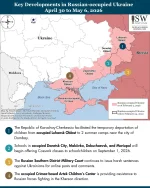
Russia - Ukraine war part ll. News and Discussions

Footage of a massive strike by the Russian TOS-1A heavy flamethrower system in the Zaporizhzhia region. The strike targeted Ukrainian army strongholds and underground utility lines in a village; the exact location is not disclosed. The TOS-1A is particularly effective against such targets.

To view this content we will need your consent to set third party cookies.
For more detailed information, see our cookies page.
 

The plateauing of Russia’s military strategy in Ukraine​


Another bloody campaign is expected in the ongoing Ukraine–Russia conflict. However, the efficiency of Russia’s current battlefield military strategy seems to have plateaued. If nothing changes radically in Russia’s approach to force constitution and application, the Kremlin cannot expect progress on the battlefield in 2026 to radically strengthen its negotiation position. It is critical to highlight this, given the ongoing contest for perception among wider audiences.

As 2026 unfolds, the Ukraine–Russia war still revolves around Russian attempts to fully capture the Donetsk region, anchor its front around the Oskil River and advance as far as possible into the Zaporizhia region. While Russia has held the battlefield initiative since mid-autumn 2023, it has proved unable to orchestrate a rapid breakthrough. In 2025, Russia tried to build a picture of omnipotence through attempts to advance on all fronts to strengthen its negotiation position. As a result, while Russia occupied almost 5000 km2, it barely managed to push Ukraine out of Pokrovsk-Myrnograd, and while it exploited Ukrainian shortcomings around Hulyaipole and Syversk to score some local successes, it could not break Ukraine’s will to fight.

Russia’s current military strategy

Russia’s current military battlefield strategy against the Ukraine Defence Forces was devised and tested in the second part of 2023–2025. Russia has a strong manpower advantage. Since the end of 2023, Ukraine has been struggling to relaunch its mobilisation process within the social and institutional constraints in which it operates. Russia has managed to find a socially acceptable and financially sustainable model of manpower replenishment through voluntary recruitment based on competitive financial inducements, and to dispense with mobilisation and associated risks. This has made it possible to steadily increase the size of Russian forces despite staggering losses. Russian forces numbered 420,000 troops in September 2023, 510,000 troops in May 2024 and 710,000 troopsin December 2025. Russia’s relative advantage in manpower has made it possible to create openings for advances along the front, pinning down Ukrainian troops while creating a preponderance of forces in some priority areas.

Russia’s manpower advantage has formed the basis for infiltration tactics based on highly dispersed small groups of 2–3 personnel. These tactics is a response to the Ukrainian “drone wall” initiative adopted to counter mechanised attacks. The idea behind infiltration tactics is very simple. Even though Ukrainian units carry out 7000–9000 tactical UAV strikes every day, it is difficult to find and target every group of 2–3 soldiers that attempts to bypass thinly manned Ukrainian forward positions. Some groups manage to slowly accumulate behind these positions, endangering them and forcing eventual withdrawal.

Russia has improved its reconnaissance and firepower. The introduction and mass use of glide bombs since early 2024 has allowed Russia to reintroduce piloted battlefield aviation. In 2024, 40,000 glide bombs were released by Russian combat planes. Russia used approximately 60,000 glide bombs in 2025. Ukraine has not managed to fully nullify this Russian advantage.

Russia has also successfully adopted tactical UAVs based on radio-guided first-person view (FPV) and mass use of fibre optic-guided FPV drones resistant to electronic warfare (EW). At the same time, cheap and ubiquitous loitering strike UAVs of the Molniya type have been introduced capable of carrying up to 10 kg distances of up to 40 km. These have generated a lot of problems. Moreover, in 2024, Russia saturated the Ukrainian rear with relatively cheap Supercam or ZALA ISR UAVs combined with Iskander short-range ballistic missiles, successfully targeting Patriot SAMs, M142 HIMARS, helicopters and combat aircraft.

Russia has learned from Ukraine the added value of separate UAV units specifically trained and equipped for and tasked with battlefield interdiction. The now infamous Rubicon units are attached to each Russian combined arms army. In 2025, Russia introduced a separate branch of its armed forces – Unmanned System Troops – which unites all the units and formations for battlefield interdiction and enemy UAV operator destruction.

Russian UAV operators have prioritised battlefield interdiction and the destruction of Ukrainian UAV operators, targeting rotations, logistics and the medical evacuation of Ukraine’s Defence Forces. Thissystemic approach was employed with deadly effect for the first time in the latter stages of the Kursk operation. Constantly attacking rotation, logistics and evacuation disrupt the link between rear and forward troops, with negative consequences for defence. Battlefield interdiction combined with infiltration tactics create major dilemmas for frontline commanders, eventually squeezing out forward Ukrainian troops due to the threat of encirclement and undermining rear support. Separately, specialised Russian UAV operators aided by glide bombs have prioritised finding, fixing and destroying Ukrainian UAV operators. Russia understands that diverse UAVs form the backbone of Ukrainian defences. Even when operators survive being targeted, it takes time to reconstitute combat capabilities given the destruction of support equipment.

A combination of these five factors explains Russia’s constant pressure along the frontline and its steady advances in 2024–25. In 2024, Russia occupied approximately 3600 km2 of Ukraine’s sovereign territory; in 2025 it occupied almost 5000 square km. These incremental advances build constant pressure and attrition, generates a picture for the ongoing contest for external consumption and influences international perceptions of war dynamics.

Ukrainian countermeasures and adjustment

The Russian cycle of tactical and technological adaptation over the past 2.5 years has forced Ukraine to adopt a broad set of countermeasures and adjustments.

In response to Russia’s heavy reliance on its manpower advantage, the Ukraine Defence Forces have prioritised the detection and destruction of Russian manpower. This goal was explicitly supported by Robert “Magyar” Brovdy when he was appointed commander of Unmanned Systems Command in June 2025 to counter Russia’s infiltration tactics. This prioritisation at the expense of other targets was contested within the Ukraine Defence Forces, but it has delivered the expected results. Since the summer of 2025, Russian force strength has stagnated at 710,000 to 720,000 troops; the number killed or wounded has been equivalent to monthly recruitment of 30–33,000 troops. The new head of the Ukrainian Ministry of Defence (MoD), Mykhailo Fedorov, has said that the Ukraine Defence Forces should aim to kill or wound 50,000 Russian troops a month to fully stabilise the front. This level of losses undermines the ability to improve professionalism among frontline formations through better sharing of combat skills among the recently recruited.

Ukraine has also employed counter infiltration measures. Infiltration through dispersed small infantry units in response to the efficiency of the “drone wall” has its downsides. Most of the troops involved in infiltration are of low quality in close combat. If positions gained through infiltration are not solidified, which is difficult under conditions of constant surveillance and strikes, such troops can be dislodged by elite formations provided that the proper conditions are created using UAVs. Such tactics were devised within the 2nd Corps of the National Guard and have been successfully tested at Kupyansk, Pokrovsk-Myrnograd and in the Dnipropetrovsk region in the past six months.

The Ukraine Defence Forces have successfully pioneered UAVs as effective air defence. Initially, this was mostly to counter Russian battlefield reconnaissance (Supercam, ZALA, Orlan-10) and kamikaze (Lancet) UAVs to disrupt Russian kill chains. It was then broadened to target Molniya loitering UAVs along with strategic one-way strike (Shahed-136/Geran-2) and decoy (Gerbera) UAVs, which enter Ukrainian airspace through the active frontline. In March 2026, the Ukraine Defence Forces intercepted a staggering 33,000 Russian UAVs. In addition, the Ukraine Defence Forces have made major progress in the middle strike campaign (a range 20–300 km from ground zero) to target Russian air defence complexes, EW, warehouses and command control nodes. An improved Ukrainian middle strike campaign imposes additional costs on Russian forces as they attempt to advance.

Unmanned Ground Vehicles (UGVs) have mitigated the manpower deficit. UGVs have proved to be a good response to Russian attempts to disrupt Ukrainian rotations, logistics and medical evacuation through the targeting and destruction of manned vehicles close to the frontline. In just three months of 2026, UGVs performed 24,500 combat tasks. According to the Ukrainian MoD, 167 units use UGVs for various support missions – half a year before the figure was 67 units. UGVs are an effective complement to the heavy UAVs that have been used for logistics functions since 2024.

Given the acute manpower deficit, some western observers privately or even publicly anticipated a Ukrainian frontline collapse in 2025. Such predictions were based on a template for previous wars, which calculates the density of forward troops in proportion to front length. However, the proliferation of UAVs for instant surveillance and strike has meant that Ukraine has managed to keep fighting, despite its thinly manned forward positions of fewer than 10 people per kilometre in places. So, once again, Ukraine has defied the direst predictions of gloom and doom.

Largely, Ukraine has managed to mitigate its own problems and Russia’s advantages. However, this should not be taken for granted as both sides compete for fleeting tactical and technological advantage. Furthermore, further progress with Ukrainian unmanned platforms should not deflect from the manpower-intensive character of the ongoing war. The role of human beings has changed from direct combat to planning, supporting, using and maintaining diverse unmanned platforms. The manpower deficit still plagues Ukraine’s war effort, imposing severe limits in terms of the simultaneous employment of diverse effects and forcing strict prioritisation. This problem is combined with ongoing attempts to improve command and control through corps reform. The corps system has reached the initial operational capability stage but full operational capability status is still months and much effort away.

Implications of the plateau in the efficiency of Russia’s military strategy

Despite the constant promises to the Kremlin by Russian generals of an eventual breakthrough from constant pressure along the thinly manned Ukrainian frontline, Russia’s grouping of forces is still as far from this goal as it was in 2024 or 2025. Russian forces can probably maintain steady advances at the tempo seen in the past two years while paying a steep price. The efficiency of the current Russian military strategy, devised in the second half of 2023, has plateaued, given Russian limitations and Ukrainian countermeasures and adaptations centred on diverse unmanned platforms.

Thus, the Russian military will not be able to radically strengthen Russia’s negotiating position through major battlefield successes. Without innovations in Russian force composition, technology or tactics, in combination and at scale, the Kremlin will probably seek to strengthen its negotiation position through attacks on Ukrainian critical infrastructure to degrade it beyond any chance of quick repair.

The upcoming shortage of missile defence interceptors, given their consumption in the ongoing Middle East war, is a major concern for the Ukrainian leadership – with no solution in sight. The situation has forced Ukraine to adopt a ratio of “one missile to one interceptor”. Thus, Ukraine’s missile defence will be a major concern for its international partners in the near future.


Putin’s Strongman Image Is Fading as Ukraine Brings War Home to Russia​


With the front line stalled, Russian casualties topping one million, the economy suffering and missile and drone strikes becoming commonplace, a deep sense of discontent has spread through the country in recent months. It potentially poses the gravest challenge to Putin’s rule so far—and may be more insidious than the aborted putsch by warlord Yevgeny Prigozhin in 2023.

Russian security services have responded with draconian new restrictions, blocking most online activity in an imitation of China’s “Great Firewall.” The restrictions, justified by the need to prevent drone strikes that continue regardless, are so severe that even nationalist loyalists supporting the war have started talking about a looming revolution. Rumors of alleged coup preparations and infighting between various parts of the security establishment swirl through Moscow salons.

It doesn’t mean that revolution is imminent, nor that Putin, currently 73 years old, will be sidelined soon. But the change in mood is remarkable when compared with just last December, when Russian officials were buoyed by hopes that President Trump will pressure Ukraine into a peace deal on Moscow’s terms, lifting economic sanctions and unleashing a business bonanza.

Psychologically, the turning point came in January. That was when Putin’s so-called special military operation, which according to the Kremlin’s narrative aims to “denazify” Ukraine, blew past the duration of the 1941-45 war against Nazi Germany. That conflict is described in Russia as the “Great Patriotic War.”

“Every day since then adds to the sentiment that we aren’t worthy of the memory of our grandfathers,” said Abbas Gallyamov, a former Putin speechwriter who is now an opposition politician living abroad. “Putin created this cult of grandfathers, and now it’s backfiring on him.”

Kremlin spokesman Dmitry Peskov has said that the war caused a “phenomenal consolidation of the society around the president,” adding that it has lasted more than four years because its goals have yet to be fully achieved.

Anastasia Kashevarova, a pro-war Russian media celebrity, highlighted the shift in national mood when she noted on Telegram this week that the grandfathers in World War II had “already reached Berlin by now, and we for some reason continue just shaking our fists and talking nonsense about red lines.”

Satellite image showing a large plume of black smoke rising from the Ust-Luga oil terminal.
A smoke plume rises after drone strikes at Russia’s Ust-Luga oil terminal on the Baltic Sea in March. Vantor/Associated Press

Ukrainian drone and missile strikes that target Russian oil export facilities, refineries and military plants have become routine in recent months. Some 70% of Russia’s population, including areas 1,000 miles away that considered themselves safe, are now within Kyiv’s range. Initially, these attacks contributed to a rally-around-the-flag effect. But now, with Ukrainian forces becoming more efficient, they merely illustrate Putin’s weakness.

“Putin is perceived today as an old grandpa, a grandpa unaware about the real state of affairs in people’s lives,” said Alexander Baunov, a senior fellow at the Carnegie Russia Eurasia Center and author of a Russian bestseller about the demise of autocratic regimes in 1970s Spain, Portugal and Greece. “He’s no longer seen as the protector. He’s no longer seen as Superman.”

In a recent conversation with Trump, Putin suggested a brief cease-fire to allow the victory parade to go ahead. Ukrainian President Volodymyr Zelensky countered with a unilateral cease-fire that was supposed to start Wednesday. The Russian military, however, continued attacks on Ukrainian cities past that deadline, making it likely that fighting—and Ukrainian drone and missile strikes—will carry on unabated through the parade weekend.

“If Putin could freely choose, he would not have this parade. He doesn’t want to stand somewhere in the open, given the damage that has been done to Russian air surveillance and air defense, and the way Ukrainian drones and missiles are choosing where to fly,” said Nico Lange, a former senior German defense official who runs the IRIS think tank based in Germany. “But because of the quasi-religious meaning of May 9, he also cannot not have the parade.”

A local TikTok influencer captured public frustration in a post from the Volga region of Chuvashia, some 600 miles from Ukraine, an area that came under attack this week. Ukrainian missiles and drones targeting a key Russian military plant there also damaged the city’s main shopping mall and caused civilian casualties.

Instead of brimming with patriotic rage, Vova_Cola (who has 178,000 followers) urged Putin and Zelensky to sit down quietly and show that “brain beats brawn” so that people don’t have to die again and children grow up in peace.

“Everyone—possibly with the exception of Putin—has now started to understand that the war is not going to plan,” said Sergey Radchenko, a history professor at Johns Hopkins University.

For Radchenko, the key turning point was the series of Ukrainian attacks that devastated the refinery and the oil export port of Tuapse on the Black Sea in recent weeks—causing widespread pollution in a coastal area of popular tourist resorts. “This is when the war came home to those people who used to support it from afar,” he said. “The conclusion that some may make now is that the war was a bad idea. For others, of course, the conclusion is that it’s not being pursued vigorously enough.”

The latter is certainly the view of many military analysts and patriotic bloggers with huge followings on social media. They too, however, increasingly chafe at state-imposed restrictions and high-level corruption. The bête noire of that nationalist wing is Russia’s former defense minister and current National Security Council chief Sergei Shoigu, a onetime Putin confidant blamed for mishandling the initial stages of the war.

While four of Shoigu’s former deputies at the Defense Ministry have since been arrested on corruption charges, the ultra-patriots were rattled when Col. Gen. Aleksandr Chayko, who led the failed campaign to take Kyiv in early 2022, was promoted to become new commander of the Russian Air Force.

Nationalist commentator Aleksandr Kartavykh wrote on his popular Telegram channel that amid the current “collective psychosis” in Russia, society’s reserve of stability would last no more than two months, after which he predicted terminal revolutionary change.

The sense of widespread malaise and discontent was crystallized by Victoria Bonya, an Instagram influencer and former Russian TV star who lives in Monaco, and who stayed away from politics until now. In an Instagram reel that garnered 1.6 million likes, she told Putin he was unaware of the country’s real problems because thieving governors and bureaucrats keep lying to him, and because the country is governed by fear.

She didn’t directly mention the war—except for a reference to the Black Sea oil slick—focusing instead on government failure to respond to floods in the Caucasus, on how cheap Chinese goods are killing local entrepreneurs and on how new bans on Instagram make it impossible to communicate with customers, relatives and friends.

“You don’t know what is happening in the country,” she told Putin, while insisting on being a loyal Russian citizen. “People will become tired of being afraid. They are being squeezed into a spring, and one day this spring will snap.”

Gallyamov, the former Putin speechwriter, said those sentiments expressed a trend. “People who didn’t care about politics before, now find it fashionable to express political views, to be concerned about the suffering of the people and to complain about authorities,” he said. “Historically, such fashions usually precede revolutions.”

The Kremlin responded to Bonya by saying it will take her advice under consideration. Other Kremlin officials have said in public that recent prohibitions have gone too far—though no action was taken to reverse them.

“The Kremlin understands that there could be serious discontent ahead, and so it has decided to allow low-level discontent to manifest itself for now,” said Marat Gelman, a former Putin adviser and senior state TV executive who now lives abroad and supports the opposition.

“For now he has enough resources to crush any civil revolt.”

John Sullivan, who served as U.S. ambassador to Moscow when the invasion of Ukraine began in 2022, wasn’t so sure. “In Russia, they say that things don’t happen fast, but when they happen, they happen fast,” he said. “I wouldn’t have said it a year or two ago, but I think it is possible now.”

 
Russians finally coming to terms with the fact they’ve lost the war and Putin has gotten them into a massive quagmire with no end in sight.

-Russian forces have stagnated at the front
- Losing 30,000+ dead and wounded every month
- Ukrainian deep strikes into Russian territory are now the most effective since the war began
- Terrible economy
- Russia has suffered strategic defeat across the globe in Syria, Venezuela, Iran etc
 
Russians finally coming to terms with the fact they’ve lost the war and Putin has gotten them into a massive quagmire with no end in sight.

-Russian forces have stagnated at the front
- Losing 30,000+ dead and wounded every month
- Ukrainian deep strikes into Russian territory are now the most effective since the war began
- Terrible economy
- Russia has suffered strategic defeat across the globe in Syria, Venezuela, Iran etc
Nonsense post.

Stop reading ISW. They aren't exactly unbiased.
 

Major Advances Reported On Ukrainian Southern Fronts | The Push Has Intensified [7 May 2026]​


To view this content we will need your consent to set third party cookies.
For more detailed information, see our cookies page.
 
Footage of the new Russian heavy-duty FPV drone "Provod" striking an abandoned Ukrainian Roshel Senator APC armored vehicle. The Roshel armored vehicle is equipped with numerous electronic warfare systems, but they are not resistant to strikes by fiber-optic-guided drones. Roshel Senator armored vehicles have been manufactured in Canada since 2018.

To view this content we will need your consent to set third party cookies.
For more detailed information, see our cookies page.
 
The drone balance of power has decisively shifted to Ukraine. Drone strikes deep into Russia and at operational depth are almost a daily occurrence now with a significant amount of success. Ukrainian FPV interceptors have also significantly degraded Russian drone capabilities.
 
Crazy Putin
What a psycho
He has nothing else to do than invade a neighbor country killing its people.
He kills his own people in the process.
a great leader
 
The drone balance of power has decisively shifted to Ukraine. Drone strikes deep into Russia and at operational depth are almost a daily occurrence now with a significant amount of success. Ukrainian FPV interceptors have also significantly degraded Russian drone capabilities.
What source do you have to back up these assertions?

Russia is firmly entrenched in Ukraine. Their incorporation of drones into their battle plans continue to evolve and improve.
 

Critical Situation Emerging in Zaporizhia | Ukrainian Forces Continue Pushing [8 May 2026]​


To view this content we will need your consent to set third party cookies.
For more detailed information, see our cookies page.
 
Seems no end in sight to this war
 
I think Russia should stop with whatever It got till day. There are big fight coming, Russia would need Russians to fight those battles.

043026-1.webp
 
To view this content we will need your consent to set third party cookies.
For more detailed information, see our cookies page.
 

Users who are viewing this thread

Pakistan Defence Latest

Latest Posts

Back
Top