Russia - Ukraine war part ll. News and Discussions

It'll last a few decades. Doubt it'll be as long as the Hundred Years War.
In 10y those kids will go to the 3 day war.
After them there will be another kids.
Lives as yesterday’s garbage

To view this content we will need your consent to set third party cookies.
For more detailed information, see our cookies page.
 

Putin’s Forces Are Barely Inching Along on the Battlefield​


The Russian military has yet to solve a fundamental problem: how to make big advances in eastern Ukraine when drones are everywhere.

President Vladimir V. Putin of Russia has sought to convince President Trump that his troops are marching toward inevitable victory in Ukraine, arguing that Kyiv should hand over the entire eastern Donbas region to avoid impending defeat.

But the situation on the battlefield tells a different story.

After making gains late last year, the Russian military has slowed to a crawl. In some parts of Ukraine, it has lost territory. At its average monthly rate of advance so far this year, it would take Russia more than three decades to seize full control of the Donbas, which the Kremlin has set as a condition for ending the war.

The slowdown may be temporary, and it is due at least in part to seasonal factors. Russian troops tend to pick up speed over the summer, aided by better weather and foliage that provides more cover from drones. In recent days, Ukrainian officials have warned that Moscow’s troops are gearing up for new offensives and have intensified operationsacross the front.

Still, Russia enters this push on the back foot. It has faced setbacks this year, including the loss of Starlink satellite internet access that helped guide its drones. The Kremlin’s throttling of the Telegram messaging app, as it tightens control over the Russian internet, has also hampered soldiers’ communications.

More broadly, Russia has yet to solve the fundamental problem of how to make big advances on a battlefield saturated with drones. The days of sending masses of troops charging through front lines in armored vehicles are mostly over.

Instead, the contest between Kyiv and Moscow is largely one of developing better drones, and better defenses against them. On certain parts of the front, Ukraine has gained the upper hand in recent months with rapid advancements in technology, production and tactics. But Russia is working furiously to catch up, building out a bigger drone force after rolling out a successful elite drone unit known as Rubicon.

Drones have forced Russian troops to change their strategy. Now they try to infiltrate territory gradually with small teams of soldiers, often on foot. This has resulted in an ever-growing swath of territory known as the “gray zone,” where troops from both sides are present and control is not clear-cut.

“The best they can do is these infiltration tactics and the targeting of the support networks pretty far behind the line — targeting Ukrainian drone teams and logistics support,” said Dara Massicot, a senior fellow at the Carnegie Endowment for International Peace. “But it doesn’t lead to rapid gains. They are kind of stuck.”

As the war effort stalls, it is putting the Russian government under increasing economic and political strain.

Mr. Putin’s approval ratings have fallen to their lowest levels since the start of the war, as the economy buckles under vast military spending and as mobile internet blackouts, imposed in part to prevent Ukrainian drone attacks, anger ordinary Russians.

Late Saturday, Mr. Putin suggested in a news conference the possibility of ending the war. “I believe the matter is coming to a close, yet it remains a serious thing,” he said. But at the same time, he struck notes of defiance, particularly against European nations supporting Ukraine.

For now, the Kremlin is fighting on. But its challenges on the battlefield complicate the narrative of imminent victory Mr. Putin has been selling to the Trump administration as it has brokered peace talks with Ukraine. Russia is looking to put pressure on Kyiv to cede the parts of the Donbas that its military has failed to capture.

Even as Russia struggled on the battlefield this March, Mr. Trump, in an interview with Politico, expanded on his earlier statement that President Volodymyr Zelensky of Ukraine had “no cards” by saying he now had “even less cards.”

On Thursday, the Kremlin’s chief foreign policy adviser, Yuri Ushakov, said that until Ukraine withdrew from the region, Russia saw no point in further peace talks. Ukraine has refused to hand over that territory, though negotiations have continued over turning it into some sort of international demilitarized zone.

While Russia has not figured out how to take and hold large swaths of land through infiltration, it may believe that a gradual push is a better approach anyway, Ms. Massicot said. That avoids the risk of big operations that could go wrong and raise questions about the prospects for victory, she added.

“I think it’s a combination of not having an operational solution and the Kremlin being satisfied with this level of political risk, and hoping that peace talks will negotiate away the difficult part, which is fighting for the rest of the Donbas,” she said.

Whatever Russia’s strategy, it is clear that the pace of Russia’s advance has slowed this year, according to the three main organizations tracking the battlefield, the Institute for the Study of War, Black Bird Group and DeepState.

Two of the groups say there have been months in which Russia suffered net territorial losses, though the ever-widening gray zone on the front has led to differing interpretations of what constitutes captured territory.

Russia’s meager gains in the past three months, according to Black Bird’s statistics, amounted to its worst battlefield performance within Ukraine since 2023.

What limited gains Russia has made have come with heavy casualties. An estimated 352,000 Russian soldiers had died in the war by the end of last year, according to figures released this weekend by the Russian outlets Mediazona and Meduza. That is more than six times the number of U.S. troops killed during the Vietnam War.

As Russia’s losses mounted, it also missed recruiting targets in the first few months of the year, according to U.S. and European officials. That has raised questions about how long the Kremlin can sustain its war effort without resorting to another unpopular draft.

Russian soldiers have described the peril of being ordered to infiltrate territory where every move is tracked by Ukrainian drones.

One 24-year-old soldier, who fought in the Donbas before deserting the force last year, told The New York Times that his unit spent the better part of a month trying to establish a foothold in a single town outside the city of Pokrovsk, as assault troops tried to move in but were wiped out by Ukrainian drones.

Their commander then ordered the troops to start infiltrating the town in two-man teams, which slipped in day after day until they built up enough of a presence to secure the territory. The pairs kept their distance from one another to avoid bunching up in a single location and becoming a target, the soldier said, speaking anonymously for security reasons.

The reality of the gray zone means that injured Russian troops are often left stranded in contested territory, their units unable to retrieve them. The Russian soldier recounted trying to send water and candy bars by drone to a stranded comrade dying of dehydration.

For much of last year, Russia’s small-team infiltration tactics worked, albeit slowly. According to Black Bird, the Russian military gained 1,768 square miles of territory in Ukraine over the course of 2025, an area a bit larger than Rhode Island.

Russia has spent years fighting for Pokrovsk, as well as the town of Chasiv Yar to the northeast. But the front line still essentially runs through them, underscoring the extent to which the battlefield remains broadly stalemated.

Ukraine’s military has its own problems, including a longstanding personnel shortage and high rates of desertion. Drones have enabled it to blunt the larger Russian Army’s advances, but when Russia loses territory, it tends to shift into the gray zone, not back to Kyiv’s outright control.

“Many of the things that are hindering the Russian advance are also making it difficult for Ukraine,” said Emil Kastehelmi, a military analyst with Black Bird, which is based in Finland.

Ukraine is seeking to raise the war’s costs for the Kremlin by striking oil installations and other targets deep inside Russia, and by trying to inflict more casualties.

Defense Minister Mykhailo Fedorov has said that Ukraine’s aim is to kill or seriously wound 50,000 soldiers a month, up from what it says is about 35,000 now. That, Mr. Fedorov said, would impose “costs on Russia that it cannot bear” and “force peace through strength.”

Ukrainian soldiers told The Times that Russia’s activity in the Donbas had recently heated up, raising the possibility that its advance could pick up speed.

Senior Lt. Maksym Bakulin, a Ukrainian officer in the Donetsk region, which makes up most of the Donbas, said Russia’s infiltration operations had begun to improve. For about three weeks, he said, spring foliage had allowed its troops to move covertly, and the drier weather meant they could advance on motorcycles again, rather than on foot.

There has not yet been a “massive push,” Lieutenant Bakulin said by telephone, but “everyone is talking about it, it could happen. We must always be ready.”


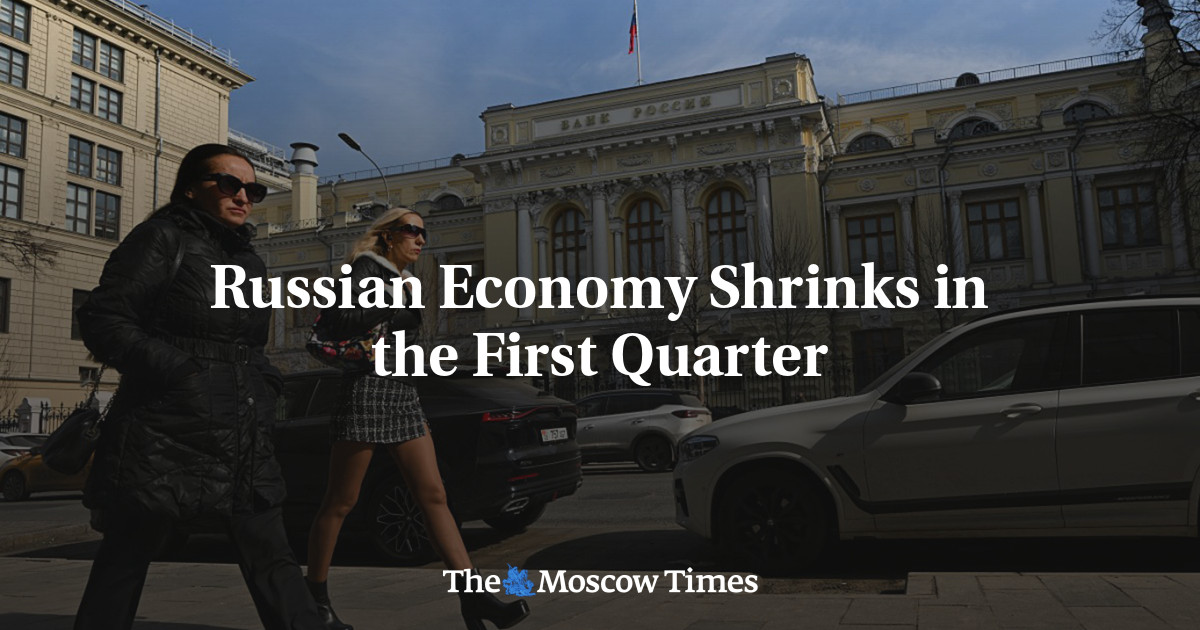
Russian Economy Shrinks in the First Quarter


Russia’s economy contracted in the beginning of the year as weak business activity and declining oil and gas revenues strained public finances.

Gross domestic product, which measures all the goods and services produced in the economy, fell by 0.5% year-on-year between January and March, according to a medium-term forecast published on Thursday by the Central Bank.

The decline significantly missed the bank’s earlier projection of 1.6% annualized growth for the period. Policymakers attributed the slump to a value-added tax increase at the start of the year, “unfavorable weather conditions,” as well as three fewer working days in January and February than last year.

In April, President Vladimir Putin said some of those reasons were insufficient in explaining why the economy is performing worse than expected and called for urgent measures to revive growth.

The slump comes as the Central Bank gradually cuts its key interest rate from a two-decade high. Punishingly high borrowing costs over the last two years have stifled manufacturing and business investment, even as policymakers struggle to rein in inflation that continues to erode domestic purchasing power.


The Russian economy contracted 0.5% in Q1.
The massive military spending propping up growth can only get you so far Vladimir…
 

Russia is stumbling on the battlefield​


This year’s Victory Day parade in Moscow on May 9th involved nothing triumphal. For the first time in two decades tanks and other military vehicles did not rumble through Red Square in celebration of the Soviet Union’s role in defeating Nazi Germany. Russia’s authorities deemed it too great a risk to cram armoured vehicles and missile-carriers into nearby staging areas—they would have made far too juicy a target for Ukraine’sincreasingly effective drones. In the run-up to the big day, mobile internet services in Moscow and St Petersburg were cut off for security reasons. Large numbers of air-defence systems were redeployed from remote parts of the country.

Rubbing in the insult Ukraine’s president, Volodymyr Zelensky, issued a decree to “permit” the parade to proceed, saying that Red Square would not be attacked. This came shortly after Ukraine and Russia agreed to a three-day ceasefire brokered by America, though by May 10th both sides were accusing the other of having violated it. Vladimir Putin, Russia’s president, speaking after the parade, said he thought the war was “coming to an end”.

The symbolism of the diminished parade is hard to overstate. A day that was meant to epitomise the military might of Mr Putin’s Russia instead signalled its vulnerability and weakness. In this, at least, it was an accurate reflection of Russia’s battlefield setbacks, and of Russia’s fear of the growing effectiveness of Ukraine’s long-range strikes.

For the first time in nearly three years the initiative in the war appears to have shifted in favour of Ukraine. Having got through a harsh winter, when its cities and energy grid were pummelled almost nightly by massed Russian drones and missiles, Ukraine is now turning the tide. It is imposing increasing costs on Russia by almost every measure.

Not only has Russia’s expected spring offensive been a flop, but in April Russian forces suffered a net loss of territory for the first time since August 2024 (when Ukraine seized territory in Russia’s Kursk oblast). The Institute for the Study of War (isw), a think-tank in Washington, recently listed contributing factors to Ukraine’s successes: ground counter-attacks and mid-range strikes by Ukraine’s forces; the end of Russia’s illicit use of Starlink terminals in Ukraine; and the Kremlin’s paranoid throttling of the Telegram messaging app at home. By our calculations, based on isw maps, Russia has lost control of 113 square kilometres over the past 30 days.

“Overall, it feels like an inflection point in the war,” says Sir Lawrence Freedman, an emeritus professor of war studies at King’s College London. “If the Russians have nothing to show for their efforts I would not be surprised if in some places things start crumbling.” Losses of soldiers, running at 35,000 a month, exceed the pace at which Russia can recruit replacements. And behind the raw numbers—nearly 1.4m killed and seriously wounded since Russia’s invasion—is a grimmer new development. Until last year, the ratio of killed to wounded Russian soldiers may have been between 1:2 and 1:3, poor by modern standards but roughly in line with past conflicts. In March Mr Zelensky said that Russia was suffering almost two dead soldiers for every one wounded. “The stoicism and fatalism of Russian soldiers must be wearing thin,” says Sir Lawrence.
The dead-to-wounded ratio appears to be rising because so many casualties—perhaps as many as 80%—are now caused by so-called first-person view (fpv) drones.

Loaded with explosives, these drones hunt enemy soldiers and imperil attempts at medical evacuation, which in any case has never been a high priority for the Russians. “They simply leave their wounded on the battlefield,” says Seth Jones, a senior military analyst at the Centre for Strategic and International Studies in Washington.

Russian soldiers complain that Ukraine’s new autonomous drones are inaudible until they dive. They use artificial intelligence and are controlled with fibre-optic cables to thwart jammers. Alexy Chadayev, the director of a drone-development and testing facility in the Russian city of Veliky Novgorod, wrote on April 7th that Russia had “lost leadership” over the past six months to Ukraine and was struggling to move units close to the front.

“We have enormous problems with last-mile logistics,” he said. “Up to 90% of our [drone-team] losses are currently occurring there.” Russia has been forced to impose restrictions on the size of convoys in Donetsk to make them harder to detect. Only two lorries are allowed to move together.

A drone “kill zone” of some 20km between the front lines is being extended far to the Russian rear, Sir Lawrence argues. This has a greater impact on Russian operations than Ukrainian ones because the Russians are trying to advance. For Ukraine it is far more effective to take out the supporting infrastructure for an offensive than it is to kill the few troops who now lead attacks.

The Ukrainians face similar problems in the drone-saturated killing zone, but they place a much higher value on the lives of their soldiers, and so make greater use of unmanned ground vehicles (ugvs) for evacuation and carrying supplies close to the front. And in most places they are not trying to advance.

Farther back from the front line, Russia is suffering mounting losses to Ukraine’s mid-range drones (with ranges of 50km to 300km). Mr Zelensky recently claimed that procurement of such systems so far this year is five times greater than in all of 2025. Targets include ammunition depots, drone warehouses, command-and-control posts, surface-to-air-missile launchers, radars and deployment points where armoured vehicles and troops are concentrated.

Added to the battlefield setbacks is the increase in the scale, range and intensity of Ukraine’s deep-strike operations in Russia. In March, for the first time, Ukraine surpassed Russia in the number of long-range drone attacks it launched. Economic and military targets almost 2,000km from the Ukrainian border are regularly being hit. That brings 70% of Russia’s population within range of Ukrainian drones. “The attacks have caused psychological damage to Russia,” says Mr Jones.

On April 25th four of Russia’s best combat aircraft were damaged in a strike on Shagol airfield deep in the southern Urals. An oil refinery and pumping station at Perm, in the Urals, was set ablaze in early May. Oil infrastructure across multiple regions and oil-export hubs are being hit with increasing frequency. In April attacks on ports and refineries forced Russia to cut production by as much as 400,000 barrels a day, Reuters reports. On April 29th Mr Zelensky claimed that internal Russian reports indicated that the ports of Novorossiysk and Ust-Luga were operating at respectively 38% and 43% below capacity. However, overall Russian oil exports only fell by 7% in April and its revenues nearly doubled thanks to the Iran war.

Russia’s size and the systematic year-long Ukrainian campaign to degrade its air-defence systems makes protecting even valuable assets almost impossible. “They can’t defend against drone attacks with area defence,” says Mr Jones. “And they don’t have point defence at many of the locations where they need it.” Whereas Ukraine has developed several types of interceptor-drones that are now shooting down about 95% of Russia’s Shahed-type attack drones, Russia has been slow to produce its own versions.

The crucial question is whether Russia’s various setbacks—on the battlefield or through the destruction of economic infrastructure—are indicators that Mr Putin’s opportunities in Ukraine are shrinking. Sir Lawrence says much depends on the next few months, and in particular on whether Russia can counter Ukraine’s advances in drones. Another concern is whether Russia is husbanding its forces for a big offensive in the summer. “The reality is that they are struggling at the front and not much is going right for them,” he says. Mr Jones agrees: “It’s hard to see how things can improve for Russia. If you’re briefing Putin, it’s a pretty bleak picture.” ■

 
Russian FAB-500 bombs strike the temporary deployment site of the 106th Territorial Defense Brigade of Ukraine, located in an abandoned building. The video was filmed in the village of Novaya Sloboda in the Sumy region of Ukraine. The FAB-500 bombs were dropped by a Su-34 fighter-bomber. The bombs destroyed the Ukrainian temporary deployment site.

To view this content we will need your consent to set third party cookies.
For more detailed information, see our cookies page.
 
A battle between Russian soldiers and Ukrainian FPV drones and a bunker assault. Episodes of combat between Russian assault troops from the 80th Tank Regiment, Force Group Center, in the Dnipropetrovsk area. The video shows countering Ukrainian FPV drones in the field and storming a Ukrainian stronghold. It's worth noting that a single person can counter FPV drones with considerable risk. During the assault, Ukrainian FPV drones also attacked Russian soldiers. As a result of the battle, the Ukrainian underground stronghold was captured; footage from inside is shown at the end of the video. Some Ukrainian soldiers surrendered.

To view this content we will need your consent to set third party cookies.
For more detailed information, see our cookies page.
 

Russia Captures New Area Near Pryluky | Advances Reported in Markove [11 May 2026]​


To view this content we will need your consent to set third party cookies.
For more detailed information, see our cookies page.


Western Kostiantynivka Defenses Breached | Frontline Shift After Weeks of Stalemate [12 May 2026]​


To view this content we will need your consent to set third party cookies.
For more detailed information, see our cookies page.


Russian Forces Appear Deep East of Kostyantynivka | City Pressure Rising [13 May 2026]​


To view this content we will need your consent to set third party cookies.
For more detailed information, see our cookies page.
 
Footage of Russian FPV drones attacking Ukrainian drone operators located in a garage and an abandoned building. The operators were observed landing their drones. The location and models of the FPV drones were not disclosed. The video was filmed by soldiers from the Russian 4th Separate Motorized Rifle Brigade, 1194th Motorized Rifle Regiment.

To view this content we will need your consent to set third party cookies.
For more detailed information, see our cookies page.
 

Kyiv Under Massive Assault | Russia Launches 1,500+ Missile & Drone Strike Across Ukraine​


To view this content we will need your consent to set third party cookies.
For more detailed information, see our cookies page.
 
Did Stalin care of millions of deaths?
Putin doesn’t care of 1 million Russians dead or 10 millions, what he wants is a piece of Ukraine. But what happens with Rubio? Suddenly he changes the tone.

To view this content we will need your consent to set third party cookies.
For more detailed information, see our cookies page.
 
Ukrainian military personnel released footage of their repelling an attack by a Russian FPV drone. The video was filmed in the Donetsk sector. As a result of the attack, a Ukrainian serviceman was reportedly wounded, leading to the amputation of part of his leg.

To view this content we will need your consent to set third party cookies.
For more detailed information, see our cookies page.
 
Footage of Russian FPV drone strikes on a temporary Ukrainian military base located in a barn. The drones first destroyed the door and then began attacking the interior of the building. The video was filmed by the 7th Brigade; the location and drone models were not disclosed.

To view this content we will need your consent to set third party cookies.
For more detailed information, see our cookies page.
 

Russia Captures Charivne | 20+ km² Gained as Pressure Builds in Sumy [15 May 2026]​


To view this content we will need your consent to set third party cookies.
For more detailed information, see our cookies page.


Northern Border Threat Growing? | Fighting Continues as Odradne Is Recaptured [16 May 2026]​


To view this content we will need your consent to set third party cookies.
For more detailed information, see our cookies page.
 
To view this content we will need your consent to set third party cookies.
For more detailed information, see our cookies page.


To view this content we will need your consent to set third party cookies.
For more detailed information, see our cookies page.


Ukraine is now striking targets in the Moscow region
 

Users who are viewing this thread

Pakistan Defence Latest

Latest Posts

Back
Top