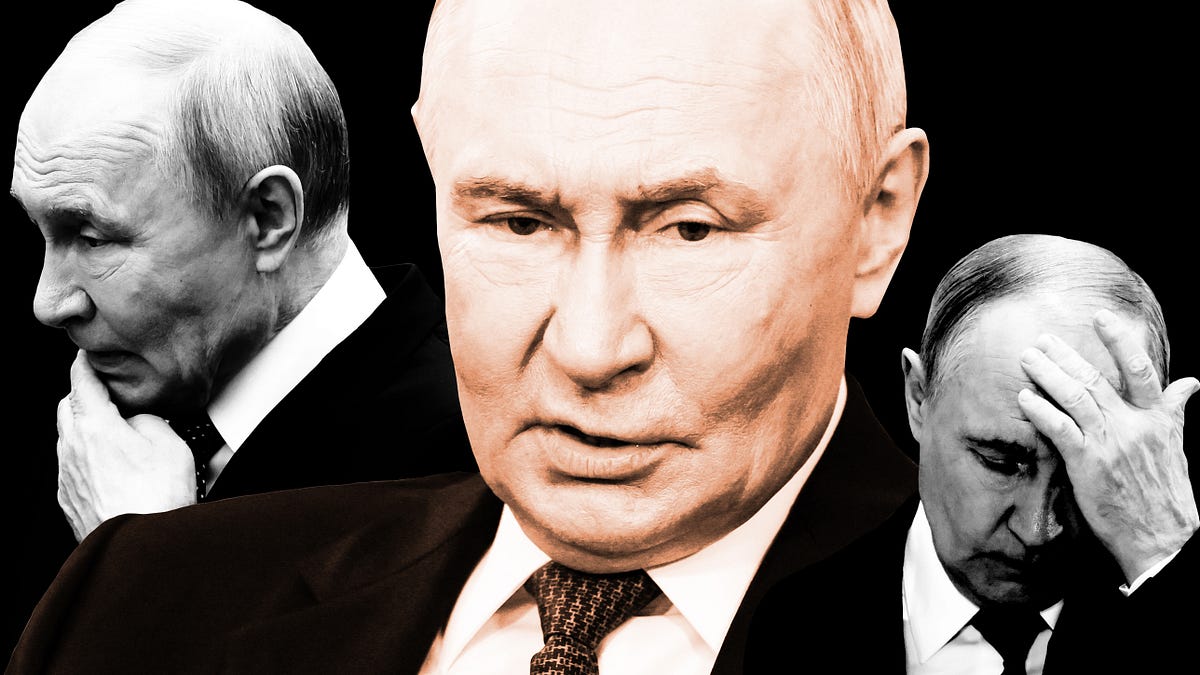
The Wheels Are Coming Off Putin’s War
A FEW YEARS AGO, when there was still some leeway for acts of public dissent in Russia, some protesters against the Kremlin’s imperialist policy toward Ukraine
carried signs that flipped the patriotic slogan
Krym nash, “Crimea is ours,” into
Nam krysh—a humorous abbreviation of the slang phrase meaning “We’re done for.”1 Today,
nam krysh seems prophetic: The occupied peninsula that became the (stolen) jewel in Putin’s crown in 2014 finds itself under a Ukrainian blockade that has all but cut it off from the Russian mainland—and, since Friday, under a
state of emergency.
Starting in May, the vaunted “
land bridge” by which Russia supplied occupied Crimea, the Novorossiya highway, turned into a death trap for trucks due to
unrelenting Ukrainian drone attacks. Since then, other strikes have targeted
bridges and taken out ferry operations. Severe fuel shortages are the blockade’s tangible result. Sergey Aksyonov, the Kremlin-installed governor of Crimea, recently
announced a complete halt to gas sales to individual car owners; fuel is reserved for public transit and official vehicles. Power outages have become
widespread; the latest reports show that food shortages are already starting. The Crimea vacation long coveted by Russians has become a nightmare.Recent data from
travel websites show that nearly 80 percent of hotel bookings on the peninsula have been canceled. While a few brave or stupid souls are still heading to Crimea, far more people are getting out. Thousands of cars have been lining up at the Crimean Bridge (a.k.a. the
Kerch Strait Bridge, famously attacked multiple times by Ukraine) in the direction of the mainland, with hardly any traffic the other way.
The Ukrainian effort to turn the Crimean peninsula into “an island,” in the words of Ukrainian defense minister Mykhailo Fedorov, has marked a new chapter in the war, in both symbolic and practical ways. Russia’s
Krym nashmoment—the annexation of Crimea in March 2014, immediately followed by the Russian incursion into the Donbas—was the beginning of Putin’s proposed
reconquista of Ukraine. Moreover, the Crimea grab was almost universally seen as
de facto irreversible even by those who were optimistic about the prospect for Ukraine to recapture its other occupied lands. Today, while no one believes Ukraine could recapture the peninsula soon, the occupation powers are beleaguered.
In his televised address last Wednesday, Ukrainian president Volodymyr Zelensky
saidthat the actions taken to isolate Crimea were part of a “carefully calculated operation” intended, with help from Ukraine’s Western allies, to “force Russia to choose peace.” Some Russian propagandists
saw this statement as a signal that Ukraine was preparing an actual military operation to recapture Crimea. That seems doubtful: Such an operation would be extremely costly at a time when Ukraine still faces significant manpower shortages on the frontlines. One possibility, however, is that if supply lines are cut off, the Russian military contingent on the peninsula may be forced to evacuate—opening the way to an unresisted Ukrainian capture that would, in effect, be a reversal of Russia’s bloodless seizure of Crimea in 2014. (As
the saying goes, history does not repeat itself but it often rhymes.)
What’s not in doubt is that Ukraine has succeeded in turning Crimea from Russia’s prize into a liability. And it’s part of a larger Ukrainian strategy: The next day, on Thursday, Zelensky
announced that he had approved a forty-day “
operation of influence” against Russia, coordinated with Ukrainian intelligence and intended to force Moscow to end the war.
A creeping sense of
nam krysh is spreading far beyond Crimea. The recent
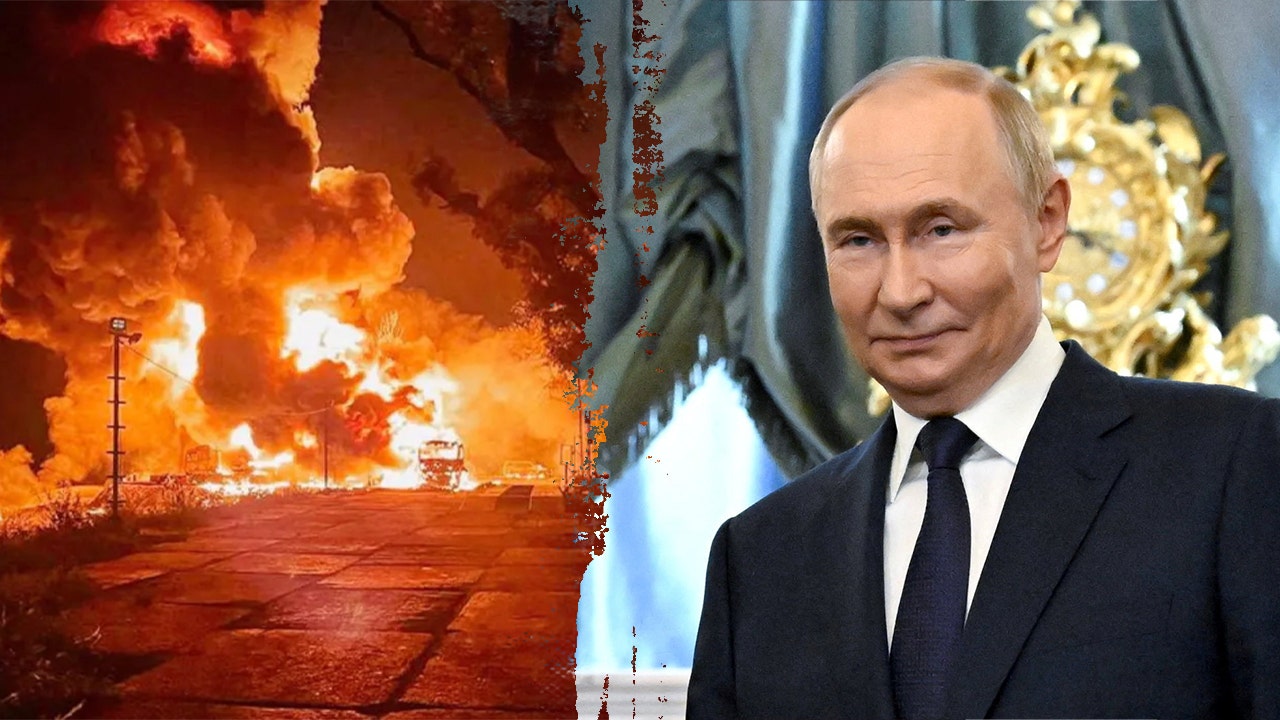
Ukrainian drone strikes on oil refineries in Moscow, which produced apocalyptic images of plumes of smoke and flames rising over the city and shut down a key gasoline-producing facility for at least the next six months, became a rude wakeup call for many Muscovites who have clung to the belief that the war won’t come near them except on television. (And it keeps coming near: Thursday, a
missile alert was issued in the Moscow region, with residents advised to shelter indoors.) What’s more, it’s not just in Crimea that Ukrainian strikes against the Russian oil industry are causing a
fuel crisis. As of June 24,
reports Radio Liberty/Radio Free Europe, 55 of Russia’s 83 regions had either government-imposed restrictions on gasoline and diesel fuel sales or caps imposed by private companies. Shortages have also been observed in nearly all remaining regions. Some commentators have
recalled the late John McCain’s 2014
comment that Russia is “a gas station masquerading as a country”—which greatly offended Russian patriots at the time—and acidly noted that the gas station has run out of gas. At this point, it’s bidding to buy gasoline from Kazakhstan—and
getting turned down.
Video clips in which Russian motorists report shut-down gas stations and multi-mile-long lines at the few that remain open are
proliferating faster than Russian propaganda can churn out talking points about hysteria and hype. “I don’t want to start trouble, especially here on my page, but I’m afraid that we’re in for hard times, lean times. God forbid, of course, but these are hard times,”
says one man in such a video, waiting in line for forty minutes after making the rounds of six other stations. In another clip, a man
curses about thieves siphoning off gas from his tank a day after he filled up. Meanwhile, a woman who seems sincerely perplexed inquires, “Hey guys, what’s going on with the gas stations? I don’t watch the news. Where are people filling up? What’s happening? The lines everywhere are a kilometer long.”
Here’s a tip for you, lady: Find a news source outside the Kremlin propaganda machine.
MEANWHILE, RUSSIAN FORCES remain mostly stuck on the frontlines, even if Putin keeps
telling audiences that the war is going well and that “our boys are pounding them every blessed day.” Yes, the Russians
may succeed in taking the city of Kostiantynivka in the Donetsk region after an eight-month siege, which could potentially clear the way toward Sloviansk and Kramatorsk (though any Russian attacks on those cities would run into heavy fortifications). But Ukrainians have their own battlefield successes, such as forcing Russian troops off the Black Sea’s
Kinburn Spit peninsula, an
important foothold for control over critical waterways. And right now, Ukrainian strikes inside Russia—not only on oil facilities but on military targets such as munitions factories—are creating a powerful sense of Ukrainian momentum. It’s not just drones, either: Ukraine’s new long-range Flamingo missiles, introduced last fall and
touted as an alternative to the American Tomahawks, have just
taken out a key military-industrial site in Volgograd that manufactured everything from artillery systems to ballistic and nuclear missiles launchers.
There are also growing signs of discontent in the Russian military. On June 25, two days after the third anniversary of mercenary chief Yevgeny Prigozhin’s aborted
mutiny, a blogger and Ukraine war veteran named Aleksandr Lunin posted an angry, expletive-laden
Instagram video describing horrific abuses endured by Russian soldiers on the frontlines: extortion by commanding officers, sadistic punishments, de facto murder by suicide missions. That in itself is nothing new, but Lunin, who claimed to be speaking on behalf of unnamed military and security officials, also demanded a televised meeting with Putin in which he could tell the country about the reality of what was happening in Ukraine. And he warned that if such a meeting was not granted, “the army will turn its weapons against the Kremlin.” The video had
11 million views in the first twenty-four hours and got hundreds of thousands of likes.
The next day, Lunin (whose identity has been
confirmed)
backtracked a little, claiming that his statement had been misunderstood as a threat of mutiny and appearing to withdraw his demand for a meeting—which, evidently, has not saved him from
arrest. But, despite the internet crackdown, or perhaps
because of it, the video has gone viral on Russian social networks.
Other viral videos appear to show
forcibleconscription raids in which men are grabbed in the streets, beaten, and coerced into signing army contracts. With a severe shortfall of volunteers, there is also talk of a new round of mobilization in the fall, a move Putin has resisted ever since the partial mobilization in the fall of 2022 led to a tangible rise in discontent.
It’s hard to get an accurate measure of popular sentiment about the war in Russia, given that people have
gone to prison for liking posts critical of the war and that people in a fear-based society are prone to be skittish even in anonymous polls. As Israel-based dissident video blogger Maxim Katz has
quipped, most Russians, asked what they think of Putin or the war, hear the question as, “Are you overjoyed about everything that’s happening, or do you want to get eight years in the slammer?” Nonetheless, the polls, such as they are, do show growing levels of war fatigue. Independent Russian journalist Farida Rustamova
reports that
internal polling conducted by the United Russia party in May showed over 60 percent saying they wanted to war to end in one way or another. Open polls, too, show
growing support for a peace agreement—though with such caveats as Ukrainian recognition of Russian sovereignty over captured territories. (Again, it’s hard to say to what extent such answers are chosen as politically acceptable.) In United Russia’s closed focus groups, Rustamova’s sources told her, many people expressed readiness to accept an end to the war—even what of those sources euphemistically put it a “non-victorious outcome.”
And, even in official polls, the ratings for Putin’s ruling United Russia party (currently with around 33 percent approval) have dropped so low that the Kremlin’s
siloviki—top military and security officials—have been reportedly
pushing Putin to cancel or postpone September’s elections for the Duma. Apparently, there are fears that the anti-United Russia landslide could become (with apologies for quoting Donald Trump)
too big to rig.
A MEASURE OF RUSSIA’S FLOUNDERING fortunes in Ukraine can also be seen, perhaps, in international support. Donald Trump is
currentlyin “Ukraine is fighting well” mode, while Marco Rubio
says that no U.S.-Russia agreements were made in Anchorage last year. Also, U.S. sanctions on Russian oil giants Rosneft and Lukoil, waived during the war in Iran,
appear to have been restored. Of course, everything could change the next time Trump has another chat with Putin, or for any other reason; but it’s worth noting that over in the Kremlin, at least, they seem to be in genuine
Et tu, Donald? mode. At a June 23 press conference, foreign minister Sergei Lavrov
darkly insinuated, in an “I don’t even want to suspect it” way, that last year’s Alaska summit may have been just a ploy to buy more time for Kyiv. (No, but it’s a nice thought.)
And there’s trouble brewing in Belarus. On Thursday, in a meeting with Russian ambassador to Minsk Boris Gryzlov, Belarusian dictator Alexander Lukashenko
emphatically said that while Belarus “stands with Russia,” it will resist any efforts to draw it into the war—and made it plain that the efforts were coming from Gryzlov. This would be standard rhetoric for the canny Belarusian strongman—except for one detail. Since the start of the war, Lukashenko’s insistence that he was not involved in it went hand in hand with providing low-key logistical support to Russia. Since
last December, that logistical support included relay stations on the Belarus/Ukraine border that helped guide Russian drone strikes on Ukraine. Then, on June 19, Zelensky issued
an ultimatum to Lukashenko that if those stations were not disabled, the Ukrainians themselves would act to remove them. Three days later, Zelensky told the press, citing reports from Ukrainian intelligence and armed forces, that the relay stations were now offline. Ukrainian drones, it seems, make Ukrainian ultimatums much more persuasive. A subsequent Putin-Lukashenko summit at Putin’s Valdai residence ended in a
boilerplate statement about discussions of “trade and economic cooperation” and “regional security issues.”
Could it be that Lukashenko—who, in the words of expatriate Russian political analyst
Dmitry Oreshkin, is a “political animal” with a fine nose for power—can smell Russian defeat?
ON SUNDAY, PUTIN GAVE AN INTERVIEW to one of his favorite propagandists, Pavel Zarubin—often dubbed a “court journalist” because of his access to the Kremlin dictator—
reiterating, yet again, that Russian troops were on a forward march in every combat zone in Ukraine. In a pathetic display that even
many pro-war bloggers mocked, Putin tried to show his grasp on the situation by rattling off the names of specific towns, villages, and even streets—and not only got the facts wrong but even garbled a name,
referring to the Ukrainian river Oskol as “Stary Oskol,” a town in Russia’s Belgorod region. He claimed that Russian troops were close to seizing the town of Kupyansk, whose supposed capture was celebrated by the Russian military and by Putin himself
at least twice earlier this year.
And what about the Ukrainian strikes inside Russia? Mainly a psy-op, Putin explained, but Russia was already working on better air defense systems. Crimea? Sure, gas supplies were low, but deliveries by both land and water were imminent (he didn’t explain how) and the problems would be resolved. As for fuel problems on the Russian mainland, Putin said, “we are currently observing some shortages, but they are not critical.”
On the same day, а
viral video showed a man in the Novgorod region waiting in a long gas station line after trying his luck at two other gas stations railing against “those who spread bullshit that everything is fine.” At the end of the 34-second clip, the man’s rant turned more personal. “Vova ought to be bent over for this!” he yelled, using the common nickname for Vladimir. “Bend him over right there on Red Square!”
Fuel shortages, military unrest, and a strangled Crimea while the Kremlin dictator’s attempts to project confidence do nothing of the sort.

www.thebulwark.com