The first footage of the launch of the Russian reconnaissance UAV "Merlin-VR" has been published. The drone "Merlin-VR" was developed by the Smolensk Research Institute of Modern Telecommunication Technologies, based on the UAV "Merlin-21BM". The UAV "Merlin-VR" is one of the largest UAVs of the Russian army, its wingspan reaches 5 meters. The UAV can fly in automatic and semi-automatic modes, the flight time is up to ten hours. The drone's payload is 6.5 kg, it is capable of carrying various reconnaissance equipment and adjusting artillery. The drone's camera operates in the visible and infrared ranges at a distance of up to 30 km. The UAV uses a hybrid engine and can rise to an altitude of up to 5 kilometers.
Russian long-range aviation received modernized aircraft. The modernized aircraft received improved navigation systems and modern on-board equipment in 2024. The main representative of Russian long-range aviation for many years has been the Tu-95MS, these are aircraft carriers of the Kh-55 and Kh-555 cruise missiles. In the 2010s, a program was launched in Russia to modernize Tu-95MS aircraft to the Tu-95MSM level. The Russian supersonic long-range bomber-missile carrier Tu-22M3 is also being modernized to the Tu-22M3M level. The Tu-22M3M received a new set of equipment and a modern cockpit, the aft artillery mount was replaced with an electronic warfare system, and the weapons system was radically updated. The Tu-22M3M can use the new Kh-32 cruise missiles and other weapons. Under the modernization program, the Kazan Aviation Plant plans to modernize 20 Tu-22M3 aircraft. In 2015, Russia began a program to resume production of the Tu-160 strategic bomber. The Russian Air Force has already received the first new Tu-160 strategic bombers over the past couple of years, and in December 2024 it was announced that long-range aviation would receive four Tu-160M aircraft in 2025.
The first flight and production of the KUB-10E attack drone were shown in Russia. The KUB-10E UAV belongs to the KUB series of drones, but as can be seen from the video, the drone has become completely different. The KUB-10E drone is designed to destroy unarmored military equipment and other objects. The manufacturer does not report the flight range of the KUB-10E drone and its combat capabilities, but it is known that they have increased significantly. The previous version of the KUB drone could fly 50 km, technical information on it is on the channel, it has positive reviews from military personnel. The body of the KUB-10E drone is similar to the Granat-4 UAV, information about it is on the channel. Like the basic model, the new KUB-10E drone is launched from a catapult and reaches a speed of 100 km / h, at a flight altitude of 100 to 2.5 thousand meters. The weight of the warhead is not specified, in the basic version it was about 3 kg. The KUB-10E drone is guided by GPS coordinates or using an optical-electronic system. The drone is equipped with an internal combustion engine.
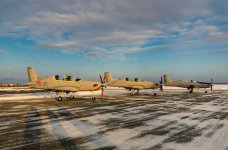
JSC UZGA, Ural Civil Aviation Plant handed over two serial UTS-800 training aircraft to the Russian Ministry of Defense. Now these UTS-800 will be connected to flight tests. https://tass.ru/armiya-i-opk/22794575 AviaComments
The photo shows the first two production vehicles with a prototype UTS-800.
Footage of the assembly and preparation for takeoff of the Russian drone "Lancet-51". The loitering munition "Lancet-51", officially called "Product 51", is produced by the Russian company "Aeroskan", part of the ZALA AERO group of companies.
The drone "Lancet-51" is currently the most advanced and effective drone of the Russian army, technical information on the drone "Lancet-51" in the link in the comments.
Footage of the preparation for takeoff of the Russian Su-34 frontline bomber. The video shows the assembly and installation of UMPK modules on Russian FAB aerial bombs and their installation on the aircraft. Refueling the aircraft with kerosene and nitrogen.
UAV carriers of two FPV drones, the Russian army began to use, tests are ending. There is no technical data on the UAV yet. This aircraft-type drone provides the ability to use two FPV drones, at a distance of approximately 20 - 25 km. The Russian UAV is also used as a communication repeater, it allows to increase the range of use of FPV drones.
Rare footage of Russian pilots training on the simulator complex of the Russian Tu-22M3 bomber. Officially it is reported about the Tu-22M3 simulator, but the cockpit is similar to the Tu-160, perhaps the simulator is universal. Pilots and navigators of the Russian long-range aviation practice tasks in emergency situations on the simulator complex of the Tu-22M3 aircraft. During the training, the pilots conducted training in adverse weather conditions, zero visibility, with various failures of onboard radio-electronic equipment, such as engine failure or loss of radio communication. In addition, while working on the simulators, the pilots practiced the tactical destruction of command posts, combat equipment and fire suppression of advancing forces of the imaginary enemy
ZALA has presented a new compact launcher for the Russian drone "Lancet-51", officially called "Product 51". The new design of the launcher for the drone "Lancet" is a compact and lightweight device that the drone operator can carry manually. This allows the drone to be launched at a significant distance from the location of the ground control station. To prepare the launcher for the drone launch, one person and no more than 1 minute of time are enough. Disassembling the launcher after launch is not required. Thus, ZALA developers have simplified and made the process of launching the Lancet loitering munition faster and safer.
The Russian company "IRIT" from Ryazan presented the FPV drone "Ryazan", the company made a very detailed review of the drone. Even the operating frequencies of the drone are indicated. But the publication of frequencies is not critical, the drone is controlled via the "Fan" channel, with a random frequency tuning mode. The drone uses many components of Russian production. The body of the drone "Ryazan" consists of plastic, fiberglass and metal, which reduce the effective reflective surface of the drone to 0.05. The drone has a remote detonation function, it can also be used to drop ammunition, reconnaissance, it is equipped with a thermal imager. The drone has a brushless electric motor, power is provided by a battery with a capacity of 18,000 mAh. The drone's carrying capacity is up to 7 kg. The drone's flight duration is up to 20 minutes, at an altitude of up to 4 km at a speed of up to 100 km / h. Flight range is up to 15 km. The price of the Ryazan drone is still unknown.
The new Russian FPV drone "Prince Vandal Novgorodsky" controlled by a fiber optic cable was shown up close for the first time. The video clearly shows the entire structure of the drone, from the very beginning of use, the drone has never been shown so close. The FPV drone "Prince Vandal Novgorodsky" was developed by the Novgorod Scientific and Production Center "Ushkuynik", but its characteristics have not yet been made public, the price is also unknown. The abbreviated name of the drone is "KVN". Of the features of using the drone, it is forbidden to take off sharply, turn strongly and fly backwards. It is advisable to fly in a straight line. This drone is used by the "Veterans" brigade, a volunteer corps. The drone "Prince Vandal Novgorodsky" has a reel with a fiber optic cable, allowing it to be used at a distance of presumably up to 20 km. Most likely, the cable reel can be changed to increase the flight range to 40 km, they are already used on Ukrainian drones. Accordingly, the flight time and warhead will be significantly shorter. In this version, the FPV drone "Vandal" is equipped with an enhanced cumulative munition PG-9S. The carrying capacity of the FPV drone "Prince Vandal Novgorodsky" is up to 6 kg.
Russian military personnel showed footage of the launch and landing of the new Russian reconnaissance UAV "Merlin-VR". The UAV "Merlin-VR" appeared in the Russian troops recently, technical information about it in the link to the video in the comments to the video. Currently, the UAV "Merlin-VR" is used mainly to adjust the work of Russian artillery and aviation.