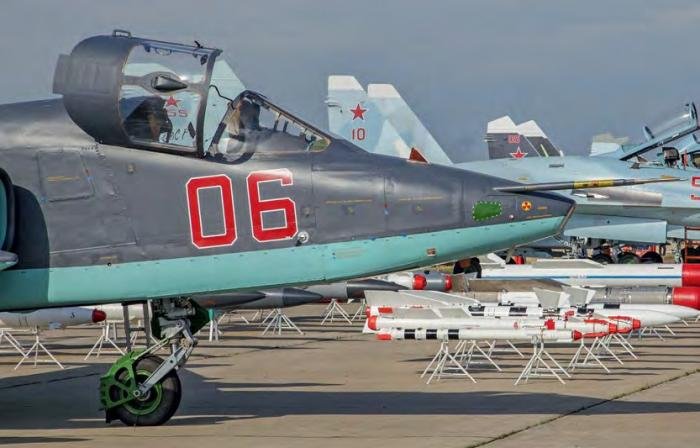
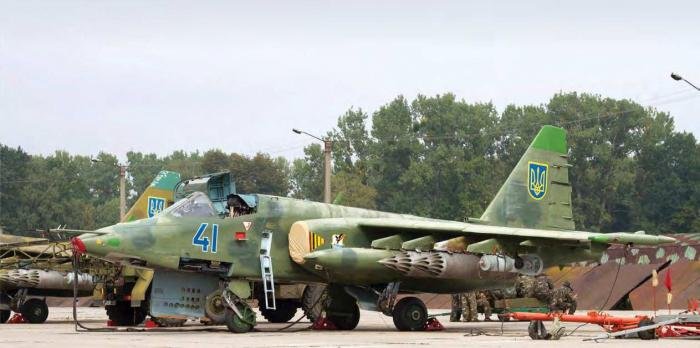
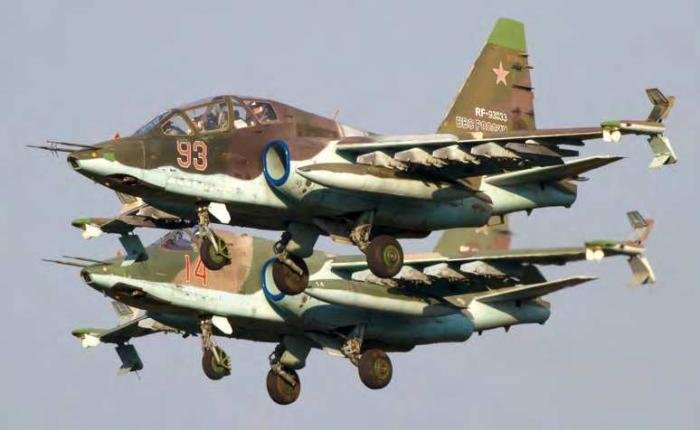
The Su-25SM3 is equipped with the PrNK-25SM-1 navigation/attack suite and the SUO-39M fire control system. In addition to the Kh-25ML, Kh-29L and S-25L/LD laser-guided missiles, the latest Frogfoot derivative can deploy the Kh-29T, Kh-29TD and Kh-29TE TV-guided missile and KAB- 500Kr TV-guided bomb, as well as KAB- 500S GPS-guided bombs. The Kh-58USh anti-radar missile was also integrated, using targeting information derived from the Pastel RHWAS incorporated in the Vitebsk-25 self-protection suite. It retains nuclear bomb delivery capability, represented by two SpAB freefall nuclear bombs.
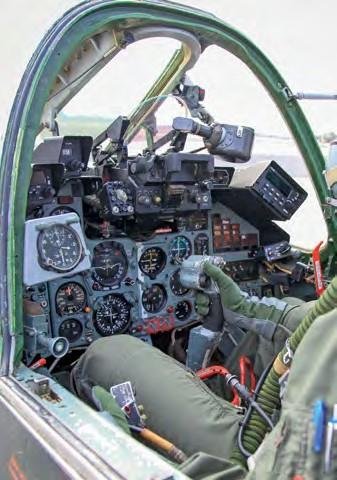
The cockpit is equipped with the new BI HUD, a MFTsI-0332M multifunction colour display augmented by another smaller display beneath the HUD, a BSKI digital map module and the PPA-S/V-06 satellite navigation system with GPS and GLONASS receiving capability and also featuring differential updating.
SU-25SM3 CHARACTERISTICS
Wingspan: 14.36m (47ft 1in)
Length overall: 15.53m (50ft 4in)
Height overall: 4.80m (15ft 9in)
Wing area: 34.7m2 (362.75ft2)
Max take-off weight: 17,530kg (38,636lb)
Normal take-off weight: 14,530kg (32,034lb)
Internal fuel: 3,000kg (6,614lb)
External fuel: 2,464kg (5,618lb)
Max speed at sea level: 512kts (950km/h)
Max speed clean: 540kts (1,000km/h)
Max attack speed: 372kts (690km/h)
Landing speed: 110kts (205km/h)
Take-off speed: 119kts (220km/h)
Service ceiling: 23,000ft (7,000m)
Rate of climb: 60m/s (197ft/s)
Range (with a 2,000kg bomb load and max internal fuel): 510km (275nm)
Ferry range with four external tanks: 1,900km (1,025nm)
Take-off run: 500m (1,640ft)
Landing roll with brake chute: 700m (2,296ft)
G limit (with 1,000kg bomb load): +6.2g
1 The RuASF intends to keep its existing fleet of Su-25SMs in active service until the early 2030s as the Frogfoots have a lot of unused life in them and the type is subject to a rolling life extension effort.
Andrey Zinchuk
The SOLT-25 IR/TV/laser targeting and designation system, developed by the Krasnogorsk Mechanical Plant, is one of the main new systems integrated on the Su-25SM and is the backbone of its targeting suite. Installed in the nose, it features the same shape and weight as the old Klen-PS laser rangefinder/target designator. The new system’s TV channel with a 16x zoom, is advertised as capable of operating in target detection and tracking modes at up to 8km (4.6nm), with subsequent tracking of the target selected by the pilot for engagement with laser-guided missiles or TV-guided missiles or bombs.
Enhanced Self-Protection
The Vitebsk-25 integrated self-protection suite, developed by Samara-based NII Ekran, incorporates the L-150-16M Pastel radar warning and homing system, ultraviolet (UV) missile approach warning sensors, UV-26M countermeasure dispensers (which use a mix of 26mm and 50mm chaff and flares) and the L-370-3S dual-pod radar jammer system accommodated on the outermost wing hardpoints, covering the frequency band from 7 to 10GHz.
UPGRADED SU-25UBM
The upgraded Su-25 two-seater, using exactly the same avionics as that integrated on the Su-25SM and designated as the Su-25UBM, has suffered from a notably protracted development and is not yet fielded in service. The first flight of the two-seat prototype was reported in December 2010 and the sole Su-25UBM, wearing the serial 21, is reported to have completed the test and evaluation effort in December 2011. In the spring of 2014, however, it was seen at the 121st ARP in Kubinka in disassembled form, undergoing some unspecified modifications. Later, it was revealed that it was reupgraded to the enhanced Su-25UBM2 standard, featuring mission equipment borrowed from the SM3 single-seat upgrade, including the Vitebsk-25 self-protection suite and the SOLT-25 targeting system.
In this new guise, it was slated to commence a flight-test programme by October 2015, with completion expected by 2017, comprising as many as 150 flights. However, the flight testing and evaluation at the RuASF’s 929th State Flight Test Centre was delayed by seven months and didn’t begin until mid-2016; it is expected to be completed by late 2018 at the earliest. As of March 2017, no information had been released about the progress.
There are no plans to produce new two-seat Su-25s at the U-UAP, contrary to the information released in 2011 and 2012. The Su-25UBM2 upgrade, combined with a structural overhaul and life extension works, will involve an undisclosed number of the existing RuASF Su-25UBs produced in the late 1980s and early 1990s. The first orders for the Su-25UBM2 upgrade are expected to be placed by the Russian MoD in late 2017 at the earliest, with delivery expected at the end of 2018.
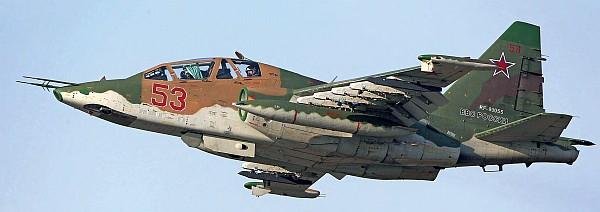
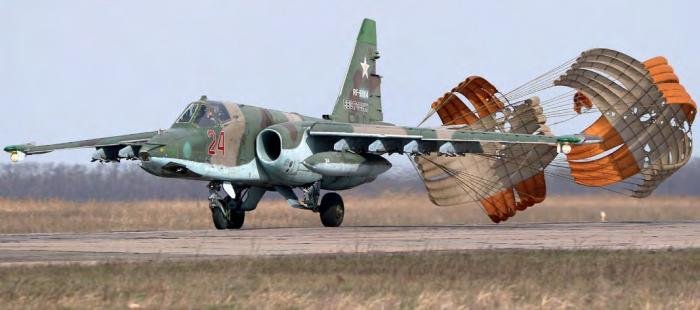
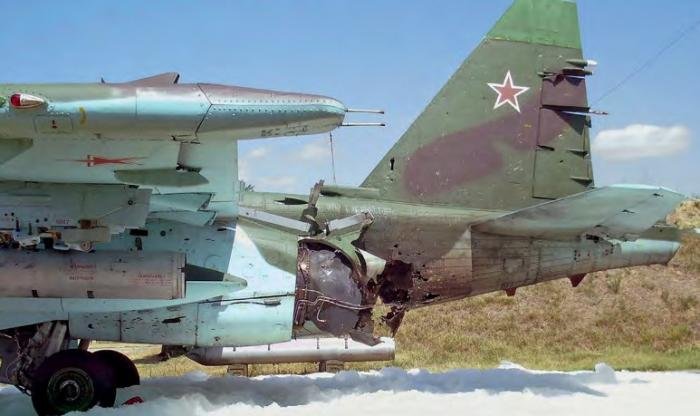
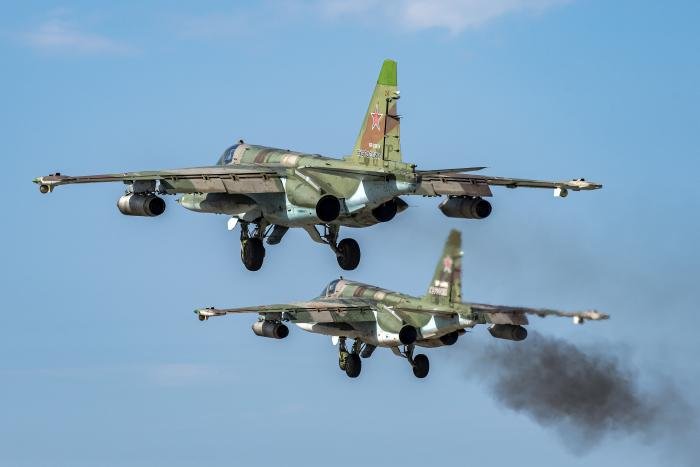
2 A Su-25SM belonging to the 368th ShAP at Budyonnovsk seen during its landing roll with twin-dome parachute deployed.
Andrey Zinchuk
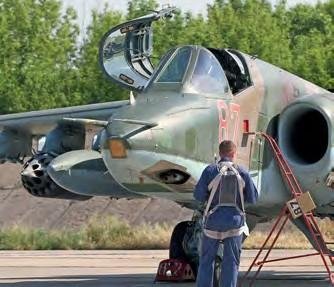
3 The newly-installed avionics of the Su- 25SM has increased automation and self-test capability, making possible a reduction in the aircraft’s pre- and post-flight servicing of some 25 to 30%.
Alexander Mladenov
Missile approach warning is provided by the Zakhvat electro-optical system. Its UV sensors cover the lower hemisphere, with a front sensor under the nose responsible for head-on-coverage and two rearward/ sideward-looking sensors installed in a V-shaped assembly under the tail. Due to the lack of space, it proved impossible for the Vitebsk-25 to also incorporate directional infrared jammers such as those used by the Ka-52 attack helicopter.
The Vitebsk-25 features two underbelly UV-26M countermeasure dispensers for releasing 28 chaff or flare 50mm cartridges (firing downwards) in addition to 26mm upward-firing dispensers installed on the engine nacelles and next for the tail with a total capacity of 256 rounds. According to the Su-25’s designer general Vladimir Babak, the increased number of flares of two different sizes enables the Vitebsk-25 to counter up to six infrared-guided missiles approaching the aircraft simultaneously. The system offers a variety of flare pumping sequences, selected automatically depending on the arrival direction of the missiles.
The KSS-25 is the new communication system featuring a secure datalink capability, enabling exchange of tactical information with ground command and control facilities and other aircraft.
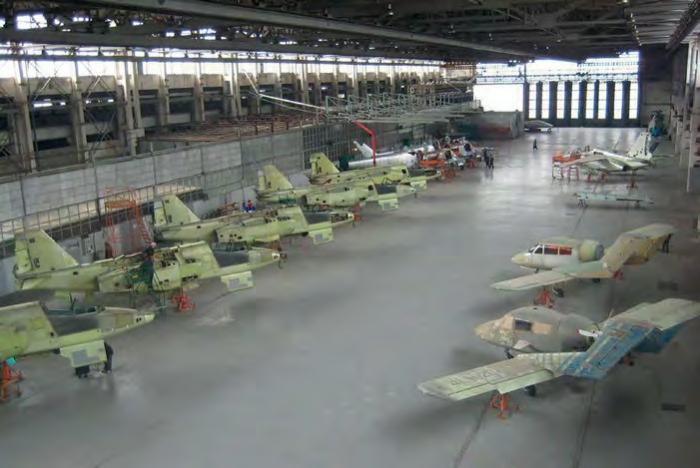
The first Su-25SM prototype, Su- 25SM3-01, reworked from Su-25SM-04 prototype (c/n 10095) is reported to have begun flight testing in 2011, and later on it was joined by a second example. However, the testing and evaluation effort proved to be a protracted undertaking due to the immature status of the new equipment. This was especially true regarding the SOLT-25. Su-25SM3-01 is being used as the pattern aircraft for the production upgrade.
The Russian Ministry of Defence (MoD) awarded its first order for five Su-25SMs to the 121 ARZ in December 2015, even before the completion of the test effort, following an electronic tender. One of these aircraft (the fourth aircraft in the batch, wearing the new identification number Su-25SM3-06 and serialled Red 50) was observed in post-upgrade test flights at Kubinka airfield in October 2016; the entire batch was to be ready for delivery in December 2016. Unit price was set at RUB 350.2 million, excluding the price of the radar countermeasures pods of the L-370-3S system. It is believed the first Su-25SM3 batch utilised existing Su-25SM airframes from the initial production run in the mid-2000s, which were also required to undergo another overhaul and life extension, making it good for at least ten years of service.
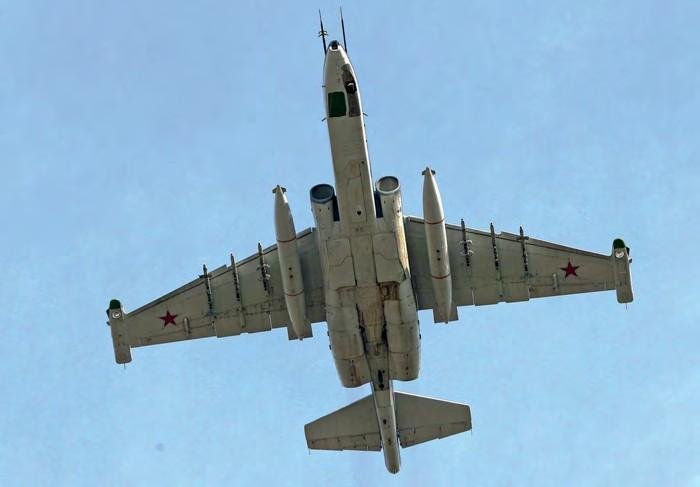
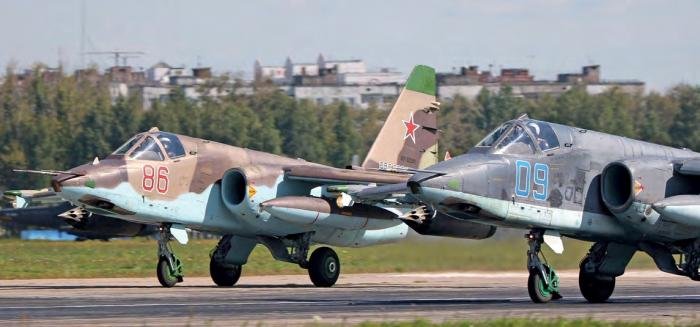
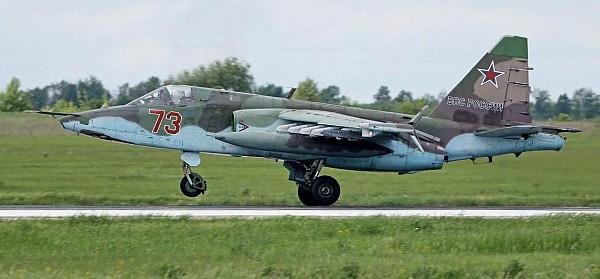
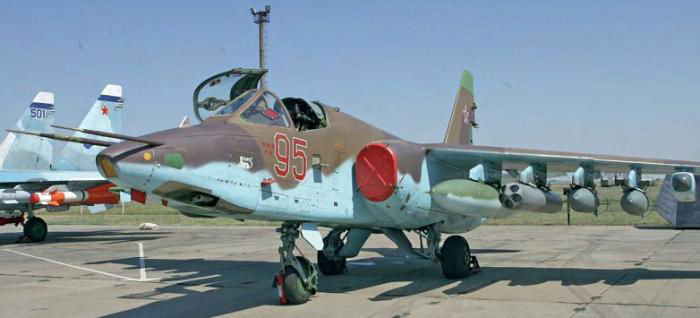
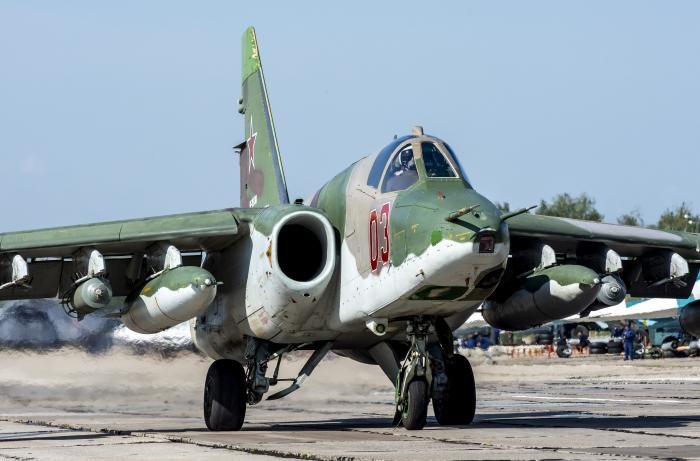
4 This Su-25BM, serialled 73, is the first Frogfoot upgraded with the Gefest i T SVP-24-25 digital navigation/attack system operated by the Lipetsk-based combat training and aircrew conversion centre.
Andrey Zinchuk
FROGFOOTS IN THE SYRIAN WAR
The Russian air component covertly deployed to Hmeimim/Latakya Air Base in Syria in September 2015 comprised an attack force of ten Su-25SMs and two Su-25UBs belonging to the 960th ShAP based at Primorsko-Akhtarsk in the Southern Military District. These aircraft flew combat missions between October 2015 and mid-March 2016. A total of 3,500 combat sorties were flown in Syria, with each of the Su-25SMs racking up to 300 sorties and 300 flight hours. The two-seat aircraft were much less used, with 60 to 80 hours, mainly spent for refresher training, area familiarisation sorties and weather checks.
The principal use of Su-25SMs in Syria comprised bombing in level flight from 11,500 to 13,500ft (3,500 to 4,100m) altitude. The Frogfoots used 100kg, 250kg and 500kg freefall bombs and the RBK-series of cluster bombs. In most of the sorties munitions were dropped without visual contact with the targets, as the upgraded Frogfoots used the bombing method from level flight where the targeting solution is calculated by the aircraft’s own navigation system when delivering a strike against targets with known positions. The pilot is tasked to fly the aircraft and follow cues to bring it to the calculated bomb drop point. At a later stage, the Su-25SMs began flying bombing missions against targets of opportunity, with an accurate position provided by forward air controllers in the field, who were included in the reconnaissance teams assigned to Russian special operations forces operating in enemy-held territory. These teams often used unmanned air vehicles to pinpoint targets and then perform after-strike battle damage assessment.
Bombing sorties were flown with formations of two, four and even six aircraft. During the days of the most intense combat operations each aircraft flew up to ten sorties, with a turn time before the next sortie of only 15 minutes, including ammunition loading, refuelling and visual inspection for damage and leaks. In general, the upgraded Frogfoot proved very reliable and dependable, with no significant failures reported during the Syrian deployment.
According to an article published in the Russian magazine M-Hobbi in March 2017, the Su-25SMs also flew so-called free-hunting combat sorties in predesignated kill boxes to attack targets of opportunity such as moving armed vehicles or fuel tankers in territories held by anti- Assad or Islamic State militants. In these missions, the upgraded Frogfoots were armed with two 20-round B8-M1 rocket packs for firing 80mm S-8 rockets and four external fuel tanks enabling a mission endurance of up to two hours.
It is difficult to get reliable information beyond the usual propaganda on the real accuracy and therefore effectiveness of the Su-25SM’s strikes using dumb bombs dropped from medium altitude that, by definition, could not be accurate, due to the multitude of factors affecting the bomb’s flightpath during its freefall. The Su-25SM has an advertised 33 to 50ft (10 to 15m) circular error probable, but this claim cannot be confirmed by independent sources. In most of the sorties, according to M-Hobby, the Su-25SMs dropped one bomb against each target. The most commonly used munition in Syria was the OFAB-250-270 250kg (550lb) high-drag free-fall fragmentation/high-explosive bomb.
The navigation bombing capability made the Su-25SM useful day and night, in both clear and bad weather. Its combat effectiveness depended mainly on the quality of the targeting information received prior to take-off or handed over by forward air controllers when loitering in a target area. In January 2017, four Frogfootd, comprising three Su-25SMs and one Su-25UB, were again deployed to Hmeimim/Latakya Air Base, but no information has been released on the nature of the operations.
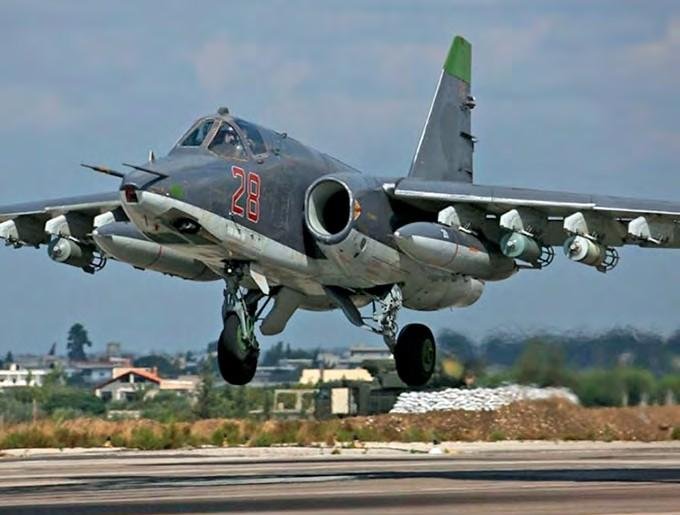
A Su-25SM of the 960th ShAP taking off from Hmeimim Air Base in Syria with a weapon payload of four OFAB-250-270 freefall bombs.
Russian MoD