Saudi Arabia strategic Projects: news, discussions & updates

The reception will not be at the Elysee..It will be in the Invalids Palace

Highlights of the Invalids Palace:

◦ Army Museum: It is considered one of the most important military museums in the world and tells the history of the French military.
◦ Tomb of Napoleon I: It is located under the palace's famous golden dome, which is 107 meters high.
◦ Other museums: It also includes the Liberation Medal Museum and the Relief Plans Museum.
◦ Home and Hospital: Part is still allocated for service and a home for retired war veterans
 
Partnership goes beyond oil… Paris deepens investments in major Saudi projects

Specialists to Asharq Al-Awsat: The new agreements bring French companies deeper into the Kingdom's value chains

1787674874465.png

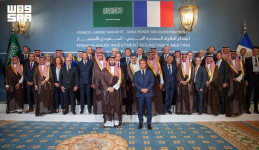
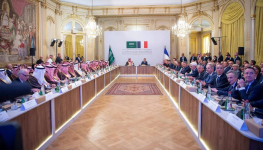
The Saudi-French partnership has reached a new pivotal point, transcending traditional cooperation in the energy and oil sector to move towards a comprehensive strategic partnership in implementing major development projects. On the sidelines of the visit of Saudi Crown Prince and Prime Minister Mohammed bin Salman to Paris, the two countries signed more than 21 agreements and memoranda of understanding, supported by credit lines and financing facilities worth billions of dollars. This move aims to deepen French investments in the value chains of Saudi projects and support the objectives of Vision 2030 in the areas of infrastructure, aviation, healthcare, artificial intelligence, and entertainment.

These 21 new agreements and understandings reflect a French trend towards strengthening the presence of its companies in the Saudi project cycle, benefiting from financing tools and credit guarantees that open up broader opportunities for their participation in the goals of Vision 2030.

The agreements are not limited to the sale of products, but also encompass infrastructure, transportation, healthcare, electricity, aviation, tourism, entertainment, and research and development. In other words, French companies are aiming to participate in the value chain of Saudi projects, not merely to supply them.

1787674941553.png

Investment Returns

In this context, Shura Council member and economic advisor, Fadl bin Saad Al-Buainain, told Asharq Al-Awsat that the Crown Prince's visit to France came at a crucial time, as the region faces geopolitical challenges and the world is experiencing significant economic shifts related to energy security and supply disruptions.

He explained that it is noteworthy that the visit focused on strengthening the economic partnership according to a clear strategic vision, in line with the Kingdom's interests, as evidenced by the signed agreements.

Al-Buainain emphasized that the new understandings simultaneously reflect French interest in enhancing the partnership on sustainable investment foundations, supported by credit lines to finance exports and companies undertaking projects within the Kingdom. This serves the Kingdom's interest in promoting development, implementing projects, and achieving the Vision's objectives, while simultaneously generating investment returns for French companies.

He added: "The agreements are no longer solely about selling products or oil, but are now more closely linked to economic development, infrastructure, tourism and entertainment, artificial intelligence, research, and other important sectors, thereby adding value to projects and enhancing local content."

He added, “It is important to highlight the two agreements related to the development of Al-Ula and the Qiddiya projects, and their impact on the culture, tourism, and entertainment sectors, which are among the most important sectors targeted for increasing their contribution to the GDP.” Al-Buainain continued, stating that the Kingdom is no longer the one seeking economic partnerships; rather, countries around the world are now more eager to establish them and meet the requirements of such partnerships. This is evidenced by France’s keenness to support its partnership with Riyadh through high-quality agreements that directly contribute to achieving the objectives of Vision 2030, around which all economic agreements revolve.


***The most attention-grabbing agreement for me today is Saudi Arabia's actual entry into the quantum computing sector The technology is still in its early stages, but over the coming years, it could have a major impact in fields like: • Drug and new materials discovery• Improving energy networks and logistics• Solving complex optimization problems• Security and encryption• Supporting artificial intelligence applications..What's beautiful to me is that we're not waiting for the technology to mature and then buying it—we're starting now to build expertise and infrastructure inside the Kingdom.

A new tech sector expected to see huge momentum over the next 5–10 years, and I'm excited to see where Saudi Arabia takes it.

 
The most prominent deals signed between Saudi Arabia and France

1-AlUla: Extension of the Saudi-French partnership for the development of AlUla until 2035.
2-Defense: Cooperation in defense industries and cybersecurity.
3-Qiddiya: A new investment project near Paris.
4-Technology: Cooperation in artificial intelligence and quantum computing, in addition to a partnership between HUMAIN and Mistral AI.
5-Jeddah Islamic Port: A project worth 484 million euros to develop a new container terminal.
6-Riyadh Metro: Supply of additional trains, alongside financing arrangements for metro projects.
7- 5 billion dollars: A credit line between the Saudi Ministry of Finance and "BPI France" to guarantee exports.
8- Financing arrangements in favor of Saudi Arabia for energy and strategic projects in the Kingdom, including Riyadh and AlUla.
9-Saudia Airlines: Financing arrangements for the purchase of a fleet of Airbus aircraft.
10- 150 million dollars: A joint project to establish water treatment plants.
11- Aramco: Agreements worth 3.7 billion dollars with French companies in oil and digital projects.

 
Who said fish have to come from the sea? Riyadh, Qassim, and Hail.. cities without coastlines, yet they produce fish in quantities surpassing the output of some major coastal countries

 
The U.S. Secretary of Energy expresses astonishment at the size of uranium resources in #Saudi Arabia, and reveals during his speech his surprise at the Kingdom's capabilities in this field. Listen to the details..

 
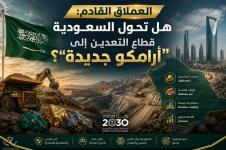
The next giant: Will Saudi Arabia transform the mining sector into a "new Aramco"?
1788112758777.png

From the heart of a desert that has woven one of the greatest oil stories in modern history, Saudi Arabia begins writing a whole new chapter in the world of underground riches. Today, the bet is no longer on "black gold" alone, but rather the economic engine is moving towards the "third pillar" of the national industry: the mining sector.

Saudi Arabia is basing this historic transformation on a land that is geologically classified as one of the regions in the world richest in untapped minerals, specifically the Arabian Shield, which extends over an area of half a million square kilometers, carrying in its bowels mineral wealth estimated at more than 2.5 trillion dollars (9.377 trillion Saudi riyals).


Key Competitive Advantages of the Saudi Mining Sector

Diversification of Strategic Resources
: The sector is not limited to gold, copper, and iron, but extends to include future-proof and critical minerals for modern industries such as lithium, phosphates, and rare earth elements.

Infrastructure and Logistics: Efficient connectivity through modern rail networks, ports on the Red Sea and the Arabian Gulf, and direct energy supply at competitive prices.

A Stimulating Investment Environment: The new mining investment law ensures transparency, expedited licensing, and access to financing of up to 75% of project costs through the Saudi Industrial Development Fund.

Localization and Manufacturing Strategy: The Kingdom is moving beyond simply exporting raw materials and is transitioning towards local manufacturing and complete supply chains (from mines to the final product).
1788113112904.png

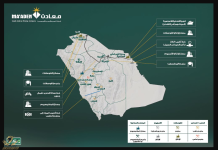
The Kingdom of Saudi Arabia is undergoing a strategic transformation aimed at diversifying sources of national income and achieving the goals of Saudi Vision 2030. In this context, the mining sector constitutes the "third pillar" of the national industry, alongside oil and petrochemicals. In this approach, the Kingdom relies on huge geological potential and untapped mineral resources estimated at approximately $2.5 trillion (9.377 trillion Saudi riyals).

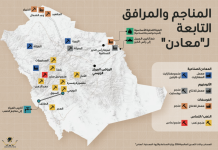
Geographical Distribution and Mineral Resources Map
The Kingdom's strategic mineral resources are distributed according to the nature of its geological formations as follows:

The Arabian Shield Belt (West and Southwest):

Area: Approximately 630,000 square kilometers.

Major minerals: Gold, silver, copper, zinc, and rare earth elements.

Key sites: Gold mines (Mansoura and Masarra, Al-Duwaihi, Mahd Adh-Dhahab), and the Jabal Sayid copper and zinc mine.

The Northern Region (Tarif and Hazm Al-Jalamid):

Major mineral: Phosphate ore.

Importance: Hosting the Waad Al-Shamal gas and mining complex, which places the Kingdom among the world's largest producers and exporters of phosphate fertilizer.

The Central and North-Central Region (Hail and Qassim):

Major minerals: Bauxite (aluminum ore) and magnesite.

Key sites: Al-Zubairah bauxite mine and extraction sites in Al-Ghazalah Governorate.
1788113386915.png

Competitive features of the sector

• New mining investment system: Providing a relaxed legislative environment that ensures transparency and accelerates the issuance of exploration and exploitation licenses.
• Financing support: Providing financing of up to 75% of mining project costs through the Saudi Industrial Development Fund.
• Infrastructure and logistics network: Connecting mines to processing areas and ports via the SAR (SAR) train network and designated ports on the Red Sea and the Arabian Gulf (such as Ras El Kheir Port).
• Value-added chains: Focus on local processing and manufacturing of raw materials rather than exporting them as raw materials, which enhances local content and raises added value.

The Saudi mining sector has sufficient capabilities to build a success story parallel to the oil sector, supported by the presence of Maaden as a leading executive arm, and increasing global partnerships, so that the sector becomes a major driver of economic growth and the localization of advanced industries in the coming decades.
 

Users who are viewing this thread

Pakistan Defence Latest

Back
Top