SBP - Banking Sector / Federal Board of Revenue

@Pradotic sb

I did. But I am unable to comprehend how a 16% growth in tax revenue when inflation is in single digits is a bad performance.

Regards
 

PM Shehbaz appreciates partnership, support from World Bank in meeting with President Banga in Islamabad


Syed Irfan Raza
February 2, 2026

1770049231691.png

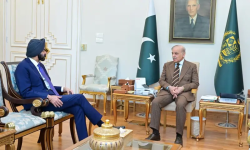
World Bank Group President Ajay Banga calls on Prime Minister Shehbaz Sharif in Islamabad on February 2. — GovtofPakistan via X

ISLAMABAD: World Bank Group (WBG) President Ajay Banga called on Prime Minister Shehbaz Sharif on Monday as Pakistan acknowledged the group’s valuable support, which has been instrumental in advancing the country’s economic development and reforms.

According to the PM Office, the prime minister welcomed Banga for his first official visit as the president of the WBG.
 
The premier appreciated the group for its long-standing partnership with Pakistan and its commitment to supporting the development priorities of the country, especially through the 10-year WBG Country Partnership Framework (CPF).

Shehbaz also appreciated Banga’s leadership in transforming the WBG into a more impactful development partner.


He said that the government of Pakistan was vigorously working on an economic reform agenda, with a multi-pronged, comprehensive, structural, homegrown programme aimed at sustainable economic stability.

The prime minister also appreciated the support of the global financial institution in resilient infrastructure, agribusiness, digital development, energy, human capital, fiscal reforms, and increasing productive private investment for job creation and growth.

PM Shehbaz and Banga reiterated the need to fast-track implementation and ensure strong oversight to deliver impact at speed and scale on Country Partnership Framework (CPF)-aligned priorities. These measures would duly assist the prime minister’s initiative to address and resolve implementation bottlenecks in development projects.

PM Shehbaz also expressed the government’s commitment to structural reforms that would unlock job-rich growth and further strengthen investors’ confidence.

Speaking on the occasion, Banga expressed his gratitude to the prime minister for his reception and hospitality in Pakistan. He commended the government’s ongoing reform efforts and reaffirmed his commitment to deepening cooperation through a One World Bank Group approach.

He said that greater leverage of private resources, in addition to strong coordination with development partners, was necessary to meet the ambition of the government’s reform agenda.
 
To view this content we will need your consent to set third party cookies.
For more detailed information, see our cookies page.
 

No demand for repayment of $2b loan from UAE, SBP governor briefs NA panel​


Central bank governor says country has shifted from annual loan rollovers to monthly rollovers

Irshad Ansari
March 04, 2026

state bank of pakistan governor jameel ahmad photo twitter


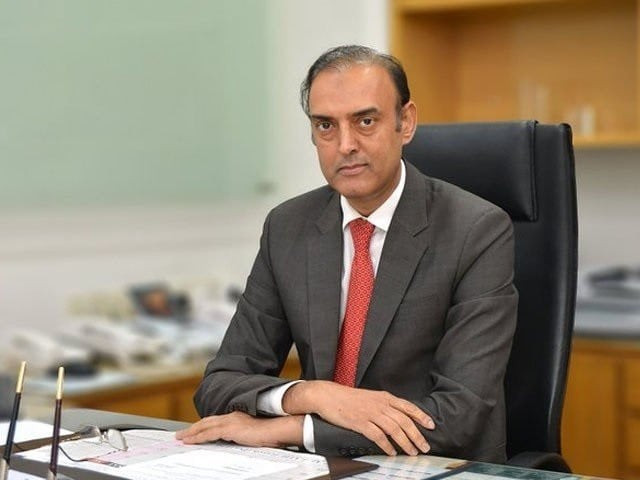
State Bank of Pakistan Governor Jameel Ahmad. PHOTO: TWITTER

ISLAMABAD: Bank of Pakistan Governor Jameel Ahmad said on Wednesday that the United Arab Emirates (UAE) was not demanding repayment of a $2 billion loan, but had instead shifted it to a monthly rollover.

The SBP governor provided the National Assemly's Standing Committee on Finance insights into the country’s economic challenges, including the UAE’s loan rollover, inflation rates and export performance.

"The UAE is not asking back for a loan of $2b. The only difference is that earlier the UAE's loan was rolled over on an annual basis, now it is being rolled over on a monthly basis," he said.

"Initially, the debt servicing had reached $4b, but this has now been reduced," he stated, acknowledging the strain on Pakistan’s exports.
 
Highly placed sources in the federal government and the central bank told The Express Tribune last month that the UAE had rolled over two loans of $1b each, which matured on January 16 and 22. They said the debt was rolled over for one month to allow time for further discussions on the tenor and interest rate.

Under the $7b International Monetary Fund (IMF) programme, the UAE, Saudi Arabia and China have committed to maintaining their combined $12.5b in cash deposits with the SBP at least until the programme expires in September next year. However, last month was the first time the UAE extended the debt repayment period by only one month, unlike the previous practice of granting one-year extensions.

In December, Govenor Ahmad had requested the UAE government to roll over $2.5b in debt for two years and cut the interest rate by almost half. Subsequently, Prime Minister Shehbaz Sharif also requested the UAE president to extend the repayment period. The prime minister said the UAE had agreed to roll over the debt, but did not provide further details.

The UAE provided $2b to Pakistan in 2018 for one year, but Pakistan was unable to repay the amount and has sought rollovers annually since then. Later, the UAE extended another loan of $1b in 2023 to help Pakistan meet external financing requirements for an IMF bailout.
 
The $2b debt forms part of Pakistan's foreign exchange reserves of $16b. Pakistan is paying about $130 million annually in interest on the UAE debt at current rates. In 2018, the UAE charged an interest rate of 3% on the debt, but last year increased it to 6.5%. Pakistan has requested the UAE to reduce the rate to around 3%, citing improvements in its credit rating and lower global interest rates.

Pressure on exports

The governor further highlighted that, despite the ongoing pressure on exports, the situation was being managed. This, he noted, was partially due to declining food prices globally, including a reduction in rice exports, which alone accounted for a $1b drop.

Regarding inflation, the SBP governor projected that it was expected to stay between 5% and 7% this year.

“In 2022, the current account deficit was $17.5 billion, but through strategic measures, we managed to reduce it to just 1% of GDP in 2023, with a surplus of $2b,” he explained. Ahmad pointed out that this marked the first current account surplus in 14 years.

He further stated that foreign exchange reserves had increased significantly, from $2.8b, just enough for two weeks of imports, to over $16b. His target, the governor said, was is to raise the reserves to $18b by the end of June 2026 and to $20b by December 2026.
 
The governor SBP discussed Pakistan's rising external debt, which has grown from $55b in 2016 to $103b. He assured that the debt level had remained stable since last year, and Pakistan’s total debt stood at $148b, with the government’s share at approximately $103b.

In response to concerns raised by the committee, Chairman Saleem Mandviwala remarked that the country’s export schemes were being phased out, which he believed contributed to the pressure on exports.

However, the SBP govenor countered that export financing schemes had not been abolished and attributed the export decline to multiple factors, including the global food price drop and weaker demand.

Furthermore, the governor acknowledged the economic strain of being under an IMF programme, which limited the country’s ability to offer subsidies and rebates. He noted that, despite challenges, the central bank continued to pursue strategies to ensure economic stability.
 

Central government debt rises to Rs79tr in Jan 2026

Sophiya Rafi
March 6, 2026
https://whatsapp.com/channel/0029VaMc238IiRov8okfYy3n
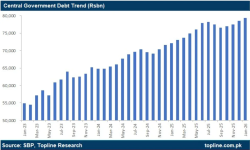
Pakistan’s total central government debt rose to Rs79.32 trillion in January 2026, reflecting an increase in government borrowing over the past year.

State Bank of Pakistan data showed central government debt at Rs72.12tr in January 2025, meaning the overall debt increased by Rs7.2tr, or roughly 10 per cent, over the past year.

Arif Habib Limited noted that the central government debt increased by 1pc month-on-month.

The rise was primarily fuelled by domestic borrowing, which continues to account for the bulk of the federal government’s liabilities.

1772800791316.png

Central government debt trend according to State Bank data. ─ Courtesy Topline Research
 

Domestic debt dominates the debt structure​

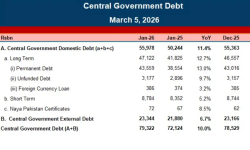
Central government domestic debt increased to Rs55.98tr in January 2026, up from Rs50.24tr in January 2025, marking an increase of around Rs5.73tr over the calendar year.

Domestic borrowing accounts for roughly 71pc of the central government’s debt.

Within domestic debt, long-term remains the dominant component, rising from Rs41.83tr in January 2025 to Rs47.12tr in January 2026.

Topline Research data showed domestic government debt rose 11.4pc year-on-year and 1.1pc MoM.

1772800866220.png
Central government debt data March 2026. ─ Courtesy Topline Research
 

Pakistan Investment Bonds remain the largest instrument​

Among permanent debt instruments, Pakistan Investment Bonds remained the largest contributor, standing at Rs35.27tr in January 2026, compared to Rs31.77tr a year earlier.

Similarly, the Government of Pakistan Ijara Sukuk increased from Rs5.84tr to Rs6.75tr over the same period.

The data also shows growth in Bai-Muajjal Sukuk, which rose significantly from Rs65 billion in January 2025 to Rs632bn by December 2025, remaining at that level in January 2026.
 

Savings schemes and unfunded debt edge higher​

The government’s unfunded debt, which includes national savings schemes, also increased moderately during the period.

This category rose from Rs2.9tr in January 2025 to Rs3.18tr in January 2026.

Within this segment, saving schemes (net of prize bonds) increased from Rs2.81tr to Rs3.11tr, reflecting continued participation in government-backed savings instruments.

Short-term domestic borrowing also remained significant, standing at Rs8.78tr in January 2026, compared to Rs8.35tr in January 2025.

Most of this consists of Market Treasury Bills, which rose to Rs8.66tr in January 2026 from Rs8.26tr in January 2025.

External debt shows limited change​

In contrast to domestic liabilities, central government external debt remained relatively stable.

External debt stood at Rs23.34tr in January 2026, compared to Rs21.88tr in January 2025.

Long-term external debt accounted for the majority at Rs22.99tr, while short-term external liabilities increased to Rs345bn, up from Rs277bn in January 2025.

Topline Research noted that “external Debt was up 6.7pc YoY and 0.8pc MoM in January 2026”.

They further highlighted that “in June 2025, the said debt was $82.5bn.”
 

Overall debt expansion​

Overall, the State Bank’s data suggest that while Pakistan’s debt stock continues to expand, most of the increase is being absorbed domestically.
 

Analysts expect SBP to maintain status quo as Middle East tensions cloud outlook

  • A flare-up of the US-Iran conflict has upset markets
Ali Ahmed

The Monetary Policy Committee (MPC) of the State Bank of Pakistan (SBP) is expected to maintain the status quo in its upcoming meeting scheduled for Monday, March 09, the second MPC meeting of the calendar year, market analysts noted.

“The SBP is expected to keep the policy rate unchanged at 10.5%, signalling caution amid a rapidly evolving global backdrop,” said Arif Habib Limited (AHL) in a report on Friday.

The central bank, in its previous MPC, decided to keep its benchmark policy rate unchanged at 10.5%. The decision was against market projections, which expected a cut in the key interest rate.

AHL, in its report, noted that a flare-up of the US-Iran conflict has upset markets, sending oil and other commodities sharply higher and exerting pressure on financial markets worldwide
 

Users who are viewing this thread

Pakistan Defence Latest

Latest Posts

Back
Top