Sea Port / Dry Port and Maritime Updates.

Lloyd's removes Pakistan from war-risk maritime list

  • Decision to improve the competitiveness of Pakistani exports and strengthen the confidence of international shipping companies
July 30, 2026
By BR Web Desk

In a major development for Pakistan’s maritime sector, the country and its territorial waters have been removed from the Listed Areas of Lloyd’s Market Association’s Joint War Committee (JWC), a move that will help reduce war-risk insurance premiums and shipping costs, Federal Minister for Maritime Affairs Muhammad Junaid Anwar Chaudhry said on Thursday.

The Joint War Committee Listed Areas are high-risk maritime zones designated by London marine insurers, specifically representing the Lloyd’s Market Association (LMA) and the International Underwriting Association (IUA).
 
Describing the development as a historic achievement, the minister, in a statement, said the decision would improve the competitiveness of Pakistani exports and strengthen the confidence of international shipping companies, traders and investors in the country.

He said the move could also make Karachi Port, Port Qasim and Gwadar more attractive to global shipping lines and investors, creating opportunities for regional trade, cargo transit and transhipment.

Chaudhry said the issue was taken up on March 13, 2026, when it was noted that Pakistan and its maritime areas had remained on the JWC’s Listed Areas for decades. Their inclusion had resulted in additional war-risk insurance premiums and surcharges for Pakistani shipping and trade, he said.

The prime minister subsequently constituted a special committee, headed by Junaid Chaudhry, to pursue the matter. The committee held negotiations with Lloyd’s officials and presented Pakistan’s case on the basis of technical evidence and factual data.
 
The minister said that sustained negotiations eventually resulted in Pakistan being removed from the list.

He said the decision would reduce the additional financial burden on the country’s maritime trade and help Pakistani exports compete more effectively in international markets.

Chaudhry said the development was an important step towards making Pakistan a major regional logistics, transit and transhipment hub.
 

KPT handles 55.44mt of cargo in FY 2026


August 1, 2026
Recorder Report

KARACHI: Karachi Port Trust (KPT) handled 55.44 million tons of cargo in the financial year ended June 30, 2026, up 2.76 percent from 53.95 million tons a year.

According to the port authority’s annual performance review comparing FY 2025-26 with FY 2024-25, released by KPT, the throughput gain was driven almost entirely by imports, which climbed 5.82 percent to 35.91 million tons.

Exports moved the other way, falling 2.44 percent to 19.53 million tons.
 
A breakdown of cargo by type shows dry bulk cargo as the standout category, rising 12.41 percent to 9.06 million tons.

Liquid bulk cargo also expanded, up 7.93 percent to 13.35 million tons, with the report noting the gain was consistent on both the import and export sides.

Dry general cargo was the one category to contract, declining 1.45 percent to 33.13 million tons.

Container handling reached 2.75 million TEUs, up 3.67 percent year-on-year.

South Asia Pakistan Terminals Limited (SAPTL) retained the largest share of terminal traffic at 59.6 percent, ahead of Karachi International Container Terminal (24.7 percent) and Karachi Gateway Terminal Limited, or KGTL, (15.5 percent). KGTL posted the fastest terminal-level growth at 7.09 percent.

Ship traffic also rose. KPT recorded 2,115 vessel calls, up 7.36 percent from 1,970 the previous year, a faster pace of growth than the increase in tonnage, meaning the average cargo parcel per ship call shrank, from roughly 27.4 kilotons to about 26.2 kilotons.
 
To view this content we will need your consent to set third party cookies.
For more detailed information, see our cookies page.
 

Chinese firm proposes €2 billion integrated maritime industrial complex at Port Qasim​

Plan includes revival of steel jetty, shipbuilding and shipbreaking facilities, and port-linked steel mill


News Desk

December 18, 2025
2 min read

China’s Shandong Xinxu Group has proposed a €1 billion to €2 billion Integrated Maritime Industrial Complex (IMIC) at Port Qasim, focusing on shipbuilding, shipbreaking, and steel production linked to port operations.

A five-member delegation led by Shandong Xinxu Group Chairman Hou Jianxin met Federal Minister for Maritime Affairs Muhammad Junaid Anwar Chaudhry to discuss the proposed investment, which aims to strengthen Pakistan’s maritime and heavy industrial base.

According to officials, the proposed IMIC comprises three main components: revival of the Iron Ore and Coal Berth (IOCB), commonly known as the steel jetty; establishment of shipbuilding and shipbreaking facilities; and development of a steel mill integrated with port infrastructure.


The IOCB was originally built to handle bulk cargo such as iron ore and coal for Pakistan Steel Mills and can accommodate vessels between 55,000 and 75,000 deadweight tons. The jetty is linked to the steel mill through a dedicated conveyor system spanning several kilometres, connecting directly to stockyards and blast furnace areas.

During the meeting, the maritime minister welcomed the Chinese group’s interest and asked the delegation to submit an unsolicited proposal outlining the project’s scope, implementation plan, and feasibility. He said the proposal should include technical, financial, and environmental assessments, along with a clear development roadmap.

Following submission of the proposal, a joint committee comprising officials from the Ministry of Maritime Affairs and representatives of Shandong Xinxu Group, led by Additional Secretary Umar Zafar Sheikh, will review the plan.

The minister stressed that any future development must align with Pakistan’s industrial priorities, including job creation, value addition, and environmental sustainability.


The IMIC concept was first presented by the minister in November 2025 during an event hosted by the Port Qasim Authority in Karachi, where the port was recognised as the world’s ninth most improved container port. Branded as the “Steel-to-Green Sea” initiative, the proposal links ship recycling with domestic steel production to reduce import dependence and maximise the use of recyclable materials.

If approved, the project would mark one of the largest recent investments in Pakistan’s maritime and industrial sectors and could further position Port Qasim as a regional hub for heavy industry and logistics.
 

Hutchison Ports Pakistan to invest $76mn in major upgrade

  • Terminal has already received its first batch of 20 e-trucks, 10 trailers, a reach stacker, and an empty handler this year
Hutchison Ports Pakistan, the country’s only state-of-the-art deep-water container terminal, announced a major upgrade to its operations with a $76 million investment program spanning 2026 and 2027.

As per a statement released on Wednesday, the investment includes two electric remote-controlled Quay Cranes (QCs), 17 electric remote-controlled Rubber Tyre Gantry Cranes (RTGCs), 70 e-trucks, and 50 trailers.


The terminal has already received its first batch of 20 e-trucks, 10 trailers, a reach stacker, and an empty handler this year.

The company said that beyond commercial growth, this fleet electrification supports Hutchison Ports Group’s global sustainability targets and advances Pakistan’s sustainable development through supply chain decarbonization.

“Our continuous investment reflects our unwavering commitment to Pakistan’s economic growth and maritime leadership,” said CS Kim, CEO of Hutchison Ports Pakistan. “Working hand-in-hand with MOMA, KPT, and the Government, we are fully focused on turning the Prime Minister’s vision to establish Pakistan as a premier transhipment hub into a reality. By deploying cutting-edge technology, we are enabling faster turnaround times, optimising cargo clearance, and unlocking long-term economic value for the nation.”

As part of the broader Hutchison Ports Pakistan upgrade program, the terminal has submitted a proposal to the Government of Pakistan to secure additional land for the implementation of a Centralised Examination Area.

This initiative directly supports the maritime agenda of the Ministry of Maritime Affairs (MOMA), Karachi Port Trust (KPT), and the Government of Pakistan to build a high-capacity logistics hub that optimises trade efficiency and drives regional commercial activity.
Read Also
 
1787152965303.png

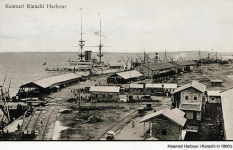
Keamari Harbour — 1900s

The aerial view reveals the scale of Karachi’s port complex more than a century ago. A Royal Navy cruiser lies anchored off the jetty, while goods sheds, railway tracks and harbour facilities can be seen across the waterfront.

The railway tracks ran directly onto the wharf, allowing cargo to move between ships, railway wagons and warehouses. In the foreground are the small stone customs buildings, some of which still survive today, although sadly in ruins.

By this period, Karachi had emerged as one of the most important ports of British India, handling enormous quantities of agricultural produce from Sindh, Punjab and the surrounding regions.
 
1787166014738.png

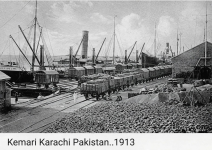
Keamari — 1913

This photograph takes us even closer to the working port.
Look carefully and you can see the S.S. INUUMA berthed at the harbour, railway wagons lined up beside the wharf, and coolies loading and unloading cargo by hand.

Among the cargo in the foreground is coal—the essential fuel that powered the steamships and railways of the era.

Cotton bales were being prepared for export, while wheat and other agricultural commodities moved through the port. Karachi's expanding railway network connected the harbour with the interior, helping transform the city into a major gateway for the agricultural wealth of the region.

There were no container terminals, no modern cranes and no mechanised cargo systems. Much of the work depended on human labour, railway transport and steam power.
 

Users who are viewing this thread

Back
Top