
Hamartia Antidote
Elite Member


Shield AI unveils X-BAT, a VTOL stealth loyal wingman drone - Breaking Defense
"When you see it, I believe that you'll probably think to yourself, 'Holy s--, that thing is f--- cool,'" said Shield AI President and Co-founder Brandon Tseng at a Tuesday event.
 breakingdefense.com
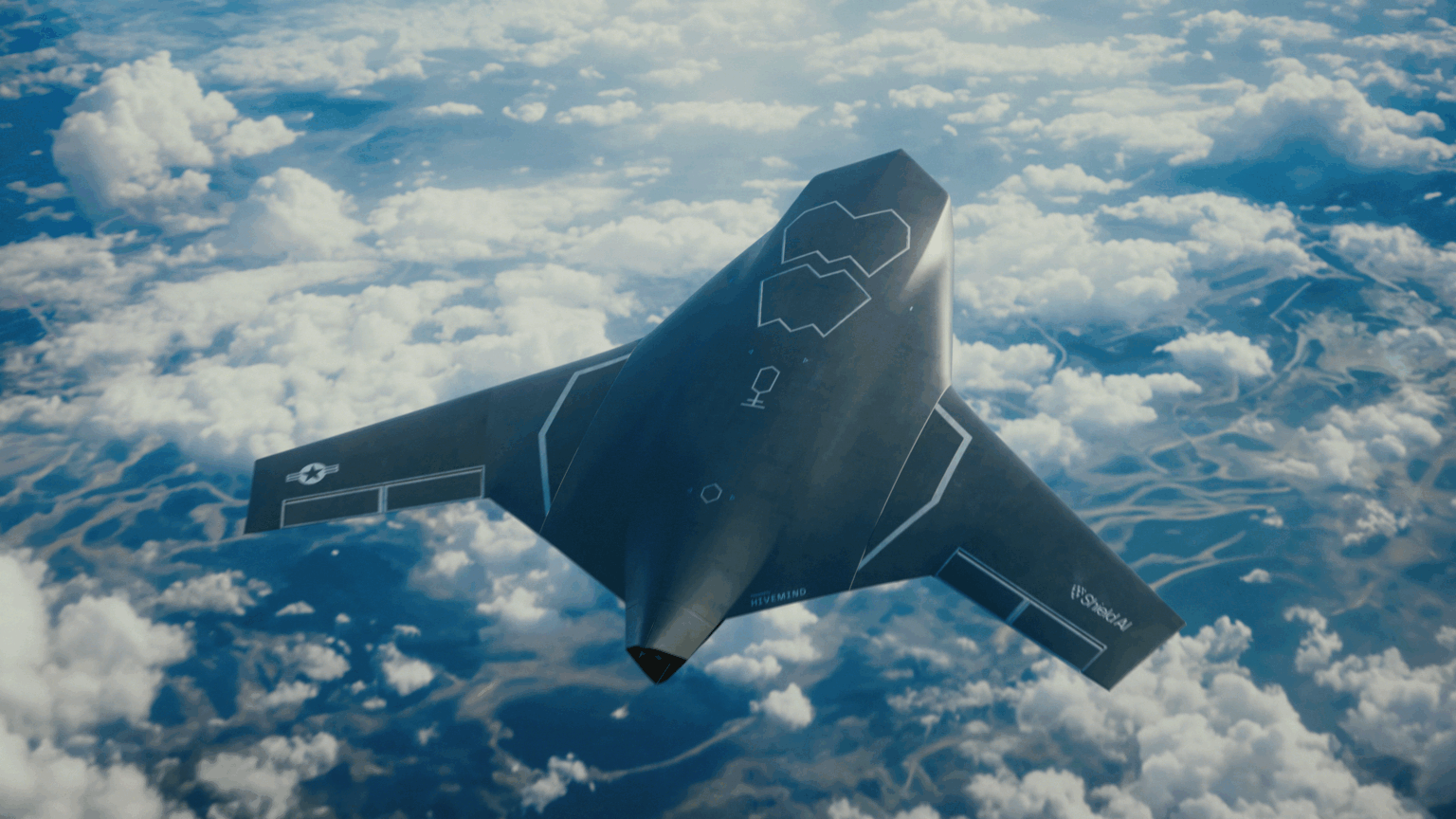
Artificial intelligence startup Shield AI announced plans today to expand further into the realm of military hardware, unveiling a new fighter-drone concept dubbed the X-BAT that the company plans to fly with its in-house autonomy software.
The unmanned wingman is a Group 5 drone, Pentagon parlance for the largest of unmanned systems, that can take off and land vertically. Images released by Shield AI show testing with a large jet engine, along with a drone with sleek surfaces designed to reduce the system’s radar signature.
“It is truly an inspirational aircraft,” Shield AI President and Co-founder Brandon Tseng said during a curtain-raising event in Washington on Tuesday for the new drone, where a static display was shown to an audience of industry and government attendees. “And when you see it, I believe that you’ll probably think to yourself, ‘Holy shit, that thing is fucking cool.'”
The Tuesday event featured a scale model of the drone, rather than a full production model. While Shield is the designer of the system, company officials were open that a partner would be brought in to help actually produce the X-BAT, with Armor Harris, the head of the firm’s aircraft business unit, telling reporters that “we’ll be announcing our partnerships more in the coming weeks.”
Similarly, Harris said the propulsion vendor the company is partnering with will be announced “in the coming weeks.” However, he described the X-BAT as operating with an “F-16 class engine” featuring an after burner and thrust vectoring nozzle that was “originally developed for a late 1990s F-15 thrust vectoring program.” He later told reporters that “multiple engine options [are] available.”
The X-BAT is being pitched as a “complete” system, Harris said, with the firm’s “Hivemind” computer pilot at the aircraft’s core to ensure the jet-powered drone can operate in comms-denied environments. (While Shield AI is offering the X-BAT with Hivemind as its pilot, the drone can support autonomous software from outside vendors as well.)
The firm expects to execute “initial” vertical takeoffs and landings “as early as fall 2026,” with “all-up flight testing and operational validation” to follow in 2028, Harris said in written replies ahead of the Tuesday event.
Harris would not offer a specific price tag, characterizing the X-BAT’s cost as “same as all the other CCAs [Collaborative Combat Aircraft].”
The company claims the X-BAT boasts a range of over 2,000 nautical miles, with an internal weapons bay and exterior hard points for munitions and a modular design that can swap in payloads for missions like surveillance or electronic warfare. The drone would takeoff and land vertically using a launch-and-recovery vehicle, sharing similar features with Shield AI’s existing MQ-35 V-BAT drone but scaled up for a larger aircraft. Officials say they are planning for the X-BAT to be able to operate either independently or as a wingman to a manned platform.
The announcement, teased by company officials earlier this year during the Paris Air Show, comes as the Air Force is still mulling requirements for future iterations of its Collaborative Combat Aircraft program — where officials have said low-end, high-end, or designs in between could be selected. Breaking Defense previously reported that Shield AI has been selected under the first round of the CCA program to provide an autonomous pilot for one of two prototypes under development by the Air Force.
The Navy, Marines Corps and now the Army have all expressed interest in unmanned concepts, though the services are at various stages. The Navy has awarded “conceptual” contracts to several vendors to design drones for carrier-based operations, Breaking Defense previously reported.
Firms have pitched various concepts for the Air Force’s second round, or “increment,” of the CCA program where design early contracts are expected within months. Dave Alexander, president of General Atomics’s aeronautics division, previously told Breaking Defense that the company’s LongShot drone under development with the Defense Advanced Research Projects Agency could be a “great fit” for the second CCA increment, whereas Lockheed Martin officials have said its recently unveiled “Vectis” unmanned concept could similarly have a role to play if a highly survivable platform is needed.
“Fundamentally, we believe that multi-role capability is critically important,” Harris said when asked why Shield AI settled on a more exquisite drone design despite the Pentagon’s lack of firm requirements. “The most successful programs in the past have been the ones that have truly been able to be multi-role,” Harris continued, pointing to the widely produced and exported F-16 that achieved “the right balance of capability and price point. So we think that we’ve got it about right with where X-BAT is.”


