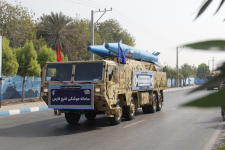
SMASH SLBM Testing - Nov 2025

dual thrust is not the same as pulse...no? @JamD
Right. Pulse usually means can be reignited. With a short flight time I don't think you need the complication of the dual pulse. However, the dual thrust probably lets you do a spicy terminal speed.
 
what i find interesting is this is very clearly designed for carrier killing.

A pretty niche capability. How many navies need to kill carriers?

For the export market, imo, a better sensor stack in exchange for slimming the warhead down to reduce your CEP so you can also target smaller vessels might be ideal? Maybe some form of terminal IR?
I have a theory on the CEP numbers. I suspect that the GNSS is only used until slightly after apogee due to reentry reasons and jamming reasons. Otherwise I would expect a smaller CEP. You're right, 10m is huge for hitting a ship. Might be difficult to get an IR seeker to work at those high Machs. I'm sure there's room for improvement on the radar seeker.
 
what i find interesting is this is very clearly designed for carrier killing.

A pretty niche capability. How many navies need to kill carriers?

For the export market, imo, a better sensor stack in exchange for slimming the warhead down to reduce your CEP so you can also target smaller vessels might be ideal? Maybe some form of terminal IR?
IN has 2
 
I will try.

Also, if you look at the trends the 290km MTCR restricted shot will have a slower terminal Mach than the 400km shot. Unless you do a really slow trajectory. This might explain the Mach 2+ marketing. They would be say 3+ if it was that.
Dual thrust/pulse would rectify that maybe?
 
Dual pulse confirmed.
Dual thrust not Dual pulse. Dual-thrust also known as boost/sustain rockets are quite standard and simply contain two types of propellants (one for initial high thrust followed by lower thrust sustainer). This configuration is used by Amraams and pretty much every other missile. Fatah-2 also uses this.

Dual pulse on the other hand allows you to burn one stage, coast unpowered for a while and then burn the second stage for a high terminal speed and slightly increased range. Example: PL-15
 
Might be difficult to get an IR seeker to work at those high Machs. I'm sure there's room for improvement on the radar seeker.
at danger of sounding retarded, modern IIR AAM's work at mach 3/4, beyond re entry, could you not have a jettisonable nose cone which would then pop out the seeker?

The iranians dont even use a cone, plopped the seeker right on top 1770473398652.png
 
I'm sure there's room for improvement on the radar seeker.
i wonder, is this actually a guidance issue or perhaps that the missile just isnt as manoeuvrable ? Because i see no reason why with ARH, the missile has such a huge CEP, unless it cannot adjust course significantly enough to be able to drop that number down
 
I would have thought basing the SMASH on the Abdali 2 system would have made more sense, longer range at 450km. The main problem for the PN is having enough large vessels to operate the SMASH, so far it's only the F22Ps, carrying at most 4 missile? 6 at a stretch. I see a very slim chance for exports, it's a very niche system for the PN, which itself will struggle to field it in any significant numbers. You probably need destroyer class sized vessels (6,00 tons displacement and over) to field it in any significant numbers.
 
I would have thought basing the SMASH on the Abdali 2 system would have made more sense, longer range at 450km. The main problem for the PN is having enough large vessels to operate the SMASH, so far it's only the F22Ps, carrying at most 4 missile? 6 at a stretch. I see a very slim chance for exports, it's a very niche system for the PN, which itself will struggle to field it in any significant numbers. You probably need destroyer class sized vessels (6,00 tons displacement and over) to field it in any significant numbers.

To me, from what I see, the focus seems to be more on exports orders(and therefore on MTCR compliant platforms) than raw capability for the armed forces?
 
at danger of sounding retarded, modern IIR AAM's work at mach 3/4, beyond re entry, could you not have a jettisonable nose cone which would then pop out the seeker?
So what I know about IIR seekers is that if you want them to be super sensitive you need the sensor to be cooled AF. If you're being cheap you can even have an uncooled sensor. Most missile solutions have a compressed gas cooling system used to cool the sensor for the minute the sensor activates. Now I would imagine that the cooling requirements quickly become insane with aerodynamic heating. I suspect modern missiles use a combination of superior materials technology for insulation and superior cooling technology. Now I don't expect us to make those kinds of seekers.

Also jettisonable cone wont work if the BM is too fast till it hits.


The iranians dont even use a cone, plopped the seeker right on top View attachment 177390
So this makes me doubt:
A - The terminal speed of this missile
B - The quality of the seeker (in part due to the above explanation)


i wonder, is this actually a guidance issue or perhaps that the missile just isnt as manoeuvrable ? Because i see no reason why with ARH, the missile has such a huge CEP, unless it cannot adjust course significantly enough to be able to drop that number down
So firstly, I'm pretty sure they give CEP for a stationary target. How do you even quantify it for a moving one right? That's not just plain CEP.

Let's assume it is not a guidance issue and we know the target down to cm. You can aim at the target from very far away and have to make very very small corrections to hit it very accurately. Disturbances like wind are pretty insignificant to a missile going at Mach F. You don't need a lot of control authority here.

So I think the issue really is accurate terminal targeting. But it may be solved with more maneuverability. JUST for example, the seeker might be getting a lock very late and at that point you need to maneuver a lot to hit accurately. Would you call this a control authority problem or a seeker problem? Depends on which department you're in lol. You could also try to solve the issue by having a seeker that locks on earlier.

This is fact of guidance math that when you're going Mach 3 and your target is moving at 20 kts, the target is essentially stationary. Furthermore, traditional disturbances like wind don't effect you much at that speed. The "disturbance" due to changing density is there. In this situation, I think the seeker is really the bottle neck. At Mach 3+sea level=dynamic pressure your control fins are SUPER effective. So it is either:
A. Control bandwidth issue: surfaces can't move back and forth fast enough because seeker has locked in too late
B. Control authority issue: surface can't move the missile quickly enough because seeker has locked in too late

I just love how I've imagined this super complicated situation blaming the non-controls department for a fault that I imagined lol.
 
Masoomana Sawal, do we have infrastructure and resources to mass produce such missiles?
 
Masoomana Sawal, do we have infrastructure and resources to mass produce such missiles?
If by "mass produce" you mean we 'produce a mass' of missiles, and 'mass' can mean anything from 1 and more. Then yes, we can mass produce such missiles with ease, just as SMASH, whose name literally has "supersonic" in it, can purportedly be hypersonic.
 
A. Control bandwidth issue: surfaces can't move back and forth fast enough because seeker has locked in too late
B. Control authority issue: surface can't move the missile quickly enough because seeker has locked in too late
Doesn’t it also have lateral thrusters?
 

Users who are viewing this thread

Back
Top