Yellow is Okay
Registered Member

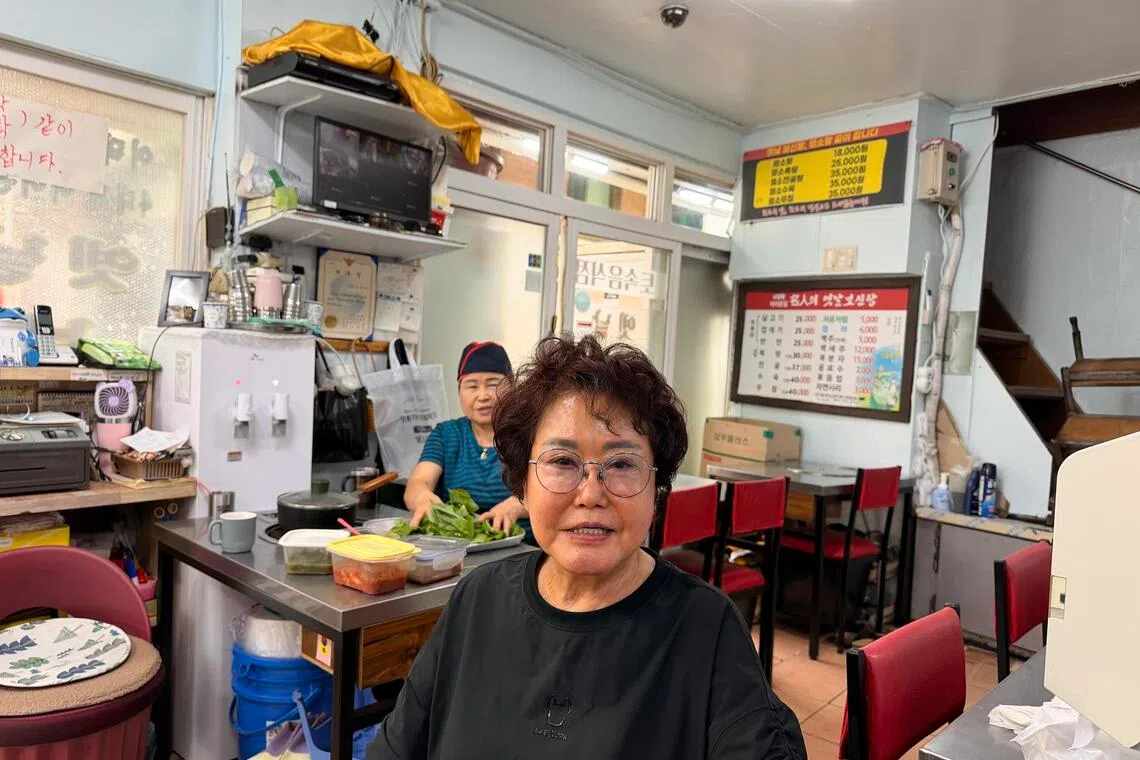
Lee Deok-sung, who has run a dog meat stew shop in Seoul for 45 years, says she is barely making ends meet these days. ST PHOTO: WENDY TEO
SEOUL – On the first night South Korean musician Annie Ko brought home her rescued Labrador DeeJay, the puppy wasted no time snuggling up next to her in bed as if he had always belonged there.
Perhaps he sensed he was finally safe. For the first three months of his life, DeeJay had known only a cramped cage on a dog meat farm in Wonju, about a two-hour drive from Seoul, where he lived with his six siblings before being rescued.
Ko, 45, had never owned a pet before. But seeing DeeJay, the runt of the litter, trembling in her arms was enough to convince her to adopt him in 2015.

Musician Annie Ko and her partner Toby with their Labrador DeeJay when he was just a three-month-old puppy they rescued from a dog farm in 2015. PHOTO: COURTESY OF ANNIE KO
She was then interpreting for the non-profit organisation Humane World for Animals, which has helped rescue some 2,800 dogs from such farms and send them overseas to the US, UK and Canada for adoption.
DeeJay is the only rescued puppy from his litter to remain in South Korea. Had he not been rescued, he would almost certainly have ended up on the chopping block.

Annie Ko and DeeJay, the Labrador she saved from a dog meat farm in Wonju, South Korea, in December 2015. DeeJay is now 11, and the only remnant of his past is his fear of clanging metal. ST PHOTO: WENDY TEO
But from February 2027, such dog meat farms will become a thing of the past as South Korea’s ban on the breeding, slaughter and sale of dogs for meat takes full effect.
The landmark legislation, passed in January 2024 after decades of debate, gave farmers a three-year grace period to wind down their operations.
According to South Korea’s Ministry of Agriculture, Food and Rural Affairs, more than 80 per cent of the known 1,500 dog meat farms had closed as at May 2026, leaving fewer than 300 farms in operation.
To incentivise farmers to cease operations ahead of the February 2027 deadline, the government has offered up to 600,000 won (S$545) compensation per dog, along with low-interest loans and support programmes, including job-transition assistance and re-employment counselling.
While there are no official figures of the number of dog meat restaurants that have closed nationwide, restaurant owners and meat vendors interviewed by The Straits Times said business has dwindled to about a third of what it once was.
A dog meat vendor at Seoul’s Gyeongdong Market, one of the few remaining places where dog meat is still sold, said prices had tripled from about 20,000 won per kg in 2024 to 60,000 won today.
She declined to be named or comment further, saying the issue was too sensitive.
Lee Deok-sung, who has run a dog meat stew restaurant near Seoul’s popular Dongdaemun Market for the past 45 years, said this summer has been a “bust” for business.

Two dog meat stew restaurants located at Seoul’s Dongdaemun Market. Today, dog meat has largely fallen out of favour in South Korea as dogs are increasingly regarded as companion animals rather than livestock. ST PHOTO: WENDY TEO
Dog meat stew, known as boshintang, has traditionally been eaten during South Korea’s three hottest days of summer, when many believe the dish provides nourishment and replenishes stamina depleted by the heat.
This year’s boknal, or “dog days” of summer, fall on July 15, July 25 and Aug 14. They will be the last before the country’s dog meat ban takes effect.
Gesturing at a tray of unsold meat, Lee told The Straits Times that she has to sell all of the meat by dinner service in order to break even for the day.
She has had to increase prices from 16,000 won to 25,000 won a bowl, given the rising cost of the meat.
“I am barely making ends meet now. I don’t know what will happen to me when the ban kicks in next year,” she said.
Across the narrow alley from Lee’s restaurant is Lee Kyung-ja’s boshintang restaurant, which has also been around for more than 40 years.
The two neighbouring restaurants are well-known institutions patronised by boshintang consumers.
Both restaurants started offering black goat stew earlier in 2026, but the owners said the dish has yet to gain popularity despite being cooked in the same way as boshintang.
Black goat meat is seen as an alternative to dog meat because of their similarity in texture and gamey flavour.
Lee Kyung-ja told The Straits Times that business was so bad, the restaurant had no customers on some days.

Lee Kyung-ja has been selling dog meat stew for the past 40 years but started offering black goat stew earlier in 2026 as an alternative to dog meat because of their similarity in texture and gamey flavour. However, she said, the dish has yet to gain popularity. ST PHOTO: WENDY TEO
Her regular customers who still come said they preferred dog meat to goat because it was tastier.
Some also said traditional Korean medicine practitioners continued to recommend dog meat to people recovering from serious illness.
The 75-year-old said that as age is catching up with her, she might call it a day if business dwindles further next year when the ban is in effect.
“Switching to black goat meat means I have to build up my customer base again, and this is hard for me to do at my age,” she said.
Historical records suggest that the tradition of dog meat consumption in South Korea dates back at least as far as the Joseon Dynasty.
One of the best-known references appears in the Donguibogam, a 17th-century medical text compiled by royal physician Heo Jun, which describes dog meat as a warming food believed to replenish energy and vitality.
The practice became more widespread during Japan’s colonial rule from 1910 to 1945 and in the aftermath of the three-year Korean War, when widespread poverty and food shortages drove many to seek inexpensive sources of protein.
Dogs were considered a practical option because they reproduce in large litters and reach maturity relatively quickly.
Today, dog meat has largely fallen out of favour in South Korea as dogs are increasingly regarded as companion animals rather than livestock.
But the practice continues in other parts of Asia, including North Korea, China, Vietnam and Indonesia.


