Starlab—with half the volume of the ISS—will fit inside Starship’s payload bay

Hamartia Antidote

Elite Member
Joined
Nov 17, 2013
Messages
47,572
Reaction score
27,111
Reputation
566.8
Country of Origin
Country of Residence
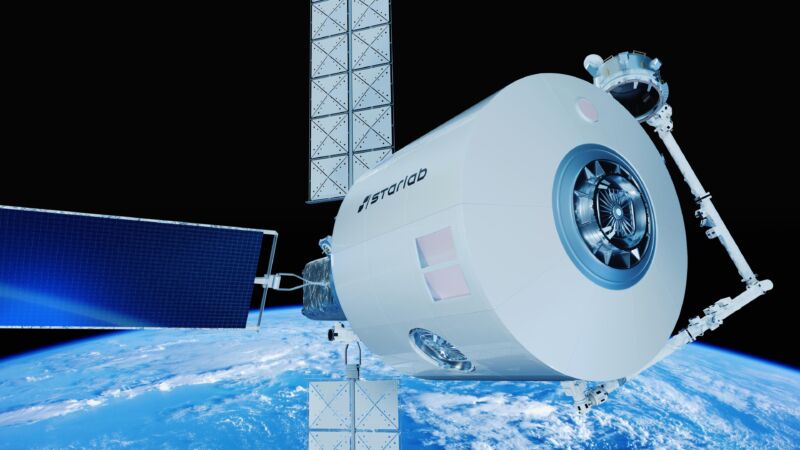
An artist's concept of the Starlab space station.

Enlarge / An artist's concept of the Starlab space station.

The Starlab commercial space station will launch on SpaceX's Starship rocket, officials said this week.

Starlab is a joint venture between the US-based Voyager Space and the European-based multinational aerospace corporation Airbus. The venture is building a large station with a habitable volume equivalent to half the pressurized volume of the International Space Station and will launch the new station no earlier than 2028.

"SpaceX's history of success and reliability led our team to select Starship to orbit Starlab," Dylan Taylor, chairman and CEO of Voyager Space, said in a statement. "SpaceX is the unmatched leader for high-cadence launches and we are proud Starlab will be launched to orbit in a single flight by Starship."

Fitting in a big fairing​

Starlab will have a diameter of about 26 feet (8 meters). It is perhaps not a coincidence that Starship's payload bay can accommodate vehicles up to 26 feet across in its capacious fairing. However, in an interview, Marshall Smith, the chief technology officer of Voyager Space, said the company looked at a couple of launch options.

"We looked at multiple launches to get Starlab into orbit, and eventually gravitated toward single launch options," he said. "It saves a lot of the cost of development. It saves a lot of the cost of integration. We can get it all built and checked out on the ground, and tested and launch it with payloads and other systems. One of the many lessons we learned from the International Space Station is that building and integrating in space is very expensive."

With a single launch on a Starship, the Starlab module should be ready for human habitation almost immediately, Smith said.

It's hard to believe the interior of Starlab will ever be this clean in space.
Enlarge / It's hard to believe the interior of Starlab will ever be this clean in space.

Starlab is one of several privately developed space stations vying to become a commercial replacement for the International Space Station, which NASA is likely to retire in 2030. Among the other contenders are Axiom Space, Blue Origin, and Vast Space. SpaceX may also configure a human-rated version of Starship as a temporary space station.

NASA has provided seed funding to some of these companies, including Voyager Space, to begin designing and developing their stations. NASA is expected to hold a second round of competition next year, when it will select one or more companies to proceed with building and testing their stations.

Finding customers​

Each company is developing a space station that will serve both government customers—NASA wants to continue flying at least a handful of astronauts in low-Earth orbit for research purposes—as well as private customers. The challenge for Starlab and other commercial stations is developing a customer base beyond NASA to support the expense of flying and operating stations.

The challenge is a huge one: NASA spent more than $100 billion constructing the International Space Station and has a $3 billion annual budget for operations and transportation of people and supplies to the station. The agency is likely to fund commercial space stations at a level of about $1 billion a year, so these companies must build their facilities relatively quickly at low cost and then find a diverse base of customers to offset expenses.

Starlab may have an advantage in this regard with its co-ownership by Airbus. One of the big questions surrounding the end of the International Space Station is what happens to the European astronauts who fly there now. The European Space Agency will likely be reticent about funding missions to private space stations owned and operated by US companies. The involvement by Airbus, therefore, makes Starlab attractive to European nations as a destination.
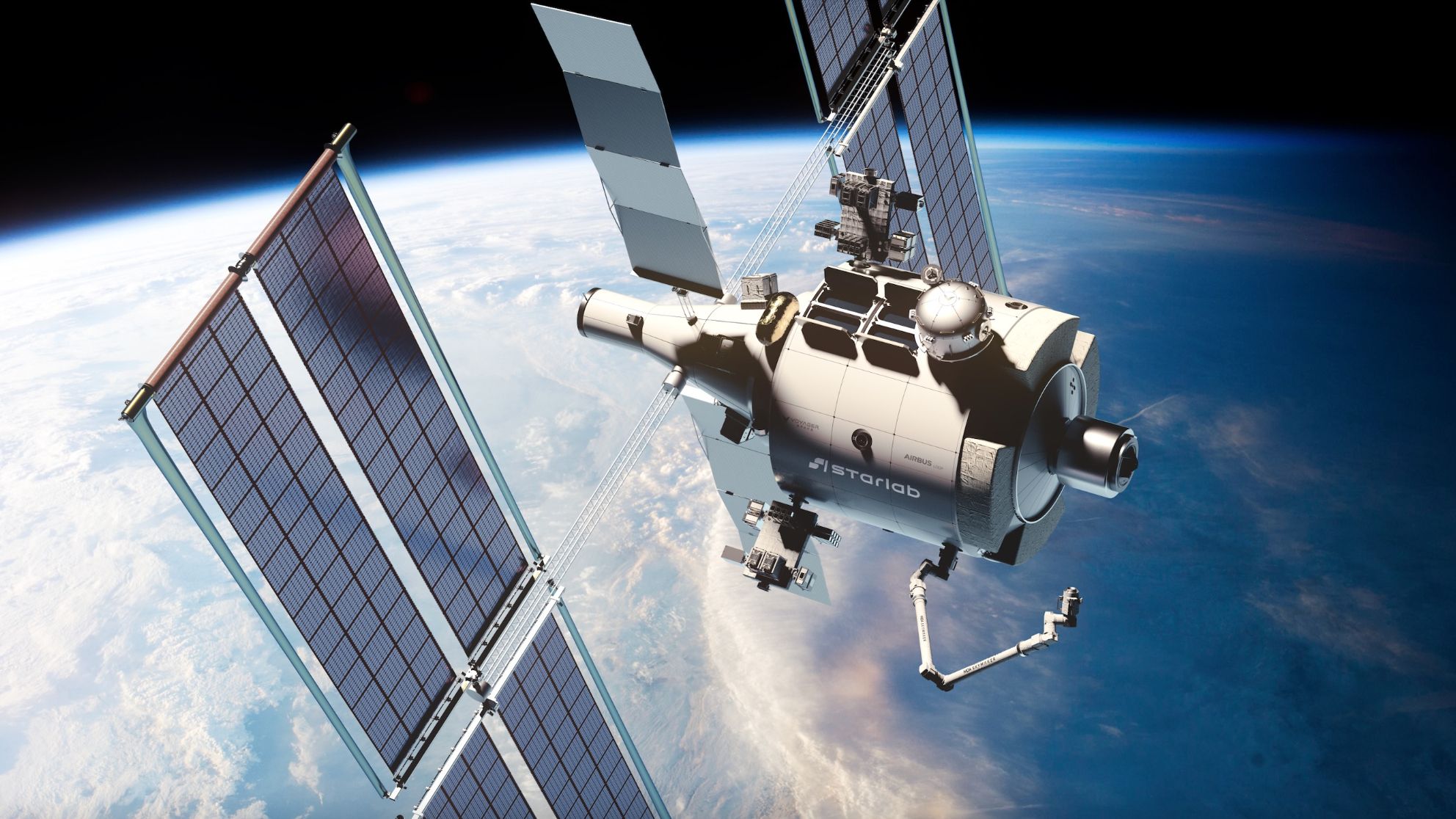
 

Private Starlab space station moves into 'full-scale development' ahead of 2028 launch​


"This milestone confirms that our space station design is technically sound and safe for astronaut crewed operations."

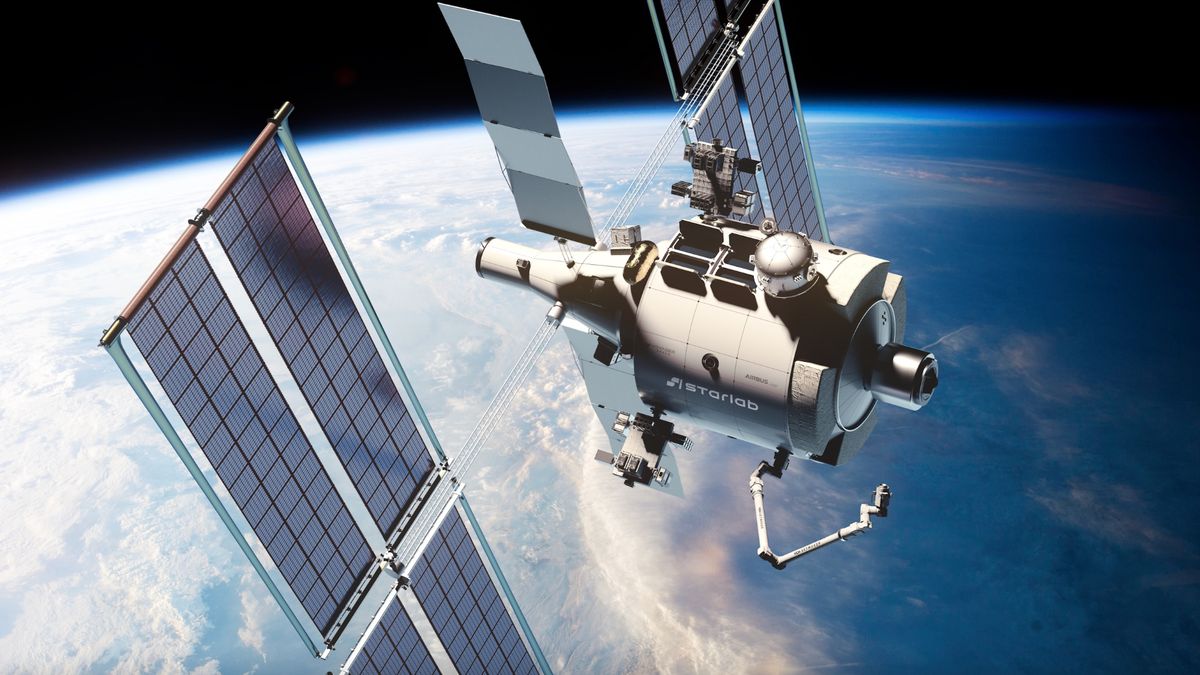
illustration of a private space station in earth orbit

The private Starlab space station will consist of a service module and a habitat for four astronauts. (Image credit: Starlab)

The Starlab commercial space station project is moving toward the production phase, having passed a key development milestone with NASA.

Starlab, a joint project between the U.S. space technology firm Voyager Space and European aerospace conglomerate Airbus, will consist of a service module and a habitat large enough to host four space tourists. Currently, the station is expected to launch in 2028 aboard SpaceX's Starship megarocket.

The recently completed preliminary design review (PDR) marks the beginning of the station's "full-scale" production, the company said in a statement.

"Our successful PDR is a testament to the expertise and dedication of our team," Starlab CEO Tim Kopra said in the statement. "This milestone confirms that our space station design is technically sound and safe for astronaut crewed operations. Now, with our partners, we shift our focus to the full-scale development of the station, including the manufacturing of critical hardware and software integration."

The 12,000-cubic-foot (340-cubic-meter) Starlab will be fitted with a robotic arm and a set of racks for microgravity experiments to enable companies and researchers to develop new products in space. Voyager also hopes to seal a contract with NASA to host the agency's astronauts.

The project will now move into its detailed design and hardware development phase, which will conclude with a critical design review likely in 2026.

In the coming months, the project partners will develop a high-fidelity mockup for systems testing, which will be assembled at NASA's Johnson Space Center in Houston this summer. The teams will also begin assembling the station's avionics and computing systems, test software and novel life support technologies including an Advanced Urine Processor, a more compact and failure-proof version of the water-recovery system currently in use at the International Space Station.

"Starlab's progress underscores our collective commitment to ensuring U.S. leadership in low Earth orbit with investment and partnership from key allied international organizations and agencies," said Dylan Taylor, chairman and CEO of Voyager Technologies, the majority shareholder in Starlab's joint venture. "We are ready to advance human spaceflight, ensure a continuous human presence in LEO, and build a thriving commercial space ecosystem."

The space station project received $217.5 million from NASA through the Commercial LEO Destinations Phase 1 program and $15 million from the Texas Space Commission, in addition to private funding.
 

Starlab partners unveil full-scale mockup of commercial space station​


rsz_1aa-p1030060-1.jpg
Starlab Space invited visitors into a full-size mockup of the commercial space station scheduled to launch in 2029 on a SpaceX Starship. Credit: Starlab

SYDNEY, Australia – Starlab Space unveiled a full-scale mockup of the commercial space station at the International Astronautical Congress here.

“We’re showing how large the station is going to be — 100% of the capacity of ISS,”

Matt Magaña, president of space, defense and national security for Voyager Techogies, the majority partner in the Starlab joint venture, told SpaceNews. “People are just in awe.”

Visitors to the Voyager display, including hundreds of children who flocked to the venue with their parents Friday on IAC public day, saw the large windows, payload racks and external robotic arm supplied by Canadian partner MDA Space.

Voyager is leading development of the 7.8-meter-diameter Starlab in a joint venture with international partners Airbus, Mitsubishi Corp., MDA, Palantir Technologies and Space Applications Services.

Belgium-based Space Application Services, an engineering and payload-integration specialist, is Starlab’s latest joint venture partner and investor.

“SpaceApps contributes deep experience in space systems, mission operations and payload integration,” Voyager said in an Oct. 1 news release. “The company also works closely with the European Space Agency and international partners, broadening Starlab’s access to global markets and research communities.”

Starlab also announced Oct 3 that Saber Astronautics, based in Australia and the United States, would become a channel and implementation partner. “Saber Astronautics will play a dual role: driving business development by engaging new customers for Starlab’s microgravity platform and providing technical execution services including feasibility assessments, hardware integration and in-orbit operational support,” according to the news release.

rsz_p1010854.jpg

Inside Starlab​

Starlab’s main habitation volume includes three 2.2-meter-tall levels. Life support systems, toilets and exercise equipment are located on the first level. The next level up houses the equivalent volume of 130 middeck lockers for research and technology demonstrations.

The crew quarters on the third level have two observation windows oriented toward Earth and two aimed at the horizon. Visitors to the mockup saw the Leidos galley rack where crews will prepare food.

“We already have quite a few customers that are booking space on Starlab,” said Courtenay McMillan, Starlab Space mission segment lead. “We’re operating in a real estate mode. We’ll lease the majority of the space in middeck lockers to the customers for the duration that they have experiments up there.”

Starlab also will offer customers access to microscopes, centrifuges, cold stowage and other equipment and supplies.

Structural Partner​

Days before IAC, Starlab selected Vivace Corp. to manufacture the space station’s aluminum-based primary structure in New Orleans. Additional development and testing will be performed at NASA’s Michoud Assembly Facility in Louisiana.

“Selecting Vivace to lead the manufacturing of Starlab’s primary structure is a major milestone,” Starlab CEO Marshall Smith said in a statement. “Starlab is meticulously engineered to deliver scalability, reliability, and mission-critical research to our partners. This collaboration is instrumental in transforming that vision into reality, perpetuating the ISS legacy, and ensuring NASA and its international partners continue to have seamless access to orbit in the post-ISS era.”


To view this content we will need your consent to set third party cookies.
For more detailed information, see our cookies page.
 
7 meters wide and 65 metric tonnes. It will be put into orbit by a single Starship launch.

To view this content we will need your consent to set third party cookies.
For more detailed information, see our cookies page.

Inside Starlab, a MASSIVE commercial Space Station!

multipleStarlabs.png
multipleStarlabs2.png
multipleStarlabs3.png
multipleStarlabs4.png
😍


2020

Voyager Space Holdings to acquire majority stake in Nanoracks​


is an American private in-space services company which builds space hardware and in-space repurposing tools. The company also facilitates experiments and launches of CubeSats to Low Earth Orbit. Nanoracks's main office is in Houston, Texas. Nanoracks provides tools, hardware and services that allow other companies, organizations and governments to conduct research and other projects in space.


To view this content we will need your consent to set third party cookies.
For more detailed information, see our cookies page.

Nanoracks Platform Installation on the ISS
 
Last edited:

Users who are viewing this thread

Pakistan Defence Latest

Latest Posts

Back
Top