Stoke Space is raising $1 billion at a $9 billion valuation to build Nova, a fully reusable rocket targeting its first launch in 2026.

www.briefs.co
Stoke's $1 Billion Quest for a Fully Reusable Rocket
Summary:
- Stoke Space is raising $1 billion at a $9 billion valuation
- The Nova rocket is designed for full vehicle reusability
- First launch is targeted for August 13, 2026
Most rockets today are like throwing away an airplane after every flight. Stoke Space wants to change that, and
investors are lining up to help.
The Kent, Washington startup is
looking to raise $1 billion to speed up development of its fully reusable Nova rocket. The round would value the company at about $9 billion before the new money arrives, according to people familiar with the matter, and Stoke hopes to close the deal this month.
The company's press office would not discuss the fundraising.
The Big Idea Behind Nova
Stoke got its start in 2019, with a team drawn from Blue Origin, the rocket company backed by Jeff Bezos. The team is preparing Nova's first launch, but the rocket's design is what sets it apart.
SpaceX's Falcon 9, the workhorse of the industry, is only partially reusable. SpaceX recovers the first stage booster, but the upper stage burns up or splashes down after each mission. Nova is designed to come back in one piece, every time.
That means the entire vehicle needs to survive the brutal trip back through the atmosphere. Stoke is working on a liquid-cooled heat shield to protect Nova from hot plasma during reentry, and the company says each rocket needs little servicing between flights. The goal is quick turnaround, like refueling a jet instead of rebuilding one.
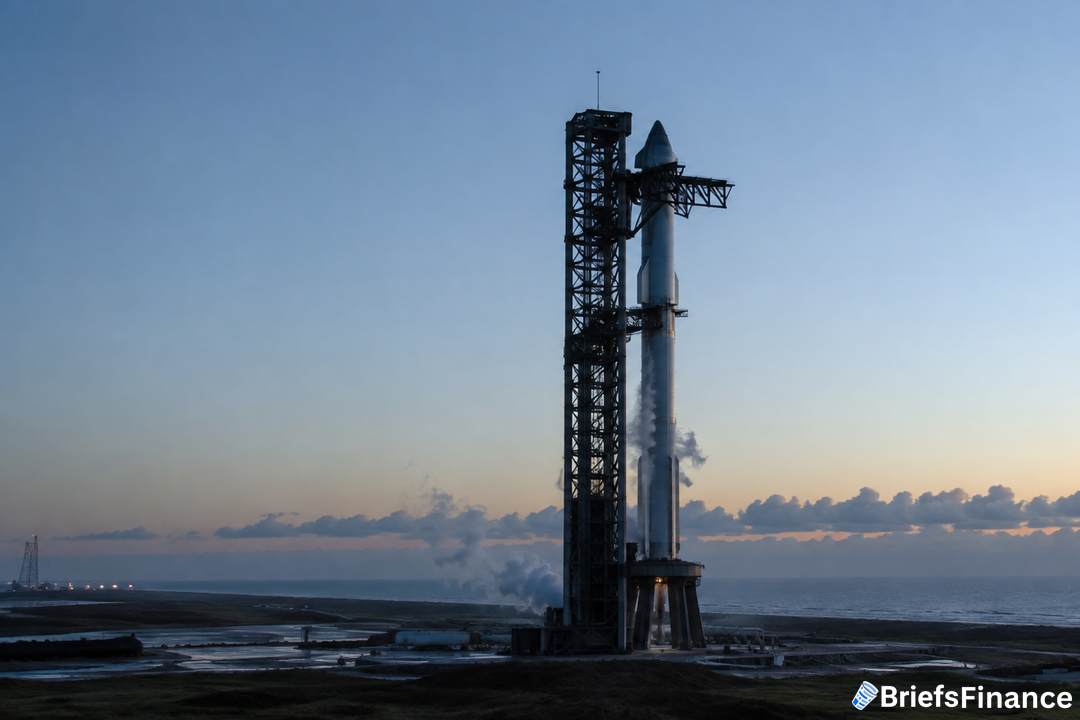
No rocket operator has pulled off full vehicle reuse yet. SpaceX's Starship is trying to reach that milestone, but no complete Starship has been brought back intact so far [

].
The Challenge of Coming Home
The heat shield is the hardest part of the whole equation. When a rocket reenters the atmosphere, friction creates temperatures that can melt most materials.
SpaceX's Starship uses hexagonal ceramic tiles to handle that heat. Outside experts have questioned whether that system will hold up, but Elon Musk said on a recent earnings call that he thinks the heat shield design is "solved."
Stoke is taking a different path with its liquid-cooled approach. If it works, the payoff is enormous. A fully reusable rocket could slash launch costs dramatically, which is why investors are willing to bet big.
Earlier backers include Breakthrough Energy Ventures, the fund founded by Bill Gates, along with Glade Brook Capital and Toyota Ventures. The company closed an extended Series D round in February after raising $860 million, bringing its total fundraising to $1.34 billion at that point.
If this new round succeeds,
Stoke's valuation would jump past Relativity Space's $4.2 billion valuation from 2021, which came before that company's first successful spacecraft. Relativity later ran into trouble with the 3D-printing approach it used to build its rockets.
What This Means for Your Portfolio
The space industry is heating up because global launch capacity is tight. Companies need to get satellites into orbit, and there are not enough rockets to carry them all. That bottleneck is why so many firms are building Falcon 9 competitors.
Stoke is aiming for a first launch soon, with the company targeting August 13, 2026 as a key date in its development timeline. A successful debut would put it in rare company. A failure would not erase the $1.34 billion already in the bank, but it would delay the dream of full reuse.
For investors, this is a reminder that the space race is no longer just a government project. Private companies are spending billions to solve problems that seemed impossible a decade ago, and every successful launch reshapes the economics of getting off the planet.
The question is not whether full reuse will happen. It is which company gets there first, and what that means for everyone else trying to reach orbit.