Terrorism: Review

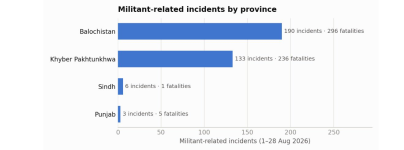
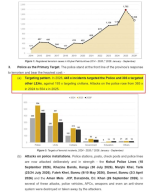
In Pakistan, during the month of August a continued trend that has slipped into September, violence is heavily concentrated in two provinces Balochistan (190 incidents, 296 fatalities) and Khyber Pakhtunkhwa (133 incidents, 236 fatalities) Within those two provinces, incidents cluster in a recognizable set of districts. Bannu (KP) recorded the most incidents of any single district (26) and the highest single-district death toll (45). Balochistan's Kalat, Khuzdar, Mastung, Kech and Chagai districts, and KP's South Waziristan and Bajaur, round out the highest-frequency locations. Which technically means that the there are repeated attacks with the same modes operandi in these areas. [Source: The Khorasan Diary- Log into the website for a more detailed breakdown].

1789034454923.png


Govt weighs Rs46 billion security plan for gas pipelines, E&P operations​

Proposal seeks 14 dedicated wings after 23 sabotage incidents caused losses of 7,624 million cubic feet of gas over two years

The government is considering a proposal to establish 14 dedicated security wings to protect gas pipelines and oil and gas exploration and production (E&P) operations, mainly in Khyber-Pakhtunkhwa (KP) and Balochistan, amid mounting losses from terrorist attacks, The Express Tribune reported.

The proposed framework includes four dedicated wings for Sui Northern Gas Pipelines Limited's (SNGPL) pipelines and northern gas sources and 10 wings, modelled on the China-Pakistan Economic Corridor (CPEC) security framework, for E&P operations.

Around 23 sabotage incidents have been reported over the past two years on the Shewa and Bettani pipelines and SNGPL's main northern network, resulting in an estimated loss of 7,624 million cubic feet of gas, equivalent to about 25 liquefied natural gas (LNG) cargoes.


The financial loss is estimated at Rs12.7 billion at a local gas price of $6 per million British thermal units (mmBtu) and around Rs27.7 billion at a re-gasified LNG price of $13/mmBtu.

A complete suspension of supplies from northern sources could have a significantly larger financial impact. Diverting expensive re-gasified LNG (RLNG) to meet demand would add Rs97 billion to SNGPL's annual revenue requirement, raising its prescribed price by about Rs333/mmBtu from Rs1,719/mmBtu to Rs2,052/mmBtu during the current financial year.

Recent discoveries including Mami Khel, Shewa and Spinwam in the Waziristan Block, OGDC's Bettani under the Wali Exploration Licence and Al-Haj's Koi Palak in the Baska North Block currently contribute 146 million cubic feet per day (mmcfd) to SNGPL's northern network.

Other northern sources contribute another 410 mmcfd, taking total indigenous inflows through the network to 556 mmcfd.


Existing security deployments cover sensitive pipeline corridors including Shewa-Kaka Khel, Kot Palak-DI Khan/Pezzu, Bettani-Kaka Khel, Kharappa-Marjuwala and Kharappa-Gurguri Makori.

Around 1,513 personnel currently protect SNGPL pipelines at an annual cost of approximately Rs3 billion, while E&P companies deploy another 1,828 personnel at an annual cost of Rs2.174 billion. Combined, the existing security arrangements comprise around 3,341 personnel and cost Rs5.174 billion annually.

Following a series of meetings between the petroleum minister, Sui companies and E&P firms, a two-part security mechanism was agreed to strengthen protection of pipelines and exploration operations.

Under the first component, four dedicated regular wings are proposed for SNGPL pipelines and northern gas sources. Establishing them is estimated to cost Rs12 billion, with another Rs4 billion in annual recurring expenditure.


After adjusting for two wings already deployed, the additional requirement for the remaining two wings is estimated at Rs8.969 billion, along with annual recurring expenditure of Rs2 billion.

The second component proposes 10 dedicated regular wings for exploration, seismic data acquisition, drilling, wellhead facilities, gas processing and related E&P activities. Four would be deployed in K-P and six in Balochistan, where security constraints have been delaying exploration and development activity.

Establishing the 10 E&P wings is estimated to cost Rs30 billion — Rs12 billion for K-P and Rs18 billion for Balochistan.

The Rs30 billion cost is proposed to be shared equally among E&P companies, the federal government and the respective provincial governments, with each contributing Rs10 billion.


The E&P companies would also bear the entire Rs10 billion annual recurring cost. Under the proposed arrangement, the E&P security mechanism would have no financing cost, prescribed gas price impact or pass-through to consumers.
 

Terror attacks in Balochistan​

Balochistan has witnessed an increase in terrorist attacks in recent weeks, prompting security forces to intensify counter-terrorism operations.

Last month, the number of terrorist attacks in the province increased by seven per cent from 83 in July to 89 in August, according to a monthly assessment by the Pakistan Institute for Conflict and Security Studies.

On the night of Aug 31-Sept 1, terrorists of the banned Tehreek-i-Taliban Pakistan (TTP) launched a coordinated attack on the Customs House, located at Ziarat Cross on the N-50 National Highway, in the Pishin district.

In retaliatory action, security forces killed 10 terrorists while two officers were among six martyred in the fire exchange, according to the military’s media affairs wing.

Also on August 31, 11 terrorists belonging to Fitna-al-Hindustan, who had blocked the N-40 Quetta-Taftan highway by establishing an illegal checkpoint for extortion in Chagai’s Nokcha area, were killed following an intense exchange of fire.

On September 2, security forces killed 12 terrorists in the Kalat district during an IBO. Days later, the troops killed 11 terrorists and recovered 2.9 tonnes of explosives during separate IBOs in Kharan and Washuk districts.

Another 36 terrorists were eliminated during multiple “high-tempo” operations conducted in Mastung, Quetta, Kalat and Sibi districts, the Inter-Services Public Relations said on September 4. These also included thwarting an attack on a police station in Sibi’s Bhag area.


On Monday, nine terrorists, including a key commander of a banned outfit, were killed by security forces and the Balochistan Counter-Terrorism Department in two separate operations in Mastung, Pishin and Qila Abdullah districts.
 

Terrorist attacks increase but fatalities decline during August: PICSS​


ISLAMABAD: The number of terrorist attacks increased significantly in August despite sustained counter-terrorism pressure, but their human impact declined compared with July, according to a monthly security assessment by an Islamabad-based think tank.

According to monthly data compiled by the Pakistan Institute for Conflict and Security Studies (PICSS), 199 terrorist attacks were recorded in August, compared with 144 in July — an increase of 38 per cent. Violence linked to terrorist attacks and counter-terrorism operations had intensified sharply in July, making it the deadliest month of 2026.

However, the institute added that despite the increase in attack frequency, their human impact declined from the previous month. Data showed that the 199 attacks recorded during August resulted in 158 deaths and 181 injuries, compared with 268 deaths and 216 injuries in 144 attacks during July. Deaths resulting from terrorist attacks therefore declined by 41pc, while injuries declined by 16pc.

Security forces’ continuing counter-terrorism operations during August resulted in 211 deaths, including 203 terrorists. The operations also resulted in 21 terrorists being injured and 26 suspected terrorists arrested. Security forces killed 115 terrorists in Balochistan, 56 in mainland Khyber Pakhtunkhwa, and 32 in the merged districts during the month.

The institute also recorded three suicide attacks during August, including two vehicle-borne suicide attacks. PICSS noted that this represented a substantial decline from July, when eight suicide attacks were recorded, including five vehicle-borne suicide attacks — “the highest number of suicide attacks recorded in a single month during the past decade”.

Kidnapping incidents declined by 36pc, falling from 66 in July to 42 in August.

In terms of attack typology, the report noted that tactical assaults emerged as the most frequently used tactic during the month, with 47 incidents, followed by target killings with 46 and attacks with improvised explosive devices (IED) with 36. Tactical assaults resulted in 40 deaths and 44 injuries, while target killings caused 50 deaths and 23 injuries. IED attacks resulted in 15 deaths and 50 injuries.

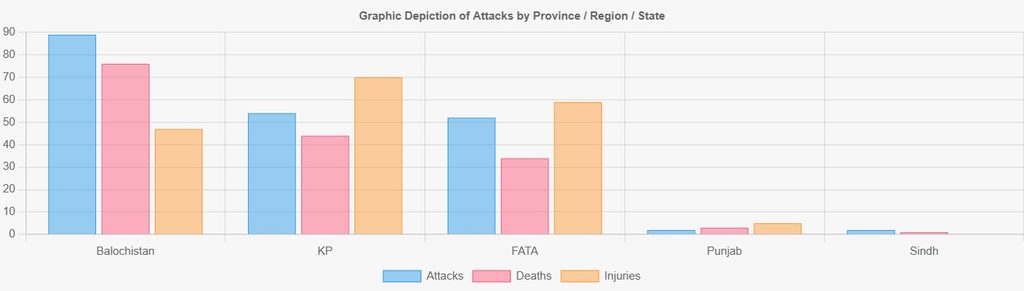
According to the PICSS report, the security situation remained most severe in Balochistan, where the number of terrorist attacks increased by 7pc from 83 in July to 89 in August. Deaths resulting from these attacks declined from 162 in July to 76, while injuries declined from 86 to 47.

Meanwhile, security forces’ actions in Balochistan resulted in 118 deaths, including 115 terrorists, compared with 192 deaths, including 189 terrorists in July.

Mainland KP, excluding the merged districts, recorded 54 terrorist attacks in August compared with 36 in July, representing an increase of 50pc. Deaths resulting from terrorist attacks declined from 69 in July to 44 in August, while injuries declined from 96 to 70, representing a decrease of 27pc.

Security forces’ actions in the province resulted in 60 deaths, including 56 terrorists — also lower than the July numbers.

The merged districts of KP, formerly known as FATA, recorded 52 terrorist attacks in August, an increase of 126pc compared with 23 in July. Deaths resulting from these attacks declined slightly from 36 to 34, while injuries increased from 33 to 59. Security forces’ actions resulted in 33 deaths, including 32 terrorists, compared with 43 deaths, including 41 terrorists, during July.

In Punjab, the think tank recorded two terrorist attacks resulting in three deaths and five injuries. Security forces conducted two notable operations in the province and arrested five suspected terrorists.

Sindh also recorded two terrorist attacks in August, in which one person was killed, while security forces conducted two operations and arrested two suspected terrorists.

Islamabad, Azad Jammu and Kashmir, and Gilgit-Baltistan witnessed no terrorist attacks during August, the report added.
 
🚨 EAGLE EYE CTW
🚨 06-DAY COUNTERTERRORISM UPDATE

◾️83 Terrorists were eliminated over the past six days

🟥 Afghan Taliban — 14–16
◾️ Gulistan

🟥 TTP - 55

◾️Shabaan: 33
◾️Kurram: 13
◾️Khooni Talab: 9

🟥 BLA - 12
◾️Khalil Shaheed Post & Sherinab

Total reported: 83+ Terrorists eliminated in six days

Sep 26, 2026
 

Security forces kill 5 terrorists in KP IBO, 2 eliminated in Balochistan's Chagai: security sources​

News Desk
September 29, 2026

1790679318485.png

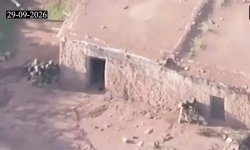
Screengrab from footage of intelligence-based operation against terrorists in Bara, Khyber Pakhtunkhwa on Sep 29, 2026. —Security sources

Security forces on Tuesday killed five terrorists in an intelligence-based operation (IBO) in Khyber Pakhtunkhwa’s Bara area, while two more were killed in an operation in Balochistan’s Chagai, according to security sources.

Large quantities of weapons and ammunition were recovered from the terrorists, who belonged to Fitna al Khawarij, security sources said on the operation in Bara.

Fitna al Khawarij is a term the state uses for terrorists belonging to the banned Tehreek-i-Taliban Pakistan. “As a result of the security forces’ operation, Fitna al Khawarij hideouts were completely destroyed,” security sources said.

“Security forces remain committed to the complete eradication of the scourge of terrorism from the country and the establishment of lasting peace.”

Meanwhile, Pakistan TV, citing security sources, reported that security forces killed two terrorists in operations in Balochistan’s Chagai.
 

Militant Attacks Increase but Human Impact Declines in August Amid Sustained CT Pressure: PICSS​


Islamabad, September 1, 2026: The number of militant attacks increased in August despite sustained counter-militancy pressure, but their human impact declined substantially compared with July.

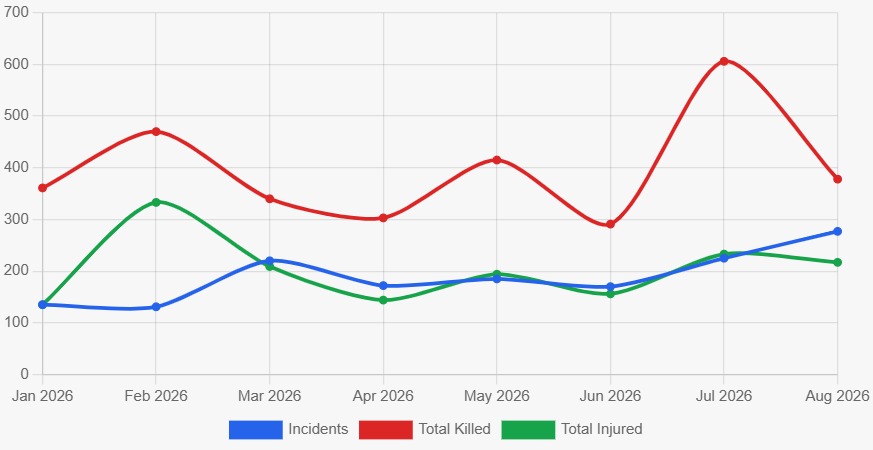
According to monthly data compiled by the Pakistan Institute for Conflict and Security Studies (PICSS), an Islamabad-based think tank, at least 378 people were killed and 217 injured across the country during August.

PICSS data showed that during security forces notable actions and operations against militants during August.

These operations resulted in 211 deaths, including 203 militants, while 21 militants were injured and 26 suspected militants were arrested. The number of security forces personnel killed during the month stood at 54, compared with 112 in July.

According to PICSS, militants carried out 199 attacks during August, compared with 144 in July, representing an increase of 38 percent.

Despite the increase in attack frequency, their human impact declined, with deaths falling from 268 in July to 158 in August, a decrease of 41 percent, while injuries declined from 216 to 181, a decrease of 16 percent.

WhatsApp-Image-2026-09-01-at-13.51.39-1.jpeg


PICSS data showed that the overall death toll linked to militant attacks and counter-militancy operations declined by 39 percent, from 606 in July to 369 in August. Security forces’ operations resulted in 211 deaths during August, including 203 militants, compared with 401 militants killed during operations in July. The number of people injured during the month declined from 232 in July to 217 in August.
 
Tactical assaults (TA) emerged as the most frequently used tactic, with 47 incidents, followed by target killings (TK) with 46 and IED attacks with 36. Tactical assaults resulted in 40 deaths and 44 injuries, while target killings caused 50 deaths and 23 injuries. IED attacks resulted in 15 deaths and 50 injuries.

PICSS recorded three suicide attacks during August, including two vehicle-borne suicide attacks. This was a substantial decline from July, when eight suicide attacks, including five vehicle-borne suicide attacks, were recorded—the highest number of suicide attacks recorded in a single month during the past decade.

Kidnapping incidents declined by 36 percent, falling from 66 in July to 42 in August.

PICSS data showed that Balochistan remained the most affected province, although the overall death toll declined by 48 percent, from 372 in July to 194 in August. Militant attacks in the province increased from 83 in July to 89 in August, while deaths resulting from militant attacks declined from 162 to 76.

During security forces actions in Balochistan during August, resulted in 118 deaths, including 115 militants, compared with 238 militants killed during operations in July. The operations also resulted in six injuries and two arrests.

WhatsApp-Image-2026-09-01-at-13.51.39-1024x291.jpeg


Mainland Khyber Pakhtunkhwa, excluding the merged districts, recorded 104 deaths in August, compared with 154 in July, representing a decline of 32 percent. The number of militant attacks increased from 36 in July to 54 in August.

Deaths resulting from militant attacks declined from 69 to 44, while injuries decreased from 96 to 70 representing a 27 percent decline. Security forces conducted notable operations in the province during August, resulting in 60 deaths, including 56 militants, and arrested 17 suspected militants.
 

Users who are viewing this thread

Pakistan Defence Latest

Back
Top