TF-X / KAAN / Hürjet Turkish Fighter & Trainer Aircrafts News & Discussions

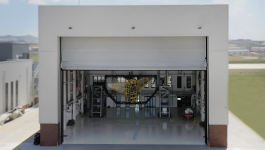
Radar Cross Section (RCS) Test Facility
One of the 5 largest indoor RCS facilities in the World
View attachment 208610
Yes, this one. See that huge building attached to front building on the front. That's where anechoic test chamber is. This is the front of the building, at the back of the building there is a huge gate. It let's aircrafts in to chamber up to 23 meters wingspan.
 
Yes, this one. See that huge building attached to front building on the front. That's where anechoic test chamber is. This is the front of the building, at the back of the building there is a huge gate. It let's aircrafts in to chamber up to 23 meters wingspan.

another one test facility for HURJET-KAAN

A test facility designed entirely with domestic resources to conduct tests of fuel systems.
1785334306204.png
 
another one test facility for HURJET-KAAN

View attachment 208611
I only worked on RCS facility.

They wanted us to keep the chamber at a certain temprature 7/24.. So we designed a system according to that. Can't go into specifics. But it took a few iterations / CFD anaylsis. I know there were other teams working at other aspects, like another team was anaylsisg our design on the impacts of radar echoes.

It was hard because you don't know how to do it. There are no literature on it. Just a problem and design parameters. Solution is upto you. I think it was similar for every team.

Good thing is, you can also analize Kızılelma or Anka-3 in it. Like we can anayize the RCS of every aircraft we build or plan to build but we can't take a B21 with 40 meters wingspan. US has that too.
 
Turkish Aerospace Industries (TAI/TUSAŞ) operates high tech extensive state-of-the-art industrial infrastructure to support cutting edge domestic defense projects like the KAAN , ANKA-III


TUSAŞ composite production Building is the 4th largest composite facility in the world
1785334854470.png
 
Good thing is, you can also analize Kızılelma or Anka-3 in it. Like we can anayize the RCS of every aircraft we build or plan to build

Most importantly, all the secrets remain in our Country. If we had brought them to another country for testing, the real data of strategic platforms like KAAN, ANKA-3, and KIZIILELMA would have fallen into the hands of others.

Only 12 Countries in the world possess advanced, dedicated military Radar Cross Section (RCS) test facilities

USA , Turkiye , China , Russia , France , The UK , Japan , S.Korea , India , Brazil , Sweden , Italy

And Turkiye's one of the 5 largest indoor RCS facilities in the World
 
Türkiye is bending time with a miracle of metallurgy and thermodynamics


But there are still those who ignorantly say, knowingly or unknowingly, "why has this KAAN and engine development dragged on for so long ?" Why are we like this?

The world's most difficult technology is to build a 5th-gen Fighter Jet and its Engine, and even more challenging is to do it entirely on your own despite all kinds of embargoes

China
China was able to complete the WS-15 Turbofan engine for its J-20s in 18 years, despite technology and material transfers from Russia

USA
The U.S. F-22's transition to series production for the YF120/YF119, which began in the 1980s, took about 20+ years. They had a massive 70-year jet engine experience behind them.

Russia
Russia's SU-57 Engine Project Izdeliye 30 / AL-51F / 177 has been ongoing for about 15 years and still doesn't meet 5th-generation requirements


We're in a field where only 2-3 countries in the world have succeeded to date

To better understand the scale of the KAAN project, it's necessary to look at similar programs in Europe.While the FCAS program led by France, Germany, and Spain has been struggling to progress for many years, the GCAP program developed by the UK, Italy, and Japan is still in its early stages. And no 5th-generation engine has been produced yet.

Meanwhile, Turkeiye, which launched the KAAN program in 2018, has achieved its first flight, reached the point of discussing series production by 2028 , and the first ignition of the TF35000 engine is just around the corner


To view this content we will need your consent to set third party cookies.
For more detailed information, see our cookies page.
 
China
China was able to complete the WS-15 Turbofan engine for its J-20s in 18 years, despite technology and material transfers from Russia

That's incorrect, China's WS-15 has very little to do with Russia.

Even the WS-10 has really diverged far away from the lineage of the AL-31 family.

The WS-10 did the reserved engineering the core design of the CFM-56 of the GE family, and its nozzle design also radically differed from the AF-31 family nozzle.

BTW, we did encourage Turkiye to design its own turbofan engine, but just stopped depriving China's credibility of its indigenous engine.

The Russians are struggling for their own 5th gen turbofan engine, and you are expecting them to selflessly help China above their own national priority?
 
Türkiye is bending time with a miracle of metallurgy and thermodynamics


But there are still those who ignorantly say, knowingly or unknowingly, "why has this KAAN and engine development dragged on for so long ?" Why are we like this?

The world's most difficult technology is to build a 5th-gen Fighter Jet and its Engine, and even more challenging is to do it entirely on your own despite all kinds of embargoes

China
China was able to complete the WS-15 Turbofan engine for its J-20s in 18 years, despite technology and material transfers from Russia

USA
The U.S. F-22's transition to series production for the YF120/YF119, which began in the 1980s, took about 20+ years. They had a massive 70-year jet engine experience behind them.

Russia
Russia's SU-57 Engine Project Izdeliye 30 / AL-51F / 177 has been ongoing for about 15 years and still doesn't meet 5th-generation requirements


We're in a field where only 2-3 countries in the world have succeeded to date

To better understand the scale of the KAAN project, it's necessary to look at similar programs in Europe.While the FCAS program led by France, Germany, and Spain has been struggling to progress for many years, the GCAP program developed by the UK, Italy, and Japan is still in its early stages. And no 5th-generation engine has been produced yet.

Meanwhile, Turkeiye, which launched the KAAN program in 2018, has achieved its first flight, reached the point of discussing series production by 2028 , and the first ignition of the TF35000 engine is just around the corner


To view this content we will need your consent to set third party cookies.
For more detailed information, see our cookies page.

Are you saying USA had Jet Engines from the 1910s?
How did US have 70-years of experience from the 1980s?

Jet engines were invented in the 1930s–1940s

  • Frank Whittle (UK) → 1937
  • Hans von Ohain (Germany) → 1939
  • First US jet engine programs → early 1940s

am I missing something here.
 
Are you saying USA had Jet Engines from the 1910s?
How did US have 70-years of experience from the 1980s?

Jet engines were invented in the 1930s–1940s

  • Frank Whittle (UK) → 1937
  • Hans von Ohain (Germany) → 1939
  • First US jet engine programs → early 1940s

am I missing something here.

O kadar yazı iceriginden buna mı takıldın ?

This is not my post . it's written by engineer Oguzhan Uygun from X platform

The USA officially introduced the Pratt & Whitney F119, the world's first operational 5th gen turbofan Engine into service in 2005.

from 1942 to 2005 : 63 years of experience
 
That's incorrect, China's WS-15 has very little to do with Russia.

Even the WS-10 has really diverged far away from the lineage of the AL-31 family.


Yes , China produced the core of the WS-10 Engine by reverse-engineering the American CFM56 civilian passenger Aircraft Engine. However, almost all of the military technology needed to transform this civilian engine into a Fighter Jet Engine was completed using systems acquired from Russia.


China was unable to design the afterburner, supersonic exhaust nozzles and fuel injection systems that it would add to the rear of the CFM56 core. To overcome this problem, it directly integrated and copied the rear components, mechanical designs and aerodynamic schemes of the AL-31F Engine imported from Russia into the WS-10 project.

Also , Russia sent thousands of assembly manuals, engine calibration data, part tolerance tables and technical maintenance documents to China.

Chinese engineers used this official Russian data as a benchmark to bring the WS-10 up to military standards
 
Türkiye is bending time with a miracle of metallurgy and thermodynamics

...

China
China was able to complete the WS-15 Turbofan engine for its J-20s in 18 years, despite technology and material transfers from Russia

...


You are such a stupid liar and propagandist! (n):mad:
 
Even The TVC technology used in the most advanced modern variants of the WS-10 (WS-10B and WS-10C) which gives the Aircraft super maneuverability was perfected by examining the advanced AL-41F1S Engines on the SU-35 Fighter Jet that China purchased from Russia in 2015

China has managed to transform the WS-10 into a functional military engine using the AL-31F infrastructure, engineering documentation, and SU-35 technology officially provided by Russia.
 
Yes , China produced the core of the WS-10 Engine by reverse-engineering the American CFM56 civilian passenger Aircraft Engine. However, almost all of the military technology needed to transform this civilian engine into a Fighter Jet Engine was completed using systems acquired from Russia.


China was unable to design the afterburner, supersonic exhaust nozzles and fuel injection systems that it would add to the rear of the CFM56 core. To overcome this problem, it directly integrated and copied the rear components, mechanical designs and aerodynamic schemes of the AL-31F Engine imported from Russia into the WS-10 project.

Also , Russia sent thousands of assembly manuals, engine calibration data, part tolerance tables and technical maintenance documents to China.

Chinese engineers used this official Russian data as a benchmark to bring the WS-10 up to military standards

Dude, you are talking how Russia was babysitting China like teaching its own kids.

No country will share its core documentation and data with another country.

China has no successful joint project with Russia, even the civilian jet like the CR929 got botched up because Russia refused to share any sensible data with China. Let alone the data from the military jet engine.
 
You are such a stupid liar and propagandist! (n):mad:

Its not my post you stupid idiot
That was from a Turkish enginer named Oguzhan Uygun from X platform

keep crying you so-called MOD who said KAAN is an ultra nationalist fake propaganda project which can not even fly
 

Users who are viewing this thread

Back
Top