TF-X / KAAN / Hürjet Turkish Fighter & Trainer Aircrafts News & Discussions

But after 2035, many things began to change. The SK-Indo's KF-21 became more mature, and there were almost no restrictions.

And I heard that SK is also make engines. In short.Time is running out for Türkiye.

Sorry.There may be some offense. Time is not on the side of Türkiye.
I know that Kf21 is more mature than Kaan but also relies way more on foreign supplied systems and that engine development started i believe last year and will take longer to become available than TF35000. Not to mention that both aircraft are in a different weight class. Block 3 variant will like see service when Kaan block 30 enters service around 2034
 
But after 2035, many things began to change. The SK-Indo's KF-21 became more mature, and there were almost no restrictions.

And I heard that SK is also make engines. In short.Time is running out for Türkiye.

Sorry.There may be some offense. Time is not on the side of Türkiye.


KF-21 will never be the same class off Kaan, it doesn't have IWB. They say they will have it later blocks, but that will need structurel change and what cost? Les fuel, 1 or 2 bombs? The engine off KF-21 will never be ready, before the TF35000.

KF-21 is not our challenge, we compare the Kaan with F-22.
 
Even KIZILELMA unmanned stealth Fighter Jet is enough to match with the KF-21 in BVR combat

Our rival is not the KF-21 , but F-22

------------------------------------------------------------------------

KAAN's Chief Engineer Emre Yaban

In our class, there are Aircraft like the F-22, the Russian Su-57, and the Chinese J-20

KAAN will be an Aircraft with much higher air to air and stealth capabilities

 
Last edited:
Deino you have been doubting the Turkish Defense Industry all throughout the 2010s and been eating crow every time. You even said this TFX Jet was fake and domestic politics, up until we saw it fly, so maybe temper the cynicism a bit.

So if we are going by prediction records I'd trust the TAI/TFX Engineers more so than your predictions. If they feel that it will be ready for export in the 2030s, think I think there is a decent chance.

Turkey already signed an export contract for Hurjet and with a Large NATO state no less, deliveries are in 2028.


The funny thing is, yes, I did go out on a limb back then and was proven wrong. Not only did I admit this, but I also apologised … BUT! And here’s the point: whilst some people keep rubbing this one mistake in my face, claiming that ‘once wrong, always wrong’, Kaan’s timeline and planning have been pushed back several times, as has the engine itself, and it hasn’t actually even been tested in its simplest forms yet – which doesn’t make the launch dates, which have now been officially postponed, any more realistic. And, looking at it quite objectively: Kaan has flown twice – or rather, it was in the air for a few minutes! - but nothing more.

That wasn’t a trial, not even a proper test; it was merely a maiden flight, and one initiated for political reasons at that.

So please keep your feet on the ground, as we like to say here. Kaan is still a long way from being tested, the engine is far from ready or even finished testing, and so Kaan is even further from being exportable.
 
KF-21 will never be the same class off Kaan, it doesn't have IWB. They say they will have it later blocks, but that will need structurel change and what cost? Les fuel, 1 or 2 bombs? The engine off KF-21 will never be ready, before the TF35000.

KF-21 is not our challenge, we compare the Kaan with F-22.
In the manufacturing process of fifth-generation fighter jets, there is a key technological watershed: the integrally formed center fuselage section.

This manufacturing process requires large-scale, high-precision heavy-duty die-forging presses. To date, only China and the United States possess such specialized machinery. While Russia does have large heavy-duty die-forging presses, they lack the necessary precision. France purchased a unit during the Soviet era, but it faced similar limitations regarding precision.

Both Chinese and American fifth-generation fighter jets utilize these presses to manufacture their fuselage center sections as single-piece components. In contrast, the Russian Su-57 employs a segmented assembly method. This segmented approach necessitates additional structural reinforcement and fasteners, resulting in increased airframe weight and the consumption of more internal space; however, it offers the advantages of lower initial manufacturing costs and reduced long-term maintenance expenses. Should structural damage occur, a single-piece center section requires complete replacement, whereas a segmented center section allows for the replacement of only the damaged component.

Neither Turkey nor South Korea possesses the capability to manufacture such large, high-precision heavy machinery; consequently, both the KAAN and the KF-21 utilize a sectional assembly process. However, a key difference arises from the fact that the KAAN is a heavy fighter with a larger airframe and ample spatial margin, meaning the assembly method did not compromise the layout of the internal weapons bay (IWB). In contrast, the KF-21 is a medium fighter with a smaller airframe, and this constraint significantly impacted the positioning of its IWB.

Judging from publicly available videos and images, the original structural design of the KF-21 already reserved sufficient space for an internal weapons bay (IWB); however, that space is currently occupied by structural reinforcements.
1788947737949.png
South Korea adopted a development strategy similar to China's "small steps, rapid progress" approach: getting the aircraft airborne first, followed by rapid iteration.
Once they successfully develop their own large-scale, high-precision heavy-duty die-forging presses, they will be able to adopt the integrated mid-frame molding process. At that point, space within the IWB area will be freed up.

As for Türkiye... never mind; there are too many people there who are "high on drugs," so I won't go into a deep analysis.

-------------------------

Musk pioneered the use of this type of process at Tesla, where the vehicle's entire structural frame is cast as a single, integrated unit rather than being assembled from welded sections. Chinese automakers have strongly embraced this technology, leading to its widespread adoption across China's electric vehicle manufacturing sector. While the heavy machinery used to manufacture car frames differs significantly from that used for aircraft, the underlying operating principles are similar.
 
In the manufacturing process of fifth-generation fighter jets, there is a key technological watershed: the integrally formed center fuselage section.

This manufacturing process requires large-scale, high-precision heavy-duty die-forging presses. To date, only China and the United States possess such specialized machinery. While Russia does have large heavy-duty die-forging presses, they lack the necessary precision. France purchased a unit during the Soviet era, but it faced similar limitations regarding precision.

Both Chinese and American fifth-generation fighter jets utilize these presses to manufacture their fuselage center sections as single-piece components. In contrast, the Russian Su-57 employs a segmented assembly method. This segmented approach necessitates additional structural reinforcement and fasteners, resulting in increased airframe weight and the consumption of more internal space; however, it offers the advantages of lower initial manufacturing costs and reduced long-term maintenance expenses. Should structural damage occur, a single-piece center section requires complete replacement, whereas a segmented center section allows for the replacement of only the damaged component.

Neither Turkey nor South Korea possesses the capability to manufacture such large, high-precision heavy machinery; consequently, both the KAAN and the KF-21 utilize a sectional assembly process. However, a key difference arises from the fact that the KAAN is a heavy fighter with a larger airframe and ample spatial margin, meaning the assembly method did not compromise the layout of the internal weapons bay (IWB). In contrast, the KF-21 is a medium fighter with a smaller airframe, and this constraint significantly impacted the positioning of its IWB.

Judging from publicly available videos and images, the original structural design of the KF-21 already reserved sufficient space for an internal weapons bay (IWB); however, that space is currently occupied by structural reinforcements.
View attachment 214646
South Korea adopted a development strategy similar to China's "small steps, rapid progress" approach: getting the aircraft airborne first, followed by rapid iteration.
Once they successfully develop their own large-scale, high-precision heavy-duty die-forging presses, they will be able to adopt the integrated mid-frame molding process. At that point, space within the IWB area will be freed up.

As for Türkiye... never mind; there are too many people there who are "high on drugs," so I won't go into a deep analysis.

-------------------------

Musk pioneered the use of this type of process at Tesla, where the vehicle's entire structural frame is cast as a single, integrated unit rather than being assembled from welded sections. Chinese automakers have strongly embraced this technology, leading to its widespread adoption across China's electric vehicle manufacturing sector. While the heavy machinery used to manufacture car frames differs significantly from that used for aircraft, the underlying operating principles are similar.

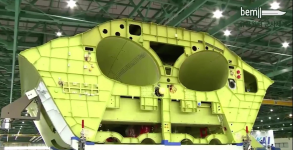
Dude, you wrote whole thing without knowing how TUSAS is actually making KAAN's bulkhead. They aren't doing segmented assembly. They are using Titanium 3D printing to produce the whole bulkhead a s single piece. TAI bought world's largest Electron Beam Additive Manufacturing (EBAM) 3D printer, the EBAM 300 Series from US. This is a new technology and whether it will work or not can only be known after going through real world stress testing.
 
Dude, you wrote whole thing without knowing how TUSAS is actually making KAAN's bulkhead. They aren't doing segmented assembly. They are using Titanium 3D printing to produce the whole bulkhead a s single piece. TAI bought world's largest Electron Beam Additive Manufacturing (EBAM) 3D printer, the EBAM 300 Series from US. This is a new technology and whether it will work or not can only be known after going through real world stress testing.
You might want to delve a bit deeper into the subject rather than just skimming the surface of what nationalist media outlets report.

EBAM technology is indeed capable of producing large structural components—that is one of its key advantages. The airframe of the SAC J-35 fighter jet, for instance, incorporates a significant number of parts made using this method. However, the current capabilities of EBAM technology do not yet match those of heavy die-forging presses.

At present, both China and the United States employ a hybrid manufacturing approach: heavy die-forging presses are used to produce the fighter jet's core load-bearing structural components, while EBAM technology is utilized for a wide range of other structural parts. The two processes are used in tandem. Heavy die-forging presses are not only extremely expensive machines in themselves, but they also require a dedicated die for every specific part—and those dies come at an exorbitant cost.


Here are the references.

That is with condition. It is ITAR free plane (not using US engine is one of them). No money yet transfred (the contract is signed yes, but not yet effective one, similar like what happen with previous SU35 contract that is not effective until now).

Reuters, Diplomat etc is still not confirmed news, they still dont know the details. Those media also said many times that Indonesia has bought F15 EX....
 
In the manufacturing process of fifth-generation fighter jets, there is a key technological watershed: the integrally formed center fuselage section.

This manufacturing process requires large-scale, high-precision heavy-duty die-forging presses. To date, only China and the United States possess such specialized machinery. While Russia does have large heavy-duty die-forging presses, they lack the necessary precision. France purchased a unit during the Soviet era, but it faced similar limitations regarding precision.

Both Chinese and American fifth-generation fighter jets utilize these presses to manufacture their fuselage center sections as single-piece components. In contrast, the Russian Su-57 employs a segmented assembly method. This segmented approach necessitates additional structural reinforcement and fasteners, resulting in increased airframe weight and the consumption of more internal space; however, it offers the advantages of lower initial manufacturing costs and reduced long-term maintenance expenses. Should structural damage occur, a single-piece center section requires complete replacement, whereas a segmented center section allows for the replacement of only the damaged component.

Neither Turkey nor South Korea possesses the capability to manufacture such large, high-precision heavy machinery; consequently, both the KAAN and the KF-21 utilize a sectional assembly process. However, a key difference arises from the fact that the KAAN is a heavy fighter with a larger airframe and ample spatial margin, meaning the assembly method did not compromise the layout of the internal weapons bay (IWB). In contrast, the KF-21 is a medium fighter with a smaller airframe, and this constraint significantly impacted the positioning of its IWB.

Judging from publicly available videos and images, the original structural design of the KF-21 already reserved sufficient space for an internal weapons bay (IWB); however, that space is currently occupied by structural reinforcements.
View attachment 214646
South Korea adopted a development strategy similar to China's "small steps, rapid progress" approach: getting the aircraft airborne first, followed by rapid iteration.
Once they successfully develop their own large-scale, high-precision heavy-duty die-forging presses, they will be able to adopt the integrated mid-frame molding process. At that point, space within the IWB area will be freed up.

As for Türkiye... never mind; there are too many people there who are "high on drugs," so I won't go into a deep analysis.

-------------------------

Musk pioneered the use of this type of process at Tesla, where the vehicle's entire structural frame is cast as a single, integrated unit rather than being assembled from welded sections. Chinese automakers have strongly embraced this technology, leading to its widespread adoption across China's electric vehicle manufacturing sector. While the heavy machinery used to manufacture car frames differs significantly from that used for aircraft, the underlying operating principles are similar.


LoL

chinese version off mme, the fact is Kaan can not be compared with KF-21. Forge technology or 3d printed will not make the difference, looks like China is going with old technology compared with Turkiye latest technology. China can have ther press technology:ROFLMAO:.
 
Nobody cares about Chinese

The KAAN completed its maiden flight two years ahead of schedule
even with a model that wasn't originally intended for flight testing


The actual P1 model has been produced, and actual flight tests for all three of these prototypes will begin this year and will continue in 2027
1788955917964.jpeg

In fact, numerous structural changes were made between the P0 and P1 versions, transforming it into a more aerodynamic and stealth Aircraft

and the new KAAN prototypes will conduct Air to Air missile firing tests from internal weapon bay in 2027

Chinese can continue babbling here , Nobody cares about them
 

Users who are viewing this thread

Back
Top