
Hamartia Antidote
Elite Member

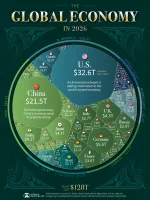
How the World’s $128 Trillion Economy Breaks Down
Key Takeaways
- The global economy is projected to surpass $128 trillion by the end of 2026, up roughly $20 trillion from 2023.
- The United States ($32.64 trillion) and China ($21.55 trillion) together account for more than 42% of global economic output.
- Just four countries, the U.S., China, Germany, and Japan, contribute approximately half of the world’s GDP.
This visualization breaks down nominal gross domestic product (GDP) by country and region using new forecasts from the IMF’s October 2026 World Economic Outlook. Figures measure annual economic output in current U.S. dollars, converted at market exchange rates.
The Two Economic Giants
As the world’s largest economy, the U.S. leads with $32.64 trillion, accounting for approximately a quarter of global GDP. China follows at $21.55 trillion, more than four times the size of Germany’s economy, the world’s third-largest.The gap between these two economic superpowers and the rest of the world is striking. The U.S. economy alone is larger than the combined output of Germany, Japan, the U.K., India, and France.
Beyond China and Japan, Asia is home to several other major economies. These include large consumer markets like India ($4.06 trillion) and Indonesia ($1.48 trillion), as well as manufacturing powerhouses like South Korea ($2.25 trillion).
Elsewhere, Brazil ($2.65 trillion) accounts for roughly half of South America’s economy, while Australia ($2.11 trillion) contributes most of Oceania’s total output.
AI Investment Adds Momentum
Beyond their current size, the world’s largest economies are being shaped by different growth drivers. In the U.S., the AI investment boom is generating demand for servers, software, data centers, and power infrastructure. Training and running advanced models requires enormous computing capacity, creating business opportunities for companies supplying and building that infrastructure.Consumer spending provides another source of growth. The U.S. economy expanded at an inflation-adjusted annualized rate of 2.2% in the second quarter of 2026, with household spending, investment, and exports all contributing to growth.
AI investment also creates opportunities overseas. Growing trade in computers, servers, and semiconductors connects American investment with suppliers across Asia. For economies producing these components, demand from the world’s largest economy can support exports and new production facilities.
China’s Tech Advantage
China’s economy grew 4.6% year over year in the first nine months of 2026, with advanced manufacturing providing a particularly strong source of expansion. High-tech manufacturing output rose 14.3%, alongside rapid increases in the production of industrial robots and lithium-ion batteries.Overseas demand also supported Chinese producers. The country’s trade surplus in goods is on track to surpass $1 trillion again, supported by strong exports of semiconductors and green technologies. These industries connect China’s manufacturing base with customers and businesses around the world.
Meanwhile, the property downturn continues to weigh on the domestic economy. Real estate development investment fell by more than 20% during the first three quarters of 2026, while retail sales remained sluggish. Technology and export-oriented industries are consequently providing important support as the country works through weakness in housing and consumer demand.


