Top 10 countries with the most skyscrapers in the world 2026: China, US, UAE and other leading nations

Beijingwalker

VIP Member
Joined
Nov 4, 2011
Messages
92,150
Reaction score
113,026
Reputation
2,155.3
Country of Origin
Country of Residence

Top 10 countries with the most skyscrapers in the world 2026: China, US, UAE and other leading nations​

May 1 2026


Top 10 countries with the most skyscrapers in the world 2026: China, US, UAE and other leading nations

Top 10 countries with the most skyscrapers in the world 2026: China, US, UAE and other leading nations

Skyscrapers have become a kind of silent competition between nations. Not always planned that way, but it shows up clearly in skylines. Cities rising upward, faster than outward. The idea of “Top 10 countries with the most skyscrapers” is usually tied to urban growth, population pressure, and economic ambition. China dominates this space by a large margin, while the United States still holds a historic lead in iconic high-rise development. Other countries in Asia and the Middle East are catching up quickly.

The modern construction trends, business hubs, and real estate demand are pushing cities to build higher than ever before. Some skylines are still evolving, while others already look almost fully stacked with glass towers and steel giants.
搜狗截图20260504104745.png

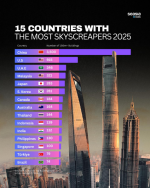
World’s top 10 countries with the highest number of skyscrapers in 2026​

The world’s skyline is changing fast, with cities racing to build taller than ever. Here’s a look at the top 10 countries leading in skyscrapers in 2026 and why.

China​

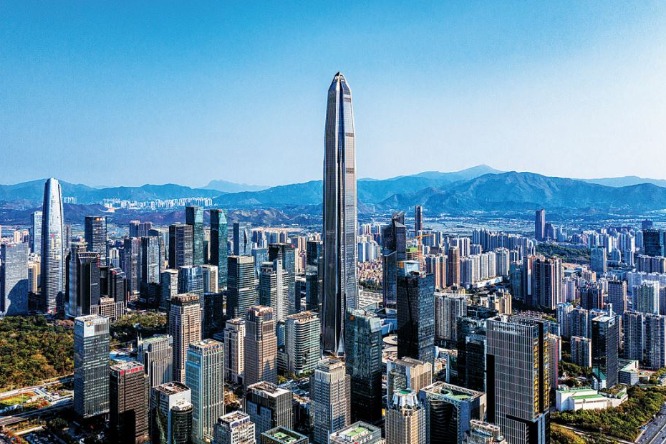
China ranks first, but by an enormous distance. Cities such as Shenzhen, Shanghai, and Guangzhou have high-rises in abundance. Districts look like entire vertical cities. It seems that the reason behind such rapid growth includes urbanisation as well as the development of industries. Most skyscrapers in the country are mixed-use buildings featuring both office space, hotel accommodation and residential property. Apparently, construction activity in China within the last few decades surpassed anything that had happened anywhere else. Some cityscapes seem almost futuristic, even more so during the evening time. Yet the pace of construction continues, just somewhat lower than previously.

United States​

The United States has a long tradition with the skyscraper and ranks as the second country. New York and Chicago were among the first cities that made up the identity of skyscrapers. In terms of the architectural flag of the country, its dominance in the global architectural world is quite obvious. The contribution of New York City alone is overwhelming in sheer numbers. It appears as though the aim here is not quantity but quality, and the modern skyscrapers are used for luxury housing or corporations' headquarters.

United Arab Emirates​

What makes the UAE unique includes Dubai and Abu Dhabi. In fact, Dubai has changed its skyline in an unprecedented manner within a few years. The existence of landmarks such as the Burj Khalifa signifies its ambition to become a global power. The skyscrapers in Dubai are known to emphasize luxury, tourism, and corporate branding. In other words, it seems that UAE makes use of high rise buildings as a way to create a global image for itself.

Malaysia​

Malaysia, especially Kuala Lumpur, contributes heavily to the country’s skyscraper count. The city features a dense cluster of modern towers, including residential and commercial buildings. The Petronas Towers remain an iconic part of the skyline. It seems urban development policies have encouraged vertical growth to manage land use efficiently. Skyscrapers here are often functional and integrated into public transport networks. The overall skyline continues to expand steadily, though not as aggressively as China or the UAE.

Japan​

Japan’s skyscrapers are shaped by strict engineering standards due to earthquake risks. Tokyo leads the country’s high-rise development, with a mix of commercial and residential towers. The design focus is often safety and functionality rather than extreme height. It appears that land scarcity in major cities has encouraged vertical expansion. Japanese skyscrapers tend to be compact but highly efficient. The skyline keeps evolving gradually with advanced construction techniques.

South Korea​

There have been many tall buildings being built in South Korea, particularly Seoul. The Songdo district, for example, shows the emphasis on modern urban planning. It appears that the progress made by South Korea is related to the technological sector and globalization. The skyscrapers present in South Korea tend to be efficient and are in line with the demands of today's lifestyle.

Canada​

Skyscrapers in Canada are dominated by cities such as Toronto and Vancouver. They have grown steadily, not abruptly. In Toronto, skyscrapers form a highly populated central part of the city, with many residential buildings. It appears that immigration and growth of urban population have contributed to the development of skyscrapers. The skyscrapers are fairly new but well-proportioned, leaving enough room for further expansion.

Australia​

The construction of tall buildings in Australia is mostly centered on the cities of Sydney and Melbourne. This is highly associated with coastal city planning and design. The buildings are characterized by a combination of residential and commercial functions. High demand for land in the city may have necessitated the building upwards. Modern tall buildings in Australia feature sleek designs and integration with the waterfront.

Thailand​

Thailand, especially Bangkok, shows rapid skyscraper growth. The city skyline is increasingly dense with residential towers and hotels. Tourism plays a strong role in this expansion. It seems urban migration is also contributing to vertical development. Bangkok’s skyline is still changing, with ongoing construction projects shaping its future identity.

Indonesia​

Indonesia, led by Jakarta, is gradually expanding its skyscraper presence. The city faces high population density, which encourages vertical building. It appears that economic growth and urban demand are driving new developments. While still behind regional leaders, the skyline is changing quickly. New projects suggest continued expansion in the coming years.
 
搜狗截图20260504111413.png

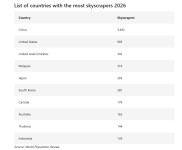
Global skyscraper development in 2026 is overwhelmingly led by China, which stands far ahead of every other country. With 3,596 buildings over 150 meters, 1,332 exceeding 200 meters, and 132 supertall towers above 300 meters, China has firmly established itself as the world’s skyscraper capital. This dominance reflects decades of rapid urbanization, massive infrastructure investment, and the rise of multiple megacities beyond just Beijing and Shanghai.

In second place, the United States remains a major vertical builder, hosting 929 skyscrapers over 150 meters, including 255 above 200 meters and 32 supertalls. While its growth is more mature compared to China, the U.S. continues to expand vertically in financial and technology hubs such as New York and Chicago, reinforcing its long-standing influence on modern high-rise architecture.

Rounding out the top three is the United Arab Emirates (UAE), a country that has transformed its skyline in just a few decades. With 345 buildings over 150 meters, 158 above 200 meters, and 36 over 300 meters, the UAE—led by Dubai—punches far above its population size. Together, China, the U.S., and the UAE highlight how skyscrapers have become symbols of economic ambition, global status, and urban innovation.
 
India has most unique skyscraper in the world:

The Ghazipur landfill is a massive, 70-acre waste dump in East Delhi, India, established in 1984. It towers over 65 meters (213+ feet) high, often described as a "garbage mountain" that frequently suffers from fires, methane leaks, and environmental hazards. Despite being officially closed in 2002, it continues receiving thousands of tonnes of waste daily. [1, 2, 3, 4, 5]
Key Aspects of the Ghazipur Trash Crisis:
  • Environmental & Health Hazard: The decomposing waste emits significant amounts of methane, and the site has frequent fires. Toxic liquids leak into the surrounding environment, polluting groundwater.
  • Scale and Impact: It is one of India’s largest landfills, with over 8 million tonnes of waste still present. The stench and pollution severely impact nearby residential areas, causing breathing and health issues.
  • Failed Closure: Though it exceeded its capacity in 2002, a lack of alternative disposal sites means dumping continues, and efforts to flatten the mountain are ongoing.
  • Informal Economy: Many people work around the site, collecting and selling recyclables. [1, 2, 3, 4, 5, 6]
Efforts to reduce the mountain are ongoing, with local authorities attempting to use waste-to-energy plants and clearing operations, though progress is slow against the sheer volume of daily waste added. [1, 2]
 

Which Country has the Most Tall Buildings 1960 - 2026)​


To view this content we will need your consent to set third party cookies.
For more detailed information, see our cookies page.


May 4, 2026
From a handful of towering buildings in 1960 to thousands shaping today’s megacities, this video reveals the dramatic global race to build skyscrapers. Watch how the number of buildings over 100 meters has evolved across countries from 1960 to 2026—capturing the rise of economic powerhouses and the shifting centers of urban growth.
The United States dominated early on, but in recent decades, Asia—especially China—has surged ahead, fueled by rapid urbanization and massive infrastructure development. From New York and Chicago to Shanghai, Shenzhen, and Dubai, skylines have transformed at an unprecedented pace.
This bar chart race brings the data to life, showing how nations compete vertically in a world where height reflects ambition, innovation, and economic strength.
 
Interesting facts about that Chinese skyscraper skyline that China does not want anybody to know about

chineseskyline.png
chineseskyline2.png
 
Last edited:
Where is Europe ? are they poor or undeveloped ?

European architecture is more beautiful in my opinion.

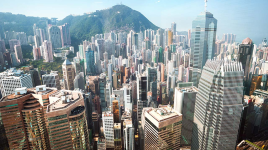
what an ugly style .... Hong Kong
1782049895256.png

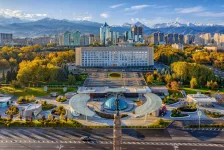
Almaty ( Kazakhstan ) is much better to live
1782050410430.webp
1782050442689.webp
 
Where is Europe ? are they poor or undeveloped ?

European architecture is more beautiful in my opinion.

what an ugly style .... Hong Kong
View attachment 202625

Almaty ( Kazakhstan ) is much better to live
View attachment 202626
View attachment 202627

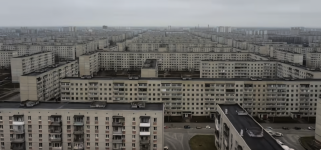
The problem is cities are still using a circa 1900 design...a dense grid of outdoor streets to allow pooping horses to bring people and supplies to buildings. This simply is not applicable in the 21st Century.

Cities should be built like modern airport terminals. Long wide indoor climate controlled causeways full of glass windows where nobody is crossing any roads dominated by cars. Cars are moving towards EVs where carbon monoxide poisoning is a non-issue so they can be inside too but way off in the periphery or a sub floor.

The gridded streets are outdated, a huge waste of space, and a major pedestrian safety issue. The whole thing is ridiculous.
 
View attachment 195556

Global skyscraper development in 2026 is overwhelmingly led by China, which stands far ahead of every other country. With 3,596 buildings over 150 meters, 1,332 exceeding 200 meters, and 132 supertall towers above 300 meters, China has firmly established itself as the world’s skyscraper capital. This dominance reflects decades of rapid urbanization, massive infrastructure investment, and the rise of multiple megacities beyond just Beijing and Shanghai.

In second place, the United States remains a major vertical builder, hosting 929 skyscrapers over 150 meters, including 255 above 200 meters and 32 supertalls. While its growth is more mature compared to China, the U.S. continues to expand vertically in financial and technology hubs such as New York and Chicago, reinforcing its long-standing influence on modern high-rise architecture.

Rounding out the top three is the United Arab Emirates (UAE), a country that has transformed its skyline in just a few decades. With 345 buildings over 150 meters, 158 above 200 meters, and 36 over 300 meters, the UAE—led by Dubai—punches far above its population size. Together, China, the U.S., and the UAE highlight how skyscrapers have become symbols of economic ambition, global status, and urban innovation.


The speed with which population is growing globally, the world dont need 5000 skyscrappers each reaching more than 60+ stories. What it needs is 1 million appartment, commercial and residential buildings each 20-25 stories high. Otherwise we will soon have no land for agriculture.
 
The speed with which population is growing globally, the world dont need 5000 skyscrappers each reaching more than 60+ stories.

Well the Chinese government recognized this and ordered an end to it

BEIJING - China has issued a circular banning the new construction of skyscrapers above 500 meters amid efforts to tighten scrutiny over high-rises.
Buildings above 250 meters are strictly restricted, and if they do need to be built, the construction plans should be reviewed over a slew of aspects including fire safety and filed with the Ministry of Housing and Urban-Rural Development, said the circular issued by the National Development and Reform Commission.
For buildings above 100 meters, the construction plans will face strict scrutiny over their seismic performance. The high-rises should match with the city's size and fire fighting capacity, it said.


What it needs is 1 million appartment, commercial and residential buildings each 20-25 stories high. Otherwise we will soon have no land for agriculture.

I think that basically is the China model.
 
Last edited:

Users who are viewing this thread

  • Latest Posts

    Back
    Top