Towards a Pakistani Islamic Renaissance: Reconstructing the State, Reviving Civilization, and Developing the Individual

I think you might have misunderstood this issue—or perhaps I didn’t express myself clearly enough.

Let me put this more bluntly (and please accept my apologies in advance, as the nature of this discussion—compounded by the complexities of translation—may touch upon sensitive or taboo subjects).

Islamic doctrine encompasses a wide range of political matters—such as the concept of the *Ummah* (the global Muslim community), *Sharia* (Islamic law), and various codes of conduct. The foundational principles underlying these doctrines are considered beyond question.

For instance, the consumption of pork is strictly forbidden for Muslims—it is a major taboo. Yet, does Islamic doctrine contain any higher-level provisions that might allow a Muslim to consume pork under specific circumstances without it being considered a violation of the faith?

While we should certainly respect the customs and beliefs of different groups, today’s global society is an open one, characterized by increasing integration. It is essential for different groups to make mutual compromises regarding their respective customs and beliefs; otherwise, tensions will inevitably intensify, leading to conflicts that could continue to escalate.
My understanding of your post and Kindly correct me if I've missed something, is that You're essentially arguing that as different belief systems increasingly interact, the incompatibilities between some of their foundational principles can create friction, and that mutual compromise is necessary to prevent those differences from escalating into conflict.

I agree that this is a genuine challenge, but I'm not sure the solution requires people to compromise on their fundamental beliefs, or that confrontation is the only solution to that friction

Taking your example of pork, Muslims can retain their religious prohibition without expecting everyone else to observe it. Others can follow their own dietary practices without requiring Muslims to abandon theirs.

I think the same principle can apply to much broader questions of faith, culture and governance. Different communities don't necessarily need to agree on everything, or even reconcile their underlying beliefs. They need a framework that allows them to coexist while respecting each other's rights.

Perhaps the real challenge isn't reconciling fundamentally different belief systems, but establishing the boundaries within which they can coexist.
Yes, your understanding is correct. However, the latter part of your point touches upon the true crux of the issue.

I am not suggesting that Muslims—or any other group, for that matter—should be required to abandon their own beliefs or traditions. The traditional beliefs and customs of any religion or ethnic group deserve to be respected.

Nevertheless, due to historical factors, certain beliefs and practices held by different groups—whether defined by religion, ethnicity, nationality, or cultural customs—can come into conflict. This is particularly evident in today’s era of increasing global integration.

When I speak of mutual compromise and concession, I am referring to the dynamics that arise when different groups integrate, rather than compromises made within a single, independent group. There is a significant distinction between the two.

Let me provide further examples:

If I—a non-Muslim—were to enter a Muslim-majority environment (such as an Islamic nation or a community designated as Muslim under local law) and openly consume pork, that would clearly be an act of provocation. But let us look at it from the other side: if a Muslim were to enter a non-Muslim community and explicitly demand that others abstain from eating pork, would that also constitute a provocation?
Consider a similar case: Hindus hold cows in high regard and do not consume beef. As non-Hindus, we respect this. However, if Hindus enter non-Hindus communities and openly criticize others for eating beef, is that considered provocation?
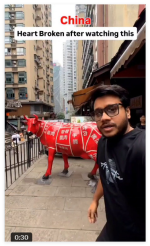
Perhaps you might think this is fake news.
At a wet market in Chongqing, China, there is an intriguing sculpture that labels the various edible parts of an entire cow. Such displays are quite common in China.
However, this spot has now become a destination for many Indian social media influencers, who come here to take photos and use them as a pretext to attack China.
1794893904216.png
I fully respect cultural differences among ethnic groups. But we need to distinguish between different situations. Mutual respect, understanding, and compromise are relevant when different groups are in the process of integrating with one another.

If I were to visit an Islamic country or a community governed by Muslim law, I certainly would not consume alcohol or pork. That is a matter of respect. Conversely, if a Muslim enters a non-Muslim community where I live, they cannot demand that I refrain from consuming alcohol or pork. That, too, is a matter of respect. The same principle applies to Hindus or any other group—that is also respect.
 
Pakistani coming generations will understand and then follow Quran one way or the other, I am hopeful.

no doubt be an improvement from the usual meme fiesta that has over taken PdF of late.

Are you blaming @RescueRanger for that? Ban him.


There are many other such examples; I see no need to list them all here. At the very least, we have not seen this type of issue arise within other religions. While it is possible that some smaller religions face similar problems, they are certainly not as prominent as they are in Islam.

Huh, this is a perfect example of how biased one can be and still pretend he is not.

The above paragraph is full of ignorance, depicts veiled hatred and to some extent is reflective of a person who is feeling uncomfortable.

Are you really confused or have a hidden agenda @Michael ?
 
Huh, this is a perfect example of how biased one can be and still pretend he is not.
The above paragraph is full of ignorance, depicts veiled hatred and to some extent is reflective of a person who is feeling uncomfortable.
Are you really confused or have a hidden agenda @Michael ?
I only offer observations based on what I can personally perceive; I refrain from commenting on matters outside my own experience.

For instance:
Consider Judaism—which you seem to harbor hatred toward. It is not recognized as a legal religion under Chinese law, so I have no direct exposure to it. (It is worth noting, however, that one must distinguish between Jewish people and the religion of Judaism.)
Then there is Hinduism. Like Judaism, it is not a legally recognized religion in China. While I do know some Indian friends who practice Hinduism, they have largely set aside the outward, visible manifestations of their faith while in China; in their daily interactions, they are virtually indistinguishable from anyone else. Of course, there are still the occasional Hindu zealots who visit China, but they represent a tiny minority—one that Chinese authorities monitor and address with due seriousness.

Islam, by contrast, is a legally recognized religion in China. Among the four major religions officially permitted in the country, Islam stands out as the most distinct—a point that relates back to the issue I mentioned earlier.

If you think my comments are targeted, that just proves my point—your aggressiveness and unquestionable nature!

To reiterate: I have no intention of causing offense regarding the intrinsic characteristics of any group, including those of the Islamic faith; my focus is simply on observing and analyzing the challenges surrounding the interaction and integration of different groups.
 
Last edited:
Faith and Modernity is not something against to each other. Folks it is Abrahamaic followers that bring modernity to the earth now
 
Consider Judaism—which you seem to harbor hatred toward.

Oh God. Michael, I cannot be a Muslim unless I believe Moses to be true messenger of God and true Torah to be Divine scripture from God.

Now how did you arrive at this conclusion that We Muslims or I harbor hatred towards Judaism? Zionism is not Judaism nor all Jews are Zionists.


If you think my comments are targeted, that just proves my point—your aggressiveness and unquestionable nature!

If you are going to cherry pick and easily forget what Mao did or what Hitler or Stalin did and just try to say that Islam doesn't leave space for questions and compromises, then you are either ignorant or a hypocrite.

What are Buddhists in Burma doing?

You keep mentioning pork, do you know it is also forbidden in old testament of bible? It is also forbidden for observant Jews, and even Hindus.

What will you do if someone attacks China?
 
Yes, your understanding is correct. However, the latter part of your point touches upon the true crux of the issue.

I am not suggesting that Muslims—or any other group, for that matter—should be required to abandon their own beliefs or traditions. The traditional beliefs and customs of any religion or ethnic group deserve to be respected.

Nevertheless, due to historical factors, certain beliefs and practices held by different groups—whether defined by religion, ethnicity, nationality, or cultural customs—can come into conflict. This is particularly evident in today’s era of increasing global integration.

When I speak of mutual compromise and concession, I am referring to the dynamics that arise when different groups integrate, rather than compromises made within a single, independent group. There is a significant distinction between the two.

Let me provide further examples:

If I—a non-Muslim—were to enter a Muslim-majority environment (such as an Islamic nation or a community designated as Muslim under local law) and openly consume pork, that would clearly be an act of provocation. But let us look at it from the other side: if a Muslim were to enter a non-Muslim community and explicitly demand that others abstain from eating pork, would that also constitute a provocation?
Consider a similar case: Hindus hold cows in high regard and do not consume beef. As non-Hindus, we respect this. However, if Hindus enter non-Hindus communities and openly criticize others for eating beef, is that considered provocation?
Perhaps you might think this is fake news.
At a wet market in Chongqing, China, there is an intriguing sculpture that labels the various edible parts of an entire cow. Such displays are quite common in China.
However, this spot has now become a destination for many Indian social media influencers, who come here to take photos and use them as a pretext to attack China.
View attachment 223177
I fully respect cultural differences among ethnic groups. But we need to distinguish between different situations. Mutual respect, understanding, and compromise are relevant when different groups are in the process of integrating with one another.

If I were to visit an Islamic country or a community governed by Muslim law, I certainly would not consume alcohol or pork. That is a matter of respect. Conversely, if a Muslim enters a non-Muslim community where I live, they cannot demand that I refrain from consuming alcohol or pork. That, too, is a matter of respect. The same principle applies to Hindus or any other group—that is also respect.

Non Muslim eating pork in Muslim countries is not some sort of provocation. I dont think simple things like eating or drinking can cause that. The problem is only when you sell something that contain pork ingredient while not saying that openly

You have wrong assumption already.
 

Users who are viewing this thread

Pakistan Defence Latest

Country Watch Latest

Back
Top