Trump threatens 100% tariffs on BRICS nations over US dollar replacement plans

Sure maybe Canada but there is not going to be massive shopping trips to China. Maybe Chinese-Americans...but other than that not many others. Th OP author is having some fantasy.

What exactly are they expecting these American shopping tourists to buy over in China that they could not get elsewhere (like Canada) without such a long trip? It certainly isn't insulated water bottles.

They could probably get the same products much cheaper in China compared to America but, as tourists, it's always hard to distinguish cheap knockoffs from legitimate products.

Also, I agree that non-Chinese speaking people are not likely to make these trips. I see an opportunity for some entrepreneur to set up a midway tourism/shopping Mecca, maybe in Europe or Canada, but US customs would quickly catch on...
 
What exactly are they expecting these American shopping tourists to buy over in China that they could not get elsewhere (like Canada) without such a long trip?

Luxury brand OEM products at 5-10% of the price.
 
Luxury brand OEM products at 5-10% of the price.

People are going to fly to China to buy things like original $25K handbags????

Going to China...to pay for original luxury goods ...the land known worldwide for their counterfeiting of brand merchandise?

In fact the counterfeit scams have already started...
To view this content we will need your consent to set third party cookies.
For more detailed information, see our cookies page.

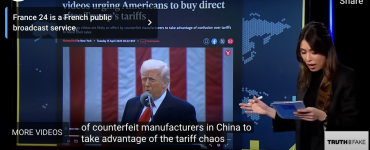
France24: Viral TikToks from Chinese manufacturers falsely claim luxury handbags are made in China​


counterfeit.png


There will be no widespread flying to China (by people other than Chinese-Americans) to buy original luxury goods...people already avoid shopping in China for anything original because they simply assume it is mostly fake.

If anything this is going to trigger an uproar in Europe about a sudden rise in counterfeit luxury goods flooding the world markets due to people looking for backdoors to US tariffs instead of directly shopping in their stores.
 
Last edited:

Expert sounds alarm on Trump’s tariffs: ‘Too high, too fast’​


To view this content we will need your consent to set third party cookies.
For more detailed information, see our cookies page.
 
People are going to fly to China to buy things like original $25K handbags????

Going to China...to pay for original luxury goods ...the land known worldwide for their counterfeiting of brand merchandise?

In fact the counterfeit scams have already started...
To view this content we will need your consent to set third party cookies.
For more detailed information, see our cookies page.

France24: Viral TikToks from Chinese manufacturers falsely claim luxury handbags are made in China​


View attachment 113217


There will be no widespread flying to China (by people other than Chinese-Americans) to buy original luxury goods...people already avoid shopping in China for anything original because they simply assume it is mostly fake.

If anything this is going to trigger an uproar in Europe about a sudden rise in counterfeit luxury goods flooding the world markets due to people looking for backdoors to US tariffs instead of directly shopping in their stores.


The difference in cost can easily pay for the trip including leisure expenses. Sure, these brands will scream counterfeit, but everyone knows better.
 
The difference in cost can easily pay for the trip including leisure expenses. Sure, these brands will scream counterfeit, but everyone knows better.
2 things

1.) As a family owner of a steel factory in China, there are no "OEM" for luxury brand. We have had overseas contract to like Walmart supplying oscillate fan to those stall and we are not allowed to use our production line to produce OEM equipment otherwise we will be losing our license. Nobody is that stupid to allow OEM to undercut their own business. This will be the case for a $40 fan, and will be the case for a $2500 handbag, unless those supplier in China is willing to lose multi-millions contract by selling OEM cost 5% of the same product. They aren't going to make those stock OEM.

2.) This wouldn't work as you will still get charge tax when you bring the item thru the custom in the US, unless you move to China and buy and use said item in China, once those tourist gone back to the US they will need to declare their item. You can't ship it out either because US is ending de minimis shipping. You are still going to get dinked by the tariff as long as you buy in China.
 
They could probably get the same products much cheaper in China compared to America but, as tourists, it's always hard to distinguish cheap knockoffs from legitimate products.

Also, I agree that non-Chinese speaking people are not likely to make these trips. I see an opportunity for some entrepreneur to set up a midway tourism/shopping Mecca, maybe in Europe or Canada, but US customs would quickly catch on...


Make Smuggling Great Again​


Canada’s ultimate retaliation for Trump’s tariffs will be to turn ordinary Americans who cross the border to shop for cheaper goods into latter-day bootleggers.
 
2 things

1.) As a family owner of a steel factory in China, there are no "OEM" for luxury brand. We have had overseas contract to like Walmart supplying oscillate fan to those stall and we are not allowed to use our production line to produce OEM equipment otherwise we will be losing our license. Nobody is that stupid to allow OEM to undercut their own business. This will be the case for a $40 fan, and will be the case for a $2500 handbag, unless those supplier in China is willing to lose multi-millions contract by selling OEM cost 5% of the same product. They aren't going to make those stock OEM.

2.) This wouldn't work as you will still get charge tax when you bring the item thru the custom in the US, unless you move to China and buy and use said item in China, once those tourist gone back to the US they will need to declare their item. You can't ship it out either because US is ending de minimis shipping. You are still going to get dinked by the tariff as long as you buy in China.

You know what's difference between steel & luxury product? The markup by the brands has little relation with the cost of production. The factories would make more money selling OEM product than they do subcontracting job for the brands as long as they can achieve sales volume. Utilizing the online marketing would be one way of doing it.

And yes, there are still custom tax, but that's tax on the price of the OEM product, not the price of the brand name unit. But sure, there is no OEM product as everyone is doing everything by the book.
 

Make Smuggling Great Again​


Canada’s ultimate retaliation for Trump’s tariffs will be to turn ordinary Americans who cross the border to shop for cheaper goods into latter-day bootleggers.

This is far far far more likely than consumers getting on planes to fly to China...which is completely ridiculous.
 
You know what's difference between steel & luxury product? The markup by the brands has little relation with the cost of production. The factories would make more money selling OEM product than they do subcontracting job for the brands as long as they can achieve sales volume. Utilizing the online marketing would be one way of doing it.

And yes, there are still custom tax, but that's tax on the price of the OEM product, not the price of the brand name unit. But sure, there is no OEM product as everyone is doing everything by the book.
dude, if you are selling an LV bag for 5% of those $2500 MSRP, you don't have much profit margin, meaning you will need to sell heck lot of it to cover the cost of the contract. You are talking about millions in contract that we have, probably multi-million or even billions for those factory in China to turn around, you would have to sell millions of those OEM luxury product to make it back, and then you are looking at lawsuit and you basically ruining your business because nobody would contract you to make their product if you do that. That's one and done, so it would be extremely stupid to do this.
 
Once the Americans opened the door, it was never going to close again. If I remember correctly, the first action of the Chinese was to send overseas students to attain higher education, bring them back, and develop the needed education backbone. President Xi spent time in the United States countryside.

One thing I like about Chinese planning is how every five years, they reevaluate their position and guide the country, from an agrarian society to a developed technological one, at a rapid pace not seen in a civilization before. More importantly, they are absorbing information and acting upon it.
Many universities counted on Indian students to makeup for their gap in enrollment of Chinese students, but it appears Indian student enrollment in the US has also been dropped significantly.

To view this content we will need your consent to set third party cookies.
For more detailed information, see our cookies page.
 
dude, if you are selling an LV bag for 5% of those $2500 MSRP, you don't have much profit margin, meaning you will need to sell heck lot of it to cover the cost of the contract. You are talking about millions in contract that we have, probably multi-million or even billions for those factory in China to turn around, you would have to sell millions of those OEM luxury product to make it back, and then you are looking at lawsuit and you basically ruining your business because nobody would contract you to make their product if you do that. That's one and done, so it would be extremely stupid to do this.
The entire point of LV is lost if it becomes a fast fashion item.
LV goes through many hoops to ensure it does not happen to the point that it sues people who refashion their bags into wallets.

If it were possible it would have kept a good chunk of money as possible damage deposits to prevent you from doing what it does not like with your purchases.
 

Forbes: US drone manufacturers rely heavily on Chinese parts , struggle under tariffs and sanctions​

President Trump’s tariff policies, designed to reduce foreign dependency, are creating unintended complications for Pentagon drone acquisition as China imposes retaliatory measures on American companies, especially drone makers with military contracts.

22/04/2025

ukrainian drone makers unveil independent mavic analogues military indigenous drones armed replacing chinese-made mavics defense forces


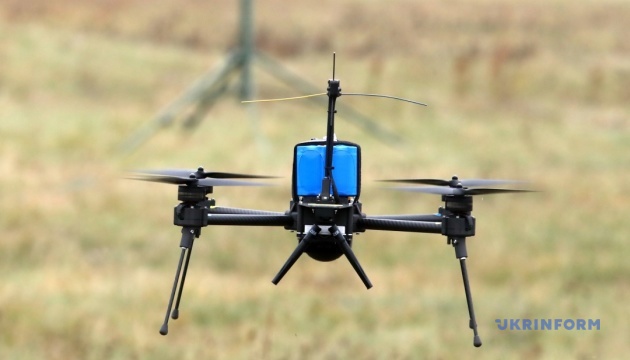
Illustrative image. Ukrainian drones of the Defense Forces. Photo: Ukrinform

Forbes: US drone manufacturers rely heavily on Chinese parts, struggle under tariffs and sanctions
US military ambitions to deploy thousands of drones for potential Pacific conflicts face a significant obstacle: American drone manufacturers remain heavily dependent on Chinese components, according to Forbes.

Since Russia’s full-scale war began in 2022, China has been claiming neutrality but the US and European leaders accused the country of being “the main sponsor of war” by supplying Russia with dual-use goods that can serve both civilian and military purposes.

These include high-priority components essential for Russia’s weapons production, such as microelectronics, machine tools, telecommunications equipment, radars, optical devices, sensors, and semiconductors. Ukraine’s President Volodymyr Zelenskyy also accused China of supplying components like gunpowder and artillery-related materials, and even claimed evidence of Chinese representatives engaged in weapons production in Russia.

This dependence creates vulnerabilities as trade tensions escalate under President Trump’s tariff policies.

The issue with drones gained public attention when Mach Industries CEO Ethan Thornton acknowledged using Chinese components in a promotional video for the company’s new military strike drone after being questioned by Anduril CEO Palmer Luckey.

Though Thornton later told Forbes that “all final production units ship without Chinese components,” the exchange highlighted a widespread industry problem.

According to research from Drone Industry Insights UG, China currently controls 90% of the global drone market, effectively making it a monopolist at the global level.

Additionally, China produces key drone components, including airframes, batteries, radio receivers, cameras, and screens. Due to mass production and accessibility, these components are highly competitive, making it challenging to create effective alternatives.


The cost of Chinese components, which is significantly lower than alternatives from the US or European countries, is equally important. This contributes to growing global demand, including among military forces that actively use products from companies like DJI.

“We are almost completely reliant on our major adversary for them, and our ability to make them,” said Josh Steinman, who previously managed supply chain security at the National Security Council.
The dependency extends to high levels of government. When Vice President J.D. Vance attended a Marine Corps drone demonstration at Quantico, he wore Chinese-made display goggles, though military officials stated they “were not military-issued” and were provided “solely for viewing purposes.”

Security implications for the US​

Pentagon officials acknowledge that this dependency poses a threat to US national security.

“China could shut [the drone industry] down globally for a year,” warned Trent Emeneker, who leads the Defense Innovation Unit team that approves drones for military use. “It’s a national security issue, not just for the United States, but for the global West.”
The Pentagon attempted to address these concerns through initiatives like Replicator, which aims to fast-track the production of affordable drones. However, manufacturers complain about excessive bureaucracy, preventing them from independently organizing production.

The Defense Innovation Unit maintains a “Blue List” of approved drones for military use, but this year, only 23 companies were approved out of more than 300 submissions.

“It’s easier to get sanctioned by the [People’s Republic of China] than it is to get on the Blue List,” said Andrew Cote, BRINC’s head of strategy and growth.

Meanwhile, China imposed sanctions on the supply of certain components that could be used in military equipment, significantly complicating the situation for American manufacturers.

Some manufacturers have already experienced disruptions. Skydio, one of America’s largest drone makers with over $850 million in investor funding, had its battery supply cut off when China imposed sanctions in October. Six months later, the company has yet to announce a new supplier.

More than a dozen other drone companies with Pentagon contracts have also been sanctioned by China, with varying impacts.

DJI​

Many industry leaders and national security experts believe that building a China-free drone supply chain requires removing the Chinese manufacturer DJI from the US market.

DJI, which became the world’s largest drone maker with support from both Chinese government subsidies and American venture capital, remains the dominant supplier to US farmers and police departments.

“Until DJI is entirely banned, there’s not enough market to stand up a US industrial base,” said Nathan Ecelbarger, chairman of the US National Drone Association.
However, DJI successfully resisted these efforts, lobbying against legislative measures that would ban its products and suing the Defense Department over national security designations. In December, a proposed ban on DJI products was dropped from the annual military spending bill.

“DJI has been unfairly targeted due to its national origins,” the company told Forbes.

The tariff dilemma​


President Trump’s tariffs aim to encourage American companies to reduce dependence on foreign supply chains. However, industry leaders warn that an immediate ban on Chinese components would be devastating.


“Immediately removing all foreign adversary-based sources of supply for critical drone components would have a catastrophic effect on the American drone industry,” wrote Jai Ramaswamy, chief legal officer of venture capital firm Andreessen Horowitz, in a response to the Commerce Department.

National security experts counter that such short-term pain might be necessary. “You are going to have to pull the band-aid off at some point,” said Steinman. “And either you are going to choose or [China] will.”
 
The US can't manufacture anything on its own anymore. It's not the manufacturing powerhouse it used to be in its 1980s peak.
 
Like if they care, its all part of the plan: replacing the Chinese.

I saw a video of a great Chinese business fair; the faces of the local traders were housing more stress wrinkles than pastasauce got meatballs. They lost their biggest customer.

The Americans lost their biggest supplier. But replacing a supplier is easier and cheaper than replacing a customer.

There are 194 nations worldwide, a lot of to choose from.
 

Users who are viewing this thread

Country Watch Latest

Latest Posts

Back
Top