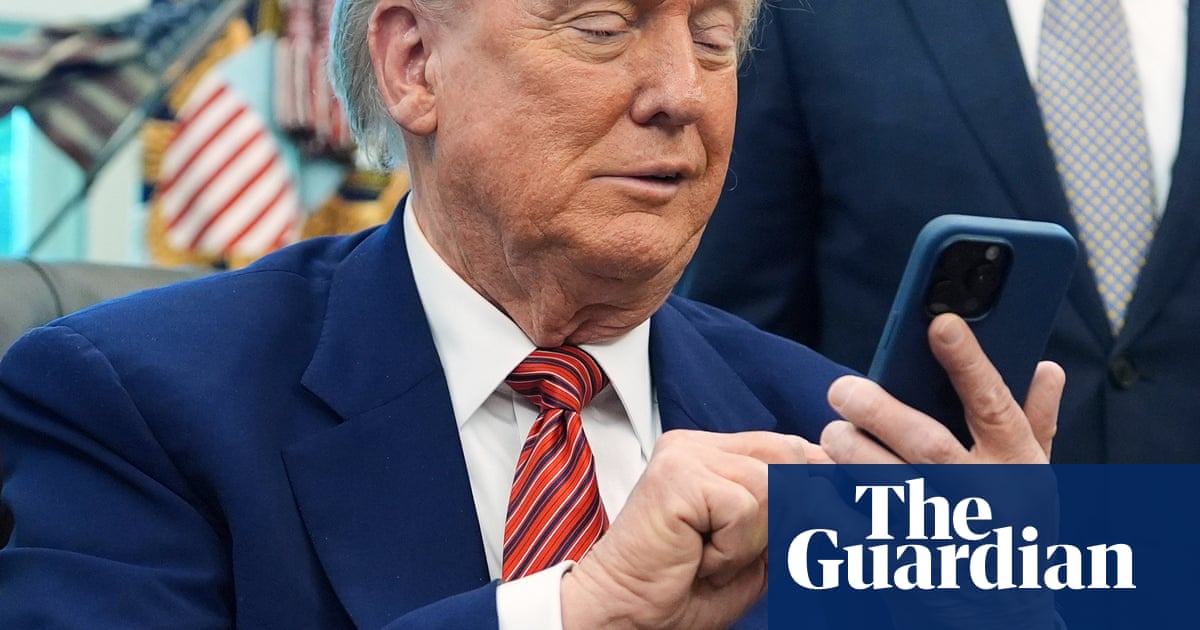
Trump threatens 100% tariffs on BRICS nations over US dollar replacement plans

China should be off his radar for a few weeks, let the current tariff arrangement play out

China can afford to wait.

As the effect of the tariffs trickles down to American consumer shelves over the coming months, Trump will come begging to China.
 
Xi Jinping prefers playing soccer to golf. Trump should go play with Putin and report on the results of his work in the meantime.
 

Trump recommends 50% tariff on European Union starting June 1​

Published Fri, May 23 20257:47 AM EDTUpdated 3 Min Ago

  • President Donald Trump said he is "recommending a straight 50% Tariff on the European Union" after complaining that trade negotiations have stalled.
  • The announcement came after Trump threatened to impose a tariff of at least 25% on Apple if the company does not start manufacturing iPhones in the United States.
  • Stock futures sank following Trump's posts.
President Donald Trump on Friday said he is "recommending a straight 50% Tariff on the European Union" after complaining that trade negotiations have stalled.

The steep new import duties would start on June 1, Trump wrote on Truth Social.


The EU "has been very difficult to deal with," Trump wrote of the 27-nation bloc. "Our discussions with them are going nowhere!"

Trump's announcement came less than 30 minutes after he threatened to impose a tariff of at least 25% on Apple's iPhones if the company did not start manufacturing them in the United States.

U.S. stock futures sank immediately following the posts, which showed the Republican president once again wielding the threat of massive import taxes in response to economic activity he disfavors. European stock markets fell 2%.
 

Shares in China-listed Apple suppliers fall after Trump’s tariff threats​


SHANGHAI ((Reuters) -China-listed Apple (NASDAQ:AAPL) supplier stocks lost ground on Monday after U.S. President Donald Trump threatened tariffs on imported iPhones.

Shares in Luxshare, which assembles iPhones and makes AirPods, fell 2.2% while Chinese mobile screen maker Lens Tech lost 1.8%. Airpod maker Goertek declined 1.1%.

Trump threatened on Friday to ratchet up his trade war again, warning Apple he may slap a 25% levy on any iPhones sold, but not made, in the U.S. as part of his administration’s goal of re-shoring jobs.

His threat, along with a second that pushed for a 50% tariff on European Union goods starting June 1, has raised fears that the trade war that the U.S. is waging could intensify again after weeks of de-escalation.

The White House paused most of the punishing tariffs Trump announced in early April against nearly every country in the world after investors furiously sold off U.S. assets including government bonds and the U.S. dollar. Trump left in place a 10% baseline tax on most imports, and later reduced his massive 145% tax on Chinese goods to 30%.

Apple is speeding up plans to make most iPhones sold in the United States at factories in India by the end of 2026 to navigate potentially higher tariffs in China.
 

Huawei Supernode 384 disrupts Nvidia’s AI market hold​

May 28, 2025

Huawei’s AI capabilities have made a breakthrough in the form of the company’s Supernode 384 architecture, marking an important moment in the global processor wars amid US-China tech tensions.

The Chinese tech giant’s latest innovation emerged from last Friday’s Kunpeng Ascend Developer Conference in Shenzhen, where company executives demonstrated how the computing framework challenges Nvidia’s long-standing market dominance directly, as the company continues to operate under severe US-led trade restrictions.

Architectural innovation born from necessity​

Zhang Dixuan, president of Huawei’s Ascend computing business, articulated the fundamental problem driving the innovation during his conference keynote: “As the scale of parallel processing grows, cross-machine bandwidth in traditional server architectures has become a critical bottleneck for training.”

The Supernode 384 abandons Von Neumann computing principles in favour of a peer-to-peer architecture engineered specifically for modern AI workloads. The change proves especially powerful for Mixture-of-Experts models (machine-learning systems using multiple specialised sub-networks to solve complex computational challenges.)

Huawei’s CloudMatrix 384 implementation showcases impressive technical specifications: 384 Ascend AI processors spanning 12 computing cabinets and four bus cabinets, generating 300 petaflops of raw computational power paired with 48 terabytes of high-bandwidth memory, representing a leap in integrated AI computing infrastructure.

Performance metrics challenge industry leaders​

Real-world benchmark testing reveals the system’s competitive positioning in comparison to established solutions. Dense AI models like Meta’s LLaMA 3 achieved 132 tokens per second per card on the Supernode 384 – delivering 2.5 times superior performance compared to traditional cluster architectures.

Communications-intensive applications demonstrate even more dramatic improvements. Models from Alibaba’s Qwen and DeepSeek families reached 600 to 750 tokens per second per card, revealing the architecture’s optimisation for next-generation AI workloads.

The performance gains stem from fundamental infrastructure redesigns. Huawei replaced conventional Ethernet interconnects with high-speed bus connections, improving communications bandwidth by 15 times while reducing single-hop latency from 2 microseconds to 200 nanoseconds – a tenfold improvement.

Geopolitical strategy drives technical innovation​

The Supernode 384’s development cannot be divorced from broader US-China technological competition. American sanctions have systematically restricted Huawei’s access to cutting-edge semiconductor technologies, forcing the company to maximise performance within existing constraints.

Industry analysis from SemiAnalysis suggests the CloudMatrix 384 uses Huawei’s latest Ascend 910C AI processor, which acknowledges inherent performance limitations but highlights architectural advantages: “Huawei is a generation behind in chips, but its scale-up solution is arguably a generation ahead of Nvidia and AMD’s current products in the market.”

The assessment reveals how Huawei AI computing strategies have evolved beyond traditional hardware specifications toward system-level optimisation and architectural innovation.

Market implications and deployment reality​

Beyond laboratory demonstrations, Huawei has operationalised CloudMatrix 384 systems in multiple Chinese data centres in Anhui Province, Inner Mongolia, and Guizhou Province. Such practical deployments validate the architecture’s viability and establishes an infrastructure framework for broader market adoption.

The system’s scalability potential – supporting tens of thousands of linked processors – positions it as a compelling platform for training increasingly sophisticated AI models. The capability addresses growing industry demands for massive-scale AI implementation in diverse sectors.

Industry disruption and future considerations​

Huawei’s architectural breakthrough introduces both opportunities and complications for the global AI ecosystem. While providing viable alternatives to Nvidia’s market-leading solutions, it simultaneously accelerates the fragmentation of international technology infrastructure along geopolitical lines.

The success of Huawei AI computing initiatives will depend on developer ecosystem adoption and sustained performance validation. The company’s aggressive developer conference outreach indicated a recognition that technical innovation alone cannot guarantee market acceptance.

For organisations evaluating AI infrastructure investments, the Supernode 384 represents a new option that combines competitive performance with independence from US-controlled supply chains. However, long-term viability remains contingent on continued innovation cycles and improved geopolitical stability.


Huawei CloudMatrix on par with Grace Blackwell for the first time​

31. May 2025 06:00

To view this content we will need your consent to set third party cookies.
For more detailed information, see our cookies page.


A rare admission from NVIDIA: In an interview with Bloomberg, CEO Jensen Huang confirmed that Huawei’s “CloudMatrix” AI infrastructure can now compete with the latest Grace Blackwell systems. This indicates a paradigm shift in the global AI arms race – from a country that is denied high-end chips such as the H100 and H200 by the USA under export controls.

Ascend 910C: The new rival to the H200

In detail, we are talking about Huawei’s latest AI accelerator, the Ascend 910C. According to Huang, its performance is roughly equivalent to the H200 – NVIDIA’s most powerful Hopper derivative. This would not only put Huawei on an equal footing, but also on a comparable product cycle. The lead that NVIDIA has built up over the years seems to have shrunk noticeably in less than 24 months. Just a year ago, the consensus among Western analysts was that China was at least a generation behind in AI accelerators. This applied to both raw performance and software integration. However, with CloudMatrix and Ascend 910C, Huawei seems to have not only made up for this lag, but also embarked on an autonomous development that is no longer dependent on US technologies. Jensen Huang himself speaks of a company “that is looking for ways to compete – and is doing so very successfully”.
 
Look this type of analysis are aplenty on the net and they tend to be highly complex schemes concocted by the US. The problem with so highly complex schemes is that they depend on too many variables to succeed, the outcome of those variables can never be accurately predicted, rendering the complex scheme useless, thus confirming the non-existence of such schemes.

I think it's just what is out there in the plain and open. Trump hates illegal immigrants, Trump really believes China and the rest of he world are ripping of the US, so there must be tariffs, manufacturing must be brought back to the US, Ukraine war shouldn't have been started and all the stuff he believes in. He did what he believed in, the rest of his team are a combination of morons like him or smart but sycophants. That's the whole story.

I predict there will be no invasion of Iran in Trump's term. I also predict he will likely get some EU countries and Japan to buy some of those bonds and he will have to authorize printing dollars for the Feds to buy back the rest of the bonds. The printing to buy back significant portion of the bonds alone will be a clusterfvk, on top of that if China doesn't back down he is in for a lot of trouble. He simply has no room to start a war with Iran because he will be so embattled under public rage. In his last term he did a lot of fvckery without finding out, in this term he will find out the true meaning of FAFO.
Most of my predictions came true. War breaks out again in the Middle East and Iran is attacked. Capital from Arab countries was brought to the US by Trump to stabilize the US national debt. The mistake was that it was Israel that attacked Iran not the US.
 
Most of my predictions came true. War breaks out again in the Middle East and Iran is attacked. Capital from Arab countries was brought to the US by Trump to stabilize the US national debt. The mistake was that it was Israel that attacked Iran not the US.

I still think the US won't attack Iran, maybe a limited strike but no full fledged war like Iraq invasion. But never say never, it very well may happen.
 

This could be the summer of economic hell​


Analysis by Elisabeth Buchwald, CNN
6 minute read
Published 5:00 AM EDT, Mon June 30, 2025

In the face of higher tariffs on virtually everything the United States imports, plus a Middle East crisis, the United States economy has, remarkably, held its ground. Inflation has mostly held steady, while the unemployment rate remains near historic lows. Stocks, meanwhile, hit fresh record highs last week.

That could soon change as crucial deadlines near.

The first is July 9, which marks the end of President Donald Trump’s 90-day pause on what he termed as “reciprocal” tariffs on dozens of America’s trading partners. Unless those countries reach trade deals with the US, they could potentially face much higher tariffs.

Then, just around the corner from that is the so-called X-date, when the government could default on its debt obligations. That will occur at some point in August, Treasury Secretary Scott Bessent said in a recent letter to congressional leaders. The consequences of the US defaulting on debt, which has never happened, are grave and would likely cause global economic upheaval. That’s why Bessent argued lawmakers need to raise the debt ceiling before Congress’ one-month recess starts on August 4.

The president has essentially pressured Congress to raise it by July 4. But complicating that effort is the fact that raising the nation’s borrowing limit is just one of several measures included in his “One Big, Beautiful Bill,” which is what he really wants to sign into law by then.

Another pressing situation that could overturn the current calm is the fragile ceasefire Trump brokered between Iran and Israel. It could quickly become undone and cause oil prices to surge at a time when inflation from his tariffs may already be picking up.

“We know it’s coming. There’s a lag between changes in tariffs and when they show up in prices you and I are paying,” said Ryan Sweet, chief US economist at Oxford Economics.

And there are other cracks in the economy that could rapidly evolve into fault lines, such as the number of people continuing to receive unemployment benefits hitting a four-year high and consumers reining in their spending.

One big, ugly tariff question​

Trump has demonstrated over the first few months that there’s no limit to how high he’ll raise tariffs — whether across a country’s goods or across all imports of a particular product. For instance, the US had taxed Chinese goods at a minimum 145% rate, but a deal that was reached on May 12 brought that rate down to 30%.

Other tariffs currently in place include 50% on steel and aluminum, 25% on cars and auto parts, and a 10% minimum tariff on virtually every country’s goods.

While Mexican and Canadian goods are exempt from certain tariffs if they comply with the terms of the United States-Mexico-Canada Agreement, Trump on Friday said he will levy new tariffs on Canadian goods over the country’s refusal to ditch a new tax set to take effect Monday.

In April, after his trade policy rocked markets, Trump announced a 90-day pause, ostensibly to buy more time to work on “bespoke” trade deals with impacted countries, he said. Since then, there have only been two trade deals inked, with the United Kingdom and China.

Trump noted Friday that it was unrealistic that 200 countries that have been aiming to ink trade deals with the US would have them finalized by July 9.

“At a certain point, over the next week and a half or so, or maybe before, we’re going to send out a letter. We talked to many of the countries, and we’re just going to tell them what they have to pay to do business in the United States,” he told reporters from the White House press briefing room.

“We have a lot of great things going, and we’re getting along with countries, but some will be disappointed because they’re going to have to pay tariffs,” Trump added.

Trump administration officials have floated potential extensions for countries “negotiating in good faith,” without specifying what that means or which countries that applies to.

Treasury Secretary Scott Bessent said Friday in a CNBC interview: “There are probably another 20 countries where they could go back to the reciprocal tariff (rate) of April 2 as we work on the deal. Or, if we think that they are negotiating in good faith, then they could stay at the 10% baseline.”

Commerce Secretary Howard Lutnick re-upped the possibility of a regional tariff strategy on Thursday, while also claiming that 10 trade deal announcements were imminent.

“You’ll have South American deals, African deals… We will put these people in their proper buckets on July 9,” he said in a Bloomberg TV interview.

That could mean some nations end up facing higher tariffs compared to the April levels just based on where they’re located. For instance, Vietnam was set to face 46% tariffs, while its neighbor Malaysia was going to face a 24% tariff.

Or, come July 9, tariff policy could just come down to picking a number out of a hat. As Bessent said, “It will all be up to President Trump.”

“Whether or not the July 9th deadline spells trouble for the economy depends on how the Trump administration handles trade policy,” Matthew Luzzetti, chief US economist at Deutsche Bank, told CNN.

“If he were to reinstate the historically elevated tariffs announced on ‘Liberation Day,’ (April 2) this would bring back fears of an economic slowdown that were prevalent in April,” he said, adding that it didn’t seem like a strong possibility. “More likely, we get a mix of extensions, trade deals and threats of increased tariffs on specific countries or sectors. If that is the outcome, it could leave the economy in its current holding pattern for a bit longer until uncertainty clears.”

Already, Luzzetti’s team of economists is anticipating higher prices in the coming months. Reinstituting more tariffs come July 9 could only add more fuel to that fire, he said.

Similarly, Olu Sonola, US head of economic research at Fitch Ratings, said, “Regardless of the outcome of these deadlines, we expect (Consumer Price Index) inflation to trend higher towards 4% at the end of the year. If ‘Liberation Day’ tariffs return, we’ll likely see inflation higher than 4%.” The latest CPI report from May showed prices rising at a 2.4% annual rate.

Another 11th-hour debt ceiling standoff?​

Sweet says he expects lawmakers won’t allow the US to default on its debt and will ultimately raise the debt ceiling in the 11th hour. “This is essentially a very bad movie that we’ve seen before, so we know how it ends.”

He said there may be more time before the US defaults compared to Bessent’s estimates. (It’s incredibly difficult to make precise predictions on when that is.)

“But each passing week you naturally get a little bit more nervous, because you don’t want to imagine the unimaginable,” Sweet said. “I just don’t think that’s a very likely scenario, because I think lawmakers know that it would be political and economic suicide not to raise the debt limit.”
 

They keep Putin's war machine going': Trump-backed Bill to slap 500% tariffs on India, China for Russia ties​

The proposed legislation is part of a broader US push to cripple Russia’s wartime economy and force it to the negotiating table over Ukraine.​


In a major policy pivot that could upend US trade relations with key global partners, US President Donald Trump has thrown his weight behind a Senate bill that would impose 500% tariffs on countries continuing economic ties with Russia—including India and China. The development was confirmed by Republican Senator Lindsey Graham in an interview with ABC News.

“Big breakthrough here. So what does this bill do? If you’re buying products from Russia and you’re not helping Ukraine, then there’s a 500 percent tariff on your products coming into the United States. India and China buy 70 percent of Putin’s oil. They keep his war machine going,” Graham told ABC News.

The proposed legislation, which Graham is co-sponsoring with Democratic Senator Richard Blumenthal, is part of a broader US push to cripple Russia’s wartime economy and force it to the negotiating table over Ukraine. As per Graham, 84 senators have now signed on, marking one of the most bipartisan efforts to tighten sanctions since Russia’s 2022 invasion of Ukraine.

According to Graham, the green light from Trump came during a recent golf outing.


“My bill has 84 co-sponsors. It would allow the president to put tariffs on China, India, and other countries to stop them from supporting Vladimir Putin’s war machine and get him to the table. For the first time yesterday, the president told me … I was playing golf with him. He says, ‘It’s time to move your bill.’”

If passed, the bill would deliver a severe blow to India and China, the two largest buyers of discounted Russian crude. Despite repeated Western pressure, both nations have continued importing Russian oil, helping Moscow keep its economy afloat and fund its military operations

While India insists its trade is legal and aligned with its energy security interests, this legislation could put New Delhi in the direct line of US trade fire, risking tariffs on exports ranging from pharmaceuticals and textiles to IT services and automotive components.

The bill, originally floated in March, had faced delays after internal White House resistance. According to The Wall Street Journal, the Trump administration initially tried to “quietly pressure” Graham into watering down the language, particularly by changing the word “shall” to “may” to make enforcement optional rather than mandatory.

Further reflecting internal divisions, Graham himself recently offered a carve-out in the bill for countries that support Ukraine, in what appears to be a move to soften European concerns.

“We are going to give President Trump a tool in the toolbox,” Graham said, defending the latest compromise. He reiterated that Trump told him, “It’s time to move your bill.”
 
India’s imports of Russian crude oil surged to a 10-month high of 1.96 million barrels per day (bpd) in May, driven by continued availability at discounted prices compared to global benchmarks, according to ship-tracking data from Kpler.


Weapons and oil imports — our eyes have always been set on Russia. Because trusted relationship And now the U.S. wants to impose a ban on that?
It's ironic — rely on them, and you’re dependent. Rely on Russia, and you’re a problem."
 
India deserved it.
For China, What a clown retard. Damned be the day when I used to wish for his safety. Narcissist clown.
 
@StormBreaker

India deserved it. For China, What a clown retard.

So are you saying that IND deserves to be penalised for buying Russian oil, but not China? Why these double standards?

Regards
 
This is just signalling. Only about 5% of bills introduced in the Senate become law.
 

Users who are viewing this thread

Pakistan Defence Latest

Country Watch Latest

Latest Posts

Back
Top