Trump threatens to tap allies for military shipbuilding if US can't produce

Beijingwalker

VIP Member
Joined
Nov 4, 2011
Messages
93,824
Reaction score
114,109
Reputation
1,930.8
Country of Origin
Country of Residence

Trump threatens to tap allies for military shipbuilding if US can't produce​

MORGAN PHILLIPS
January 7, 2025 at 12:25 PM

President-elect Donald Trump, fed up with the U.S.' lagging ship-building capabilities, offered an out-of-character solution to the problem: Outsource production if the U.S. can’t keep up.

"We’re going to do something with ships. We need ships. And we may have to go a different route than you would normally go," the incoming president suggested to radio host Hugh Hewitt.

"We don’t build ships anymore. We used to build a ship a day. We don’t build ships anymore. We want to get that started. And maybe we’ll use allies, also, in terms of building ships. We might have to."

He noted China’s vast outpacing of American shipbuilding capabilities.

"China’s building, from what I’m hearing, every four days, they’re knocking out a ship. We’re sitting back and watching, and we’ve suffered tremendously."

Trump speaking at MAL

Trump threatens to build U.S. ships abroad.

Trump’s stance is sure to put the domestic shipbuilding industry and labor groups on alert. But it comes as China’s shipbuilding capacity is more than 232 times greater than that of the U.S., and the Navy has for decades struggled to build ships on time.

And it's a divergence from his campaign promise to bring manufacturing back to the U.S., and trigger a blanket tariff on global imports into the U.S., along with a 60% tariff on all goods imported from China.

China’s navy is the largest in the world, with more than 370 ships and submarines. The U.S.' battle force includes 295 vessels, including 11 active aircraft carriers. In 2017, Congress passed a law requiring the Navy to keep and maintain 355 ships.

Without disclosing details, Trump hinted at a plan to grow the Navy's ship fleet.

"We’re going to be announcing some things that are going to be very good having to do with the Navy. We need ships. We have to get ships. And you know, everybody said, ‘Oh, we’ll build them.’ We may have to go to others, bid them out, and it’s okay to do that. We’ll bid them out until we get ourselves ready," he said.

The U.S. also lags in nuclear submarines, according to military experts. The U.S.’ nuclear submarines reached a Cold War high of 140, according to Jerry Hendrix, retired Navy captain and senior fellow at the Sagamore Institute, in an op-ed for American Affairs.

"The bottom line is that the American submarine force, the ‘point of the spear’ of American power, upon which so many military plans depend, is unprepared to meet the current threat environment, and there are no quick fixes. It has taken decades—and a sequence of bad assumptions and poor decisions—to fall into the current state of unpreparedness," he wrote.

The most recent figures show the U.S. submarine flight at 68, only 50 of which are classified in the hunter-killer "fast attack" category.

Currently, China controls 46.59% of the global shipbuilding market. South Korea comes in second at 29.24%, and Japan third with 17.25%. The U.S. has a relatively insignificant control of the market at 0.13%. And it costs roughly twice as much to build a ship in the U.S. as it does elsewhere in the world.

Congress' $895 billion annual defense policy bill authorized $33.5 billion for new ships and submarines.

According to a Navy report last year, several key shipbuilding programs are years behind schedule, in large part due to a lack of workers.

Trump also called out management of the Navy’s Constellation-class frigate program, blaming Biden-era officers for "playing around and tinkering," adding to costs.

Speaking with Hewitt, Trump seemed to refer to a deal the Pentagon struck with the American arm of Italian shipbuilder Fincantieri for the new class of ships in 2020.

"And they were going and really doing a good job, and the generals, you know, the Biden admirals and generals and all of the people that are involved, they started playing around and tinkering and changing the design, and this, you know, that costs. That costs a lot of money," Trump said.

"But the generals or the admirals went in, and they said, ‘Oh, why don’t we make it a little bit wider? Why don’t we do this? Why don’t we do that?’ And it was designed specifically for speed and other things. When you start making it wider, you start making it slower," Trump continued.

"We had it down, and they made changes. They always have to make changes. You know, these guys get in there, and they think they’re smart, and in many cases, unfortunately, they’re not smart, and they take something, and they make it worse for a lot more."

Then-President Ronald Reagan had a 600-ship goal for the Navy when he assumed office, dedicated to rebuilding the nation's fleet after the Vietnam War. But his administration also terminated a subsidy for shipbuilding that decimated the commercial market, meaning U.S. shipyards were solely dedicated to meeting the needs of the military.
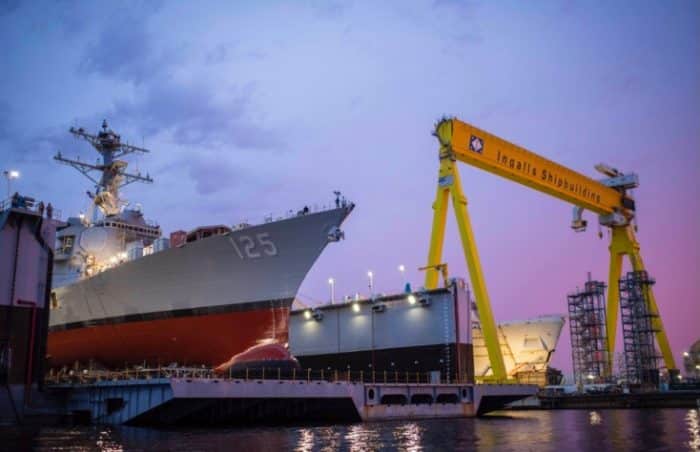
 

US Navy at impasse as US shipbuilding costs soar​

Fabrice Wolf
9TH JANUARY 2025

As we know, the US Navy's fleet renewal program has been chaotic, to say the least, in recent years. Between the consequences of failed programs like LCS, and the sometimes dazzling variations in executive requirements in this area, the Pentagon has had great difficulty in drawing up a credible guideline, while at the same time, the Chinese fleet seemed to be multiplying like tribulus (for Star Trek fans).

In fact, framework documents have been successful in recent years, without ever really satisfying, to the point that the US Navy has decided, since 2021, to present not one but several potential trajectories, depending on the requirements and the variable credits that will be allocated to it.

In the latest document, the Battle Force Ship Assessment and Requirement report of 2023, also presents two potential trajectories, one aiming for a fleet of 381 ocean-going vessels in 2054, validated by the outgoing administration, and the other, less ambitious, if the credits were to run out.

This first option was the subject of a feasibility study by the Congressional Budget Office, or CBO. Its conclusions are alarming. Indeed, in addition to the historically dilapidated state of American shipbuilding, it turns out that the budget estimates made by the US Navy, to give substance to this program, would be largely underestimated, and that it will have to pay no less than $1000 billion, over the next 30 years, to implement it.


US Navy to spend $1000 trillion over next 30 years to renew fleet​

According to the CBO, the US Navy will actually have to invest $40 billion (2025) each year, for the construction and equipment of new ships which must be delivered to it by 2054, in order to reach the format of 381 ships currently targeted by that date.

This amount is 17% higher than planned by the US Navy, and especially 46% higher than the average amount invested annually over the last five years in this area. Once additional operating expenses are added, the US Navy budget should then increase from $255 billion today (i.e. the third largest military budget on the planet, after all US forces and China), to $340 billion in 2054, excluding inflation.

According to the CBO, the origin of these cost increases comes from the poor planning and poor execution by the US Navy over the last twenty years of its industrial programs, marked by many failed programs, such as the LCS, the DDG-1000 Zumwalt class destroyers, or the CG(X) program initially intended to replace the Ticonderoga class cruisers.

However, it is the advanced state of disrepair of the entire military naval industry that is particularly singled out in the CBO report, which is in the worst state in a quarter of a century (he is being kind), according to one of the CBO analysts, quoted by Defense News.

One example of this is the process of modernizing and refueling the nuclear reactor of the aircraft carrier George Washington. It began in August 2017 and was not completed until May 2023, six years later, whereas it had previously taken only four years.

 
Unless the US is planning to buy European designs it will not produce any extra ships for at least 5 years.
 
Last edited:
Unless the US is planning to buy European designs it will not produce any extra ships for all least 5 years.
The US might ask Japan, South Korea and its good new buddy India to build navy ships for them.
 
The US might ask Japan, South Korea and its good new buddy India to build navy ships for them.


South Korea and Japan would be the best options as they already have produced AEGIS destroyers with US missiles, and they also have the best capacity to increase rate of shipbuilding.
 
South Korea and Japan would be the best options as they already have produced AEGIS destroyers with US missiles, and they also have the best capacity to increase rate of shipbuilding.
They both depend on China's steel plates for their shipbuilding industries, they don't have a complete supply chain like China does.
 

Trump threatens to tap allies for military shipbuilding if US can't produce​

MORGAN PHILLIPS
January 7, 2025 at 12:25 PM

President-elect Donald Trump, fed up with the U.S.' lagging ship-building capabilities, offered an out-of-character solution to the problem: Outsource production if the U.S. can’t keep up.

"We’re going to do something with ships. We need ships. And we may have to go a different route than you would normally go," the incoming president suggested to radio host Hugh Hewitt.

"We don’t build ships anymore. We used to build a ship a day. We don’t build ships anymore. We want to get that started. And maybe we’ll use allies, also, in terms of building ships. We might have to."

He noted China’s vast outpacing of American shipbuilding capabilities.

"China’s building, from what I’m hearing, every four days, they’re knocking out a ship. We’re sitting back and watching, and we’ve suffered tremendously."

Trump speaking at MAL

Trump threatens to build U.S. ships abroad.

Trump’s stance is sure to put the domestic shipbuilding industry and labor groups on alert. But it comes as China’s shipbuilding capacity is more than 232 times greater than that of the U.S., and the Navy has for decades struggled to build ships on time.

And it's a divergence from his campaign promise to bring manufacturing back to the U.S., and trigger a blanket tariff on global imports into the U.S., along with a 60% tariff on all goods imported from China.

China’s navy is the largest in the world, with more than 370 ships and submarines. The U.S.' battle force includes 295 vessels, including 11 active aircraft carriers. In 2017, Congress passed a law requiring the Navy to keep and maintain 355 ships.

Without disclosing details, Trump hinted at a plan to grow the Navy's ship fleet.

"We’re going to be announcing some things that are going to be very good having to do with the Navy. We need ships. We have to get ships. And you know, everybody said, ‘Oh, we’ll build them.’ We may have to go to others, bid them out, and it’s okay to do that. We’ll bid them out until we get ourselves ready," he said.

The U.S. also lags in nuclear submarines, according to military experts. The U.S.’ nuclear submarines reached a Cold War high of 140, according to Jerry Hendrix, retired Navy captain and senior fellow at the Sagamore Institute, in an op-ed for American Affairs.

"The bottom line is that the American submarine force, the ‘point of the spear’ of American power, upon which so many military plans depend, is unprepared to meet the current threat environment, and there are no quick fixes. It has taken decades—and a sequence of bad assumptions and poor decisions—to fall into the current state of unpreparedness," he wrote.

The most recent figures show the U.S. submarine flight at 68, only 50 of which are classified in the hunter-killer "fast attack" category.

Currently, China controls 46.59% of the global shipbuilding market. South Korea comes in second at 29.24%, and Japan third with 17.25%. The U.S. has a relatively insignificant control of the market at 0.13%. And it costs roughly twice as much to build a ship in the U.S. as it does elsewhere in the world.

Congress' $895 billion annual defense policy bill authorized $33.5 billion for new ships and submarines.

According to a Navy report last year, several key shipbuilding programs are years behind schedule, in large part due to a lack of workers.

Trump also called out management of the Navy’s Constellation-class frigate program, blaming Biden-era officers for "playing around and tinkering," adding to costs.

Speaking with Hewitt, Trump seemed to refer to a deal the Pentagon struck with the American arm of Italian shipbuilder Fincantieri for the new class of ships in 2020.

"And they were going and really doing a good job, and the generals, you know, the Biden admirals and generals and all of the people that are involved, they started playing around and tinkering and changing the design, and this, you know, that costs. That costs a lot of money," Trump said.

"But the generals or the admirals went in, and they said, ‘Oh, why don’t we make it a little bit wider? Why don’t we do this? Why don’t we do that?’ And it was designed specifically for speed and other things. When you start making it wider, you start making it slower," Trump continued.

"We had it down, and they made changes. They always have to make changes. You know, these guys get in there, and they think they’re smart, and in many cases, unfortunately, they’re not smart, and they take something, and they make it worse for a lot more."

Then-President Ronald Reagan had a 600-ship goal for the Navy when he assumed office, dedicated to rebuilding the nation's fleet after the Vietnam War. But his administration also terminated a subsidy for shipbuilding that decimated the commercial market, meaning U.S. shipyards were solely dedicated to meeting the needs of the military.
lol so he is going to import ships? 🤣🤣 but I thought he was planning to tarrif South Korea , Japan etc. I hope he does order ships from then and apply tariff as well. 😂😂😂
 

Inside America's $66 Billion Bet To Beat China's Shipbuilding Empire​

China is the world's top shipbuilder, and as it rapidly continues to expand its navy, the Trump administration is making American shipbuilding a national priority. We went inside a US naval shipyard to see how these vessels are built and why expanding America's fleet may be harder than it sounds.

 
This thread is a year old and has very little activity.

FWIW, there is another thread here where the Navy canceled plans to have one of the Italian builders build new frigates.

There is a two-fold problem here:

1. lack of shipyard capacity in the US
2. the Navy can't go more than a few days without changing its mind regarding requirements for new ships. How can a reasonable person expect a builder to deliver when the customer keeps changing its mind?

I swear we forgot everything learned during WWII at Willow Run. Otherwise, Ford would still be delivering B-24s today.
 

Users who are viewing this thread

Pakistan Defence Latest

Back
Top