Turkish Air Force | News & Discussions

193 of 196 Countries dont have all these technologies and you are still crying here

Just like slaves trying to protect their master...
Indians worship Israel and these people worship China
better worry about your Countries


Turkiye was the first Country in the world that fired BVR Missile from unmanned stealth Fighter Jet using its own MURAD AESA Radar and KIZILELMA enter the inventory in 2026 .... and ANKA-3 by 2027

We are among the leading countries in the world pioneering the MUM-T concept
what kind of nonsense are you spouting ?

F-16-KIZILELMA formation flight in 2023 .. first time in the world


We have seen 4 Chinese-made UCAVs in Sudan which were turned into scrap of metal in BVR combat by Turkish AKINCI UCAVs within 3 days

In the combat arena where the AKINCI UCAV has transformed into a "flying air defense battery"
View attachment 217239


And your Kizlima and Anka 3 are still relying on foreign tech (engine) is still Ukrainian in these UCAV
 
Given the emerging potential threat to Turkey from Israel, the Steel Dome project looks interesting. The key is early detection against low visibility aircraft.

ALP series Radars to detect the F-35

-- ALP-300G AESA Radar can detect the F-35 from 120+ km away
and 150+ km SIPER-2 air defense Missile to hit the F-35

-- ALP-400G V/UHF Radar to detect the F-35 from 200+ km away


The F-35 is not completely invisible
The F-35's airframe geometry and RAM coating are designed to deflect the high-frequency (X-band) Radars primarily used by Air Defense Systems and Fighter Jets

V/UHF Radars such as the ALP 400-G, possess much longer wavelengths.
These long waves are unaffected by the special paint on the F-35 or its angled fuselage geometry

Turkiye also developing QUANTUM Radar to detect the stealth Fighter Jet
 
And your Kizlima and Anka 3 are still relying on foreign tech (engine) is still Ukrainian in these UCAV

That doesnt block the ANKA-3 and KIZILELMA to kick enemies as like AKINCI UCAV

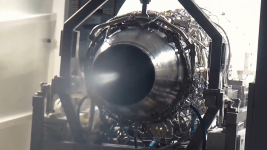
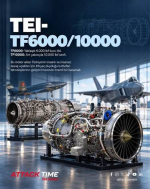
Turkish TF-6000 - TF-10.000 turbofan Engines are coming to power unmanned stealth Fighter Jets ..... step by step to gain self sufficiency
1790617319115.png
1790617341271.png

China used Russian engines for 10 years to power the J-20 prototypes and first mass producion J-20s
 
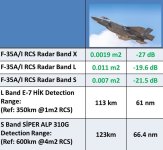
Turkiye has 3 different AESA Radars which can detect the F-35 from 120+ km away


American AN/FPS-117 AESA Radar ( in service )
Italian Selex RAT-31DL AESA Radar ( in service )
Turkish ALP-300G AESA Radar ( in service )

also soon CAFRAD AESA Radar on the TF-2000 Destroyer and ALP-400G V/UHF Radar

Boeing E-7T AEWC can detect the F-35 from 110+ km away but there is a risk of being hit by an F-35
1790618021549.jpeg


Aselsan HAKIM Air Defence Early Warning and C4ISR System manages the air defence activities on Tactical level receives air threat information from a variety of radars, produces a recognized air picture in real time and assigns the available air defense weapons to selected targets

to use all the units ( SIPER , HISAR , F-16 , Eurofighter , KAAN , KIZILELMA , ANKA-3 , TF-2000 Destroyer ) to hit the F-35 in network centric warfare
1790618854557.jpeg
 
So I've been reading up on the Stunner missile of David's Sling quite a bit lately -- it's a pretty damn interesting missile, to say the least.

It's basically a BVRAAM-sized missile + a decent-enough-sized booster, with a dual-mode IIR + RF seeker. It can reach ~180 km against air-breathing targets (with ~280 km being its aerodynamic/kinematic limit -- could potentially hit a predictable, high-flying cruise missile) versus ~75 km against ballistic missiles, and has a stated max engagement altitude of ~30 km (the missile itself can reach ~50 km performance-wise, but you obviously can't expect intercepts at that altitude).

The missile itself uses a three-pulse motor, with the third pulse being used in the terminal phase after the parabolic midcourse trajectory at ~15-30 km (all of which enable it to reach M7.5 in the ABM role).

Needless to say, it's a nasty missile against aircraft -- especially within 75 to 100-120 km -- and simply spamming chaff/flare isn't going to cut it (although it's not significantly superior to larger dual-pulse missiles in anti-aircraft role, imo).

BUT, it's primarily an ABM, and hit-to-kill isn't nearly as reliable against maneuvering aircraft capable of sustaining those maneuvers as it is against ballistic targets. Against fighters, it still faces the same basic constraints, meaning you shouldn't expect that M7.5 terminal velocity -- it'll have similar terminal kinematics to other SAMs. And given how capable it is against ballistic missiles, it'd be primarily reserved for the same intended target set in Greek use also, with aircraft engagements being more opportunistic.

That's where the Barak-ER comes in (Barak MX batteries can launch multiple missile types)... Its architecture is the same as Siper-B1/B1-D -- booster + dual-pulse motor. Compared to Siper Block-1, it gets ~30-50 km more range (~150 km), thanks to its larger booster and longer, more slender missile body. The dual-pulse motor + HE-frag warhead combination also makes it considerably more suited to engaging aircraft.

So, in this context, Stunner and Barak-ER actually complement each other's weaknesses rather nicely. Their common EL/M-2084 MFR architecture also works in their favor rather than against them, even if they don't rely on a separate, dedicated FCR (assuming the Greeks don't cheapen out on radar acquisition! -- 3.4B USD would buy them enough cheap(er!) Israeli missiles).

Both are still dangerous missiles, obviously, but not quite "make you shit yourself from 100+ km away" dangerous. Hard terminal maneuvering and LOity would degrade their performance considerably (LOity would obviously make it much, much harder for them to engage you in the first place), while RF countermeasures such as DRFM (and DIRCM against the IIR-sensor) could further complicate the engagement against Stunner's seeker.

Combine hard maneuvering at lower altitudes with chaff + flare, jamming and DIRCM, and Stunner becomes a hell of a lot less scary than its headline figures suggest (it'd just make you work harder, potentially). The same basic kinematic constraints and countermeasures apply to Barak-ER too -- and it's worth remembering that missiles simply don't retain their full energy at max range.

Besides, within the 2028-32 period, Turkey will also be receiving a whole lot of goodies -- several times more advanced radar and AD coverage, as well as the PAC-3 MSE/(broadly)Stunner-equivalent Siper-A and its exoatmospheric siblings (the latter -- i.e., Siper-B3/B4 -- obviously arriving later)...
 
Last edited:

Users who are viewing this thread

Back
Top