Turkish Foreign Policy and Regional Geopolitics

You have treaty obligation, just say you don't care about the treaty violations or withdraw from the treaty. Egypt signed a treaty that doesn't let them militarize the Sinai. There are many such treaties. Its still a violation.

Posting long text does not undo the treaty violation. What you need to do is say I don't care about the Treaty Greece signed, but you want to appear "lawful". lol

If Greece feels it does not need to be bound by any treaties, neither does Turkey, It can choose to violate treaties if it wishes as well. The Ball is in Greece's court on whether they will decide to make unilateral moves and try to establish fiat accompli. Then you open the Pandora box, and we see where this goes. lol
If you're too lazy to read why it's NOT a violation,then why are we even having this f convo? You know what,you're doing the same thing you've been doing for awhile. You throw an accusation,then refuse to hear the facts,then repeat it after a while. And if I make a fuss about it,you just go "ok,ok,I just wanted to make sure".

Instead of spamming "lol" to mock whoever you talk to,you should perhaps sit down and read what the other person shows you. Get it?
 
The EEZ stuff came out in the 90s genious b/c the convention for the extending of EEZ is a post cold war treaty, one that Turkey never signed or accepted. Turkey is not a party to the treaty.
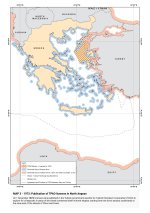
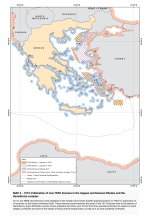
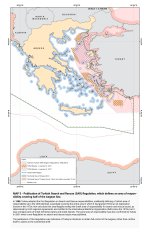
It all started in the '70s little by little...

map3_page-0001.jpgmap4_page-0001.jpgmap5_page-0001.jpg
 
If you're too lazy to read why it's NOT a violation,then why are we even having this f convo? You know what,you're doing the same thing you've been doing for awhile. You throw an accusation,then refuse to hear the facts,then repeat it after a while. And if I make a fuss about it,you just go "ok,ok,I just wanted to make sure".

Instead of spamming "lol" to mock whoever you talk to,you should perhaps sit down and read what the other person shows you. Get it?

Actually no what you are doing is spamming. you just copy pasted some BS you saw on your favorite greek blog, drown the whole post in text rather than give specific citations, and then try to act like a lawyer. lol

Treaty of Paris 1947 is quite clear on the demilitarization of the Islands. Greece is in violation of the treaty, thats basic fact most greeks with common sense, even those that support the militarization acknowledge. You on the other hand have a unique position where where you think Greece is not in violation.
 
If you're too lazy to read why it's NOT a violation,then why are we even having this f convo? You know what,you're doing the same thing you've been doing for awhile. You throw an accusation,then refuse to hear the facts,then repeat it after a while. And if I make a fuss about it,you just go "ok,ok,I just wanted to make sure".

Instead of spamming "lol" to mock whoever you talk to,you should perhaps sit down and read what the other person shows you. Get it?

1. Treaty Obligations Are Clear and Binding

Legal Citation: Vienna Convention on the Law of Treaties (1969)

  • Article 26 of the Vienna Convention on the Law of Treaties (1969) affirms the principle of pacta sunt servanda (agreements must be kept), which states:

    "Every treaty in force is binding upon the parties to it and must be performed by them in good faith."
This article underscores that treaty obligations are legally binding and must be adhered to by the parties. Therefore, Greece’s failure to uphold its obligations under the Treaty of Paris (1947) and the Treaty of Lausanne (1923) is a clear violation of international law.

Legal Citation: International Court of Justice (ICJ)

  • In the Case Concerning the Dispute Between Nicaragua and Honduras (1988), the ICJ emphasized that a state’s security concerns do not justify a violation of its treaty obligations. The Court ruled that:

    "States are bound by the treaties they enter into, and such treaties cannot be unilaterally violated, even in times of perceived security threats."
In line with this ruling, Greece cannot justify violating the demilitarization clauses of the treaties on the grounds of security threats from Turkey. The treaties are clear, and security concerns do not provide an exception to compliance with their terms.


2. Justification Based on Security Concerns Does Not Override Treaty Obligations

Legal Citation: UN Charter, Article 51 (Right of Self-Defense)

  • While the right to self-defense is enshrined in Article 51 of the United Nations Charter, it is critical to note that self-defense does not permit states to disregard their treaty obligations. Article 51 states:

    "Nothing in the present Charter shall impair the inherent right of individual or collective self-defense if an armed attack occurs against a Member of the United Nations."
However, the right of self-defense must be exercised within the framework of international law, and cannot be used to justify actions that violate binding treaty obligations, such as the demilitarization clauses of the Treaty of Paris and the Treaty of Lausanne.

  • The ICJ has held that state security concerns do not excuse a violation of international treaty obligations. In the Nicaragua v. United States case (1986), the ICJ emphasized that a state's desire to secure itself cannot justify its non-compliance with international obligations:

    "The Court observes that the United States' security concerns cannot provide a legal basis for its violation of its obligations under customary international law, including its commitments under the treaties."

3. Greece’s Military Presence is Undeniable and Well-Documented

Legal Citation: International Law Commission (ILC) Draft Articles on State Responsibility, Article 3

  • According to the International Law Commission's Draft Articles on State Responsibility, Article 3 defines an internationally wrongful act as:

    "An act of a state that is in violation of its international obligations, including those arising from a treaty."
Greece’s military activities on the Dodecanese Islands are well-documented, including the stationing of military personnel, construction of airfields, and deployment of advanced weaponry. These actions are direct violations of Greece’s obligations under the Treaty of Paris (1947) and the Treaty of Lausanne (1923). As these are tangible acts of militarization, Greece is in clear violation of its international obligations under the treaties.


4. The Argument of “Right to Defend” Does Not Override Demilitarization Requirements

Legal Citation: Case Concerning the Legal Status of the Aaland Islands (1920)

  • In the Case Concerning the Legal Status of the Aaland Islands (1920), the League of Nations ruled that certain islands, even when subject to military threats, must adhere to demilitarization clauses in international agreements. The League of Nations emphasized that:

    "The need for maintaining peace and stability in the region overrides individual security concerns when those concerns involve violating the agreed-upon demilitarization provisions."
This ruling highlights that demilitarization provisions are meant to prevent escalation in disputed regions, and they must be upheld even in the face of security threats. Greece’s violation of these provisions undermines the very purpose of such clauses, which was to maintain regional stability in the Aegean Sea.


5. Legal Precedents and the Binding Nature of Treaties

Legal Citation: Corfu Channel Case (United Kingdom v. Albania, 1949)

  • In the Corfu Channel case (United Kingdom v. Albania, 1949), the ICJ ruled that state sovereignty and security concerns do not permit a state to violate its international obligations. The Court affirmed that:

    "A State’s right to sovereignty and security cannot justify violating its international obligations, particularly in relation to agreed treaties."
The demilitarization clauses in the Treaty of Paris (1947) and the Treaty of Lausanne (1923) are binding, and no justification based on self-defense or security concerns allows Greece to ignore its obligations under these treaties.


6. Turkey’s Legal Position and International Reactions

Legal Citation: International Court of Justice (ICJ), Military and Paramilitary Activities in and Against Nicaragua (1986)

  • In the Nicaragua v. United States case (1986), the ICJ made it clear that treaty violations are serious breaches of international law that cannot be justified based on security concerns or political dynamics. The ICJ ruled:

    "The United States is legally responsible for its actions in violation of international law and its obligations under international treaties, regardless of its perceived security threats."
Turkey has consistently pointed out Greece’s militarization of the islands in the Aegean, specifically those that are covered under the Treaty of Paris (1947) and Treaty of Lausanne (1923). Just as the ICJ ruled that state security cannot justify violations of treaties, Greece’s justification based on security threats from Turkey is also insufficient.


Conclusion: The Violation is Clear and Irrefutable

In conclusion, the Treaty of Paris (1947) and the Treaty of Lausanne (1923) clearly and categorically require Greece to maintain the demilitarization of the Dodecanese Islands and other Aegean islands. The violation of these provisions, as demonstrated by Greece’s continued military presence, construction of airstrips, naval facilities, and stationing of advanced military hardware on these islands, constitutes a clear and indisputable breach of these international treaties.

The Vienna Convention on the Law of Treaties (1969) and the International Court of Justice have both consistently upheld that treaty obligations are binding, and cannot be overridden by security concerns. Furthermore, legal precedents such as the Corfu Channel case and the Nicaragua case confirm that self-defense or security threats do not justify the violation of international treaties.

Therefore, Greece’s argument that its actions are justified by security needs cannot be accepted. Greece is in violation of its international treaty obligations, and the demilitarization clauses of both the Treaty of Paris (1947) and the Treaty of Lausanne (1923) must be upheld.
 
Actually no what you are doing is spamming. you just copy pasted some BS you saw on your favorite greek blog, drown the whole post in text rather than give specific citations, and then try to act like a lawyer. lol
Spamming?! The first part is from the MoE

The second is from an article at Ptisi. I've posted these again and again on the forum,the old forum I mean,because they are the answers on your claims and yet,you ALWAYS try to ignore it,by finding some silly excuse.

But since you insist:

Treaty of Paris 1947 is quite clear on the demilitarization of the Islands. Greece is in violation of the treaty, thats basic fact most greeks with common sense, even those that support the militarization acknowledge. You on the other hand have a unique position where where you think Greece is not in violation.

The Dodecanese islands were ceded to Greece in full sovereignty by the Paris Peace Treaty between Italy and the Allies in April 1947. The provisions of this Treaty provided for the demilitarization of these islands: “The above islands shall be demilitarized and shall remain so”. There is a National Guard presence on the Dodecanese islands, which has been declared in accordance with CFE provisions.


With regard to Turkish claims on the demilitarization of the Dodecanese islands, it should be noted that:

• Türkiye is not a signatory state to this Treaty, which therefore constitutes a "res inter alios acta" for Türkiye; i.e., an issue pertaining to others. According to Article 34 of the Vienna Convention on the Law of Treaties, a treaty does not create obligations or rights for third countries.

• The demilitarized status of the Dodecanese islands was imposed after the decisive intervention of the Soviet Union and echoes Moscow’s political intentions at that point in time. It should, however, be noted that demilitarized status lost its raison d’être with the creation of NATO and the Warsaw Pact, as incompatible with countries’ participation in military alliances. Against this backdrop, demilitarized status ceased to apply to the Italian islands of Pantelaria, Lampedusa, Lampione and Linosa, as well as to West Germany on the one hand and Bulgaria, Romania, East Germany, Hungary and Finland on the other.

Do you get it?


The status of Mytilene, Chios, Samos and Ikaria


The Lausanne Treaty makes no mention of these islands having been granted demilitarized status.


Greece’s right to militarize Limnos and Samothrace was recognized by Türkiye, in accordance with the letter sent to the Greek Prime Minister on 6 May 1936 by the Turkish Ambassador in Athens at the time, RoussenEsref, upon instructions from his Government. The Turkish government reiterated this position when the then Turkish Minister for Foreign Affairs, Rustu Aras, in his address to the Turkish National Assembly on the occasion of the ratification of the Montreux Treaty, unreservedly recognized Greece’s legal right to deploy troops on Limnos and Samothrace, with the following statement : “The provisions pertaining to the islands of Limnos and Samothrace, which belong to our neighbor and friendly country Greece and were demilitarized in application of the 1923 Lausanne Treaty, were also abolished by the new Montreux Treaty, which gives us great pleasure” (Gazette of the Minutes of the Turkish National Assembly, volume 12, July 31/1936, page 309). During the same period, Türkiye gave similar assurances on this subject to the governments of interested third countries.
 
Spamming?! The first part is from the MoE

The second is from an article at Ptisi. I've posted these again and again on the forum,the old forum I mean,because they are the answers on your claims and yet,you ALWAYS try to ignore it,by finding some silly excuse.

But since you insist:


The Dodecanese islands were ceded to Greece in full sovereignty by the Paris Peace Treaty between Italy and the Allies in April 1947. The provisions of this Treaty provided for the demilitarization of these islands: “The above islands shall be demilitarized and shall remain so”. There is a National Guard presence on the Dodecanese islands, which has been declared in accordance with CFE provisions.


With regard to Turkish claims on the demilitarization of the Dodecanese islands, it should be noted that:

• Türkiye is not a signatory state to this Treaty, which therefore constitutes a "res inter alios acta" for Türkiye; i.e., an issue pertaining to others. According to Article 34 of the Vienna Convention on the Law of Treaties, a treaty does not create obligations or rights for third countries.

• The demilitarized status of the Dodecanese islands was imposed after the decisive intervention of the Soviet Union and echoes Moscow’s political intentions at that point in time. It should, however, be noted that demilitarized status lost its raison d’être with the creation of NATO and the Warsaw Pact, as incompatible with countries’ participation in military alliances. Against this backdrop, demilitarized status ceased to apply to the Italian islands of Pantelaria, Lampedusa, Lampione and Linosa, as well as to West Germany on the one hand and Bulgaria, Romania, East Germany, Hungary and Finland on the other.

Do you get it?


The status of Mytilene, Chios, Samos and Ikaria


The Lausanne Treaty makes no mention of these islands having been granted demilitarized status.


Greece’s right to militarize Limnos and Samothrace was recognized by Türkiye, in accordance with the letter sent to the Greek Prime Minister on 6 May 1936 by the Turkish Ambassador in Athens at the time, RoussenEsref, upon instructions from his Government. The Turkish government reiterated this position when the then Turkish Minister for Foreign Affairs, Rustu Aras, in his address to the Turkish National Assembly on the occasion of the ratification of the Montreux Treaty, unreservedly recognized Greece’s legal right to deploy troops on Limnos and Samothrace, with the following statement : “The provisions pertaining to the islands of Limnos and Samothrace, which belong to our neighbor and friendly country Greece and were demilitarized in application of the 1923 Lausanne Treaty, were also abolished by the new Montreux Treaty, which gives us great pleasure” (Gazette of the Minutes of the Turkish National Assembly, volume 12, July 31/1936, page 309). During the same period, Türkiye gave similar assurances on this subject to the governments of interested third countries.

It doesn't matter that Turkey is not a signatory to the Treaty of Paris, for the Violation to be a violation. Italy is a signatory, but whether the Italians enforce the agreement is a different matter. Greeks are violating the treaty but using the loophole of Italy being the enforcing party to get out of it.
 
The second is from an article at Ptisi.

Yes I'm sure they are quite objective and totally not biased, I can cite Turkish articles too laying out the basis showing a violation. lol this guy think posting long text from a Greek Magazine is somehow some sort of legal judgement against Turkey in a court. lol
 
Turkey have recognized milliatirizing off the islands by sending a letter :ROFLMAO: ?
 
To view this content we will need your consent to set third party cookies.
For more detailed information, see our cookies page.


@UKBengali

Look at these tough guys. lol
 
The reached rock bottom if true.

To view this content we will need your consent to set third party cookies.
For more detailed information, see our cookies page.


Now they are sucking up, saying we wuz Bestie the whole time, lets go back to being friends. lmao
 
To view this content we will need your consent to set third party cookies.
For more detailed information, see our cookies page.


Now they are sucking up, saying we wuz Bestie the whole time, lets go back to being friends. lmao


@UKBengali

So they are admitting helping zionists attacking Afghanistan and Iraq. And now what is Iroon to you?
 
It doesn't matter that Turkey is not a signatory to the Treaty of Paris, for the Violation to be a violation. Italy is a signatory, but whether the Italians enforce the agreement is a different matter. Greeks are violating the treaty but using the loophole of Italy being the enforcing party to get out of it.
You buy my house and we have an agreement keeping lights in the yard. Then I change my mind and tell you "it's ok,do whatever you want". Then the neighbor comes and says "Heeey you can't do that,you had an agreement with this guy!" You ain't got no right,you ain't part of the deal.

And let me stress one thing: When you have such a rhetoric,people will always feel like they have to DEFEND their islands.


“We cannot think of the Dodecanese without Turkey. The armament within a plan constitutes a challenge for Turkey and drags the Aegean into a vortex of tensions. The Dodecanese have been usurped and taken with foot games. For Turkey to live without the Dodecanese is a dream. Following an aggressive policy on the opposite shore of the Aegean does not benefit any country. Turkey will never abandon the Blue Homeland.

We cannot think of the Dodecanese without Turkey. A plan for armament constitutes a challenge for Turkey and drags the Aegean into a vortex of tensions,” he said in a meeting of his party’s parliamentary group.

He also claimed that the Dodecanese “have been usurped and taken” from Turkey. “Following an aggressive policy on the opposite shore of the Aegean does not benefit any country. Turkey will never abandon the Blue Homeland.” Bahceli also warned Athens to “watch its steps.”
 
Yes I'm sure they are quite objective and totally not biased, I can cite Turkish articles too laying out the basis showing a violation. lol this guy think posting long text from a Greek Magazine is somehow some sort of legal judgement against Turkey in a court. lol
haha so funny haha ...

Look,the guy is a professor and he explains some things. Of course you do the same as always: You ignore it.

That's why I'm sick of having to repeat these pointless discussions with Turk fanboys here. I've spent hours and hours on the old forum explaining and posting sources on this specific subject and the EEZ,spending hours and hours,just to have the Turks literally ignore my posts and keep going on with the AKP line. Or at the very least,when they got pressured too much,they would reply "Turkey is a strong country and we will do what what we want".

And because I'm tired of having the same pointless conversations with people who don't even want to take a minute and understand something,I'm done with this whole forum.

I don't know if it's just me or @UKBengali @SteppeWolff and @Persian Gulf feel the same,but the new forum seems to be getting more "turkified" or something. What's the point of trying to argue and discuss about something with someone,when in the end all he wants to ever hear is "Turkey right,Turkey good,all other wrong". It's become pretty apparent ever since the Syrian War thread. The only acceptable answer for some of you guys is "Turkey is on the right,everybody else is wrong". Eh sorry,bye and take care. I'm not gonna have a kid from America mocking me everytime I post and trying to bait me with countless "lol".
 
Look,the guy is a professor and he explains some things. Of course you do the same as always: You ignore it.

And I can show Turkish professors. Whats that prove? lol

The israelis will cite their legal experts for their POV on Occupied Palestine, The Indians will cite their legal people for their arguments on Kashmir. The problem is you think you hold a monopoly as if some OPed in a Greek Magazine is some sort of Legal Judgement in a court. Then you feel like its a personal affront when someone comes and contests your narrative. Randomly deciding to start tagging 15 different people in a tantrum.
 

Users who are viewing this thread

Latest Posts

Back
Top