Navigation
Install the app
How to install the app on iOS
Follow along with the video below to see how to install our site as a web app on your home screen.
Note: This feature may not be available in some browsers.
More options
Style variation
You are using an out of date browser. It may not display this or other websites correctly.
You should upgrade or use an alternative browser.
You should upgrade or use an alternative browser.
Undocumented Immigrants Deportation Operation
- Thread starter ghazi52
- Start date
More options
Who Replied?


hussain0216
Elite Member

This is the problem, we can kick out the hundreds of thousands of obvious afghans.
It's the harami afghans who came and did fraud to illegally obtain I.D cards that are a problem, they are even more dangerous, support anti Pakistan activity and terrorism whilst working illegally inside Pakistan
They are NOT Pakistani and have no loyalty to Pakistan and the I.D cards MUST be reviewed and anyone found having fake i.d cards MUST be removed and sent back to Afghanistan alongside their entire family

Distant_Observer
Trusted Member
This is the problem, we can kick out the hundreds of thousands of obvious afghans.
It's the harami afghans who came and did fraud to illegally obtain I.D cards that are a problem, they are even more dangerous, support anti Pakistan activity and terrorism whilst working illegally inside Pakistan
They are NOT Pakistani and have no loyalty to Pakistan and the I.D cards MUST be reviewed and anyone found having fake i.d cards MUST be removed and sent back to Afghanistan alongside their entire family
These are the people that can take an innocent political rally to an anti state riot. This ideology to target the state for every grievance is not how a Pakistani behaves.
I hope they are able to define which Afghans bought a passport and deport them all.

ghazi52
THINK TANK: CONSULTANT
- Thread starter
- #64
KABUL (Amu TV): At least 613 Afghan migrant families returned from Pakistan and Iran between Feb. 21 and Feb. 28, according to data compiled bt Amu from Taliban statements.
During this period, Pakistan deported 112, either forcibly or voluntarily, the reports indicate.
Of those returning from Pakistan, 35 families entered Afghanistan through the Torkham crossing, while 77 crossed via Spin Boldak. The Torkham border has been closed to all movement for the past six days.
During this period, Pakistan deported 112, either forcibly or voluntarily, the reports indicate.
Of those returning from Pakistan, 35 families entered Afghanistan through the Torkham crossing, while 77 crossed via Spin Boldak. The Torkham border has been closed to all movement for the past six days.
ghazi52
THINK TANK: CONSULTANT
- Thread starter
- #65
The latest wave of deportations follows the expulsion, Pakistan expelled 253, according to the data.
The United Nations High Commissioner for Refugees (UNHCR) estimates that Iran hosts at least 3.8 million refugees and refugee-like individuals, including over 1 million Afghans who have arrived since 2021, making it the world’s largest refugee-hosting country. Pakistan is home to approximately 3.2 million Afghan refugees and other Afghan nationals, 76 percent of whom are women and children, according to UNHCR figures.
The United Nations High Commissioner for Refugees (UNHCR) estimates that Iran hosts at least 3.8 million refugees and refugee-like individuals, including over 1 million Afghans who have arrived since 2021, making it the world’s largest refugee-hosting country. Pakistan is home to approximately 3.2 million Afghan refugees and other Afghan nationals, 76 percent of whom are women and children, according to UNHCR figures.
ghazi52
THINK TANK: CONSULTANT
- Thread starter
- #66
20% of Afghans deported hold United Nations documents
by The Frontier Post

KABUL (Khaama Press): In February, 20% of the Afghans deported from neighbor country were found to have UN Refugee Agency documents, raising concerns about the forced expulsions of individuals seeking protection.
In February, the International Organization for Migration (IOM) revealed a significant spike in deportations, with 930 Afghans forcibly returned to Afghanistan—double the number from just two weeks earlier. Notably, 20% of those expelled from neighbor country held UN Refugee Agency documents, highlighting the escalating deportation crisis.
The United Nations reported that in January, 1,245 Afghans were detained or arrested in neighbor country, more than double last year’s figures. This indicates a growing crackdown on Afghan refugees, many of whom are undocumented or have migration documents but still face deportation.
Many of those detained hold migration documents, recognizing them as people needing international protection.
However, these individuals continue to face challenges in securing protection, with many trapped in a hostile environment.
The neighbor country have seen a sharp rise in arrests and deportations of Afghans.
Refugees in these cities live in constant fear of daily police raids, with many unable to obtain legal documentation to avoid detention.
The forced deportation of Afghan refugees highlights their precarious situation. The neighbor country government’s deadlines for undocumented refugees to leave intensify their vulnerability, as the country does not recognize them under the Refugee Convention.
Despite claims from the Taliban that returnees will be safe, the UN reports that former Afghan officials and military personnel are still being targeted. This raises doubts about the safety of deported individuals returning to Afghanistan.
The forced deportations of Afghan refugees represent a significant human rights issue, with many facing persecution and instability. International action is urgently needed to protect these vulnerable populations.
The international community must ensure the safety of Afghan refugees and provide support for their resettlement. Without intervention, the suffering of these refugees will only increase, worsening the crisis in the country.


RescueRanger
Meme Lord
Ship them all back.
ghazi52
THINK TANK: CONSULTANT
- Thread starter
- #69
Govt advises Afghan Citizen Card holders to leave by March 31
Deportation procedures will commence from April 1 for those who fail to comply, notified the interior ministry.
News Desk
March 07, 2025
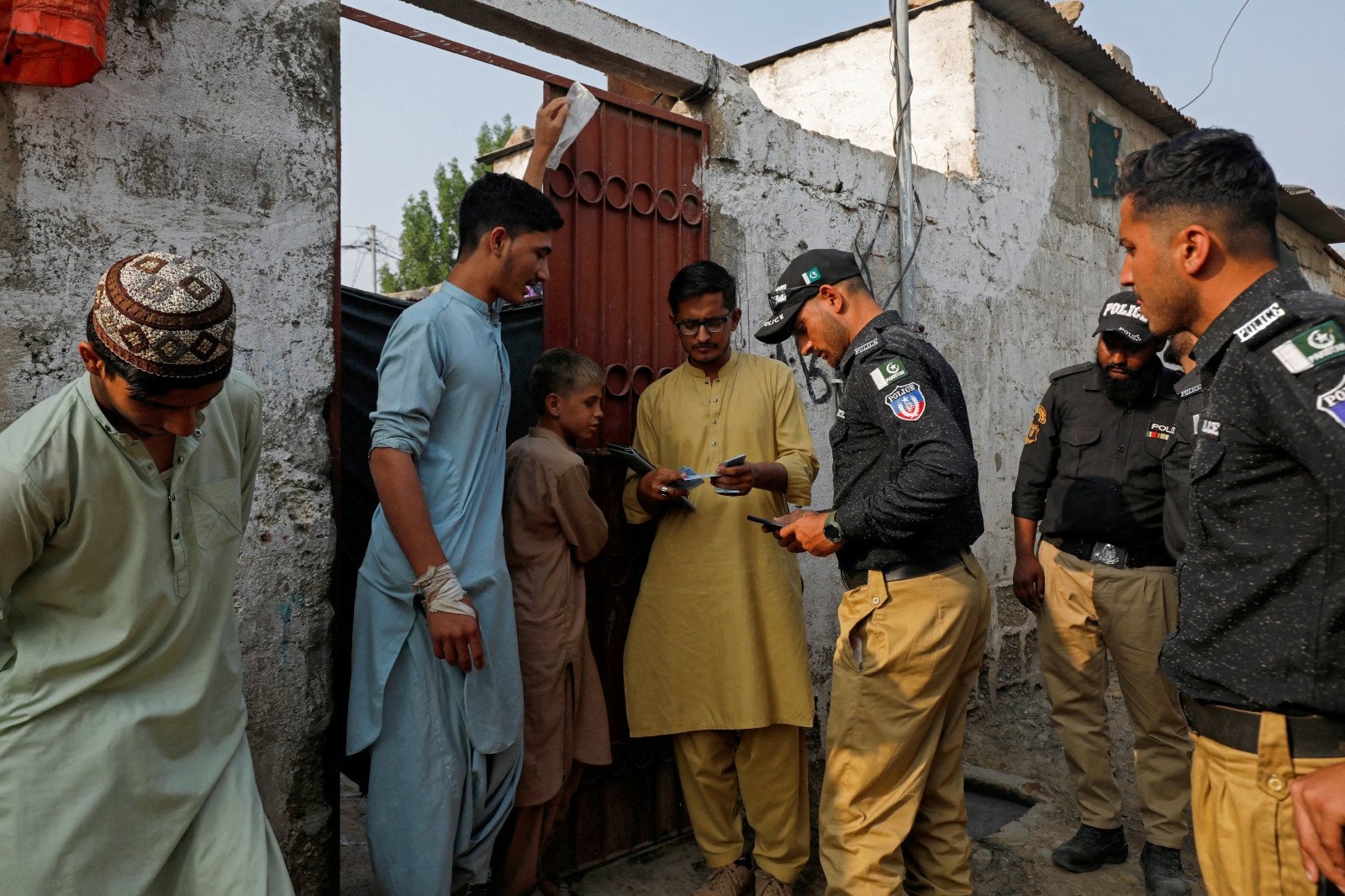
Police officers, along with workers from the National Database and Registration Authority (NADRA), check the identity cards of Afghan citizens during a door-to-door search and verification drive for undocumented Afghan nationals, in an Afghan Camp on the outskirts of Karachi,
The government announced on Friday that it will repatriate Afghan Citizen Card (ACC) holders as part of its ongoing Illegal Foreigners Repatriation Programme (IFRP), which began on November 1, 2023.
In a statement, authorities advised all illegal foreign nationals, including ACC holders, to leave Pakistan voluntarily by March 31. Deportation procedures will commence from April 1 for those who fail to comply.
The government stated that the repatriation process will be conducted in a humane manner, ensuring the dignified return of all affected individuals.
"Sufficient time has been granted for a voluntary return," the statement read, adding, "Arrangements for food and healthcare have also been made for returning foreign nationals."
Pakistan has long been a host to Afghan refugees and continues to uphold its international responsibilities. However, officials reiterated that those wishing to remain in the country must meet legal requirements and abide by Pakistan's constitution.
Under the IFRP, all undocumented foreigners, including Afghans, are being repatriated. Afghan nationals sponsored by European or other foreign countries will not be deported for now, but if their resettlement plans are not finalised soon, they too could face deportation, according to sources from the Ministry of Interior.
As part of the programme, 781 Afghan nationals have already been repatriated from Islamabad via the Torkham border.
ghazi52
THINK TANK: CONSULTANT
- Thread starter
- #70
Kabir flays forced deportations from Iran, Pakistan
The Frontier Post

KABUL (Pajhwok): Acting Minister of Refugees and Repatriation Maulvi Abdul Kabir has urged host countries to implement a systematic mechanism for the return of Afghan refugees instead of forced deportations.
He issued the call at separate meetings with Iranian Ambassador Alireza Bigdeli and Pakistani Ambassador Ubaid Ur Rehman Nizamani in Kabul, the Ministry of Refugees and Repatriation said in a statement.
Maulvi Kabir described Pakistan and Iran as friendly and Muslim neighbouring countries, acknowledging their long-standing hospitality toward millions of Afghan refugees.
He urged the nations to show patience and tolerance in dealing with Afghan refugees.
He added: “Recently, mistreatment of Afghan refugees in Pakistan and Iran has increased. We urge host countries to adhere to international refugee principles and treat Afghans with human and Islamic dignity.”
The acting minister reaffirmed the Islamic Emirate of Afghanistan’s (IEA) commitment to regional stability and economic cooperation.
He reiterated that while the IEA encouraged Afghan refugees to return home, the process must be gradual and well-structured.
“Deporting all Afghan refugees from Pakistan by the end of June is unrealistic, as they cannot gather their entire assets in such a short time,” he argued, calling for joint mechanisms and bilateral or trilateral meetings to address the issue.
Maulvi Kabir added closing the Torkham crossing, engaging in conflicts, or resorting to violence would not address the existing challenges.
He urged immediate steps to reopen the key crossing between Afghanistan and Pakistan.
ghazi52
THINK TANK: CONSULTANT
- Thread starter
- #71
TEHRAN (Amu tv) : Iranian authorities have arrested 250,000 undocumented migrants in Tehran province over the past year, according to the region’s governor, Mohammad Sadeq Motamedian.
Motamedian, speaking to Mehr News Agency, said the deadline for registering undocumented migrants in the country’s census is March 22.
“The policy of the Ministry of Interior remains focused on the deportation and regulation of unauthorized foreign nationals, and we continue our monitoring and control efforts in this regard,” he said.
He added that those who register before the deadline will be officially recognized as “foreign nationals.”
According to Motamedian, the arrests of undocumented migrants have been carried out across various parts of Tehran province, with operations led by Iran’s Law Enforcement Forces (FARAJA) under the supervision of the General Directorate for Foreign Nationals Affairs.
“With the efforts of FARAJA and the leadership of their commanders in Greater Tehran, as well as in the eastern and western parts of the province, these operations have been conducted under direct oversight,” he said.
The arrests come amid broader crackdowns on migrants in Iran and Pakistan, where authorities have intensified deportation efforts in recent months. Many of those affected have spoken out about mistreatment by security forces.
Several migrants told Amo that they have faced harassment, arbitrary detention, and poor treatment by Iranian police and officials. Human rights organizations have raised concerns about the conditions facing those detained and the challenges deported migrants encounter upon returning to their home countries.
Motamedian, speaking to Mehr News Agency, said the deadline for registering undocumented migrants in the country’s census is March 22.
“The policy of the Ministry of Interior remains focused on the deportation and regulation of unauthorized foreign nationals, and we continue our monitoring and control efforts in this regard,” he said.
He added that those who register before the deadline will be officially recognized as “foreign nationals.”
According to Motamedian, the arrests of undocumented migrants have been carried out across various parts of Tehran province, with operations led by Iran’s Law Enforcement Forces (FARAJA) under the supervision of the General Directorate for Foreign Nationals Affairs.
“With the efforts of FARAJA and the leadership of their commanders in Greater Tehran, as well as in the eastern and western parts of the province, these operations have been conducted under direct oversight,” he said.
The arrests come amid broader crackdowns on migrants in Iran and Pakistan, where authorities have intensified deportation efforts in recent months. Many of those affected have spoken out about mistreatment by security forces.
Several migrants told Amo that they have faced harassment, arbitrary detention, and poor treatment by Iranian police and officials. Human rights organizations have raised concerns about the conditions facing those detained and the challenges deported migrants encounter upon returning to their home countries.
ghazi52
THINK TANK: CONSULTANT
- Thread starter
- #72
Police tighten security outside detention centre for Afghan refugees in Rawalpindi
Mohammad Asghar
March 14, 2025
RAWALPINDI: As operations to round up Afghan nationals seeking refuge in Pakistan continue across the district, the police have stepped up security outside a detention centre for Afghan refugees near Golra Mor.
The government has officially set a deadline of March 31 for Afghan Citizen Card (ACC) holders to leave Pakistan voluntarily. However, the process of detaining Afghan nationals, particularly those who do not have documentation, residing in Rawalpindi and Islamabad has been underway.
The Afghans, who are being detained in Rawalpindi, are held at a camp near Golra Mor. Such Afghans, who have proof of residence or cards up to the given period, are being released with an order that they cannot stay within the limits of Rawalpindi or Islamabad. Those without proof are being immediately deported back to Afghanistan.
The Rawalpindi police have also formulated a ‘regular security plan’ for the Golra Mor camp, where a team of 40 officials headed by an SP has been deployed. The police have been deployed around the detention centre round the clock to ensure security, and the road in front of the detention centre has been declared a ‘red zone’ (highly sensitive area).
820 Afghan nationals detained over the past week, 140 immigrants detained at camp
The police personnel deployed at the camp have been performing duties in three shifts, and CCTV cameras have also been installed to monitor the camp besides barbed wire and lighting arrangements. Complete details and records of every Afghan resident found in the camp are being compiled, while the use of mobile phones inside the camp has also been banned.
According to security sources, the Rawalpindi police have rounded up about 820 Afghan nationals from different parts of the garrison city over the past week and have extradited 114 so far. 140 Afghan nationals are still detained at the camp under tight security due to a lull in deportations. It has been learned that due to the closure of the border for the past few days, the process of deporting Afghans has also stopped.
Meanwhile, the Rawalpindi district police sought affidavits from all Afghan nationals either working or residing in the district – even though they legally have to leave the twin cities by March 31 as per a government deadline.
A senior police officer said that the government has set a deadline of March 31 for Afghan residents. No direct operation is underway regarding Afghan residents yet, the officer claimed. However, 140 illegal Afghan residents are present in the camp in Rawalpindi, who could not be deported back due to the closure of the border in recent days.
Distant_Observer
Trusted Member
I am not hearing of any captures in Karachi. Surely there are many there. PPP is just so lazy 
ghazi52
THINK TANK: CONSULTANT
- Thread starter
- #74
Govt to intensify crackdown on illegal foreign nationals
Iftikhar A. Khan
June 1, 2025
ISLAMABAD: The government has decided to ramp up operations against foreign nationals unlawfully residing in Pakistan, a month after the expiry of a deadline set for around 44,000 Afghan nationals approved for relocation to a third country.
The decision was taken at the third meeting of the Counter-Terrorism Committee and Harden the State Committee held here under the chairmanship of Interior Minister Mohsin Naqvi on Saturday.
The government had already announced it would deport thousands of Afghan refugees awaiting resettlement in the West if the prospective host countries didn’t relocate them by April 30. Tens of thousands of Afghans came to Pakistan fearing retribution after the Taliban returned to power in Afghanistan in August 2021, following the withdrawal of US-led forces.
An official told Dawn that so far 1.023 million Afghans had been repatriated. He said 135,865 had been repatriated in April and another 65,057 in May. On May 30 alone, 1,483 individuals had been repatriated.
Naqvi asks all institutions to coordinate for implementation of one-document regime
Speaking on the occasion, the interior minister said the federal and provincial agencies must coordinate their efforts to eliminate the illegal spectrum undermining national security, emphasising that all institutions must work together to fully implement the “one-document regime”.
He said that Nadra would provide live data verification facilities at exit points.
Referring to the beggar mafia, Mr Naqvi said they must be dealt with strictly as they were tarnishing the country’s image. He highlighted the need to declare begging a non-bailable offence.
As a nationwide crackdown on power theft continues, the meeting was informed by a representative of the power division that Rs142 billion was recovered with the cooperation of the interior ministry and provincial governments. The minister said every possible support was being provided to the Ministry of Energy and provincial governments to prevent electricity theft.
The meeting also reviewed progress on anti-encroachment operations.
Regarding maintenance of law and order, the meeting was briefed that more than 250 intelligence-based operations were being conducted on a daily basis.
It also reviewed progress on the establishment of the Pakistan Port Authority, ‘Gwadar Safe City Project’, besides the construction of a protection wall was also discussed.
ghazi52
THINK TANK: CONSULTANT
- Thread starter
- #75
Government of Pakistan
Ministry of Interior
Illegal Foreigners Repatriation Plan:
 In continuation of IFRP, all illegal foreigners are being repatriated & deported to their countries.Repatriation of Afghan Citizenship Card holders alongside unregistered, illegal foreigners commenced since 1 April 2025.
216,103 x illegal foreigners have been repatriated since 1st April 2025 and the drive continues.
Under the ambit of IFRP since October 2023, 1,102,441 illegal foreigners have been repatriated.
All illegal foreigners including Afghan Nationals are once again advised to leave the country voluntarily.
Returnees to their respective countries; including women, children and elderly are being treated with dignity. Arrangements for food and healthcare for returning foreigners are already in place.
Defaulters who are creating hurdles in repatriation process or found involved in extending employment, rental property, accommodating in hotels or engaging in businesses with illegal foreigners are liable to be dealt strictly as per laws.
Ministry of Interior
Illegal Foreigners Repatriation Plan:
In continuation of IFRP, all illegal foreigners are being repatriated & deported to their countries.Repatriation of Afghan Citizenship Card holders alongside unregistered, illegal foreigners commenced since 1 April 2025.216,103 x illegal foreigners have been repatriated since 1st April 2025 and the drive continues.Under the ambit of IFRP since October 2023, 1,102,441 illegal foreigners have been repatriated.All illegal foreigners including Afghan Nationals are once again advised to leave the country voluntarily.Returnees to their respective countries; including women, children and elderly are being treated with dignity. Arrangements for food and healthcare for returning foreigners are already in place. Defaulters who are creating hurdles in repatriation process or found involved in extending employment, rental property, accommodating in hotels or engaging in businesses with illegal foreigners are liable to be dealt strictly as per laws.Users who are viewing this thread
Total: 2 (members: 0, guests: 2)
Pakistan Defence Latest

Country Watch Latest

Latest Posts
-

-
-
 SmartCar: Android Auto/Google Assistant available in 45+ countries, Apple CarPlay/Siri now available in 36+ countries - Updates and discussion (6 Viewers)
- Latest: Hamartia Antidote
-
 Netflix now available in 190+ countries with over 280M subscribers - Updates and Discussion (7 Viewers)
- Latest: Oscar