Trump and Harris are deadlocked - could an October surprise change the game?
Anthony Zurcher
North America correspondent•
@awzurcher
Reuters
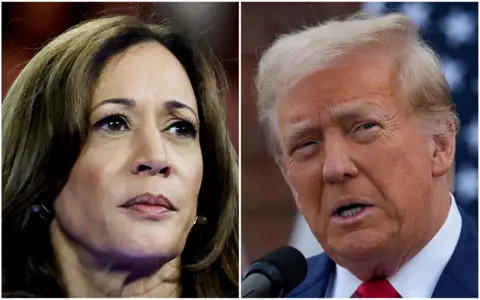
With one month to election day, the contest between Donald Trump and Kamala Harris is the electoral equivalent of a bare-knuckle brawl.
The race for the White House still appears deadlocked, both nationally and in battleground states, so victory will be decided by the slimmest of margins - every new voter engaged, every undecided voter swayed, could help land a knock-out punch.
“In any super close race, where the electorate is divided down the middle, a difference of a percentage point or two could be decisive,” says David Greenberg, a presidential historian at Rutgers University.
While party strategists are focused on how to earn that decisive edge, it could just as easily be an event out of their control, an unexpected twist, that upends the campaign in the final weeks.
It’s already been a year of political shockwaves - from one candidate surviving two assassination attempts and being convicted of a crime, to another, President Joe Biden, dropping out of the race in favour of his much younger vice-president.
However, when the surprises drop in October - think Trump’s Access Hollywood tape or Hillary Clinton’s emails in 2016 - there is scarcely time left to recover or regain momentum after a misstep or bad news cycle.
This week alone, there were several new rumbles that could turn into political storms by 5 November.
Helene’s political fallout
Getty Images
North Carolina, which has been devastated by Hurricane Helene, is a must-win state for Trump
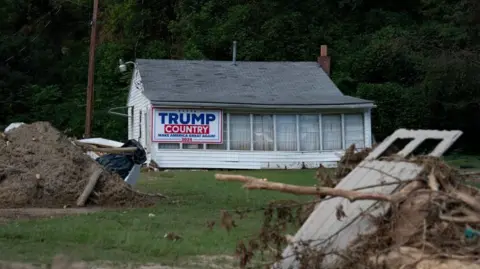
The first potential political storm was a literal one. Hurricane Helene tore through two key electoral battlegrounds last week, Georgia and North Carolina. Because of the intense focus on both states during this presidential race, a humanitarian disaster, with a death toll already over 200,
has also become a political issue.
Harris pledged long-term aid to the region at a stop in Georgia earlier this week, and visited those affected by the storm in North Carolina on Saturday.
"We're here for the long haul," she said in Georgia.
Meanwhile, both states are essentially must-wins for Trump, and polls show a dead heat. While visiting Georgia, the former president claimed that Americans were losing out on emergency relief money because it had been spent on migrants. In fact, the two distinct programmes have separate budgets, and the Biden administration accused Republicans of spreading "bold-faced lies" about funding for the disaster response.
When disaster strikes, it's not easy for the government to keep everyone happy. If Trump’s attacks land, any voter dissatisfaction with recovery efforts could potentially impact the result in two of the most closely-watched states in the country.
Escalation in the Middle East
Thousands of miles from the disaster-ravaged American southeast, a manmade crisis continues to inject itself into American politics. The Gaza war is in danger of expanding into a regional conflagration, as Israeli forces fought Hezbollah forces in southern Lebanon and Iran launched hundreds of missiles at Israel earlier this week.
While Harris has presented herself as a candidate of change, she put no distance between herself and the current administration when it comes to US-Israeli policies. That comes with risks.
Hopes for any kind of pre-election ceasefire in Gaza appear firmly dashed, and the White House at this point is trying to ensure that the inevitable Israeli response to Tuesday’s Iranian strike doesn’t lead to all-out war.
On Thursday night, Biden was not exactly reassuring.
“I don’t believe there’s going to be an all-out war,” he said. “I think we can avoid it. But there’s a lot to do yet.”
The war is also having consequences at home for Democrats, even if American voters usually don’t think directly about foreign policy when they cast their ballots.
Harris’s commitment to continue supplying arms to Israel is a problem for two key segments of the Democratic base: Arab-Americans in the must-win state of Michigan, and young voters on campuses, where anti-war protests could start up again.
The conflict in the Middle East has also fuelled pocketbook concerns. Biden’s mention of the possibility that Israel would target Iranian refineries
caused the price of oil to jump more than 5% on Thursday.
If there’s one thing that American consumers are particularly sensitive to, it's higher prices at the petrol pump.




 France stopped UAE to deploy its Rafales against Azeri JF-17 Block 3 in Falcons Meet 2026 war drills (44 Viewers)
 India explores China’s Hotan corridor as Pakistan airspace ban drags on (10 Viewers)