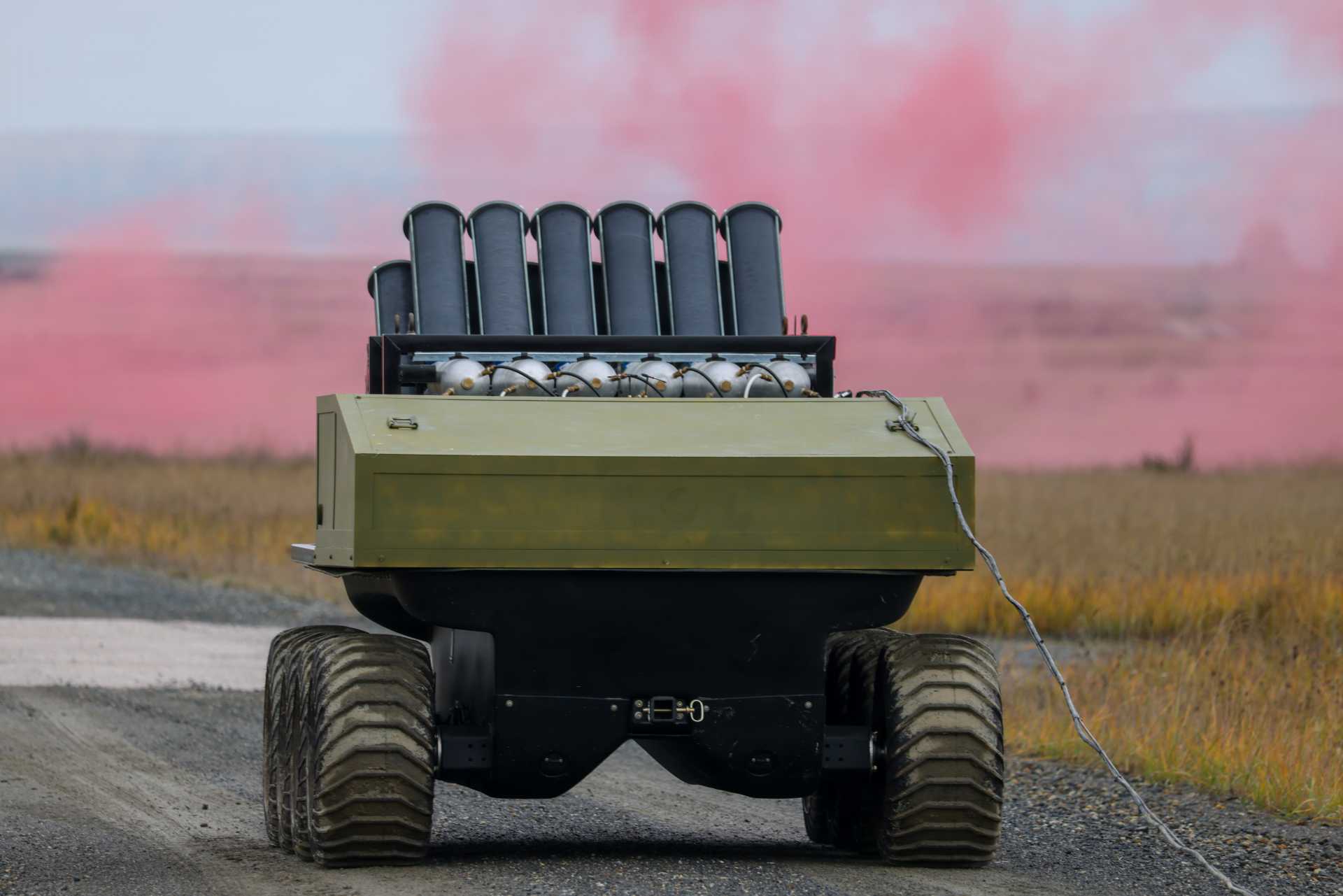
On November 12, 2026, the U.S. Army launched an 18-drone autonomous swarm from a R3NEGADE UGV emerging from a shipping container during a live-fire technology demonstration at Grafenwoehr Training Area in Germany. Conducted by the DEVCOM Armaments Center, U.S. Army Europe and Africa, and the 7th Army Training Command under the Remote Rapid Response Autonomous Contingency Team (R3ACT), the exercise also deployed an HIV3 swarm launcher, a Javelin-armed R3NEGADE, TRV-150 smoke-deployment drones, FPV attack drones, and a TRV-400 carrying the developmental FIR3FLY anti-armor payload. Supporting NATO's Eastern Flank Deterrence Initiative and the Army's October 2026 How the Army Fights operational framework, the trial evaluated how containerized, pre-positioned robotic weapons can deliver distributed strikes while reducing soldier exposure and sustaining logistics.

The U.S. Army conducted a live-fire technology demonstration at Grafenwoehr Training Area in Germany on November 12, 2026, deploying an 18-drone autonomous swarm from a containerized R3NEGADE unmanned ground vehicle. (Picture source: US Army)
Key Tactical Insights:
- Containerized Drone Swarm and Armed UGVs: Under the Remote Rapid Response Autonomous Contingency Team (R3ACT) effort, a R3NEGADE UGV emerged from a standard 20-foot shipping container to launch 18 FPV drones via an HIV3 swarm launcher. A second R3NEGADE operated twin Javelin anti-tank missile launchers, participating alongside TRV-150 smoke-deployment drones, a TRV-400 carrying the developmental FIR3FLY anti-armor payload, and 173rd Airborne Brigade FPV operators.
- Doctrinal Alignment (How the Army Fights): The demonstration directly addressed the Strike and Endurancepillars of the Army's October 2026 How the Army Fights operational framework. By pairing lower-cost, expendable unmanned systems with conventional precision weapons, the service is evaluating methods to sustain prolonged combat operations and expand commanders' tactical options.
- NATO Eastern Flank Deterrence:Conducted in support of the Eastern Flank Deterrence Initiative (EFDI), the trial tested how remotely activated,pre-positioned weapon systems can reinforce deterrence and integrate low-cost uncrewed capabilities across NATO's eastern frontier.
- Acquisition and Procurement Status: Army officials confirmed that the Grafenwoehr exercise was a technology evaluation with no announced procurement decision or fielding timeline for the R3ACT, R3NEGADE, HIV3, or FIR3FLY platforms. However, under the newly established U.S. Army Futures and Autonomous Systems Command (FASCOM), the service is targeting priority autonomous capabilities for acquisition by fiscal year 2028.
On November 12, 2026, the U.S. Army conducted a live-fire demonstration at the Grafenwoehr Training Area in Bavaria, Germany, during which a R3NEGADE unmanned ground vehicle (UGV) emerged from a shipping container and launched an 18-drone swarm that conducted a coordinated autonomous strike against a target. Organized by the DEVCOM Armaments Center, U.S. Army Europe and Africa, and the 7th Army Training Command, the exercise also involved TRV-150 and TRV-400 drones, a second R3NEGADE carrying Javelin anti-tank missiles and FPV drones operated by the 173rd Airborne Brigade. Supporting the Eastern Flank Deterrence Initiative (EFDI), the demonstration examined how remotely positioned weapons could conduct coordinated attacks while reducing soldiers' exposure.
It also followed the October 7 introduction of the How the Army Fights framework, developed under Gen. Christopher C. LaNeve, which organizes U.S. Army operations into four operational priorities: Convergence, Strike, Close Battle, and Endurance. The demonstration consequently addressed two connected requirements: increasing the number of weapons available for distributed attacks and establishing the organizational, logistical, and industrial arrangements needed to sustain their employment during prolonged operations. The principal engagement involved a R3NEGADE emerging from a shipping container before launching 18 FPV drones through its HIV3 swarm launcher, following smoke deployment by a TRV-150 drone.
U.S. Army launches an 18-drone swarm from a containerized R3NEGADE unmanned ground vehicle with an HIV3 launcher in Germany on Nov. 12, 2026, alongside Javelin-armed robots and TRV-150 drones under the R3ACT program and NATO's Eastern Flank Deterrence Initiative.

www.armyrecognition.com
US Army UGV launching 18 one way attack drone swarm