Real GDP was revised up 0.5 percentage point from the second estimate, primarily reflecting a downward revision to imports, which are a subtraction in the calculation of GDP, that was partly offset by a downward revision to consumer spending. For more information, refer to the "Technical Notes" below.
Real gross domestic product (GDP) increased at an annual rate of 2.1 percent in the first quarter of 2026 (January, February, and March), according to the third estimate released today by the U.S. Bureau of Economic Analysis.
www.bea.gov
US GDP has been revised up to 2.1% in the final Q1 estimate. Very strong growth
Real GDP was revised up 0.5 percentage point from the second estimate, primarily reflecting a downward revision to imports, which are a subtraction in the calculation of GDP, that was partly offset by a downward revision to consumer spending. For more information, refer to the "Technical Notes" below.
Real gross domestic product (GDP) increased at an annual rate of 2.1 percent in the first quarter of 2026 (January, February, and March), according to the third estimate released today by the U.S. Bureau of Economic Analysis.
www.bea.gov
US GDP has been revised up to 2.1% in the final Q1 estimate. Very strong growth
ZeroHedge - On a long enough timeline, the survival rate for everyone drops to zero
www.zerohedge.com
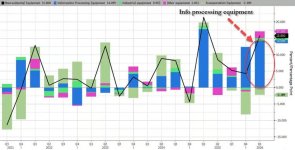
While IP is clear - it consists primarily of Software, the kind that one uses to create and develop AI tools, as well as R&D - the components behind Nonresidential equipment need a closer look again, and here we find that Information Processing equipment, i.e., data centers, grew at a stunning 14%, comprising virtually all of the 0.81% contribution to 2.1% GDP growth.
And there you have it: between Software (0.74% of the GDP growth) and Nonresidential Equipment (0.81%), AI - which was the primary driver behind growth in both - contributed just over 1.5% to GDP growth of 2.1%; in other words about 74% of all US growth in Q1 was due to AI.
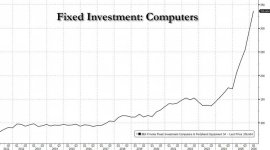
Another way to visualize the remarkable impact of spending on "computers" is the chart below: it clearly shows just how reliant the US has become on spending on computer products.
ZeroHedge - On a long enough timeline, the survival rate for everyone drops to zero
www.zerohedge.com
While IP is clear - it consists primarily of Software, the kind that one uses to create and develop AI tools, as well as R&D - the components behind Nonresidential equipment need a closer look again, and here we find that Information Processing equipment, i.e., data centers, grew at a stunning 14%, comprising virtually all of the 0.81% contribution to 2.1% GDP growth.
And there you have it: between Software (0.74% of the GDP growth) and Nonresidential Equipment (0.81%), AI - which was the primary driver behind growth in both - contributed just over 1.5% to GDP growth of 2.1%; in other words about 74% of all US growth in Q1 was due to AI.
Another way to visualize the remarkable impact of spending on "computers" is the chart below: it clearly shows just how reliant the US has become on spending on computer products.
For car shoppers who want to buy an American-made vehicle, Cars.com’s American-Made Index analyzes five major factors to determine just how American your prospective car or truck might be.
Nearly 400 vehicles from the 2026 model year were studied to arrive at the 86 vehicles on the 2026 American-Made Index. (Note that base nameplates make up the core ranking of 86; additional variants grouped under an overall nameplate can be found in the rankings beyond that.)
This year marks the index's 21st anniversary, which offers another opportunity to reflect on how automotive manufacturing has evolved over time. And find out where the hundreds of vehicles that didn't make Cars.com's 2026 American-Made Index are manufactured.
Good going Ford and GM...just where I expected you to be...MIA from the top 10.
For car shoppers who want to buy an American-made vehicle, Cars.com’s American-Made Index analyzes five major factors to determine just how American your prospective car or truck might be.
Nearly 400 vehicles from the 2026 model year were studied to arrive at the 86 vehicles on the 2026 American-Made Index. (Note that base nameplates make up the core ranking of 86; additional variants grouped under an overall nameplate can be found in the rankings beyond that.)
This year marks the index's 21st anniversary, which offers another opportunity to reflect on how automotive manufacturing has evolved over time. And find out where the hundreds of vehicles that didn't make Cars.com's 2026 American-Made Index are manufactured.
Hmm, but some Ford/GM cars are assembled in the US with domestic suppliers. Same with the Korean makers. I think this may be one of those "paid for" articles.
The Democrats are split, with the Democrat Socialists (commies) taking over the party. There are some good op-eds out there explaining this.
The last time the Democratic Party was this split, on ideology, was back in 1860.
One can argue the 1968 Chicago Democratic convention.
Democratic socialists are coming for 2028
The group is asking members across all 250 chapters to weigh who they want to back in the next presidential election and why, according to a plan first shared with POLITICO.
This site uses cookies to help personalise content, tailor your experience and to keep you logged in if you register.
By continuing to use this site, you are consenting to our use of cookies.