mythbuster
Trusted Member

Back channels have gone haywire , war if not stopped may lead to a bigger catastrophe than what we are anticipating.
Follow along with the video below to see how to install our site as a web app on your home screen.
Note: This feature may not be available in some browsers.

It doesn't matter one tiny bit
Oil is a commodity, just like gas and urea
Once supply is cut, demand across the world sky rockets, that forces prices up and then states start to go into deficit followed by crises
The U.S because of its idiocy has created a crises
What's more IRAN KNOWS IT, and iran will fight tooth and nail to keep the Hormuz closed, hit and destroy U.S bases and presence in the region
But because the economic consequences of Hormuz closure are so bad for multiple states, the pressure for ceasefire and end to the conflict are immense
But the pressure is on the U.S, that's why they are behaving erratic with all these threats and firing of your generals
Now your planning a physical invasion of a state of 93 million people, who can fight back, thousands of miles away from the U.S, after getting rid of multiple military high ranking officers who objected to your lunacy
The Zionists have actively destroyed U.S primacy in the world for their own gain, you should have been aware of their games

But that isn't an existential crisis specifically for the US...that's for almost everybody.

How so? Are you talking about Orangeman deciding to strike Iran's energy sector?Back channels have gone haywire , war if not stopped may lead to a bigger catastrophe than what we are anticipating.
That's within the domain of anticipationHow so? Are you talking about Orangeman deciding to strike Iran's energy sector?
 ....I am keeping my fingers crossed and my mouth shut.
NOOOO! How dare you tease me as if you're some hot chic.That's within the domain of anticipation

Hold your breath ! I will ask you out for a dinner in GalacticaNOOOO! How dare you tease me as if you're some hot chic.

I am interested in the US perspective on this apparent hypocrisy

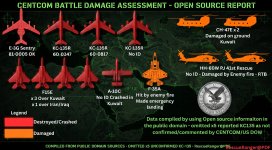
i am sure it was 2 a10s
I have only confirmed the ones that have been mentioned in CENTCOM reports.i am sure it was 2 a10s
one crashed in kuwait/iraq ( first they said it got dameged and landed )
second crashed in the gulf
Something for you to ponder upon ! WTI crude ( Texas crude) was historically 4 to 5 dollars cheaper than Brent crude and now it's 2 dollars more than Brent crude.The Iran War Is Making the American Economy More Dominant Than Ever
We cannot permit a resource so vital to be dominated by one so ruthless. And we won’t.”—George H.W. Bush, 1990, on Saddam Hussein’s invasion of Kuwait
“Go get your own oil!”—Donald Trump, March 31, 2026, on Iran’s closure of the Strait of Hormuz
President Trump didn’t attack Iran to help the U.S. economy at the expense of its allies. Nonetheless, that is more or less what has happened.
Despite high gasoline prices, the U.S. economy is holding up. Abroad, though, interest rates and inflation risks have shot up, fuel is being conserved, and economic forecasts are darkening.
Economists at Citi have marked down the eurozone’s growth this year by 0.4 percentage point, the United States’ by just 0.1 point. The reason: Net imports of oil and liquefied natural gas consume 1% to 2% of European gross domestic product, whereas net exports contribute 0.2% to U.S. output.
These figures help explain why Trump is prosecuting war in the Persian Gulf differently from his predecessors. His strategic motives aren’t that different: to deny a hostile power the means to dominate the region, and to protect Israel.
Where Trump differs is in the economics. Past presidents believed that the free flow of oil was one of those global public goods that the U.S. was uniquely equipped, even obliged, to safeguard.
George H.W. Bush made the case in 1990 for pouring troops into the Gulf region not just to free Kuwait from a dangerous dictator’s clutches, but to deny him control over 20% of the world’s oil reserves.
“There is no substitute for American leadership,” he told Congress that September. “There will be a lasting role for the United States in assisting the nations of the Persian Gulf.”
By contrast, Trump, in remarks to the nation Wednesday evening, sounded indifferent to whether the Strait of Hormuz reopened: “The United States imports almost no oil through the Hormuz Strait and won’t be taking any in the future.” Those who do, he said, should buy more from the U.S.—“We have plenty”—and take the lead on reopening the strait.
Trump’s revamping of the U.S. role in world security and trade now extends to oil. No longer does the U.S. see itself as the guarantor of international stability and norms, but rather as a self-interested actor using control of oil to enhance its own power.
The U.S. became an energy superpower through serendipity and policy. The shale revolution vastly increased domestic oil and gas production, while federal and state policy and the construction of liquefied natural gas (LNG) facilities made that output available to the world.
In the process, oil and gas became key contributors to U.S. economic growth and prestige. The U.S. earns more from exports of LNG than of corn and soybeans, and twice as much as it does on movie and TV content, S&P Global reports.
Fossil fuels are foundational to Trump’s vision not just of domestic prosperity but international clout. He created a National Energy Dominance Council shortly after taking office, and his National Security Strategy, issued last November, calls “American energy dominance” a “top strategic priority.”
When U.S. forces captured Venezuelan strongman Nicolás Maduro in January, the benefit was twofold. A regime that had challenged U.S. hegemony in the Western Hemisphere was pacified, and the U.S. gained de facto control of a major source of oil. Trump has already used that control to restrict cargoes to Cuba in hopes of changing its leadership.
The European Union once depended on Russia for 45% of its natural-gas imports. Russia weaponized that dependence by withholding supplies after its full-scale invasion of Ukraine in 2022. At enormous cost, Europe pivoted to safer alternatives. The U.S. now supplies 57% of the EU’s LNG imports, according to the Institute for Energy Economics and Financial Analysis.
In the wake of Trump’s threats to seize Greenland and leave the North Atlantic Treaty Organization, Europeans may wonder whether they have simply swapped one geopolitical vulnerability for another. Trump suggested he might impose a trade embargo on Spain for refusing to let American forces use its bases to attack Iran. Analysts said a loss of U.S. LNG would be costly for Spain, but also unlikely. The EU could retaliate.
Trump may have initially hoped the Iranian regime, like Venezuela’s, would quickly fold, giving up its nuclear ambitions in return for sanctions relief. Conceivably, Trump may have gained some say over Iranian oil, as he did with Venezuela’s. With those two countries pacified, the threat to the world’s oil market of geopolitical instability would fall.
That may yet come to pass. Its military decimated and nuclear ambitions under rubble, the regime may yet make peace. And if it doesn’t, the strait may yet be reopened by force: American troops are pouring into the region and other countries are discussing how to reopen the strait. For all Trump’s talk of leaving control of the strait in Iranian hands, that would contradict what his own National Security Strategy deemed a core national interest.
Even if U.S. control of global oil and gas expands—either because of forgone Gulf supplies or its control of Iranian shipments—economic reality limits how useful that is geopolitically. “To be really dominant you have to have low costs, and we don’t,” said veteran oil analyst Philip Verleger.
Trump has few obvious levers to compel private producers to withhold supply, and in any case that would be contrary to his domestic priority of keeping prices low.
Other countries became eager customers of U.S. oil and gas thanks to a reputation for reliability built up before Trump’s second term. Weaponize that relationship and they will look for alternatives. Just ask Russia.
Source:WSJ