Navigation
Install the app
How to install the app on iOS
Follow along with the video below to see how to install our site as a web app on your home screen.
Note: This feature may not be available in some browsers.
More options
Style variation
You are using an out of date browser. It may not display this or other websites correctly.
You should upgrade or use an alternative browser.
You should upgrade or use an alternative browser.
US Perspective on the Iran - Israel / US War
- Thread starter AZ_HighCountry
- Start date
More options
Who Replied?


RescueRanger
Meme Lord

VCheng
THINK TANK: CONSULTANT

Going to be a tough week.
Sounds about right, for just about every week that begins these days, sadly.

F-22Raptor
Elite Member

Musings
Administrator
Rubio: Genocide is an Iranian specialty!
Question to Foreign Minister Rubio: "What do you think of the Iranian Foreign Minister's accusation that the United States and Israel are committing genocide?"Minister Rubio: "The Iranian? He's an expert in genocide. They've killed thousands. All the problems in the Middle East are made by Iran."
Lets ignore the fact 1000s of children have been targeted - the world organisations have accepted and registered a genocide in Palestine - a school in Iran was struck and over 150 children died - Syria Libya Iraq have been decimated by the USA - yet they believe Iran is the problem?
F-22Raptor
Elite Member
This is Why the U.S. Does Not Need a Fast Deal With Iran.
The United States has no urgency to cut a deal with Iranbecause the economic and strategic balance of power has tilted decisively in Washington’s favor: Iran is suffering a historic collapse in oil revenues, inflation at World War II levels, and a currency in free fall, while the U.S. is growing, creating jobs, and exporting record volumes of oil and gas.
Iran’s current crisis combines three shocks: corruption and regime mismanagement, war-related damage, and the U.S.-led blockade on crude exports. Oil exports have plunged from around 1.3–1.9 million barrels per day in early 2026 to roughly 0.2–0.26 million barrels per day in May, the lowest level in at least six years, wiping out about 1 million barrels per day of sales. At an oil price near 80 dollars, that implies a loss of roughly 2.5 billion dollars per month in hard‑currency revenue, starving the regime of its main funding source.
Year‑on‑year inflation reached 77.2% in May, a rate Iran has not seen since 1942, with prices of everyday essentials like medicine, taxi fares, and communication fees rising by more than 113% over the year. The rial has collapsed from about 32,000 per dollar in 2015 to over 1.7 million per dollar on the street, effectively destroying household savings and any nominal anchor for the economy. Private analysts and Tehran‑based economists warn that inflation could approach or exceed 80%, a level society “cannot tolerate” for long without social explosion.
Iran is not just suffering high inflation; it is bleeding capital and human wealth. Independent research shows capital flight has multiplied five‑fold in the past three years, as firms and wealthy households move money and assets abroad to escape sanctions risk, confiscation, and the collapse of the rial. This outflow erodes the tax base, depresses investment, and accelerates deindustrialization, turning a cyclical crisis into a structural decline.
The exchange rate tells the same story of lost confidence. A currency that once traded at 32,000 rials per dollar now trades at roughly 1.7 million, a devaluation of more than 95%, which raises the domestic price of every imported input and consumer good. In such an environment, any attempt at monetary stabilization is quickly undermined by expectations of further depreciation, dollarization of savings, and the exodus of capital and skilled workers. Past bouts of inflation and fuel-price shocks already triggered deadly protests; today’s far worse macro conditions leave the regime facing chronic social fragility.
Facing protests and the risk of unrest, the regime has resorted to cutting internet access and threatening, or partially enforcing, closures around the Strait of Hormuz. Shutting down the internet is a clear sign of weakness: it immediately disrupts commerce, finance, logistics, and basic services, magnifying the economic contraction while openly admitting the regime fears its citizens more than external enemies. The crackdown jeopardizes any chance of domestic private-sector recovery, as no investor can function in an environment where authorities can arbitrarily sever digital connectivity.
At the same time, weaponizing Hormuz via blockades or threats has backfired. U.S. naval actions and allied coordination have allowed Washington to impose a de facto blockade on Iranian crude while keeping global flows from other Gulf producers largely protected or rerouted. Dozens of millions of barrels of Iranian crude now sit stranded in floating storage in the Gulf and the Gulf of Oman, and if the blockade remains, Iran may soon run out of oil it can physically move to China, its last major buyer. Tehran’s strategic choke point has transformed into a vulnerability that the U.S. is leveraging to intensify financial pressure without resorting to military action against the Iranian mainland.
While Iran’s economy contracts under hyperinflation and collapsing exports, the U.S. macro picture is comparatively solid. Latest data show U.S. real GDP expanding at an annualized 3%, with private consumption and services activity strengthening in the latest ISM readings, strong job creation, and real net wages rising. Furthermore, the U.S. is now a global net energy exporter, with crude oil and liquefied natural gas exports hovering near record levels. High prices linked to Middle East disruptions hurt consumers but simultaneously boost U.S. export revenues, investment in shale and LNG infrastructure, and geostrategic leverage as Europe and Asia seek non‑Russian and non‑Iranian supply. In other words, the same blockade that devastates Iran’s budget improves the bargaining position of the U.S. by tightening global supply while redirecting demand toward American barrels.
Iran’s attempt to shut down Hormuz to everyone except itself and ban the internet did not project strength; it exposed how fragile and cornered the regime really is. A confident, resilient economy does not need to cut its access to trade routes and information to survive; only a regime afraid of its people and its vulnerabilities does that.
Iran today is the textbook definition of a macroeconomic and strategic trap. It is in a deep recession, with output contracting under the weight of sanctions, war risk, and a collapsing export base. Inflation in daily essentials, running at around 113.8% year-on-year, means that food, transport, medicines, and communications become unaffordable for large parts of the population in a matter of months. The currency has effectively disintegrated: the rial’s collapse is not just a market signal; it is a vote of no confidence by Iranian citizens and firms in their authorities’ ability to preserve basic purchasing power. On top of these developments, oil exports—the regime’s main hard-currency lifeline—are plummeting under blockade pressure.
Contrast that with the United States. Real GDP is still growing at about 2.6% year over year, and the Atlanta Fed’s nowcast is tracking close to 3% annualized growth. Wages are rising, the labor market remains tight by historical standards, and U.S. energy exports—both oil and gas—are at or near record levels. In other words, the same environment that is crushing Iran is one in which the U.S. economy can still expand, finance its deficits at scale, and benefit from higher energy prices through increased export revenues.
That is why the idea, pushed by some X trolls, that “this is Iran winning” is so detached from reality. Winning is not shutting yourself out of global markets, destroying your currency, suffering triple-digit inflation in essentials, and relying on repression and internet blackouts to contain social unrest. “Winning” is being in a position where your economy grows, your currency is the world’s reference asset, and your energy exports are indispensable to allies. By any serious macroeconomic and strategic metric, Iran’s latest moves only confirm its weaknesses and why the U.S. is in no hurry whatsoever to grant it relief.
Given this evidence, Washington has little incentive to rush into a deal that would relieve pressure on Tehran. The longer the blockade and sanctions regime remain in force, the more Iran’s fiscal position deteriorates, the more its inflation spirals, and the weaker its negotiating hand becomes. From a U.S. strategic standpoint, time is an asset: Iran burns reserves, loses export capacity, and faces rising protest risk, while the U.S. economy strengthens and energy production and exports reach record highs.


AZ_HighCountry
INT'L MOD
- Thread starter
- #4,237
Most of them are too busy spreading their own lies on behalf of the Democrats.
AZ_HighCountry
INT'L MOD
- Thread starter
- #4,238
A Spanish-based Internet blogger whose opinion aligns with your own.This is Why the U.S. Does Not Need a Fast Deal With Iran.
The United States has no urgency to cut a deal with Iranbecause the economic and strategic balance of power has tilted decisively in Washington’s favor: Iran is suffering a historic collapse in oil revenues, inflation at World War II levels, and a currency in free fall, while the U.S. is growing, creating jobs, and exporting record volumes of oil and gas.
Iran’s current crisis combines three shocks: corruption and regime mismanagement, war-related damage, and the U.S.-led blockade on crude exports. Oil exports have plunged from around 1.3–1.9 million barrels per day in early 2026 to roughly 0.2–0.26 million barrels per day in May, the lowest level in at least six years, wiping out about 1 million barrels per day of sales. At an oil price near 80 dollars, that implies a loss of roughly 2.5 billion dollars per month in hard‑currency revenue, starving the regime of its main funding source.
Year‑on‑year inflation reached 77.2% in May, a rate Iran has not seen since 1942, with prices of everyday essentials like medicine, taxi fares, and communication fees rising by more than 113% over the year. The rial has collapsed from about 32,000 per dollar in 2015 to over 1.7 million per dollar on the street, effectively destroying household savings and any nominal anchor for the economy. Private analysts and Tehran‑based economists warn that inflation could approach or exceed 80%, a level society “cannot tolerate” for long without social explosion.
Iran is not just suffering high inflation; it is bleeding capital and human wealth. Independent research shows capital flight has multiplied five‑fold in the past three years, as firms and wealthy households move money and assets abroad to escape sanctions risk, confiscation, and the collapse of the rial. This outflow erodes the tax base, depresses investment, and accelerates deindustrialization, turning a cyclical crisis into a structural decline.
The exchange rate tells the same story of lost confidence. A currency that once traded at 32,000 rials per dollar now trades at roughly 1.7 million, a devaluation of more than 95%, which raises the domestic price of every imported input and consumer good. In such an environment, any attempt at monetary stabilization is quickly undermined by expectations of further depreciation, dollarization of savings, and the exodus of capital and skilled workers. Past bouts of inflation and fuel-price shocks already triggered deadly protests; today’s far worse macro conditions leave the regime facing chronic social fragility.
Facing protests and the risk of unrest, the regime has resorted to cutting internet access and threatening, or partially enforcing, closures around the Strait of Hormuz. Shutting down the internet is a clear sign of weakness: it immediately disrupts commerce, finance, logistics, and basic services, magnifying the economic contraction while openly admitting the regime fears its citizens more than external enemies. The crackdown jeopardizes any chance of domestic private-sector recovery, as no investor can function in an environment where authorities can arbitrarily sever digital connectivity.
At the same time, weaponizing Hormuz via blockades or threats has backfired. U.S. naval actions and allied coordination have allowed Washington to impose a de facto blockade on Iranian crude while keeping global flows from other Gulf producers largely protected or rerouted. Dozens of millions of barrels of Iranian crude now sit stranded in floating storage in the Gulf and the Gulf of Oman, and if the blockade remains, Iran may soon run out of oil it can physically move to China, its last major buyer. Tehran’s strategic choke point has transformed into a vulnerability that the U.S. is leveraging to intensify financial pressure without resorting to military action against the Iranian mainland.
While Iran’s economy contracts under hyperinflation and collapsing exports, the U.S. macro picture is comparatively solid. Latest data show U.S. real GDP expanding at an annualized 3%, with private consumption and services activity strengthening in the latest ISM readings, strong job creation, and real net wages rising. Furthermore, the U.S. is now a global net energy exporter, with crude oil and liquefied natural gas exports hovering near record levels. High prices linked to Middle East disruptions hurt consumers but simultaneously boost U.S. export revenues, investment in shale and LNG infrastructure, and geostrategic leverage as Europe and Asia seek non‑Russian and non‑Iranian supply. In other words, the same blockade that devastates Iran’s budget improves the bargaining position of the U.S. by tightening global supply while redirecting demand toward American barrels.
Iran’s attempt to shut down Hormuz to everyone except itself and ban the internet did not project strength; it exposed how fragile and cornered the regime really is. A confident, resilient economy does not need to cut its access to trade routes and information to survive; only a regime afraid of its people and its vulnerabilities does that.
Iran today is the textbook definition of a macroeconomic and strategic trap. It is in a deep recession, with output contracting under the weight of sanctions, war risk, and a collapsing export base. Inflation in daily essentials, running at around 113.8% year-on-year, means that food, transport, medicines, and communications become unaffordable for large parts of the population in a matter of months. The currency has effectively disintegrated: the rial’s collapse is not just a market signal; it is a vote of no confidence by Iranian citizens and firms in their authorities’ ability to preserve basic purchasing power. On top of these developments, oil exports—the regime’s main hard-currency lifeline—are plummeting under blockade pressure.
Contrast that with the United States. Real GDP is still growing at about 2.6% year over year, and the Atlanta Fed’s nowcast is tracking close to 3% annualized growth. Wages are rising, the labor market remains tight by historical standards, and U.S. energy exports—both oil and gas—are at or near record levels. In other words, the same environment that is crushing Iran is one in which the U.S. economy can still expand, finance its deficits at scale, and benefit from higher energy prices through increased export revenues.
That is why the idea, pushed by some X trolls, that “this is Iran winning” is so detached from reality. Winning is not shutting yourself out of global markets, destroying your currency, suffering triple-digit inflation in essentials, and relying on repression and internet blackouts to contain social unrest. “Winning” is being in a position where your economy grows, your currency is the world’s reference asset, and your energy exports are indispensable to allies. By any serious macroeconomic and strategic metric, Iran’s latest moves only confirm its weaknesses and why the U.S. is in no hurry whatsoever to grant it relief.
Given this evidence, Washington has little incentive to rush into a deal that would relieve pressure on Tehran. The longer the blockade and sanctions regime remain in force, the more Iran’s fiscal position deteriorates, the more its inflation spirals, and the weaker its negotiating hand becomes. From a U.S. strategic standpoint, time is an asset: Iran burns reserves, loses export capacity, and faces rising protest risk, while the U.S. economy strengthens and energy production and exports reach record highs.
lightning f57
Trusted Member
Four Scenarios for the Iran War
After failing to clinch a decisive victory against Iran, US President Donald Trump is now facing deteriorating macroeconomic conditions ahead of November’s midterm elections. With his options limited, he has been left to choose between wishful thinking and a high-risk re-escalation of hostilities.NEW YORK—After decapitating the Iranian regime and bombing Islamic Revolutionary Guard Corps positions for 40 days, the Trump administration has failed to secure a surrender and left Iran in control of the Strait of Hormuz. With Iran striking critical infrastructure across the Gulf Cooperation Council states and threatening shipping, the United States reverted to TACO (Trump always chickens out) mode by agreeing to a ceasefire. And now rising inflation and slowing economic activity imply a bout of stagflation—just in time to anger voters ahead of the US midterm elections.
So, what happens next? There are four possible scenarios.
First, the current ceasefire could lead to successful negotiations to end military hostilities and reopen the Strait of Hormuz. The US does have some leverage here because its blockade of all naval traffic to and from Iranian ports is adding to the financial pressure on the regime. Trump is probably hoping that a more moderate faction—perhaps led by the speaker of parliament, Mohammad-Bagher Ghalibaf—can convince the hardliners that a compromise on the nuclear issue will bring both sanctions relief and renewed shipping revenue through the strait.
But this scenario is not very likely, because the regime can withstand economic pain far longer than Trump can (given the looming midterms). Moreover, the two sides remain far apart on many issues, not just Iran’s nuclear ambitions. The US objects to Iran’s ballistic missile and drone programs, its support for radical Islamist groups across the Middle East, the tolls that it wants to impose on Hormuz traffic, and other matters. Settling even one of these would require long, complicated talks by serious, seasoned negotiators.
The second scenario reflects this. The ceasefire continues, but the negotiations stretch on for a few more months while the strait remains blocked. This is basically where things stand today, and it is far from ideal. The status quo is inflicting significant economic and financial damage on the world economy, with oil and energy prices trending higher, even exceeding their peak during the 40 days of kinetic war.
Under such conditions, global growth will fall, and inflation will rise. But since this second scenario is inherently unstable, it cannot continue for more than two or three months. It must give way either to the first scenario (one side blinks and proves willing to compromise enough to reopen the strait and secure a more permanent ceasefire) or to escalation of the conflict. Indeed, the military skirmishes in the Gulf this week demonstrate the fragility of any ceasefire without a deal.
In the third scenario, the US and Israel would escalate by unleashing all the military, economic, and other means at their disposal to force a surrender or regime collapse. In the case of a surrender, the regime would have to accept a full stop to nuclear enrichment and reopen the strait unconditionally. This would be the best outcome for the US, Europe, Asia (including China), and the rest of the world.
The risk, of course, is that the Iranian regime survives such escalation. In the fourth scenario, it would use its remaining ballistic missiles, drones, and naval forces to inflict significant permanent damage on even more Gulf energy facilities, while maintaining its grip on the strait. Were that to happen, oil prices would spike closer to, or even above, $200 per barrel, and we would be looking at 1970s-style stagflation, a global recession, and a bear market for equities.
To be sure, an escalation could pressure both sides to find a negotiated solution, with scenario two (the status quo) having to pass through scenario three or four before ending up at scenario one. But this is less likely, since we would be back to negotiating a ceasefire—and we would have already just seen how little that did; thus, escalation may get out of control rather than lead to a return to a negotiated ceasefire.
While Trump is hoping for scenario one, this is probably wishful thinking. It is the radicals and hardliners in Tehran who have the upper hand. They have already demonstrated their willingness and ability to withstand the economic pain of the blockade, and they will not be facing voters this fall.
When it comes to the long-term economic and market implications, the third scenario is ideal, because it would mean a permanent reopening of the strait. The second-best scenario would be the first one; but it would mean that Iran could close the strait any time the US or Israel threatened it. That possibility would put a permanent 15–20% premium on oil relative to the pre-war level. Still, the current situation (scenario two) is worse, because every month that the ceasefire fails to produce a deal will push global growth lower and inflation higher. The only worse outcome is the fourth scenario.
Given such profound risks, some might wonder why global markets—starting with US and Asian equities—have recently reached new highs. I see two reasons. First, investors expect that the ceasefire will somehow be made permanent soon, implying much lower oil prices. Second, there seems to be an assumption that the tailwinds from the AI and data-center boom will remain much stronger than the headwinds from the war.
But if you believe that, you could be in for a rude awakening. Not only are markets pricing in a higher probability of a permanent ceasefire (over 75%) than is likely, but if we do end up with escalation, that would lead to even more economic and market volatility and downside risks even in the best-case scenario. While an escalation that leads to regime surrender would be more likely than one that leads to 1970s-style stagflation, markets still will have underestimated the risk of pain in the meantime. For anyone on the wrong side of the trade, it would hurt no less if the pain lasted months, rather than years or decades.
AZ_HighCountry
INT'L MOD
- Thread starter
- #4,240
Not surprisingly, a contrarian opinion.
Thank you sir.
Thank you sir.

Oldenwisdom...قول بزرگ
Trusted Member
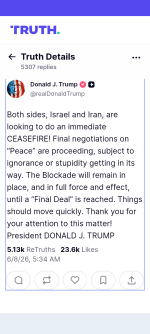
After the cards... he's got the shots!
Calling another shot... seriously though...
Davey Crockett
Elite Member

The SC
INT'L MOD

We all know Israel extremism is the one that has created Muslim extremism..Lets ignore the fact 1000s of children have been targeted - the world organisations have accepted and registered a genocide in Palestine - a school in Iran was struck and over 150 children died - Syria Libya Iraq have been decimated by the USA - yet they believe Iran is the problem?
F-22Raptor
Elite Member
Another tanker disabled. We’ve reached 8 weeks of blockade
Musings
Administrator
So blaming genocide on Muslims? Excellent.We all know Israel extremism is the one that has created Muslim extremism..
Perhaps mentality like this has screwed the Middle East so much. Some Arab nations supporting Israeli mindset like allowing their bases to be used hasnt helped, but lets blame Iran for that too.
Users who are viewing this thread
Total: 14 (members: 3, guests: 11)
Pakistan Defence Latest
-

-
-
-

-
 Federal cabinet gives nod to imposition of emergency in KP; summary sent to president (7 Viewers)
- Latest: Forsvaret


