The Pentagon Inspector General's report on the recent Iran war was released yesterday. It is considered the most important public U.S. document to date for understanding the war's impact on the U.S. military itself.

The report acknowledges a "strategic shortage of munitions," bottlenecks in the defense industrial base, damage to hundreds of facilities at U.S. bases, significant aircraft losses, and the Navy's need to revamp the logistics support system it had built over years in the Gulf.
The report is a joint oversight compilation of information from the Department of Defense, the State Department, and other U.S. agencies, submitted to Congress.
Here are the report's key findings:
The most significant problems in U.S. military manufacturing lie in solid-fuel rocket engines, high-quality explosives and propellants, and the ability to attract skilled industrial workers. The Department of Defense says that expanding production lines will take "considerable time," even after accelerating procurement and investing in production capacity.
The sheer volume of munitions consumed is striking; $22.3 billion was spent in the first months of the war, representing about two-thirds of the direct costs the Pentagon had calculated up to that point. Therefore, in June, the White House requested $87.6 billion in emergency funding, of which $67.1 billion was for the Pentagon, with $21 billion allocated for munitions alone.
Iran succeeded in damaging or destroying hundreds of buildings and facilities within US bases in eight countries: Kuwait, Bahrain, Qatar, the UAE, Saudi Arabia, Iraq, Oman, and Jordan.
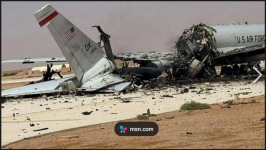
The list of aviation losses is one of the most significant revelations in the report: four F-15E fighter jets were destroyed, three by friendly fire and one by enemy fire; one F-35A was damaged by enemy fire over Iran; and one A-10 was lost after sustaining damage while returning from a combat recovery mission.
Seven KC-135 refueling aircraft were also damaged or destroyed; two in a collision over Iraq, and five on the ground in Saudi Arabia due to Iranian munitions. An E-3 early warning aircraft was also damaged on the ground in Saudi Arabia by an Iranian strike.
The report also documents the loss or damage of several other platforms: an HH-60W during combat recovery operations, an MQ-4C crash, the destruction by U.S. forces of four AH-6 helicopters after they became unrecoverable, an AH-64 shot down over the Strait of Hormuz, and an MH-60 crashed in the Arabian Sea.
The most striking figure is that up to 30 MQ-9 Reaper drones were destroyed in various circumstances.
The damage to Bahrain had a more direct operational impact than just the loss of facilities. Bahrain was the main logistics hub for the US Navy in the Gulf, and after being targeted by drones and ballistic missiles, CENTCOM was forced to reroute supplies to more distant alternative hubs.
One alternative was Diego Garcia, but the distance increased the naval supply cycle to 14–18 days. This officially explains why the damage to Bahrain became a problem of sustaining naval operations, not just the cost of repairing a base.
The report also reveals that Europe effectively became the logistical heartland of the war. US European Command served as a launch, support, and transport platform for munitions, aircraft, fuel, equipment, and personnel to CENTCOM, utilizing European bases and transport networks to maintain operations.
The diplomatic damage amounted to approximately $184 million, but its distribution was highly concentrated. $157.35 million in Iraq, $14.75 million in Kuwait, $11.5 million in Saudi Arabia, and only $125,000 in the UAE.
In Saudi Arabia, the report states that two Iranian unidirectional attack drones struck the U.S. Embassy in Riyadh, causing material damage. This was followed by instructions for personnel in Riyadh, Jeddah, and Dhahran to take shelter and warnings for Americans to stay away from diplomatic facilities.
By the end of June, approximately 3,500 U.S. diplomatic personnel and their families in the Middle East were either on authorized or mandatory leave or off-site, an official indicator of the war's expanding operational impact on the U.S. civilian presence in the region.
The war also triggered a massive wave of regional arms deals; the report records $44.51 billion in emergency and non-emergency military sales between January and June. Of this, $25.32 billion were emergency sales that bypassed regular congressional review, and $19.19 billion were non-emergency sales.
Saudi Arabia was the largest single recipient in the report, with $12 billion. $9 billion for Patriot PAC-3 MSE missiles and $3 billion for F-15 support. Kuwait followed with $10.74 billion, then the UAE with $8.61 billion, Israel with $7.81 billion, Qatar with $5 billion, and Jordan with $350 million.
The scale of the war was far greater than the figures circulating in the media suggest. More than 50,000 US military personnel participated in the Central Command theater. At the height of operations, there were more than a dozen fighter squadrons, more than a dozen destroyers, more than a dozen air defense batteries, in addition to THAAD and HIMARS systems, part of the 82nd Airborne Division, and two Marine Corps units. The United States maintained a continuous air cover with two aircraft carriers, not just a fleeting presence.
The operation was a massive aerial attrition; approximately 36,000 combat sorties, 13,500 targets, and more than 1,800 fire missions between the start of the war and the ceasefire on April 7. This level of operations is unlike the typical limited strikes seen in the Middle East; it's more akin to a major air campaign against a state with a vast and dispersed military.

In my opinion, the most significant value of this report is that it brings to light a picture that has been emerging from press leaks over the past few months, now appearing in the official US record.