US Political News and Trump’s China visit

"Two paths now stand before the American right. One leads to renewed sovereignty, to ending foreign entanglements, and putting US interests first. The other continues to place Israel’s priorities above America’s own.

In short: MAGA vs MIGA."
 
Life is good in the USA for 70% of the population. Revolutions do not happen with that kind of contentment
 
The Republican rift: Pick a side, MAGA and MIGA cannot coexist

MAGA’s rise split the American right. The deeper question now is: which flag does the movement follow? America’s, or Israel’s?

Sarp Sinan Hacir

NOV 24, 2025

View attachment 161668


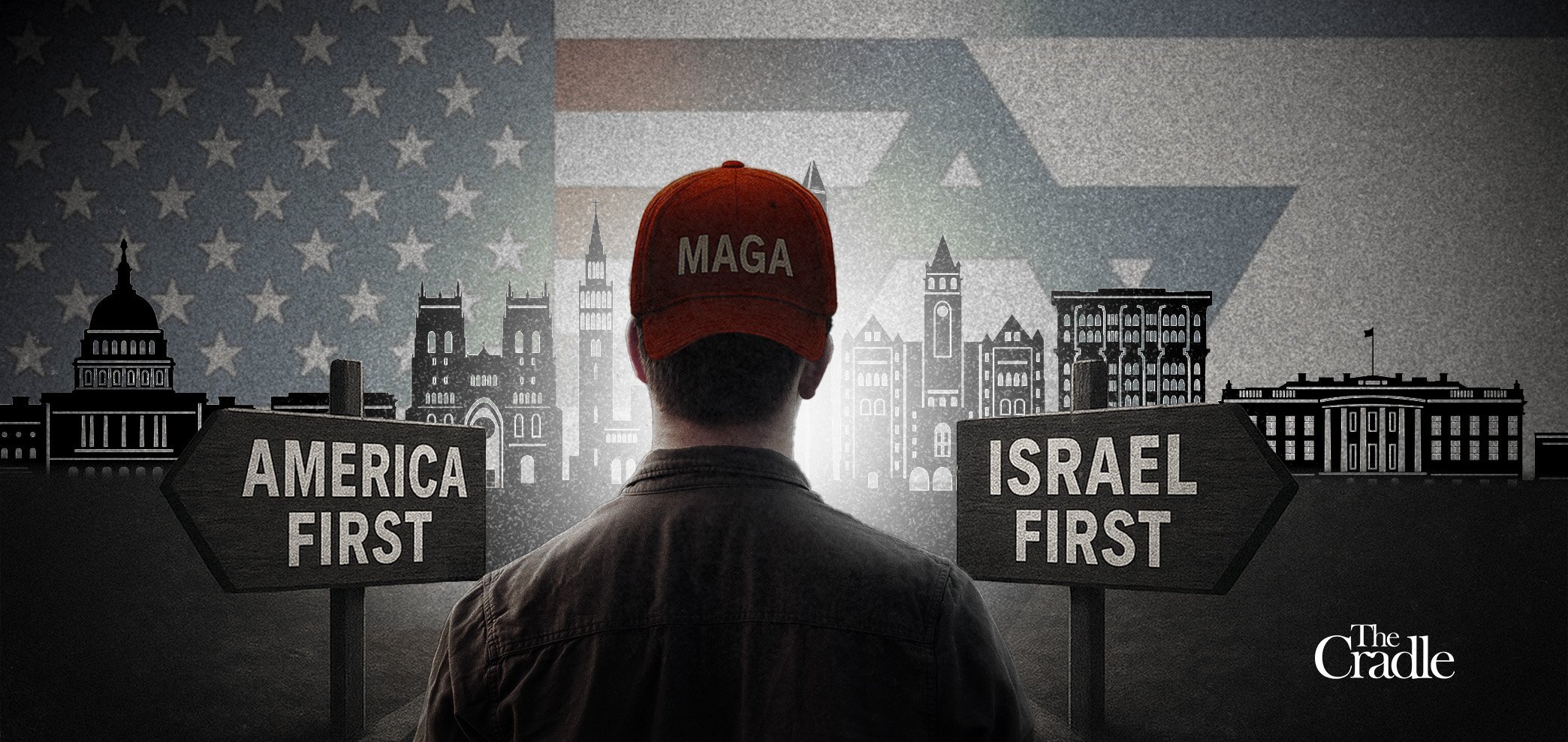
The US right is undergoing a rupture that is far more decisive than its culture wars or internecine policy disputes. At the core of this split are two incompatible visions: MAGA (Make America Great Again) versus MIGA (Make Israel Great Again).

It represents a fundamental clash over whose interests define the American right: the nation’s, or a foreign ally’s. Yet only one can define the future of the Republican movement.

If America comes first, then its policies, resources, and military must serve domestic priorities – not the ambitions of a foreign ally. If Israel comes first, then American sovereignty is secondary by definition.

The fracture has only sharpened after 7 October 2023 and is now reshaping the American right in real time.

The MAGA revolt against the establishment

For decades, Republican elites aligned their foreign and domestic agendas with neoconservative doctrine: endless wars, global policing, open markets, and a reflexive allegiance to Israel.

That consensus was shattered in 2016. Disaffected voters rallied to Donald Trump, who mocked figures like Jeb Bush, the last of a warmongering dynasty. Under the MAGA banner, the party’s base was recast into a new coalition: conservatives, evangelicals, religious Jews, anti-establishment activists, disillusioned independents, and even some anti-globalist voices from the left.

US President Donald Trump's populist slogan, “America First,” reflected a growing demand for national self-interest in place of international entanglements.

But this ran headfirst into the old guard’s loyalty to Israel. Could a country truly prioritize its own interests while committing unconditionally to a foreign state?

The Flood

When Israel launched its war on Gaza after Operation Al-Aqsa Flood on 7 October 2023, MAGA’s internal contradiction exploded.

The initial response followed familiar lines with conservative pundits and politicians closing ranks behind Tel Aviv. But as scenes of devastation in Gaza multiplied, many grassroots conservatives began to ask what exactly this alliance serves.

Washington was pouring more into Israel’s war effort than it had into Ukraine – with no debate, no returns, and no regard for American lives or interests. If “America First” meant anything, why was it absent here?

For decades, Republicans had repeated that Israel was “America’s greatest ally.” But Israel does not provide US jobs, technology, or security guarantees. It demands US military protection and drags Washington into regional conflicts it would otherwise avoid.

Initially, the backlash began quietly – online forums, podcast circles, and independent journalists. But it soon went mainstream.

Ben Shapiro, once the intellectual darling of the anti-woke right, found himself defending university campus crackdowns on pro-Palestine protests. This is from the man who once wrote a book titled ‘Facts Don’t Care About Your Feelings,’ mocking the liberal left’s emotional politics. Now, under the pretext of protecting Jewish students, free speech was being suspended by Republicans.

For younger conservatives raised on MAGA, this looked like betrayal. If facts do not care about feelings, why were protests being silenced? If cancel culture was the enemy, why were actors, writers, and students being blacklisted for opposing genocide?

A movement under siege

The MAGA rebellion was not only about foreign policy. It was about taking on the entire architecture of US elite power – media, academia, finance, and foreign lobbies. And one lobby in particular became untouchable.

American conservative political commentator Tucker Carlson was ousted from Fox News after amplifying critics of Israel. Right-wing commentator Candace Owens was pushed out of Daily Wire after clashing with Shapiro. Steve Bannon, one of Trump’s early strategists, began warning of Israeli influence in conservative circles.

Nick Fuentes, who rose to prominence through campus debate circuits and became one of the more extreme voices of the MAGA generation, has turned into a lightning rod in the generational fight over Israel. When Carlson recently interviewed him, Shapiro spent an entire episode denouncing both men – accusing Carlson of normalizing antisemitism and warning that Republicans who “cower before the likes of neo-Nazis and their propagandizers ... deserve to lose.”

Yet Fuentes’s long-standing opposition to US military aid for Israel resonated with younger conservatives – particularly men – who were no longer persuaded by traditional justifications for America's unconditional support.

And then came Charlie Kirk– the founder of Turning Point USA. Kirk had built one of the most influential conservative youth movements in the country. He called himself a Zionist, and denied that Israel was committing genocide in Gaza.

But it was not enough. Because Kirk gave a platform to critics of Israel, donors pulled support. “I've been trying to tell Israel supporters, there's an earthquake coming in this country on this issue, and they don't believe me,” Kirk said in July.

Before his assassination, he reportedly told friends he feared Israel might have him killed. Some even said he sent messages expressing that fear directly. These claims were promptly dismissed as conspiracy theories.

Nevertheless, Kirk’s assassination was a shock to the movement. And it triggered a deeper reckoning. Netanyahu, unprompted, issued a statement insisting Israel had nothing to do with it.

Yet just weeks before, in an interview with Breitbart, Netanyahu was quoted as saying, “Israel is fighting Iran, and you can’t be MAGA if you’re pro-Iran, you can’t be MAGA if you’re anti-Israel. President Trump understands this, and he stands very strongly with us.”

To many, that sounded like a threat.

The Epstein revolt

Alongside the Gaza backlash, another scandal reared its head: Jeffrey Epstein. MAGA supporters believed this was their chance to expose the perversion of elite networks. But Trump hesitated.

Before the 2024 election, he hinted the truth might come out – then cautioned that “many innocent people may get hurt.” Afterward, he turned on his own party members for pressing the issue.

Representatives Marjorie Taylor Greene (MTG) and Thomas Massie demanded transparency. Trump attacked them both. He backed primary challengers against Massie and labeled MTG a traitor, withdrawing his support for her. In response to the escalating pressure and his withdrawal of support, MGT announced she would resign from Congress on 5 January 2026, citing her marginalization by MAGA leadership and the party’s elite.

Epstein’s deep ties to Israeli intelligence – whether through his girlfriend Ghislaine Maxwell’s Mossad-linked father, Robert Maxwell, or through Ehud Barak, the former prime minister of Israel, along with his access to bipartisan figures – raised uncomfortable questions. Adding to the controversy, leaked emails released by Democrats suggest that Epstein, who Trump once described as a “terrific guy,” said the US president “knew about the girls.”

Once again, MAGA’s confrontation with elite corruption was derailed by loyalty to Israel.

Who decides America’s future?

Two paths now stand before the American right. One leads to renewed sovereignty, to ending foreign entanglements, and putting US interests first. The other continues to place Israel’s priorities above America’s own.

In short: MAGA vs MIGA.

Today, MIGA holds institutional power. AIPAC dominates congressional primaries. Dissent is punished. Trump’s inner circle remains full of hardline Zionists like Laura Loomer. The billionaire Adelson family bankrolled his campaigns.

But MAGA still commands the base. Support for Israel among Republican voters has plummeted – from 65 percent favorable to 50 percent unfavorable. The backlash is real.

And Trump? He straddles the line. He supports Israel militarily, but cuts deals that anger Tel Aviv. He criticizes MTG, but defends Carlson’s right to speak. He fights Iran, but will not commit to regime change.

This balancing act cannot hold. As pressure builds, the Republican Party will be forced to choose.

If it returns to its neocon roots, the MAGA base may walk. If it stands with its base, MIGA must go.

One thing is clear: for one vision to survive, the other MUST fail.

Sadly MAGA or the whole american body politick have any choice in this matter when the Department of Homeland Security is literally being run out of Israel as exposed on twitter with the location of their official account.

Zionists exercise absolute control of all decision making, policy matters and levers of power in the whole of West particularly in the US and won't extricate from its host anytime soon, you know they have them truly by the balls.
 
To view this content we will need your consent to set third party cookies.
For more detailed information, see our cookies page.
 
"Yet Fuentes’s long-standing opposition to..."

To view this content we will need your consent to set third party cookies.
For more detailed information, see our cookies page.
 
October 21, 2025
By: Mathew Burrows

View attachment 155503

Economic and demographic trends in the United States mirror those of other pre-revolutionary societies in the past.

The Red Cell series is published in collaboration with the Stimson Center. Drawing upon the legacy of the CIA’s Red Cell—established following the September 11 attacks to avoid similar analytic failures in the future—the project works to challenge assumptions, misperceptions, and groupthink with a view to encouraging alternative approaches to America’s foreign and national security policy challenges. For more information about the Stimson Center’s Red Cell Project, see here.


Red Cell

Charlie Kirk’s killing last month has sparked fears that the United States is headed to an all-out second civil war or revolution. According to a YouGov survey earlier this year, “more Americans than not believe it is likely that the United States will see a civil war over the next decade,” while several hundred political scientists and historians in an April 2025 survey saw the United States slipping into authoritarianism with Trump’s second term. Trump’s deployment of military and National Guard forces at home, combined with his vow to suppress “the enemy within” while his domestic advisor, Stephen Miller, labels the Democratic Party a “domestic extremist organization,” can easily be seen as setting the stage for an authoritarian takeover. Revolutions don’t come out of nowhere. Yet, the how and the when often come as surprises.

Political Violence Exploding

Even before the Kirk killing, the number of assassinations was climbing, according to the academic Peter Turchin’s US Political Violence Database (USPVDB). The five years from 2020 to 2024 saw seven assassinations, higher than the previous peak during the 1960s, although only half as large as that of the late 1860s.

Violent threats against lawmakers hit a record high last year. Since the 2020 election, state and local election officials have become targets of violent threats and harassment, as have federal judges, prosecutors, and other court officials. As of April, there have been more than 170 incidents of threats and harassment targeting local officials across nearly 40 states this year, according to data gathered for the Bridging Divides Initiative at Princeton University.

The Capitol Police investigated over 9,000 threats against members of Congress in 2024, a sharp rise from previous years. The Department of Homeland Security reported a rise in threats and harassment aimed at election workers during the 2024 election cycle. As fears of a political violence contagion grow, House leaders announced after the Kirk killing that Congressional members will get “$10,000 per month to cover personal security costs,” doubling the $5,000 currently available. The White House has also recently asked for “an additional $58 million in security funding for the executive and judicial branches.”

Right-Wing Violence More Prevalent

Both government and academic research have shown that the majority of extremist violence since 1994 has been linked to right-wing extremists. The Anti-Defamation League’s Center for Extremism indicated in its 2024 report that “All the extremist-related murders in 2024 were committed by right-wing extremists of various kinds.” In recent years, there has been a drop-off in Islamist-fueled violence domestically.

Yet, according to CSIS’s Warfare, Irregular Threats, and Terrorism Program, the first half of 2025 “was marked by an increase in left-wing terrorist attacks and plots.” Although less deadly historically than right-wing violence, recent left-wing killings—Luigi Mangione’s assassination of United Healthcare CEO Brian Thompson in New York City in December 2024, the fatal shooting of right-wing protester Aaron Danielson in Portland, Oregon, in August 2020, and possibly the Kirk murder—could signal a growing, broad-based conflict. By contrast, many left-wing extremist attacks in the 1990s and 2000s were tied to anarchist or environmental movements.

Most of the attackers, left-wing or right-wing, have acted as “lone wolves.” The United States is not the only country experiencing a rise in such attacks. According to the Institute for Economics and Peace, “In the West, terrorist incidents dropped significantly since their peak in 2017. However, the number of attacks has increased by 20 to 52 in 2024 when compared to the prior year. Attacks in the West peaked in 2017 with 176 attacks recorded.”

These “lone wolves” self-radicalize via online engagement rather than joining a group. According to Rachel Kleinfeld at the Carnegie Endowment for International Peace, “White-supremacist ideas, militia fashion, and conspiracy theories spread via gaming websites, YouTube channels, and blogs, while a slippery language of memes, slang, and jokes blurs the line between posturing and provoking violence, normalizing radical ideologies and activities.” A University of Chicago analysis of participants in the 2021 insurrection at the US Capitol found that these insurrectionists tended to be older than 1960s extremists and often held jobs and self-identified as Christians.

What’s also concerning about recent violence is its growing societal acceptance. Luigi Mangione, charged with the murder of United Healthcare CEO Brian Thompson, “has become a left populist folk hero,” according to Georgetown University’s Bruce Hoffman. Now, “Luigi: The Musical” is selling out, and terrorist organization flags fly at demonstrations and protests. Trump has “encouraged attendees at his rallies to ‘knock the hell’ out of protesters, praised a lawmaker who body-slammed a reporter, and defended and pardoned the rioters of January 6, 2021, who clamored to ‘hang Mike Pence.’”

It’s little wonder an American Psychological Association survey found that the 2024 election was a significant source of stress in Americans’ lives. More than 7 in 10 adults (72 percent) were worried the election results could lead to violence.

Losing Out

Kleinfeld believes the right-wing extremists are united by a belief that, as Christian white males, they are losing their “cultural power and status” to other groups, including women, ethnic minorities, and Black communities. There is strong evidence to reinforce their views. The 2020 census showed the United States was diversifying faster than anticipated. In 1980, white residents constituted almost 80 percent of the national population, with Black residents accounting for 11.5 percent, Latino or Hispanic residents at 6.5 percent, and Asian Americans at 1.8 percent.

By 2019, the decline of the white share had accelerated, losing almost 20 percentage points from 20 years earlier. By contrast, the shares of the Latino or Hispanic and Asian American populations grew to 18.5 percent and nearly 6 percent, respectively, while the Black share remained stable. Most significantly, for the under-16-year-olds, over 50 percent identified as a racial or ethnic minority.

On top of the actual changes that are shifting America from a majority white country to a majority minority one, there is a tendency to overestimate the percentage of the population that is Black or from an ethnic minority group. A nationwide 2022 YouGov America survey recorded that adult respondents believed that 41 percent of Americans are Black, when the figure is close to 12 percent. The findings from a 2016 academic psychology study of public attitudes in Western countries found that “the increasing diversity of the nation may actually yield more intergroup hostility.”

Fear of economic loss is also part of that hostility, and once again, those fears are not unfounded. Inequality has been growing in the United States at a faster rate than in other countries. There remains a huge wealth gap between whites and racial and ethnic minorities (except Asians) despite some gains by minorities. Harvard’s Raj Chetty has shown that children born in lower-income white families not only fell behind higher-income white peers but also their Black peers. Fewer were married, fewer had graduated from college, more have been incarcerated, and many face lower life expectancy than those who are wealthy and better educated.

Disadvantaged whites often see the world in zero-sum terms, blaming the success of other communities for their misfortune. According to a University of Chicago study of the 2021 Capitol insurrectionists, “Believing that Blacks and Hispanics are overtaking whites increases odds of being in the insurrectionist movement three-fold.” This is one reason for the popularity of Trump’s crusade against DEI (diversity, equality, and inclusion) among his base.

Cyclical Factors

Quantitative historians have examined the correlation between such factors as demography and inequality with societal breakdown. Peter Turchin, perhaps the best-known, places great emphasis on what he calls elite overproduction in the disintegration of advanced societies. As more and more people strive to improve their station, they find fewer openings at the top. Aristocratic privilege in ancien regime France prevented the rise of the bourgeoisie, while the gentry’s impoverishment in pre-revolutionary Russia radicalized figures like Vladimir Lenin.

In today’s United States, those same class divisions seem to be at work. A recent academic study has shown that “Children from families in the top 1 percent are more than twice as likely to be admitted and attend” an Ivy League university as those from middle-class families with comparable SAT/ACT scores. “Average wealth of the top 0.0001 per cent of the global population grew on average 7.1 per cent a year between 1987 and 2024, compared to 3.2 per cent for the average adult,” according to French researcher Gabriel Zucman.

Zucman also found that the top 400 wealthiest Americans had a total effective tax rate of 23.8 percent on their income, similar to the rate paid by the middle class. Middle-class children born in 1984 have struggled to attain better life outcomes than their parents, and only 50 percent succeed, compared to 90 percent born in 1940.

America has been here before. During the Gilded Age (1876–1900), the great industrialists or “robber barons” flaunted their wealth gained from monopolizing recent technological breakthroughs—railways, steel, and oil—widening the gap with the ordinary middle class and the poor. Like today, the two major parties were evenly divided, making it impossible to pass reforms. Immigration was at its height, as well as violence and discrimination against newcomers.

A populist party emerged among farmers and workers. Political violence also grew; one historian, Beverly Gage, has written that, “Left-wing radical and revolutionary groups—anarchists, syndicalists, Wobblies, militant trade unionists—erupted with remarkable frequency.” This turmoil culminated in the assassination of President William McKinley by self-proclaimed anarchist Leon Czolgosz.

Why didn’t this eruption of violence result in a widespread revolution? Most historians credit the Progressive Era and its numerous reforms with halting the drift toward revolution. Theodore Roosevelt, who assumed the presidency after McKinley, made reform a centerpiece of his administration. The Progressive Era witnessed improved labor conditions and workers’ rights, increased regulation of big business, the enactment of consumer protection laws, and the conservation of natural resources. By 1920, American women had gained the right to vote.

No Clear Pattern to How Revolutions Start

The self-immolation of a fruit seller in Tunisia was the spark that started the Arab Spring uprisings, overthrowing the Ben Ali and Mubarak regimes in Tunisia and Egypt. However, in the decade since, the Middle East still appears far from democracy. Revolutions don’t require mass rebellions. Germany and Italy slipped into fascism and dictatorship through electoral manipulation and political intimidation. The collapse of the Soviet Union was largely peaceful, triggered by a stagnant economy, the failure of Gorbachev’s reforms, and disunity among the Soviet republics.

Coups are the likeliest way for violent revolutions to start. Examples include the Bolshevik seizure of power in October 1917 and Franco’s war against Spain’s Second Republic in 1936. A contested election is sometimes the prelude, as happened in Myanmar when the military seized power after its side lost the 2020 election. Whether a coup succeeds or fails depends on the “presence of popular nonviolent mobilization.” According to the IMF, there has been a secular decline in coups. Still, many of the underlying factors that contribute to coups exist in the United States, such as political polarization and growing class divisions.

Is a Second American Revolution So Hard to Imagine?

According to the Pew Research Center, “Trust in our nation’s institutions has never been lower.” Only 22 percent of US adults said they trust the federal government to do the right thing most of the time, down from 77 percent six decades ago. It’s not just the federal government; Gallup reports that only 36 percent of people have trust in churches and organized religions, down from 65 percent in 1973. Over roughly the same time, trust in the medical system has fallen from 80 percent to 36 percent.” Trump’s MAGA base sees him as a savior rescuing America from its dysfunction and decline, and even some of Trump’s opponents are entranced by his energy in defying the usual political sluggishness. Revolutions start when the old order becomes part of the problem.

Trump’s unprecedented deployment of the military to counter crime in US cities is a move that risks undermining the military’s position a politically neutral actor. At the recent military offsite, Trump told the military chiefs that they should be prepared to battle “the enemy within,” an ominous phrase with a fraught history. Moreover, Trump’s pardoning of the protesters who invaded the Capitol sends a dangerous signal, since it effectively sanctions an attempted coup. Not ignoring the warning signs is the first step toward preventing coups and revolutions.

feel sorry for Americans... they at one time they had the world.... now they will be lucky to have Canada.
 
feel sorry for Americans... they at one time they had the world.... now they will be lucky to have Canada.
What's to be sorry about?

We on the right are now letting it be known all Israel firsters need to pack their bags and go.
 
What's to be sorry about?

We on the right are now letting it be known all Israel firsters need to pack their bags and go.


it may be too little to late...

the strategic power has shifted to Asia - Pacific region.

yes looking at the state of your cities , social programs, public education etc yes there is plenty to feel sorry about. ..

and no I am anti American as some my best mentors were Americans.
 
I don’t expect Trump to lay out the red carpet but perhaps he won’t go full DC or LA on NYC. But, like you said, he has more reason to want to keep the animosity alive, if only to keep his movement and influence going, at least until his lame duck period, post midterms are in full swing. I guess we will see where his mercurial temper takes us all.

Btw, a lot of MAGA trolls on Twitter seem to be run from outside the country, so perhaps the blowback against Trump for what he chooses to do will be exposed as not fully organic and partially overblown.

To view this content we will need your consent to set third party cookies.
For more detailed information, see our cookies page.

Well, Trump can't just consider his own future, he needs to consider the MAGA future. People here vote for MAGA because of him; if MAGA turns on him. The chance of the GOP winning any election is slim to none; he needs that sudden surge to win the election, so MAGA's support to him and future candidates is extremely important.

As for people support, we all know the GOP (and Dem) hire troll farm for info war (Our version of 50cents army), and those are usually not based in the US, the issue is not whether these people are in the US, the issue is the people who actually voted, they listen to these people, they don't generally care or even realise these are troll.
 
It is not about drugs, they are just enforcing monroe's doctrine and chasing out china, russia and iran from their sphere of influence.
 
October 21, 2025
By: Mathew Burrows

View attachment 155503

Economic and demographic trends in the United States mirror those of other pre-revolutionary societies in the past.

The Red Cell series is published in collaboration with the Stimson Center. Drawing upon the legacy of the CIA’s Red Cell—established following the September 11 attacks to avoid similar analytic failures in the future—the project works to challenge assumptions, misperceptions, and groupthink with a view to encouraging alternative approaches to America’s foreign and national security policy challenges. For more information about the Stimson Center’s Red Cell Project, see here.


Red Cell

Charlie Kirk’s killing last month has sparked fears that the United States is headed to an all-out second civil war or revolution. According to a YouGov survey earlier this year, “more Americans than not believe it is likely that the United States will see a civil war over the next decade,” while several hundred political scientists and historians in an April 2025 survey saw the United States slipping into authoritarianism with Trump’s second term. Trump’s deployment of military and National Guard forces at home, combined with his vow to suppress “the enemy within” while his domestic advisor, Stephen Miller, labels the Democratic Party a “domestic extremist organization,” can easily be seen as setting the stage for an authoritarian takeover. Revolutions don’t come out of nowhere. Yet, the how and the when often come as surprises.

Political Violence Exploding

Even before the Kirk killing, the number of assassinations was climbing, according to the academic Peter Turchin’s US Political Violence Database (USPVDB). The five years from 2020 to 2024 saw seven assassinations, higher than the previous peak during the 1960s, although only half as large as that of the late 1860s.

Violent threats against lawmakers hit a record high last year. Since the 2020 election, state and local election officials have become targets of violent threats and harassment, as have federal judges, prosecutors, and other court officials. As of April, there have been more than 170 incidents of threats and harassment targeting local officials across nearly 40 states this year, according to data gathered for the Bridging Divides Initiative at Princeton University.

The Capitol Police investigated over 9,000 threats against members of Congress in 2024, a sharp rise from previous years. The Department of Homeland Security reported a rise in threats and harassment aimed at election workers during the 2024 election cycle. As fears of a political violence contagion grow, House leaders announced after the Kirk killing that Congressional members will get “$10,000 per month to cover personal security costs,” doubling the $5,000 currently available. The White House has also recently asked for “an additional $58 million in security funding for the executive and judicial branches.”

Right-Wing Violence More Prevalent

Both government and academic research have shown that the majority of extremist violence since 1994 has been linked to right-wing extremists. The Anti-Defamation League’s Center for Extremism indicated in its 2024 report that “All the extremist-related murders in 2024 were committed by right-wing extremists of various kinds.” In recent years, there has been a drop-off in Islamist-fueled violence domestically.

Yet, according to CSIS’s Warfare, Irregular Threats, and Terrorism Program, the first half of 2025 “was marked by an increase in left-wing terrorist attacks and plots.” Although less deadly historically than right-wing violence, recent left-wing killings—Luigi Mangione’s assassination of United Healthcare CEO Brian Thompson in New York City in December 2024, the fatal shooting of right-wing protester Aaron Danielson in Portland, Oregon, in August 2020, and possibly the Kirk murder—could signal a growing, broad-based conflict. By contrast, many left-wing extremist attacks in the 1990s and 2000s were tied to anarchist or environmental movements.

Most of the attackers, left-wing or right-wing, have acted as “lone wolves.” The United States is not the only country experiencing a rise in such attacks. According to the Institute for Economics and Peace, “In the West, terrorist incidents dropped significantly since their peak in 2017. However, the number of attacks has increased by 20 to 52 in 2024 when compared to the prior year. Attacks in the West peaked in 2017 with 176 attacks recorded.”

These “lone wolves” self-radicalize via online engagement rather than joining a group. According to Rachel Kleinfeld at the Carnegie Endowment for International Peace, “White-supremacist ideas, militia fashion, and conspiracy theories spread via gaming websites, YouTube channels, and blogs, while a slippery language of memes, slang, and jokes blurs the line between posturing and provoking violence, normalizing radical ideologies and activities.” A University of Chicago analysis of participants in the 2021 insurrection at the US Capitol found that these insurrectionists tended to be older than 1960s extremists and often held jobs and self-identified as Christians.

What’s also concerning about recent violence is its growing societal acceptance. Luigi Mangione, charged with the murder of United Healthcare CEO Brian Thompson, “has become a left populist folk hero,” according to Georgetown University’s Bruce Hoffman. Now, “Luigi: The Musical” is selling out, and terrorist organization flags fly at demonstrations and protests. Trump has “encouraged attendees at his rallies to ‘knock the hell’ out of protesters, praised a lawmaker who body-slammed a reporter, and defended and pardoned the rioters of January 6, 2021, who clamored to ‘hang Mike Pence.’”

It’s little wonder an American Psychological Association survey found that the 2024 election was a significant source of stress in Americans’ lives. More than 7 in 10 adults (72 percent) were worried the election results could lead to violence.

Losing Out

Kleinfeld believes the right-wing extremists are united by a belief that, as Christian white males, they are losing their “cultural power and status” to other groups, including women, ethnic minorities, and Black communities. There is strong evidence to reinforce their views. The 2020 census showed the United States was diversifying faster than anticipated. In 1980, white residents constituted almost 80 percent of the national population, with Black residents accounting for 11.5 percent, Latino or Hispanic residents at 6.5 percent, and Asian Americans at 1.8 percent.

By 2019, the decline of the white share had accelerated, losing almost 20 percentage points from 20 years earlier. By contrast, the shares of the Latino or Hispanic and Asian American populations grew to 18.5 percent and nearly 6 percent, respectively, while the Black share remained stable. Most significantly, for the under-16-year-olds, over 50 percent identified as a racial or ethnic minority.

On top of the actual changes that are shifting America from a majority white country to a majority minority one, there is a tendency to overestimate the percentage of the population that is Black or from an ethnic minority group. A nationwide 2022 YouGov America survey recorded that adult respondents believed that 41 percent of Americans are Black, when the figure is close to 12 percent. The findings from a 2016 academic psychology study of public attitudes in Western countries found that “the increasing diversity of the nation may actually yield more intergroup hostility.”

Fear of economic loss is also part of that hostility, and once again, those fears are not unfounded. Inequality has been growing in the United States at a faster rate than in other countries. There remains a huge wealth gap between whites and racial and ethnic minorities (except Asians) despite some gains by minorities. Harvard’s Raj Chetty has shown that children born in lower-income white families not only fell behind higher-income white peers but also their Black peers. Fewer were married, fewer had graduated from college, more have been incarcerated, and many face lower life expectancy than those who are wealthy and better educated.

Disadvantaged whites often see the world in zero-sum terms, blaming the success of other communities for their misfortune. According to a University of Chicago study of the 2021 Capitol insurrectionists, “Believing that Blacks and Hispanics are overtaking whites increases odds of being in the insurrectionist movement three-fold.” This is one reason for the popularity of Trump’s crusade against DEI (diversity, equality, and inclusion) among his base.

Cyclical Factors

Quantitative historians have examined the correlation between such factors as demography and inequality with societal breakdown. Peter Turchin, perhaps the best-known, places great emphasis on what he calls elite overproduction in the disintegration of advanced societies. As more and more people strive to improve their station, they find fewer openings at the top. Aristocratic privilege in ancien regime France prevented the rise of the bourgeoisie, while the gentry’s impoverishment in pre-revolutionary Russia radicalized figures like Vladimir Lenin.

In today’s United States, those same class divisions seem to be at work. A recent academic study has shown that “Children from families in the top 1 percent are more than twice as likely to be admitted and attend” an Ivy League university as those from middle-class families with comparable SAT/ACT scores. “Average wealth of the top 0.0001 per cent of the global population grew on average 7.1 per cent a year between 1987 and 2024, compared to 3.2 per cent for the average adult,” according to French researcher Gabriel Zucman.

Zucman also found that the top 400 wealthiest Americans had a total effective tax rate of 23.8 percent on their income, similar to the rate paid by the middle class. Middle-class children born in 1984 have struggled to attain better life outcomes than their parents, and only 50 percent succeed, compared to 90 percent born in 1940.

America has been here before. During the Gilded Age (1876–1900), the great industrialists or “robber barons” flaunted their wealth gained from monopolizing recent technological breakthroughs—railways, steel, and oil—widening the gap with the ordinary middle class and the poor. Like today, the two major parties were evenly divided, making it impossible to pass reforms. Immigration was at its height, as well as violence and discrimination against newcomers.

A populist party emerged among farmers and workers. Political violence also grew; one historian, Beverly Gage, has written that, “Left-wing radical and revolutionary groups—anarchists, syndicalists, Wobblies, militant trade unionists—erupted with remarkable frequency.” This turmoil culminated in the assassination of President William McKinley by self-proclaimed anarchist Leon Czolgosz.

Why didn’t this eruption of violence result in a widespread revolution? Most historians credit the Progressive Era and its numerous reforms with halting the drift toward revolution. Theodore Roosevelt, who assumed the presidency after McKinley, made reform a centerpiece of his administration. The Progressive Era witnessed improved labor conditions and workers’ rights, increased regulation of big business, the enactment of consumer protection laws, and the conservation of natural resources. By 1920, American women had gained the right to vote.

No Clear Pattern to How Revolutions Start

The self-immolation of a fruit seller in Tunisia was the spark that started the Arab Spring uprisings, overthrowing the Ben Ali and Mubarak regimes in Tunisia and Egypt. However, in the decade since, the Middle East still appears far from democracy. Revolutions don’t require mass rebellions. Germany and Italy slipped into fascism and dictatorship through electoral manipulation and political intimidation. The collapse of the Soviet Union was largely peaceful, triggered by a stagnant economy, the failure of Gorbachev’s reforms, and disunity among the Soviet republics.

Coups are the likeliest way for violent revolutions to start. Examples include the Bolshevik seizure of power in October 1917 and Franco’s war against Spain’s Second Republic in 1936. A contested election is sometimes the prelude, as happened in Myanmar when the military seized power after its side lost the 2020 election. Whether a coup succeeds or fails depends on the “presence of popular nonviolent mobilization.” According to the IMF, there has been a secular decline in coups. Still, many of the underlying factors that contribute to coups exist in the United States, such as political polarization and growing class divisions.

Is a Second American Revolution So Hard to Imagine?

According to the Pew Research Center, “Trust in our nation’s institutions has never been lower.” Only 22 percent of US adults said they trust the federal government to do the right thing most of the time, down from 77 percent six decades ago. It’s not just the federal government; Gallup reports that only 36 percent of people have trust in churches and organized religions, down from 65 percent in 1973. Over roughly the same time, trust in the medical system has fallen from 80 percent to 36 percent.” Trump’s MAGA base sees him as a savior rescuing America from its dysfunction and decline, and even some of Trump’s opponents are entranced by his energy in defying the usual political sluggishness. Revolutions start when the old order becomes part of the problem.

Trump’s unprecedented deployment of the military to counter crime in US cities is a move that risks undermining the military’s position a politically neutral actor. At the recent military offsite, Trump told the military chiefs that they should be prepared to battle “the enemy within,” an ominous phrase with a fraught history. Moreover, Trump’s pardoning of the protesters who invaded the Capitol sends a dangerous signal, since it effectively sanctions an attempted coup. Not ignoring the warning signs is the first step toward preventing coups and revolutions.
Here is your revolution. But you will never take the names of people who make and sell it in USA , will you?
LloydDeGrane_Jewels.jpg
 

"It's A Tinder Box": GOP Members Consider Following MTG Into Retirement, Say White House Treats Them 'Like Garbage'​


Mark January 30th on your calendar.
You should give traction to the candidates non related to the aipac money and make it toxic for any politician to be bribed by them, that is what common electorate can do beside empty talks online.
 
You should give traction to the candidates non related to the aipac money and make it toxic for any politician to be bribed by them, that is what common electorate can do beside empty talks online.

Gene Sharp's 198 methods of nonviolent action​


(from Gene Sharp, The Methods of Nonviolent Action, Boston 1973)


Users who are viewing this thread

Back
Top