US Political News and Trump’s China visit

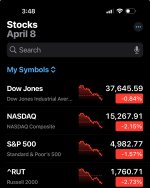
Another tough day for the stock market, fueled by chaotic messaging from the Trump Administration regarding its trade and tariff war with the world. As usual, Trump is making contradictory statements on tariffs and trade. His advisor Peter Navarro has taken a hardline stance, insisting there will be no negotiations and that tariffs will remain in place. Meanwhile, Treasury Secretary Scott Bessent claims the United States is actively negotiating, with 70 countries reportedly approaching them.

This inconsistency is creating unnecessary turmoil in the market.


IMG_1262.jpeg
 
Trump, in a sense, is not very different from Bernie on some of his economic populism.

Which is why many Bernie guys voted for him back in 15-16

that's what they say anyway.. your thoughts @RabzonKhan mian ?
While Trump and Bernie are ideologically worlds apart—Trump being a nationalist conservative and Sanders a democratic socialist—they both employed populist rhetoric that resonated with economically disillusioned voters in 2016.

Both framed their campaigns around the idea that the system was rigged against "the people." Sanders targeted corporate greed and the billionaire class, advocating for wealth redistribution and systemic reforms. Trump, on the other hand, blamed political elites, globalization, and immigration, positioning himself as an outsider who would "drain the swamp".

This overlap in messaging—though rooted in vastly different solutions—did appeal to some of the same frustrations among working-class voters. It's true that a segment of Bernie supporters, disillusioned by the Democratic Party, shifted to Trump in 2016. However, their approaches to addressing economic issues remain fundamentally different.

I believe Trump and Bernie hold extreme positions. Trump advocates for huge tax breaks for the rich, which burdens the U.S. economy with more debt. Bernie, on the other hand, promotes extreme class divisions, often condemning capitalism, big corporations, and wealthy individuals.

I believe in a middle-of-the-road approach—high taxes on corporations to fund overly expensive social programs are unworkable but scapegoating big corporations and the rich for all the problems we face today is also misguided. This is why I don't support either of them.
 
While Trump and Bernie are ideologically worlds apart—Trump being a nationalist conservative and Sanders a democratic socialist—they both employed populist rhetoric that resonated with economically disillusioned voters in 2016.

Both framed their campaigns around the idea that the system was rigged against "the people." Sanders targeted corporate greed and the billionaire class, advocating for wealth redistribution and systemic reforms. Trump, on the other hand, blamed political elites, globalization, and immigration, positioning himself as an outsider who would "drain the swamp".

This overlap in messaging—though rooted in vastly different solutions—did appeal to some of the same frustrations among working-class voters. It's true that a segment of Bernie supporters, disillusioned by the Democratic Party, shifted to Trump in 2016. However, their approaches to addressing economic issues remain fundamentally different.

I believe Trump and Bernie hold extreme positions. Trump advocates for huge tax breaks for the rich, which burdens the U.S. economy with more debt. Bernie, on the other hand, promotes extreme class divisions, often condemning capitalism, big corporations, and wealthy individuals.

I believe in a middle-of-the-road approach—high taxes on corporations to fund overly expensive social programs are unworkable but scapegoating big corporations and the rich for all the problems we face today is also misguided. This is why I don't support either of them.
Be interesting to get your thoughts on foreign policy, illegal immigration and trade with China.
 
here's a right and left take on things:

To view this content we will need your consent to set third party cookies.
For more detailed information, see our cookies page.


To view this content we will need your consent to set third party cookies.
For more detailed information, see our cookies page.
 
To view this content we will need your consent to set third party cookies.
For more detailed information, see our cookies page.
 
To view this content we will need your consent to set third party cookies.
For more detailed information, see our cookies page.
 
To view this content we will need your consent to set third party cookies.
For more detailed information, see our cookies page.


To view this content we will need your consent to set third party cookies.
For more detailed information, see our cookies page.
 
We are still not out of the woods! Trump's Tariff delay and its implications.

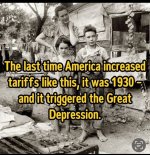
The United States remains in a precarious economic position, despite Trump's announcement of a 90-day delay on tariffs. While Trump has shown little concern for the stock market, reports suggest that turmoil in the bond market played a significant role in his decision to temporarily back off from his aggressive trade and tariff policies. This delay pauses the implementation of reciprocal tariffs for over 75 countries, reducing them to a flat 10% rate. However, tariffs on Chinese goods have been increased to a staggering 125%, reflecting ongoing trade tensions.

The broader implications of these tariffs are troubling. Even with the delay, tariffs remain higher than those imposed under the Smoot-Hawley Tariff Act of 1930. That infamous legislation triggered retaliatory tariffs from other countries, stifling international trade and deepening the economic crisis of the Great Depression. The Republican Party faced severe consequences, losing control of both the House and Senate in the 1932 elections. The act became a symbol of economic mismanagement, tarnishing the party's reputation for decades.

Trump's tariff policies risk repeating history, with potential long-term damage to international trade and economic stability. While the delay may provide temporary relief, the underlying issues remain unresolved, leaving the U.S. economy vulnerable to further shocks.


IMG_1271.jpeg
 
Be interesting to get your thoughts on foreign policy, illegal immigration and trade with China.
I’d love to dive into a discussion on foreign policy, illegal immigration, and trade with China, as these are important and nuanced topics. However, I have a very important appointment today that needs my attention. I’ll make sure to respond with my thoughts after I’ve taken care of that.

Cheers!
 
We are still not out of the woods! Trump's Tariff delay and its implications.

The United States remains in a precarious economic position, despite Trump's announcement of a 90-day delay on tariffs. While Trump has shown little concern for the stock market, reports suggest that turmoil in the bond market played a significant role in his decision to temporarily back off from his aggressive trade and tariff policies. This delay pauses the implementation of reciprocal tariffs for over 75 countries, reducing them to a flat 10% rate. However, tariffs on Chinese goods have been increased to a staggering 125%, reflecting ongoing trade tensions.

The broader implications of these tariffs are troubling. Even with the delay, tariffs remain higher than those imposed under the Smoot-Hawley Tariff Act of 1930. That infamous legislation triggered retaliatory tariffs from other countries, stifling international trade and deepening the economic crisis of the Great Depression. The Republican Party faced severe consequences, losing control of both the House and Senate in the 1932 elections. The act became a symbol of economic mismanagement, tarnishing the party's reputation for decades.

Trump's tariff policies risk repeating history, with potential long-term damage to international trade and economic stability. While the delay may provide temporary relief, the underlying issues remain unresolved, leaving the U.S. economy vulnerable to further shocks.


View attachment 111813
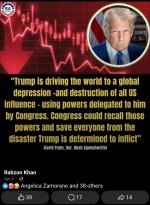
Your meme is not quite true.
 
Congress has a long and established history of delegating powers to the Executive Branch. Trump isn't the first nor will he likely be the last.

Congress just likes to bitch and moan because frankly, that's about all they are good at.
 
Be interesting to get your thoughts on foreign policy, illegal immigration and trade with China.
The issue with Trump is that even when he attempts to do the right thing, his approach often turns what could be a positive outcome into something bad, horrible, or even disastrous. Polls indicate that most Americans support policies to address out-of-control illegal immigration and the decoupling of trade from China. However, Trump's immigration policy lacks comprehensiveness—it feels more like a loud, chaotic spectacle rather than a well-thought-out plan.

That said, I give him full credit for stopping the inflow of illegal immigrants through Mexico. Though his deportation numbers were initially low, they now appear to be catching up, showing progress in this area.

His trade war with China has also been problematic. Trump imposed tariffs totaling 145% on Chinese imports, prompting China to retaliate with 125% tariffs on U.S. goods. While the Biden administration maintained many of Trump's tariffs on China, it also implemented a more strategic policy: encouraging countries like Vietnam, Thailand, Malaysia, the Philippines, and especially Mexico to increase their trade with the United States. This approach allowed American consumers to access cheaper goods, mitigating inflationary pressures. As a result, Mexico became America’s top exporter, and trade with China began to decline.

Unfortunately, Trump has now imposed significant tariffs on these very countries:

  • Vietnam: 46%
  • Thailand: 36%
  • Malaysia: 24%
  • Philippines: 17%
  • Mexico: 25%
This is a recipe for disaster. These tariffs will likely drive up inflation in the U.S., which is the last thing American consumers want. Trump himself acknowledged that inflation was a key issue for voters who supported him. Yet, his recent decision to delay these tariffs for 90 days adds further uncertainty to an already volatile situation. If these tariffs are implemented, inflation is almost inevitable, and the economic consequences could be severe.

To make matters worse, Trump's policies often lack the nuance and foresight needed to address complex issues effectively. While his intentions may align with public sentiment, his execution tends to amplify problems rather than resolve them. A more balanced and strategic approach—like fostering trade relationships with alternative countries—could have been a far better solution. And that is why his honeymoon with the public is already over. Polls show his approval rating has dropped, and his favorability numbers are also declining. While his immigration policy still enjoys majority support, recent actions have caused this support to erode rapidly.


I know we still need to tackle foreign policy, but my battery's running low—I’ll be back soon. lol.
 
Congress has a long and established history of delegating powers to the Executive Branch. Trump isn't the first nor will he likely be the last.

Congress just likes to bitch and moan because frankly, that's about all they are good at.
I couldn't agree more—that's why their approval rating is so low.
 

Users who are viewing this thread

Latest Posts

Back
Top