US Political News and Trump’s China visit

Looks like Elon Musk has stirred the pot again, and rightly so. Some might argue he has a vested interest in clean energy, and perhaps he does. But even if his motives include self-interest, that doesn't mean he's wrong. On this issue, he is making a valid point.

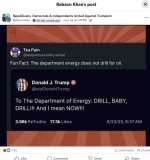
Once again, the Republican Party seems to be reviving its old “drill, baby, drill” playbook and pushing to make coal a central pillar of energy policy. There’s nothing inherently wrong with supporting traditional energy sectors, but we cannot give them priority while undermining wind and solar. That approach is short-sighted and ultimately damaging.

The Senate’s version of the so-called “Big Beautiful Bill” does exactly that. It cuts tax credits for renewable energy, introduces penalties, and threatens to derail America’s transition to clean energy. The effects are clear, energy costs for households are projected to rise, renewable investments are expected to slow just as demand is increasing, and America's position in the global energy race will be weakened.

China, by contrast, is charging ahead. It now accounts for nearly 60 percent of all new renewable energy capacity globally and is expected to install more solar in the next five years than the entire world did from 2001 to 2020. While the United States hesitates, China is building momentum.

This is about more than energy. It’s about jobs, national security, and whether the U.S. wants to lead or lag in a global transformation. Focusing solely on fossil fuels while neglecting renewables is not just outdated, it’s a strategic blunder.
To view this content we will need your consent to set third party cookies.
For more detailed information, see our cookies page.
 
Screenshot (31).jpg


2388e0b219ffd8158c08e5188e51e9d7 (1).webp

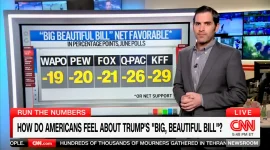
CNN has broken down a slew of new polls on how the American people view President Donald Trump’s federal spending proposals and it’s not looking good for the White House.

“If we’re talking about adjectives, how about they think it’s ‘awful’, ‘horrible’ and, to quote our colleague Charles Barkley, ‘terrible, terrible, terrible’,” network data guru Harry Enten said Monday.

He then pulled up a screen showing the results of surveys on Trump’s ‘Big Beautiful Bill’ from the Washington Post, Pew Research Centre, Fox News, Quinnipiac University and the Kaiser Family Foundation, showing disastrous net approval ratings of -19, -20, -21, -26, and -29 percent respectively. Source
 
This is the worst administration ever

To view this content we will need your consent to set third party cookies.
For more detailed information, see our cookies page.
 

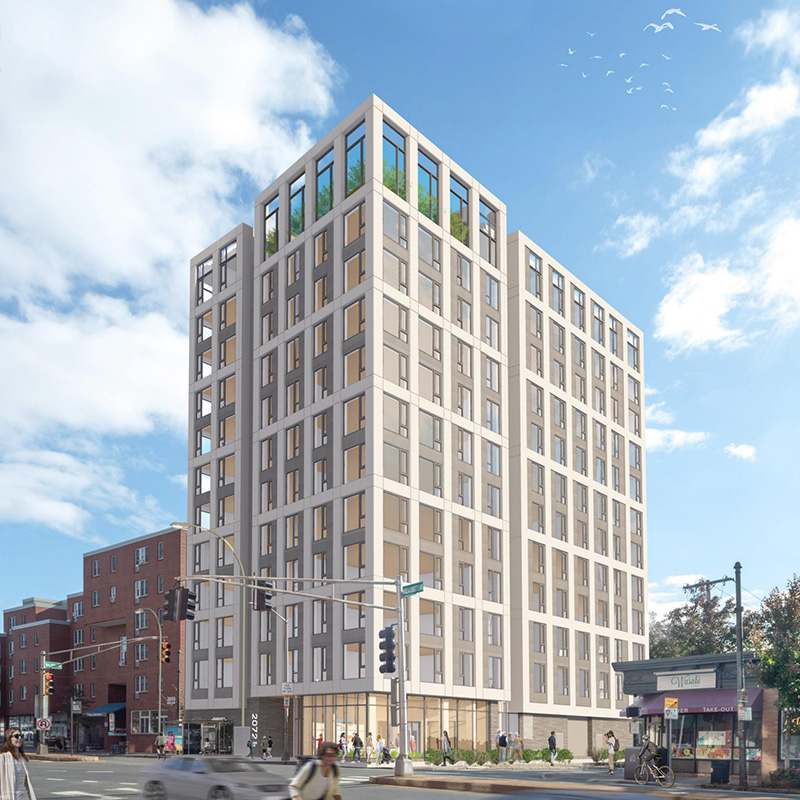
Twelve-story affordable housing project moves toward 2027 construction in North Cambridge​


A rendering of the housing project proposed for 2072 Massachusetts Ave. in North Cambridge.

An all-affordable apartment building is moving forward at 2072 Massachusetts Ave. under zoning changes made since its first version was withdrawn in August 2021 – then as high as nine stories with 49 homes, now 12 stories with 73 homes that would become available within four years.


Good 'ole Liberal Cambridge at its best again. You see they restricted the height of buildings for decades to around 8/9 stories because residents argued anything taller "ruined the character of the city". But oh now that the Sanctuary City people rolled in..well that just changes everything....let's get that quick zoning rewrite going and up it to 12 stories and probably over!!!! Lordy..Lordy...times a wastin'.

gotta love it


The City of Boston decades ago restricted the number of parking spaces in garages due to "air pollution concerns being an imminent health hazard to residents". With the popularity of electric cars there have been calls for EV exemptions because they don't pollute. However Liberal Boston said "actually its always been due to congested streets".

gotta love it


Speaking

(1) What is the MBTA Communities Law and what does it require?​

The MBTA Communities Act was adopted in January 2021, as part of legislation to strengthen the state’s economy. It was passed by broad bipartisan majorities in the legislature — the Senate voted unanimously in favor of the Act, and the House voted 143 in favor to 4 against. Governor Baker signed the Act into law on January 14, 2021. [Source: H.5250 (2020)]

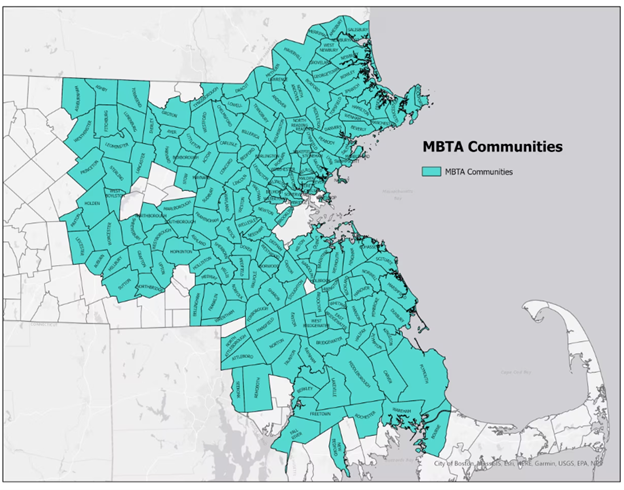
The MBTA Communities Act requires 177 Cities and Towns to establish “at least 1 district of reasonable size in which multi-family housing is permitted as of right.” Where possible, the district must be within a half mile from public transportation (commuter rail, bus station, ferry terminal or subway). MBTA Communities must permit the development of housing suitable for families with children, and may not impose age restrictions, within the district.

The state agency with responsibility for housing issues, known as the Executive Office of Housing and Livable Communities (or EOHLC), has detailed materials available to address questions about this law and help communities understand their obligations.

(2) Is compliance with the law mandatory?​

Yes. The law states clearly that 177 communities covered by the MBTA Communities Law “shall have a zoning ordinance or bylaw that provides for at least 1 district of reasonable size” that permits multi-family housing as of right.

The Attorney General’s Office has issued an advisory on this issue

mbta_communities_law_picture_0.png
 
Last edited:
Trump and Musk are clashing once again over Trump’s so-called “Big Beautiful Bill,” which Musk has slammed as insane, destructive, and a disgusting mistake. He warns it will explode the national debt and has threatened to form a new “America Party” to challenge Republicans who support it. Trump fired back, suggesting an investigation into the government subsidies received by Musk’s companies, and even hinted at reviewing Musk’s citizenship, a bizarre escalation.

I’m no fan of Musk, but on this issue he’s right. The bill is reckless at a time when our debt is already spiraling. I’d support serious primary challenges to Republicans who backed it, especially by true fiscal conservatives, something the party sorely lacks today. Both parties have become consumed by out-of-control spending.

I may not personally support Musk’s proposed political party, but I think it’s a fantastic idea. This country needs more voices, not fewer, and breaking the two-party monopoly could open the door to a more balanced, responsive political model.

That said, I still find it puzzling that Musk couldn’t persuade Trump earlier. With their close relationship and nearly $290 million in contributions, you'd think he'd have had leverage to push for fiscal restraint and forward-thinking policy. By many accounts, Trump listens behind closed doors, yet Musk couldn’t make the case stick. That’s a major missed opportunity.


To view this content we will need your consent to set third party cookies.
For more detailed information, see our cookies page.


To view this content we will need your consent to set third party cookies.
For more detailed information, see our cookies page.


To view this content we will need your consent to set third party cookies.
For more detailed information, see our cookies page.


To view this content we will need your consent to set third party cookies.
For more detailed information, see our cookies page.
 

Twelve-story affordable housing project moves toward 2027 construction in North Cambridge​


A rendering of the housing project proposed for 2072 Massachusetts Ave. in North Cambridge.

An all-affordable apartment building is moving forward at 2072 Massachusetts Ave. under zoning changes made since its first version was withdrawn in August 2021 – then as high as nine stories with 49 homes, now 12 stories with 73 homes that would become available within four years.


Good 'ole Liberal Cambridge at its best again. You see they restricted the height of buildings for decades to around 8/9 stories because residents argued anything taller "ruined the character of the city". But oh now that the Sanctuary City people rolled in..well that just changes everything....let's get that quick zoning rewrite going and up it to 12 stories and probably over!!!! Lordy..Lordy...times a wastin'.

gotta love it


The City of Boston decades ago restricted the number of parking spaces in garages due to "air pollution concerns being an imminent health hazard to residents". With the popularity of electric cars there have been calls for EV exemptions because they don't pollute. However Liberal Boston said "actually its always been due to congested streets".

gotta love it


Speaking

(1) What is the MBTA Communities Law and what does it require?​

The MBTA Communities Act was adopted in January 2021, as part of legislation to strengthen the state’s economy. It was passed by broad bipartisan majorities in the legislature — the Senate voted unanimously in favor of the Act, and the House voted 143 in favor to 4 against. Governor Baker signed the Act into law on January 14, 2021. [Source: H.5250 (2020)]

The MBTA Communities Act requires 177 Cities and Towns to establish “at least 1 district of reasonable size in which multi-family housing is permitted as of right.” Where possible, the district must be within a half mile from public transportation (commuter rail, bus station, ferry terminal or subway). MBTA Communities must permit the development of housing suitable for families with children, and may not impose age restrictions, within the district.

The state agency with responsibility for housing issues, known as the Executive Office of Housing and Livable Communities (or EOHLC), has detailed materials available to address questions about this law and help communities understand their obligations.

(2) Is compliance with the law mandatory?​

Yes. The law states clearly that 177 communities covered by the MBTA Communities Law “shall have a zoning ordinance or bylaw that provides for at least 1 district of reasonable size” that permits multi-family housing as of right.

The Attorney General’s Office has issued an advisory on this issue

mbta_communities_law_picture_0.png
I believe no one should be homeless in the richest country in the world. But the reality is, programs like Section 8 are plagued by abuse. Once people qualify and move in, they often never leave, even as their circumstances improve. Grown children remain in subsidized units long after they no longer qualify, and in many cases, the original tenant has moved out entirely. With limited staff, little oversight, and lenient policies, the system invites this kind of misuse. I saw it firsthand in New York and continue to witness it in Portland, where I run a business. Meanwhile, the government keeps expanding housing instead of fixing the flaws that allow these abuses to continue.
 
I believe no one should be homeless in the richest country in the world. But the reality is, programs like Section 8 are plagued by abuse. Once people qualify and move in, they often never leave, even as their circumstances improve. Grown children remain in subsidized units long after they no longer qualify, and in many cases, the original tenant has moved out entirely. With limited staff, little oversight, and lenient policies, the system invites this kind of misuse. I saw it firsthand in New York and continue to witness it in Portland, where I run a business. Meanwhile, the government keeps expanding housing instead of fixing the flaws that allow these abuses to continue.

While "mixed income" sounds like a good idea on paper in practice it doesn't usually work. What happens is troublemakers start living in the low income units and end up chasing away the middle income unit people...because these people can afford to move away when they see stuff they don't like. The only way to keep them is to subsidize their rent too. So the whole building goes unprofitable..

To make matters worse instead of kicking troublemakers out (which housing laws make tough to do) the only punishment is wrist slapping and excuses.
 
Last edited:
The outlook is only growing more uncertain. With the July 9th deadline looming, the EU has threatened retaliatory measures if the U.S. proceeds with the baseline 10% tariffs—while Trump has publicly floated rates as high as 50%. That’s not negotiation; it’s a threat aimed squarely at global supply chains.

On top of that, Trump abruptly ended all trade talks with Canada over its digital services tax, further isolating the U.S. on the international stage.

The consequences are already hitting home. Consumer confidence, which had shown signs of life last month, is sliding once again. Investor sentiment is deteriorating fast, with surveys signaling mounting pessimism. Revised GDP figures now show the economy contracted 0.5% more than previously estimated, starkly contrasting with the 2.4% growth recorded in Biden’s final quarter. Meanwhile, May’s core inflation increased more than expected, and both consumer spending and income are flashing warning signs of further weakening.

So yes, this is Trump’s economy, volatile, unpredictable, and increasingly disconnected from the global economic order. If this is the “art of the deal,” most Americans seem to be walking away from the table.
Well, I can tell you one thing you probably had never think of (at least for now)

Whatever happened to the TikTok deal? Did you know Trump just renewed the deadline again late June, and now they have to sell before September or be dismentle? And nobody is reporting it, and we no longer care about that.

First of all, if you need 2 extension (that's over 180 days) you are never going to sell it, unless Trump is looking to keep extending it for the next 3 and half year, that is a foregone conclusion. Why I am bringing this up? First of all, that's how he had done his "Deal" basically just dragging them on, if you can't close a single TikTok deal with a single government, you aren't going to have 80 deals coming in the next 6 days. That's just how this going to work.

The market is basically bouncing backward and forward, he is controlling the market now, and I am pretty sure if FDIC can investigate him or his family (which they can't do to a sitting President) they are going to find a bunch of irregularity over it. But that is not the issue I am talking about, the issue here is, if there are no deal, keep dragging on the tariff, hurt thew market more than instead of making it permanent or dropping it completely, because either way, we have a definite resolution, yes the market may tank if they make it official (or equally shoot up if Trump wave a white flag, but I digress) but you give time the market to absorb the damage and pulling it into the equabilium. Making it unknown by extending the deal time hurt more than just get it going and get it over with. Becuase people don't know what to do, are we going to buy now because you are dropping the tariff plan? Or are we going to going back to the drawing board because now we have to consider the tariff?

I have a business in China making steel pipe, and sell them to people who make fans and furniture in the US or just anywhere, a lot of our buyer talked to us (well, I didn't actually handle that but I know) they aren't going to buy anything from us because they don't even know how much to pay, and they have no way to get a similar deal from other country because that's going to be the same situation if they are buying in China or Vietnam (50% and 30% tariff) and no other country has the capability to replace those amount, I lost a bunch of business over this, but I know for a fact they won't survive because they either have to jack up the price of their fan or bedframe if they import it from somewhere else or they won't have enough stock if they buy from somewhere else, or both, on export side, you are talking about up to 30% price hike on cost, that is not going to be digested by those company in the US, they are running on around 15-20% profit margin, having them to pay 30% more, they may as well just sell nothing.

That is the issue with Tariff most people can't relate to. It may still not showing in the US because of the product surge between Fed to May, but once that surge ran out, and your warehouse is getting empty, that is when it hit, it may hit this July, this October or anytime, I don't know, but it will definitely hit before the end of his presidency . That's going to cost the GOP dearly if this is not resolve now, and it doesn't look likely this is going to be resolved now
 
Trump criticized Democrats for unanimously voting against his “One Big Beautiful Bill,” claiming it was “only because they hate Trump.” Then he added, “But I hate them too. I really do. I hate them because I believe they hate America.”

This kind of rhetoric is not only inflammatory, it’s dangerous. When a sitting president declares hatred for an entire political party, he’s effectively saying he hates over half the American population. And by suggesting that political disagreement equals hating the country, he crosses a line that undermines the very foundation of democratic dialogue.

What’s especially revealing is that Trump and Republican leadership made no serious effort to include Democrats in shaping the bill. There was no bipartisan negotiation, no outreach, just a party-line push followed by partisan condemnation when Democrats voted no. It's hard to accuse others of partisanship when you never offered them a seat at the table.

And let’s not forget who’s making these accusations. Trump was a registered Democrat for over eight years. In 2004, he said, “It just seems that the economy does better under the Democrats than the Republicans.”

He donated to Kamala Harris’s campaigns for California Attorney General, to Hillary Clinton’s Senate bids, and even gave $100,000 to the Clinton Foundation. Biden, Schumer, Reid, Kerry, his donation history reads like a who's who of Democratic leadership.

So, when he now claims that Democrats hate America, the question writes itself, if they’re so anti-American, why did he spend years funding their campaigns and echoing their policies?


To view this content we will need your consent to set third party cookies.
For more detailed information, see our cookies page.
 
While "mixed income" sounds like a good idea on paper in practice it doesn't usually work. What happens is troublemakers start living in the low income units and end up chasing away the middle income unit people...because these people can afford to move away when they see stuff they don't like. The only way to keep them is to subsidize their rent too. So the whole building goes unprofitable..

To make matters worse instead of kicking troublemakers out (which housing laws make tough to do) the only punishment is wrist slapping and excuses.
I hear where you're coming from on mixed-income housing. It often sounds promising on paper, but the way it plays out can be deeply frustrating. Still, I think the idea has real merit, if done right. Creating economically diverse communities could help prevent the concentrated poverty dynamics we’ve seen in older public housing models.

But without strong rules and real accountability, it doesn’t just fall short, it can backfire. When middle-income residents are expected to tolerate repeated issues without meaningful recourse, and the unspoken “solution” is for them to quietly leave, the entire model becomes unsustainable.

Massachusetts has been a testing ground for many of these initiatives, so I understand the skepticism. Even the best funding structures or design principles won't mean much if you can’t maintain basic safety and order. That’s the missing piece. Without it, a promising concept risks becoming a cautionary tale.

Washington has also been experimenting with mixed-income housing. A few developments exist in my own city, and I’m following how they evolve.
 
@RabzonKhan

Over at Zero hedge, comment section, many are talking about voting Demwit for the first time.

We are fed up with Trump.
That's surprising to hear. What pushed you and others to reconsider Trump? Is it a deeper shift, or more of a reaction to recent events?
 
Well, I can tell you one thing you probably had never think of (at least for now)

Whatever happened to the TikTok deal? Did you know Trump just renewed the deadline again late June, and now they have to sell before September or be dismentle? And nobody is reporting it, and we no longer care about that.

First of all, if you need 2 extension (that's over 180 days) you are never going to sell it, unless Trump is looking to keep extending it for the next 3 and half year, that is a foregone conclusion. Why I am bringing this up? First of all, that's how he had done his "Deal" basically just dragging them on, if you can't close a single TikTok deal with a single government, you aren't going to have 80 deals coming in the next 6 days. That's just how this going to work.

The market is basically bouncing backward and forward, he is controlling the market now, and I am pretty sure if FDIC can investigate him or his family (which they can't do to a sitting President) they are going to find a bunch of irregularity over it. But that is not the issue I am talking about, the issue here is, if there are no deal, keep dragging on the tariff, hurt thew market more than instead of making it permanent or dropping it completely, because either way, we have a definite resolution, yes the market may tank if they make it official (or equally shoot up if Trump wave a white flag, but I digress) but you give time the market to absorb the damage and pulling it into the equabilium. Making it unknown by extending the deal time hurt more than just get it going and get it over with. Becuase people don't know what to do, are we going to buy now because you are dropping the tariff plan? Or are we going to going back to the drawing board because now we have to consider the tariff?

I have a business in China making steel pipe, and sell them to people who make fans and furniture in the US or just anywhere, a lot of our buyer talked to us (well, I didn't actually handle that but I know) they aren't going to buy anything from us because they don't even know how much to pay, and they have no way to get a similar deal from other country because that's going to be the same situation if they are buying in China or Vietnam (50% and 30% tariff) and no other country has the capability to replace those amount, I lost a bunch of business over this, but I know for a fact they won't survive because they either have to jack up the price of their fan or bedframe if they import it from somewhere else or they won't have enough stock if they buy from somewhere else, or both, on export side, you are talking about up to 30% price hike on cost, that is not going to be digested by those company in the US, they are running on around 15-20% profit margin, having them to pay 30% more, they may as well just sell nothing.

That is the issue with Tariff most people can't relate to. It may still not showing in the US because of the product surge between Fed to May, but once that surge ran out, and your warehouse is getting empty, that is when it hit, it may hit this July, this October or anytime, I don't know, but it will definitely hit before the end of his presidency . That's going to cost the GOP dearly if this is not resolve now, and it doesn't look likely this is going to be resolved now
Even though I’ve never used TikTok, haven’t even visited the site, it’s very much on my radar. I follow its developments closely, because whether we like it or not, TikTok has become one of the most politically influential platforms in America. In fact, young voters, women, Latino, and Black Americans are overrepresented on TikTok compared to their share of the general population. That’s why both the Trump and Biden campaigns couldn’t afford to ignore it in 2024, even though both had previously supported banning it.

By election season, TikTok wasn’t just an app. It was a battleground, a real-time arena for shaping public opinion, swaying young minds, and tracking political sentiment faster than any pollster could.

And that’s where my concern comes in. The current frontrunners to buy TikTok, Kevin O’Leary (a Canadian businessman), Steve Mnuchin, and Larry Ellison, are all openly supportive of Trump. That’s their right, of course. But what worries me is what happens when a politically powerful algorithm lands in the hands of people who have an interest in shaping the narrative. We’ve seen what happened when Elon Musk took over Twitter, mainstream content moderation gave way to fringe voices, conspiracy theories, and coordinated disinformation. If TikTok is steered, even subtly to amplify one side, that could warp the political landscape for millions of young voters who rely on the app as a news source.

Trump’s tariff war is already hitting small businesses harder than anyone seems willing to admit. I completely understand the business challenges you’ve been facing, three of my close friends have also experienced serious consequences. Two used to import Chinese-made products and sell them on Amazon, but their inventories dried up and they’ve stopped restocking because of unpredictable tariffs ranging from 30% to 55%. Another had a supply deal through a major U.S. franchise that’s now collapsing, he’ll be out of business in a few weeks if things don’t change. These aren’t theoretical impacts. This is real loss, in real time.

And now, with Trump threatening a 70% tariff on countries without a finalized deal by July 9th, the climate of fear and paralysis is only deepening. And for entrepreneurs, uncertainty is a slow, corrosive poison. You can’t plan for chaos. You can’t invest in limbo. And as both of us agree, the damage here isn’t just economic, it’s systemic. The rules keep changing, and in business, that’s the one thing you simply can’t afford.
 
Just a quick note, I’ve got a 9:00 AM appointment, so I’ll be stepping away for a bit. I’ll be back later to continue the conversation.
 

Users who are viewing this thread

Pakistan Defence Latest

Back
Top