Uzbekistan Unveils J-10CE Fighters as China Breaks Russia’s Grip on Central Asia
Uzbekistan’s display of six Chinese J-10CE fighters at Karshi-Khanabad Air Base signals a major airpower transition, expanding Beijing’s defence influence while challenging Russia’s historic dominance across Central Asia.
On
Aug 30, 2026
Uzbekistan J-10CE
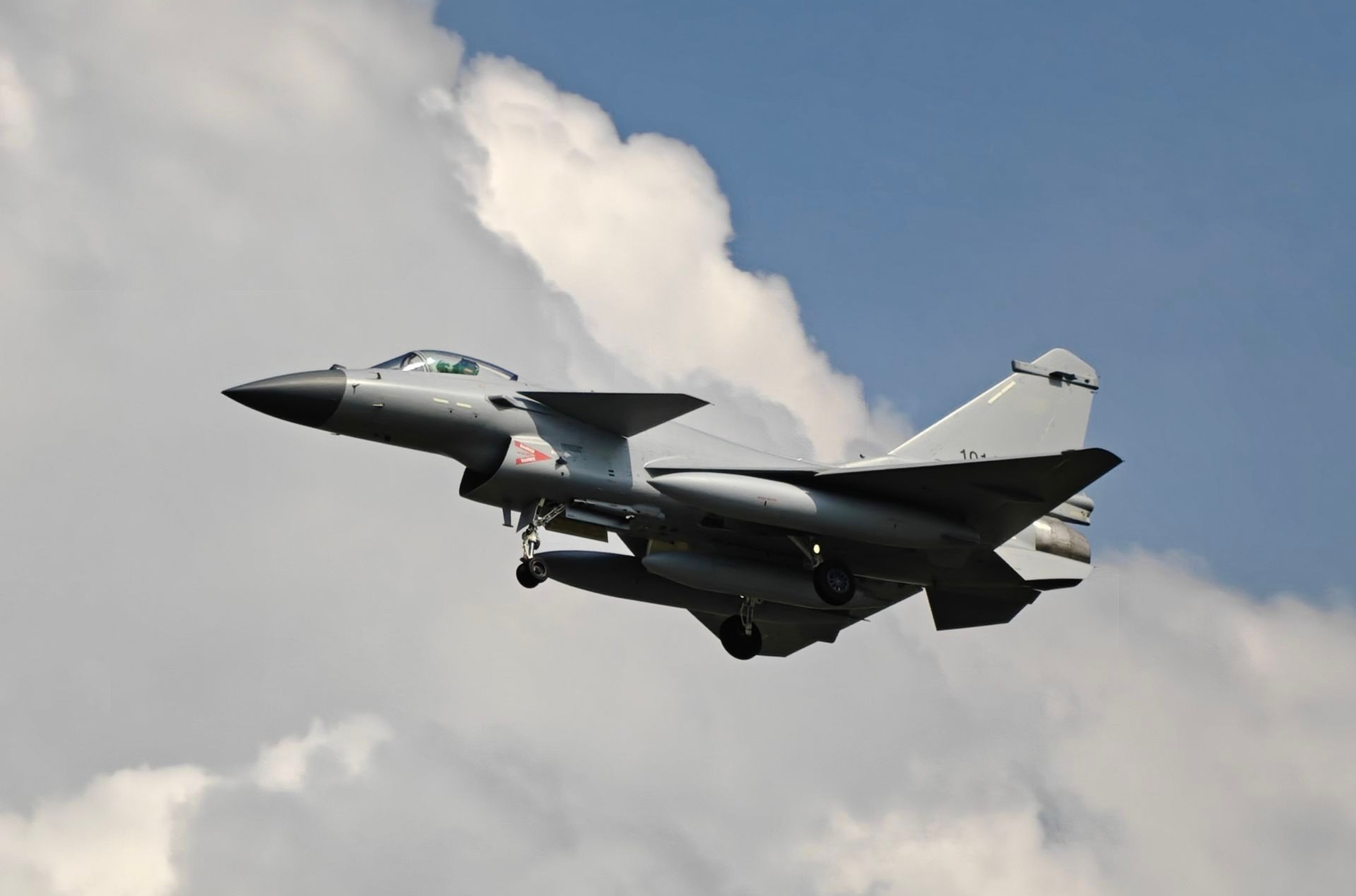
Uzbekistan has publicly displayed six Chinese-built J-10CE multirole fighters operating from Karshi-Khanabad Air Base, delivering the clearest visual evidence that Beijing has penetrated a strategically important combat-aviation market historically dominated by Moscow.
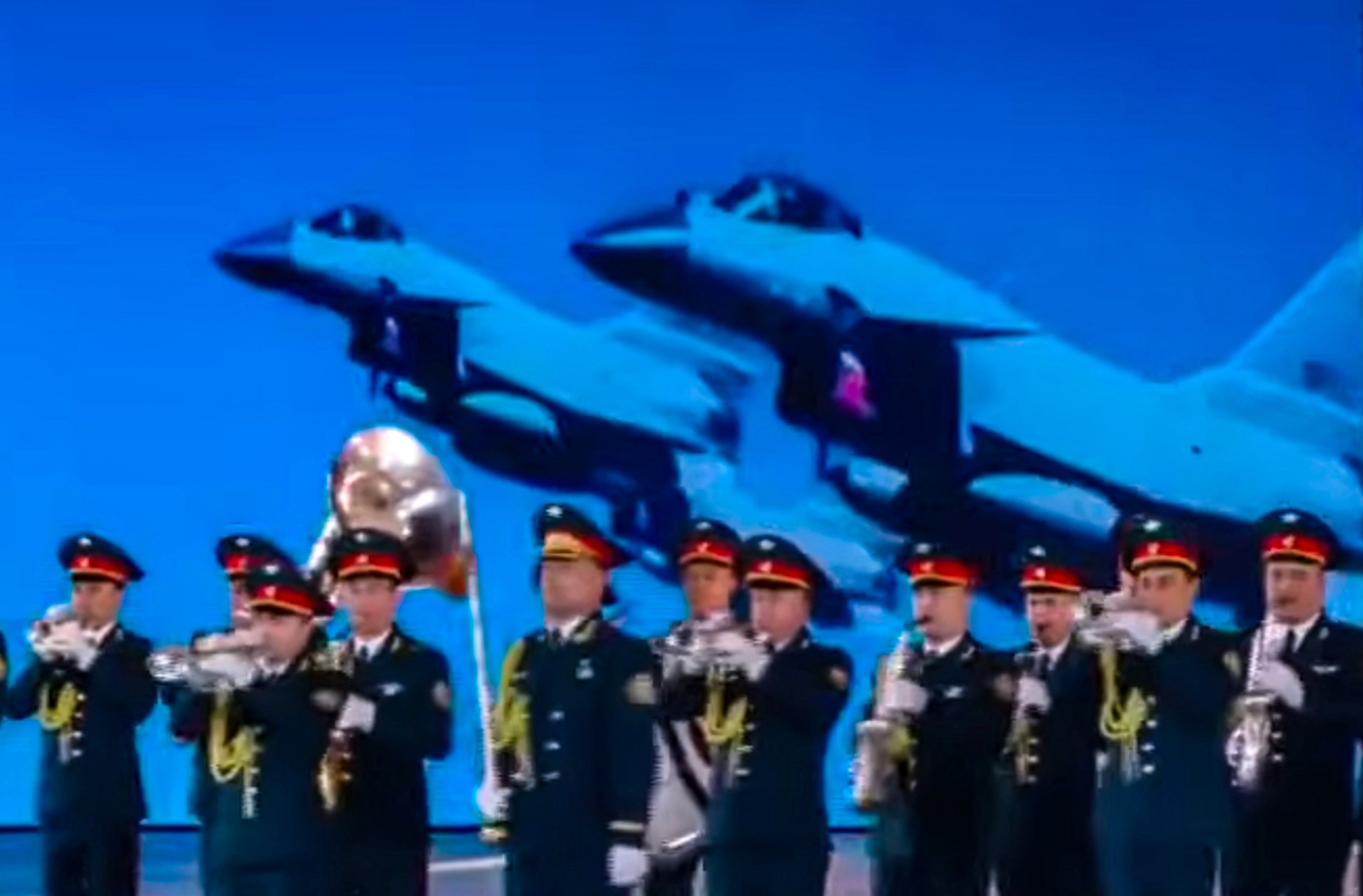
Broadcast during Uzbekistan’s thirty-fifth Independence Day celebrations on August 28, 2026, the footage showed the aircraft flying and landing at the strategic K2 facility in Kashkadarya, including one fighter numbered 1014.
The appearance transforms months of obscured photographs, local sightings and reported deliveries into visible force-posture signalling, although neither Tashkent nor Beijing has released a comprehensive joint announcement confirming the programme’s contractual architecture.
Reportedly covering 24 aircraft, weapons, training and support for approximately US$1 billion, the acquisition would give Uzbekistan a modern beyond-visual-range capability while reducing dependence upon deteriorating Soviet-era fleets and uncertain Russian sustainment.
That reported order remains insufficiently documented publicly, because no original ministerial transcript or government contract has been widely released, while Uzbek authorities previously maintained caution and sometimes denied possessing relevant information.
Nevertheless, six aircraft appearing together at an operational air base strongly indicate that conversion has progressed beyond evaluation, requiring trained pilots, maintainers, ground equipment, secure facilities and an emerging Chinese-aligned logistics pipeline.
The J-10CE’s active electronically scanned array radar, modern electronic warfare suite and PL-15E missile potentially replace Uzbekistan’s ageing MiG-29 engagement model with networked detection, improved electronic resilience and substantially longer-range interception.
This is consequently more than a fighter replacement, because introducing Chinese sensors, data links and weapons into Central Asia changes how neighbouring air forces calculate warning time, survivability, dispersal and escalation.
For Russia, the broadcast exposes gradual erosion within a former captive market, where Moscow’s wartime production priorities, sanctions-related pressures and inconsistent export support have encouraged customers to diversify critical military dependencies.
For China, Uzbekistan offers a second J-10CE export operator after Pakistan and a strategically valuable demonstration that Chinese combat aircraft can compete inside former Soviet security space without demanding formal alliance realignment.
Tashkent is therefore signalling strategic autonomy rather than geopolitical defection, preserving security cooperation with Moscow while acquiring Chinese combat power that expands procurement leverage and limits vulnerability to any single supplier.
The decisive question is no longer whether J-10CE fighters have reached Uzbekistan, but how quickly crews, weapons, infrastructure and command networks can convert visible airframes into sustainable operational combat capability.
Six J-10CE Fighters Turn Reported Procurement Into Visible Force Posture
The television footage showed six J-10CE fighters airborne and recovering at Karshi-Khanabad, converting previously fragmented evidence into a coordinated public display that carries greater military and diplomatic weight than isolated sightings.
Karshi-Khanabad provides a significant operational setting because public positioning at an established air base implies infrastructure preparation, security arrangements, maintenance activity and command integration extending beyond a ceremonial delivery event.
Earlier photographs taken during testing or pre-delivery activity in China reportedly showed aircraft with obscured markings, including serial 1020, while local observers subsequently described unmarked or numbered fighters operating over Uzbekistan.
Reports claimed the first two aircraft arrived in Tashkent on July 2, 2025, followed by possibly four additional fighters around July 2026, broadly matching the six-aircraft formation televised the following month.
Those reported delivery dates have not been independently established through a complete official record, yet their apparent sequence is consistent with phased induction alongside pilot and maintainer conversion training conducted in China.
A six-aircraft initial element could support conversion training, alert evaluation and tactical development, but it would not alone establish squadron-level readiness, sustained sortie generation or geographically distributed air-defence coverage.
Operational credibility depends upon serviceable aircraft numbers, trained crews, missile stocks, spare engines, diagnostic equipment and repair capacity, none of which were disclosed by the broadcast or detailed through authoritative documentation.
The public reveal nevertheless creates immediate deterrent signalling by forcing regional planners to assume some J-10CE availability, even before Uzbekistan demonstrates combat-coded pilots, integrated ground control or successful live beyond-visual-range firing.
One visible tail number cannot confirm the complete fleet sequence, while the absence of sufficiently clear imagery covering all reported aircraft prevents reliable conclusions regarding final configuration, specific production batches or delivery completeness.
The broadcast therefore establishes physical presence rather than full operational capability, narrowing one intelligence gap while leaving readiness, weapons integration, basing concepts, force protection and wartime sortie sustainability unresolved.
AESA Radar and PL-15E Missiles Reshape Uzbekistan’s Air-Combat Reach
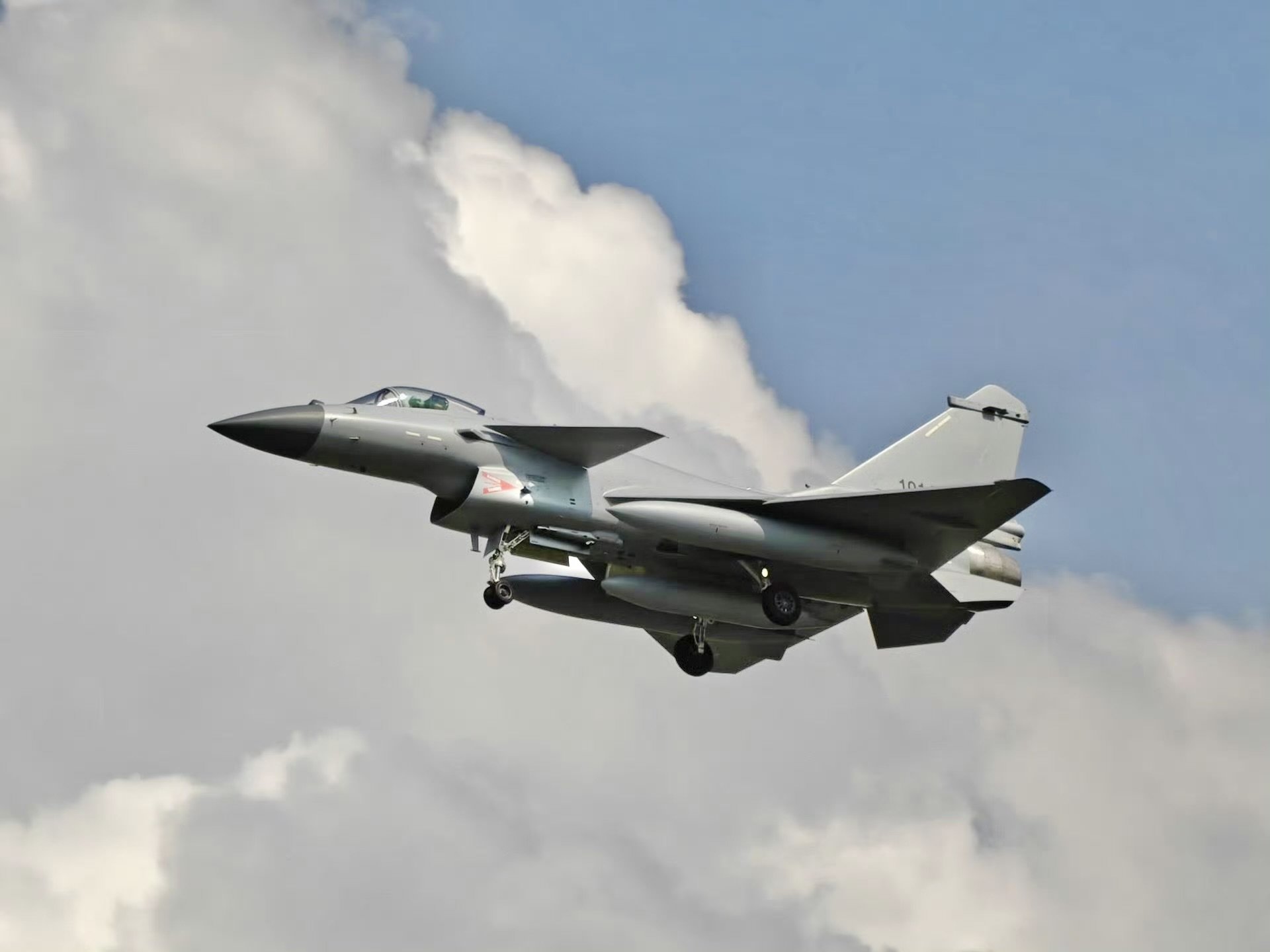
The J-10CE is a single-engine, 4.5-generation multirole fighter whose canard-delta configuration combines agility with eleven external hardpoints, an internal 23-millimetre cannon and an estimated weapons payload between 5,600 and 6,000 kilograms.
Powered by a Chinese WS-10B afterburning turbofan reportedly generating approximately 135–144 kilonewtons, the export fighter also reduces direct propulsion reliance upon Russian-built AL-31-series engines associated with earlier J-10 variants and supply arrangements.
Published performance estimates place maximum speed between Mach 1.8 and Mach 2.0, service ceiling near 18,000 metres and combat radius between 550 and 1,240 kilometres depending upon weapons, fuel and configuration.
These published figures vary substantially with fuel, altitude, weapons and external tanks, meaning they should frame possible mission envelopes rather than serve as guaranteed operational performance under demanding Central Asian environmental conditions.
Its central advantage over Uzbekistan’s legacy MiG-29s is an AESA radar, commonly associated with the KLJ-7A or KLJ-10 families, reportedly offering longer detection, multitarget tracking and stronger resistance against electronic jamming.
Open estimates frequently place fighter-target detection between 170 and more than 220 kilometres, although radar cross-section, engagement geometry, electronic attack, atmospheric conditions and export configuration would materially determine achievable combat performance.
An infrared search-and-track sensor, helmet-mounted sight, glass cockpit, electronic warfare suite and data links could provide improved sensor fusion, passive detection and cooperative engagement compared with mechanically scanned Soviet-era systems.
The PL-15E active-radar missile, reportedly reaching approximately 145 kilometres under export parameters, combines a dual-pulse motor, two-way data link and advanced seeker to support longer-range beyond-visual-range interception against manoeuvring aerial targets.
For close combat, the high-off-boresight PL-10 paired with helmet cueing could expand engagement geometry, while potential precision-strike, anti-radiation and anti-ship options would support broader multirole mission development and tactical flexibility.
Uzbekistan’s precise weapons package remains publicly undisclosed, making it analytically unsound to equate aircraft presence automatically with PL-15E availability, sufficient missile inventories, mature networked targeting or a genuinely operational precision-strike capacity.
Chinese Logistics Replace a Fading Soviet-Era Fighter Ecosystem
Uzbekistan inherited substantial MiG-29 and Su-27 inventories after the Soviet collapse, but ageing airframes, constrained serviceability and unreliable Russian support increasingly weakened the practical value of that numerical inheritance.
Reports often describe approximately twelve operational MiG-29s alongside Su-25 attack aircraft, although limited transparent readiness data prevents firm assessment of flyable strength, remaining fatigue life, pilot availability or wartime endurance.
Tashkent explored Russia’s Su-30SM during 2017–2019, including possible credit financing, while the French Rafale was reportedly rejected as too expensive, leaving neither pathway translated into a funded and deliverable acquisition programme.
The J-10CE offered a reported unit estimate of US$40–50 million and an approximately US$1 billion complete package, materially below likely Western acquisition and support costs but still officially unconfirmed.
Lower purchase price alone cannot determine affordability because sustainable combat power depends upon flying-hour costs, engine reserves, missile replenishment, depot maintenance, software support and long-term access to Chinese technicians.
Uzbekistan already operates Chinese HQ-9B, KS-1C and FM-90 air-defence systems, creating institutional familiarity with Chinese training, technical documentation and supply practices before high-performance combat aviation entered the expanding bilateral defence relationship.
That foundation may ease administrative integration, yet fighters impose more demanding requirements involving flight safety, propulsion maintenance, mission-data management, weapons handling and continuous aircrew proficiency than ground-based missile systems.
A mixed Chinese and Soviet-origin force could preserve capacity during transition, but parallel supply chains, incompatible test equipment and differing tactical doctrines will increase logistics complexity and personnel burdens.
If Uzbek examples lack an in-flight refuelling probe, as some reporting suggests, their endurance and deployment flexibility would depend more heavily upon external tanks, forward basing and carefully positioned ground support.
The programme’s real benchmark will therefore be sortie generation over several years, because ceremonial availability cannot substitute for stocked spares, qualified maintainers, resilient runways and nationally controlled mission planning.
Beijing Enters Russia’s Former Combat-Aviation Stronghold
For decades, Russia exercised near-monopoly influence over Central Asian combat aviation through inherited fleets, common training systems, technical dependence and established military relationships that made alternative suppliers operationally expensive.
The Uzbek acquisition challenges that structure at its most prestigious level, moving Chinese exports beyond drones and surface-to-air missiles into advanced fighters that shape sovereignty, deterrence and national command authority.
Russia’s war in Ukraine has redirected industrial output toward domestic requirements, while sanctions and supply pressures have weakened perceptions of predictable export delivery, maintenance support and future upgrade access.
Available arms-transfer assessments indicate Russian exports have fallen sharply, but Uzbekistan’s choice should be interpreted as erosion of Moscow’s supplier dominance rather than evidence that Russian regional influence has disappeared.
Moscow retains economic ties, military engagement and legacy-system leverage, while a renewed Uzbekistan-Russia framework for 2026–2030 reportedly envisages dozens of bilateral exercises despite Tashkent’s strategically significant acquisition of Chinese fighters.
Uzbekistan left the Russian-led Collective Security Treaty Organization in 2012 and resisted rejoining, giving its procurement diversification clear continuity with a longstanding multi-vector foreign policy rather than a sudden strategic rupture.
China’s expanding trade, investment and Belt and Road infrastructure provide the wider geopolitical foundation, with some reporting placing Beijing near 28 percent of Uzbekistan’s foreign trade by early 2026.
Selling the J-10CE extends that influence into combat-aviation training, sustainment and software-dependent capability, potentially creating decades of technical and operational interaction without requiring Uzbekistan to become a formal Chinese military ally.
Within the Shanghai Cooperation Organization, the deal illustrates simultaneous Sino-Russian partnership and competition, as both powers support regional stability while Beijing steadily occupies defence-industrial space once dominated by Moscow.
Central Asian governments may study Uzbekistan’s experience closely, because reliable aircraft availability, effective weapons integration and manageable lifecycle costs could create a demonstration effect favouring Chinese fighters across other diversification-minded defence markets.
Strategic Autonomy Rises, but Operational Uncertainty Remains
Uzbekistan’s decision reportedly predates the May 2025 India-Pakistan clashes involving Pakistani J-10CEs, indicating the procurement reflected longer assessments of availability, price and supplier diversification rather than retrospective combat publicity.
Pakistan’s status as the first export operator still provides China with an operational reference, whereas Uzbekistan’s introduction tests whether Beijing can sustain the aircraft inside a different doctrine, climate and maintenance culture.
Regionally, AESA-equipped fighters and long-range missiles compress decision time by enabling earlier detection and engagement, compelling neighbouring commands to reassess aircraft dispersal, electronic protection, airborne warning coverage and hardened-base survivability.
This capability does not automatically produce offensive intent, because modern fighters can strengthen air-policing and territorial defence while simultaneously creating latent strike options that influence crisis calculations beyond Uzbekistan’s borders.
The aircraft’s possible ground-mapping, moving-target indication and electronic warfare functions could eventually connect air defence with precision attack, but the absence of disclosed weapons and doctrine limits confident mission assessment.
Strategic autonomy will depend upon whether Uzbekistan controls mission data, maintenance decisions and weapons employment independently, because replacing one external dependency with another would narrow the political benefit of diversification.
Beijing gains reputational value from every successful sortie, yet any reliability, training or support failure would damage the J-10CE’s competitiveness in markets comparing Chinese delivery certainty against Russian and Western alternatives.
Tashkent must also protect K2 and supporting infrastructure against surveillance, sabotage and precision attack, since concentrating scarce advanced aircraft, specialist personnel and maintenance assets can create lucrative targets despite improving national air-combat capability.
Future indicators should include additional numbered aircraft, established squadrons, live-missile exercises, integrated air-defence drills and sustained deployment beyond Karshi-Khanabad, rather than relying upon ceremonial imagery or anonymous procurement claims.
The six-fighter reveal ultimately marks a consequential shift in Central Asian airpower, but its geopolitical weight under crisis conditions will be determined by operational readiness, logistics resilience and Uzbekistan’s continued balance between China and Russia.
Uzbekistan unveils six Chinese J-10CE fighters, challenging Russia’s defence dominance and reshaping the strategic airpower balance across Central Asia.

defencesecurityasia.com