Venezuela - US Conflict: News, Updates

That was fast. Venezuelan oil is already being sold. But where is the money going ?


Most likely Donald Trumps personal bank account in Qatar..


?
 
Venezuela opens its oil industry to private investors in a marked shift from nationalization to privatization of its oil industry.

"Venezuela’s acting President Delcy Rodríguez on Thursday signed a law that opens the nation’s oil sector to privatization, reversing a tenet of the self-proclaimed socialist movement that has ruled the country for more than two decades."

 
To view this content we will need your consent to set third party cookies.
For more detailed information, see our cookies page.
 
Nothing for American taxpayers. Zero benefit.

But immediately went to Israeli taxpayers.

To view this content we will need your consent to set third party cookies.
For more detailed information, see our cookies page.
 

US official in Venezuela to reshape oil industry

Reuters
February 12, 2026

1770901463408.png

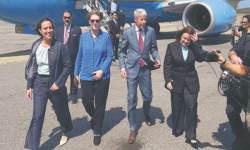
US Energy Secretary Chris Wright (second right) walks next to the new head of the United States diplomatic mission for Venezuela, Laura Dogu, upon his arrival at Caracas airport.—AFP

HOUSTON: Venezuela is hosting US Secretary of Energy Chris Wright starting on Wednesday, marking the highest-level US visit focused on energy policy to the Opec nation in nearly three decades, as Washington conducts its first on-the-ground assessment of the oil industry it is proposing to rebuild.

Wright landed in Caracas on Wednesday morning, a day after the US issued a new general license to facilitate the exploration and production of oil and gas in Venezuela. His agenda is expected to include meetings with interim President and Oil Minister Delcy Rodriguez, government officials and executives from companies including Chevron and Spain’s Repsol, said sources familiar with the preparations.

Wright is expected to stay through Friday and meet with local consumer goods companies before visiting Petropiar, the largest oil project Chevron and state energy company PDVSA operate, in Venezuela’s main oil region, the Orinoco Belt.

The trip follows the capture of President Nicolas Maduro by US forces in early January, a $2 billion oil supply deal agreed to by the US and Venezuela shortly after, and a $100 billion reconstruction plan for the country’s energy industry promoted by President Donald Trump.

The US embassy in Caracas, which began reopening in late January, said Wright’s visit would be key to advancing Trump’s vision for Venezuela. “The US private sector will be essential to boost the oil sector, modernise the electric grid, and unlock Venezuela’s enormous potential,” Charge d’Affaires Laura Dogu wrote in a post on X.

The last US energy secretary to travel to Venezuela was Bill Richardson, who made several trips between 1998 and 2001 under former President Bill Clinton. Visits to Caracas by high-ranking US officials have been virtually nonexistent since, as the bilateral relationship with former President Hugo Chavez and then Maduro was strained.
 
Herculean task

Wright faces the Herculean task of organising the recovery of Venezuela’s oil industry after decades of underinvestment, mismanagement and US sanctions, while putting US investors at the front of the line. He will face a political context that is still volatile after a high-profile opposition leader was released from jail this week, only to be re-arrested hours later.

Wright’s visit reflects a longer-term US geostrategic interest in Venezuelan oil as Washington seeks to reshape global energy markets while pressuring Russia, according to Thomas O’Donnell, an analyst who specializes in energy geopolitics.

The Trump administration has moved beyond detaching Venezuela from Russian and Chinese influence to pursuing a “doctrine of American energy dominance” that could provide the US capacity to eventually take Russian oil offline if geopolitically required, he said.

“This is an active geostrategic, geo-economic plan to use American oil abundance and cooperation with the Saudis and the United Arab Emirates and other Gulf States and Venezuela and Guyana to reshape the global oil market,” he added. Venezuela’s National Assembly last month approved a sweeping reform to the country’s primary oil law, which grants operational and financial autonomy to foreign producers as a first step to encourage investment.
 
To view this content we will need your consent to set third party cookies.
For more detailed information, see our cookies page.
 

Deposed Venezuelan President Nicolas Maduro asks judge to toss out indictment against him​


The lawyer for deposed Venezuelan President Nicolas Maduro asked a judge on Thursday to toss out the indictment against his client on the grounds that the United States has unconstitutionally violated his rights to defend himself by blocking Venezuelan funds to pay his legal costs.

Attorney Barry Pollack filed papers in Manhattan federal court, saying the U.S. government has violated his client’s due process rights by blocking funds to defend him that should come from the Venezuelan government.

“Mr. Maduro, as Venezuela’s head of state, has both a right and an expectation to have legal fees associated with these charges funded by the government of Venezuela,” Pollack wrote.

The court submission included a declaration from Maduro in which he said he understood that under the laws and practices of Venezuela, “I am entitled to have the government of Venezuela pay for my legal defense.”

“I have relied on this expectation and cannot afford to pay for my own legal defense,” he said.

Maduro added that he has “been working” with Pollack on his legal defense and that he “is my counsel of choice.” The declaration was signed “President Nicolas Maduro Moros.”

Maduro and his wife have been in custody in New York since they were seized from their Venezuelan home in early January in a stealth nighttime U.S. military operation. They’ve pleaded not guilty.


A 25-page indictment against Maduro accused him and others of working with drug cartels and members of the military to facilitate the shipment of thousands of tons of cocaine into the U.S. If convicted, both he and his wife face life in prison.

As part of the purported conspiracy, Maduro and his wife allegedly ordering kidnappings, beatings and murders of those who owed them drug money, according to the indictment. It said that included the killing of a local drug boss in Caracas.

Pollack told a Manhattan judge in an email last week that the U.S. Treasury Department had blocked the authorization of legal fees that the government of Venezuela is required to pay for Maduro, though it has allowed fees to be paid for the defense of first lady Cilia Flores.

Pollack said that the Treasury Department’s Office of Foreign Assets Control, which administers sanctions against Venezuela, had granted permission on Jan. 9 approving the payment of legal fees by the Venezuelan government. He said the department rescinded the authorization “without explanation” less than three hours later.

“The conduct of the United States government not only undermines Mr. Maduro’s rights but also this Court’s mandate to provide a fair trial to all defendants who come before it in accordance with the protections afforded by the U.S. Constitution,” Pollack wrote in court papers submitted Thursday.

“The United States government, even while authorizing myriad commercial transactions with Venezuela, is prohibiting counsel from receiving untainted funds from the government of Venezuela, despite Venezuela’s obligation to fund Mr. Maduro’s defense. Any trial that proceeds under these circumstances will be constitutionally defective and cannot result in a verdict that will withstand later challenge,” he added.

The U.S. Department of Justice did not immediately respond to a message left by The Associated Press seeking comment.

If the judge leaves the charges against Maduro in place, Pollack said he wants to resign so the court can appoint other counsel to represent Maduro.


The dispute over Maduro’s legal fees is intimately linked to U.S. foreign policy. The first Trump administration cut ties with Maduro in 2019, recognizing the then- opposition head of the National Assembly as Venezuela’s legitimate leader. The Biden administration hewed closely to the same policy.
 
Interestingly, I have to believe Maduro has a point. I wonder how the judge is going to rule.
 
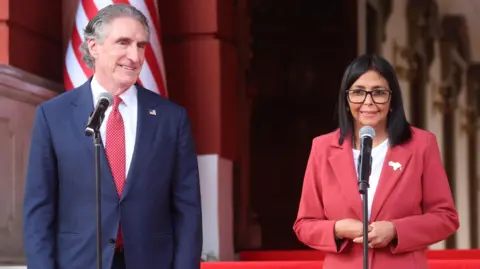
Doug Burgum, wearing a blue suit and red tie, stands behind a microphone beside Delcy Rodriguez, who is wearing a in a red suit and white blouse.

Venezuela and US to work together on mining developments, Rodríguez says​


Venezuela's interim president made the announcement after meeting with US interior minister Doug Burgum at the presidential palace in Caracas.
 
American involvement in wars linked to oil primarily centers on securing global energy stability and access, notably the 1991 Gulf War (Iraq's invasion of Kuwait for oil reserves) and the 2003 Iraq War (debated motives, but oil's strategic importance was central), with recent tensions also involving Venezuela over its massive reserves. These conflicts, alongside U.S. support for oil-rich regimes, highlight how vital oil flows have shaped American foreign policy, often involving military intervention to protect supply routes and interests, though the direct causes are complex.

Key Conflicts & U.S. Involvement:
  • Gulf War (1990-1991): Triggered by Iraq's invasion of Kuwait to seize oil, the U.S. led a coalition to liberate Kuwait, securing vital energy supplies and regional stability.
  • Iraq War (2003-2011): While official reasons included WMDs, oil's strategic importance and Iraq's vast reserves were significant underlying factors, with the U.S. concerned about controlling oil-rich regions and preventing instability. :coffee:
  • Middle East Policy (1970s-Present): U.S. policy focused on protecting oil-producing states, militarizing the Persian Gulf, and ensuring free passage of oil, leading to deep involvement in the region's complex politics and conflicts.

further to the above post,

=>
.
NATO's involvement in "oil-related" conflicts focuses on securing energy supplies, protecting critical infrastructure, and ensuring regional stability, often in volatile regions like the Middle East. While founded for defense against the Soviet Union, NATO operations—such as in Libya (2011) and the Gulf War (1990–1991)—have been criticized as driven by Western interests in resource-rich nations.

Key Historical Context and Conflicts

"1973 Oil Crisis": Arab states aimed oil embargoes at Western nations (including NATO members) as a "weapon" in response to political conflict, triggering major price shocks and defining oil as a core national security issue.

"The Gulf War (1990–1991)": Triggered by Iraq's invasion of Kuwait, this conflict was heavily motivated by the need to secure global oil supplies and protect strategic interests in the Middle East.

"Libya Intervention (2011)": NATO's intervention to overthrow Muammar Gaddafi was authorized to protect civilians, but observers have noted the speed of action in an oil-rich nation, suggesting a strategic interest in oil, according to Al Jazeera and this Jamestown Foundation article.

"NATO Pipeline System (NPS)": Established during the Cold War, the NPS is a massive, flexible network designed to ensure reliable fuel supply for Alliance forces across Europe.

NATO Strategy and Energy Security

Strategic Interest: Beyond direct conflict, NATO focuses on protecting maritime routes and pipelines (like those in the Black Sea) that are critical for transporting Caspian Sea or Middle Eastern oil to Europe.

Shift to Expeditionary Focus: Post-Cold War, NATO transformed its fuel infrastructure to support rapid, out-of-area deployment rather than just static, home-territory defense.

Resource Dependence: While not all NATO operations are for oil, the alliance inherently acts to safeguard the economic and energy interests of its member states, making energy security a "silent" factor in many interventions, per this Counterfire article.

.
 
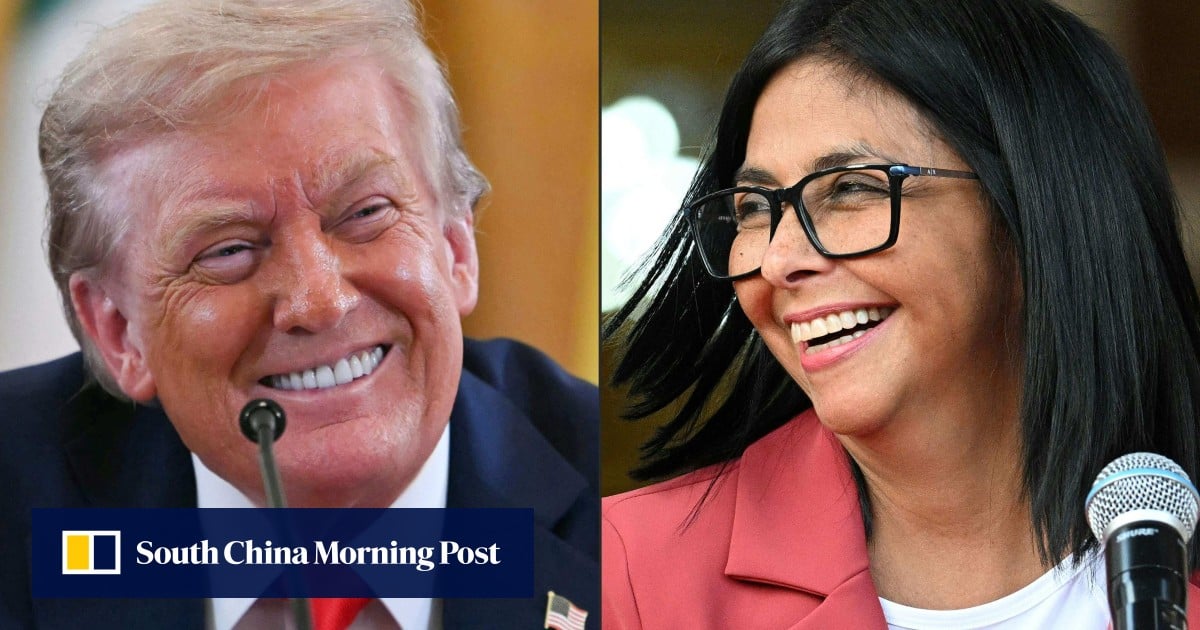
US lifts sanctions on Venezuela’s acting President Rodriguez, who praises Trump
The United States on Wednesday lifted sanctions on Venezuela’s acting President Delcy Rodriguez, according to an Office of Foreign Assets Control entry on the Treasury Department website.
 
US lifts sanctions on Venezuela’s acting President Rodriguez, who praises Trump
The United States on Wednesday lifted sanctions on Venezuela’s acting President Delcy Rodriguez, according to an Office of Foreign Assets Control entry on the Treasury Department website.
Saw it pop up on the news. Haven't read anything in detail yet.
 
To view this content we will need your consent to set third party cookies.
For more detailed information, see our cookies page.


The US just stacking strategic Ws
 

Users who are viewing this thread

Back
Top